 By Md Arif Ahamed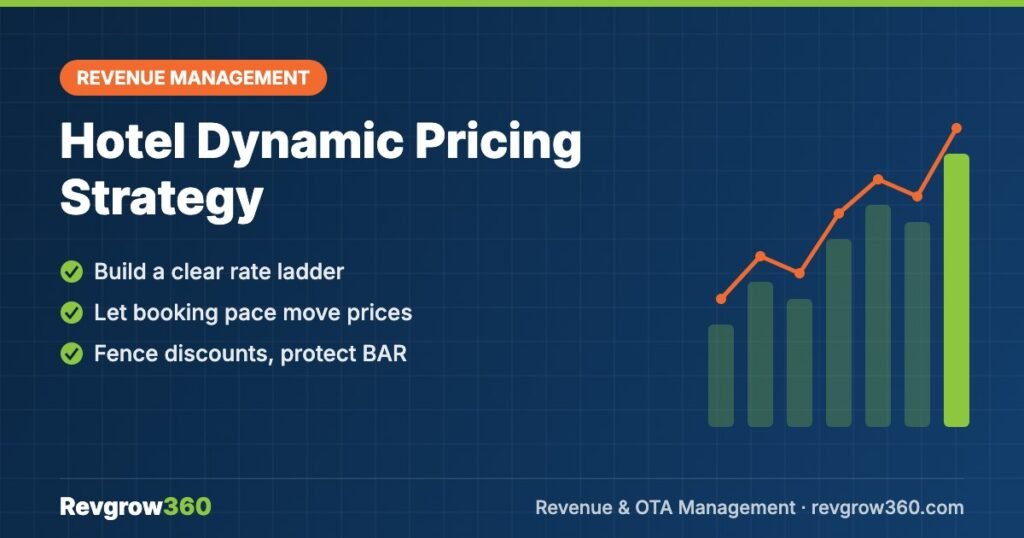
A hotel dynamic pricing strategy means your room rates change in response to demand instead of staying fixed for a whole season. Airlines have done this for decades, and most guests now expect hotel prices to vary by date, day of week and how far ahead they book. Yet many independent hotels, resorts and homestays still use a rate sheet set once a year. This guide explains how hotel dynamic pricing works, how to build a simple rate ladder, which signals should move your prices, and how to avoid the mistakes that make dynamic pricing feel random to guests and unprofitable for owners.
- Build a clear rate ladder
- Let booking pace move prices
- Fence discounts, protect BAR
What Is Hotel Dynamic Pricing?
Dynamic pricing is the practice of adjusting room rates based on expected demand and market conditions. When demand for a date is high, your price rises. When demand is soft, you use lower prices or targeted offers to stimulate bookings. The aim is to maximise revenue per available room over the whole year rather than to sell every room at one fixed rate.
It is important to separate dynamic pricing from simple seasonal pricing:
- Seasonal pricing sets different rates for peak, shoulder and off-season, but they rarely change once published.
- Dynamic pricing starts from those seasonal patterns, then adjusts each date as bookings, competitor rates and events change.
Find the right room rate for your costs and profit.
Why Fixed Rates Leave Money on the Table
With fixed rates you will almost always be wrong in one of two directions. On strong dates, you sell out early at a price below what guests were willing to pay. On weak dates, your rate is too high to attract the bookings you need, so rooms stay empty. Dynamic pricing narrows both gaps.
Consider a hypothetical 40-room hotel in Goa with a fixed rate of ₹5,500 across a 10-night period that includes a long weekend.
| Approach | Long weekend (3 nights) | Weekdays (7 nights) | Total room revenue |
|---|---|---|---|
| Fixed ₹5,500 | 120 rooms × ₹5,500 = ₹6,60,000 (sold out early) | 154 rooms × ₹5,500 = ₹8,47,000 (55% occ.) | ₹15,07,000 |
| Dynamic | 120 rooms × ₹7,500 = ₹9,00,000 | 182 rooms × ₹4,900 = ₹8,91,800 (65% occ.) | ₹17,91,800 |
These numbers are illustrative, but the logic is real: higher rates where demand is strong, sharper offers where it is weak, and more total revenue from the same rooms.
The Building Blocks of a Hotel Dynamic Pricing Strategy
1. A base rate for each room type
Start with a sensible base rate (often your “BAR”, or best available rate) for each room type, reflecting your product, location, reviews and normal market position.
2. A rate ladder
A rate ladder is a set of predefined price levels. For example, for a standard room:
- Level 1: ₹4,200 (very low demand)
- Level 2: ₹4,700
- Level 3: ₹5,200
- Level 4: ₹5,800 (normal)
- Level 5: ₹6,500
- Level 6: ₹7,300
- Level 7: ₹8,200 (peak, near sell-out)
Other room types move with fixed differentials, for example deluxe at +₹1,500 and suites at +₹4,000. A ladder keeps changes controlled and easy to explain to your team.
3. Demand triggers
Decide in advance what moves you up or down the ladder. A simple rule set might be:
- On-the-books occupancy above forecast pace by 10 points or more: move up one level.
- Occupancy above 80% with more than 14 days to arrival: move up one level.
- Pace behind last year by 10 points or more with 21+ days to go: consider moving down one level or launching a fenced offer.
- Major local event confirmed: move to the event level immediately.
4. A floor and a ceiling
Set a minimum rate below which you will not go, based on your cost per occupied room and brand position. Set a ceiling that keeps you within a credible range for your market. Floors protect profit; ceilings protect guest trust.
Signals That Should Drive Your Prices
Booking pace and pickup
Pace is the speed at which bookings arrive for a future date compared with the same point last year. It is the most reliable signal you have. If 25 rooms are on the books 30 days before a date that usually has 15 at that point, demand is strong.
Historical patterns
Last year’s results by day of week, month and event show the baseline you are adjusting from. Be careful with years distorted by one-off factors.
Market events and calendar
Festivals, school holidays, long weekends, weddings season, concerts, conferences and sports events all shift demand. Maintain a 12-month demand calendar for your destination.
Competitor rates
Competitor prices tell you about market conditions and how guests may see your value. Use them as context. If your compset drops rates sharply on a date where your pace is strong, you do not need to follow.
Search and enquiry signals
Website traffic, booking engine searches, OTA views and phone enquiries can indicate rising interest before bookings arrive. Extranets such as Booking.com’s partner hub provide some market insight tools to properties.
Rate Fences: Dynamic Pricing Without Cheapening Your Brand
Lowering your public rate is not the only way to respond to soft demand. Rate fences let you offer lower prices to specific guests under conditions:
- Non-refundable rates at a modest discount for guests who commit and pay upfront.
- Advance purchase rates for bookings made, for example, 21 or more days ahead.
- Length-of-stay offers such as “stay 3, save 10%”.
- Mobile or member rates shown only to logged-in or app users on certain channels.
- Packages that combine room, meals and experiences.
Fences help you capture price-sensitive demand while your flexible rate stays strong for guests who want flexibility.
Step-by-Step: Implementing Dynamic Pricing
- Clean your data. Export 12 to 24 months of daily rooms sold, revenue and booking dates from your PMS.
- Map demand. Identify high, medium and low demand periods, and list known events.
- Build your ladder. Define five to eight price levels per room type with fixed differentials.
- Write simple rules. Agree triggers based on pace, occupancy and days to arrival.
- Connect your tools. A reliable channel manager is essential so that rate changes reach every OTA and your booking engine at the same time. See our guide to choosing the best channel manager for hotels.
- Review on a schedule. At least weekly for the next 90 days, and daily for the next 14 days during busy periods.
- Measure results. Track RevPAR, ADR and occupancy against last year and budget, and adjust your rules.
Common Dynamic Pricing Mistakes
- Changing rates too often without reason. Constant small changes confuse staff and guests and are hard to evaluate.
- Last-minute discounting as a habit. It teaches guests to wait and undercuts those who booked early.
- Following competitors blindly. Your demand may be different from theirs.
- Breaking rate parity. If your website shows a higher rate than an OTA because of a sync error, guests notice and lose trust.
- Ignoring length of stay. High rates on a peak Saturday mean less if one-night bookings block three-night stays.
- No floor rate. Without one, a quiet period can push you into unprofitable rates.
Is Dynamic Pricing Fair to Guests?
Guests generally accept that hotel rates vary by date and demand, much as they do with flights. Problems arise when prices seem erratic or when a guest sees a lower price for the same room and conditions shortly after booking. Keep changes logical, protect rate parity across channels and use clear fences. A guest who booked a flexible rate early, for example, should not feel penalised by a later non-refundable offer.
Dynamic Pricing for Homestays and Small Properties
Smaller properties have fewer rooms, so each booking moves occupancy by a large percentage. A 6-room homestay goes from 50% to 67% with a single booking. That makes rigid rules less useful. Instead, use fewer ladder levels, perhaps four or five, and focus on a handful of high-impact decisions: event and holiday pricing set well in advance, a minimum stay on peak weekends, an early-booking offer for the off-season, and a clear direct-booking benefit for repeat guests. Small properties also benefit from packaging local experiences, which makes direct price comparison harder.
Do You Need Software?
A small property can run dynamic pricing with a spreadsheet, a channel manager and a disciplined weekly routine. As room count, room types and channels grow, a revenue management system can automate forecasting and price recommendations. Software helps, but it still needs someone who understands your market to set rules, check anomalies and manage OTAs.
Key takeaways
- A hotel dynamic pricing strategy adjusts rates by demand rather than fixing them for a season.
- Use a rate ladder with clear triggers, a floor and a ceiling to keep changes controlled.
- Booking pace is the strongest pricing signal; competitor rates are context, not instructions.
- Rate fences let you attract price-sensitive guests without lowering your public rate.
- A reliable channel manager and a weekly review routine are essential to make it work.
Revgrow360 helps independent hotels design and run dynamic pricing that fits their market, and has supported 500+ hotels with revenue and distribution strategy. Explore our hotel revenue management services or book a free consultation to discuss your pricing.
Frequently asked questions
What is dynamic pricing in hotels?
Dynamic pricing means adjusting room rates according to expected demand and market conditions instead of keeping one fixed rate for a season. Rates rise when booking pace, events or market demand are strong and fall, or are supported by targeted offers, when demand is weak. The goal is higher revenue per available room across the year.
How often should a hotel change its rates?
There is no fixed rule, but most independent hotels should review the next 90 days at least weekly and the next 14 days more often during busy periods. Change rates when a clear signal such as booking pace, an event or a sustained market shift justifies it, not simply for the sake of movement.
What is a rate ladder?
A rate ladder is a set of predefined price levels for each room type, for example seven steps from a low-demand rate to a peak rate. Instead of inventing a new price each time, you move up or down the ladder based on agreed demand triggers, which keeps pricing consistent, controlled and easy for staff to apply.
Can small hotels use dynamic pricing without software?
Yes. A small hotel or homestay can use a spreadsheet with a 365-day calendar, a simple rate ladder and a weekly review of bookings on the books versus last year. A reliable channel manager is important so rate changes reach every channel at once. Software becomes more helpful as rooms and channels grow.
More Revenue Management guides
Hotel KPIs Every Owner Should Track (With Formulas)
Occupancy alone cannot tell you if your hotel is performing. Here are the eight KPIs every owner should track, with formulas and…
Hotel Occupancy Rate: Formula, Benchmarks and Tips
Occupancy shows how full your hotel is, but not how profitable. Learn how to calculate it, benchmark it and grow it without…
Average Daily Rate (ADR): Formula and How to Raise It
ADR shows the average price you earn per occupied room. Here is how to calculate it accurately and the practical levers that…
What Is RevPAR? How to Calculate and Increase It
RevPAR shows how much room revenue every available room earns. Learn how to calculate it, read it correctly and increase it without…
Hotel Revenue Management: The Complete Guide
A practical, step-by-step guide to hotel revenue management for independent hotels, resorts and homestays, with formulas, a worked example and a weekly…
Reaping Maximum Benefits With Professional Hotel Revenue Management Companies in India
hotel revenue management companies in india If you’re a hotel business owner in India looking to maximize your revenue, partnering with an…