 By Md Arif Ahamed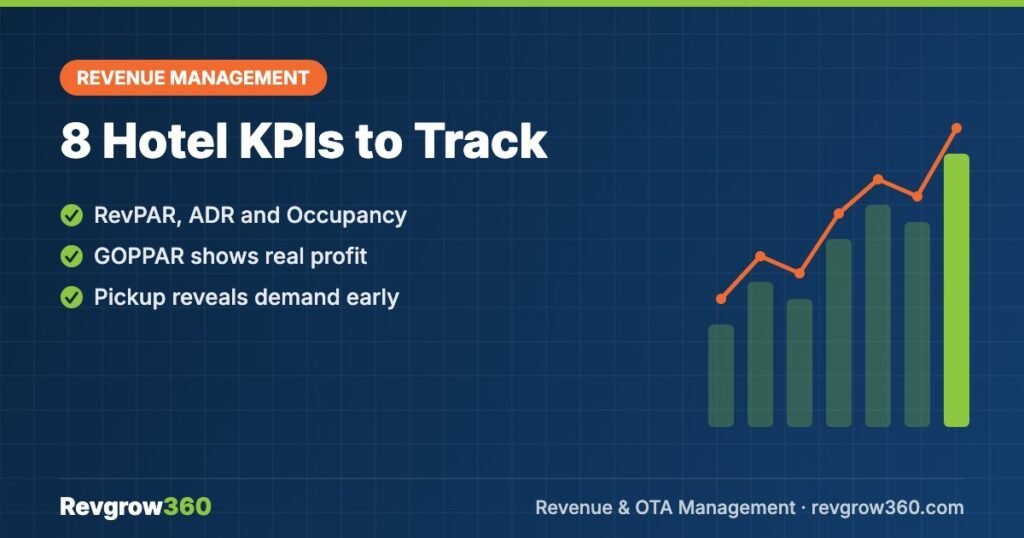
Hotel KPIs (key performance indicators) are the handful of numbers that tell you whether your property is earning what it should. Most hotel owners look at occupancy every day, but occupancy alone cannot tell you whether you priced well, sold through the right channels or made a profit. This guide explains the hotel KPIs every owner and GM should track: occupancy, ADR, RevPAR, TRevPAR, GOPPAR, average length of stay, pickup and booking window. For each one you will find the formula, a worked example using a hypothetical hotel, and what action the number should prompt.
- RevPAR, ADR and Occupancy
- GOPPAR shows real profit
- Pickup reveals demand early
Why Hotel KPIs Matter
A KPI is only useful if it leads to a decision. Good hotel KPIs help you answer practical questions: Should we raise rates for next month’s long weekend? Are we too dependent on one OTA? Are weekday guests staying long enough? Is the restaurant adding to profit? When you track the same metrics consistently, you see trends early and act before small problems become expensive ones.
Throughout this article we use one example property: a hypothetical 40-room hotel in Goa over a 30-day month, giving 1,200 available room nights. It sells 900 room nights, earns ₹45,00,000 in room revenue and ₹15,00,000 in other revenue (food and beverage, spa, transfers), and has a gross operating profit of ₹18,00,000 for the month.
Work out RevPAR, ADR, occupancy, GOPPAR and break-even.
The Core Revenue KPIs
1. Occupancy rate (OCC)
Formula: Rooms sold ÷ Rooms available × 100
Example: 900 ÷ 1,200 = 75%
Use it to: understand demand and volume, spot weak days of the week and plan staffing. Do not use it alone to judge success; a full hotel at low rates can earn less than a fuller-priced, less busy one.
2. Average daily rate (ADR)
Formula: Room revenue ÷ Rooms sold
Example: ₹45,00,000 ÷ 900 = ₹5,000
Use it to: measure pricing power. Rising ADR at stable occupancy usually signals good pricing or a better segment mix. Exclude taxes and meal components for accuracy.
3. Revenue per available room (RevPAR)
Formula: Room revenue ÷ Rooms available, or ADR × Occupancy
Example: ₹45,00,000 ÷ 1,200 = ₹3,750 (or ₹5,000 × 75%)
Use it to: judge overall room revenue performance. RevPAR is the standard metric for comparing yourself to last year, budget and competitors.
4. Total revenue per available room (TRevPAR)
Formula: Total revenue (rooms + all other departments) ÷ Rooms available
Example: (₹45,00,000 + ₹15,00,000) ÷ 1,200 = ₹5,000
Use it to: capture the full value of a guest. Resorts and hotels with strong restaurants, spas or events should track TRevPAR, because a guest who pays slightly less for the room but spends heavily on dining may be more valuable.
5. Gross operating profit per available room (GOPPAR)
Formula: Gross operating profit ÷ Rooms available
Example: ₹18,00,000 ÷ 1,200 = ₹1,500
Use it to: see whether revenue growth is turning into profit. Distribution commission, staffing and energy costs all show up here. GOPPAR is the KPI owners and investors care about most, because it reflects what the hotel actually earns.
Booking Behaviour KPIs
6. Average length of stay (ALOS)
Formula: Total room nights sold ÷ Number of bookings (or stays)
Example: 900 room nights from 360 bookings = 2.5 nights
Use it to: plan operations and pricing. Longer stays reduce turnover costs (cleaning, linen, check-in effort) and fill more of the calendar. If ALOS is falling, consider length-of-stay offers or minimum-stay rules on peak dates.
7. Pickup
Formula: Rooms on the books today − Rooms on the books at an earlier date, for the same future stay date
Example: For 15 December, you had 18 rooms booked last Monday and 26 today. Pickup over the week = 8 rooms.
Use it to: measure booking momentum. Compare pickup with the same period last year (this comparison is called pace). Strong pickup is a signal to raise rates; weak pickup well ahead of arrival is a signal to act with marketing or fenced offers.
8. Booking window (lead time)
Formula: Average of (Arrival date − Booking date) across bookings
Example: If bookings for December arrive on average 24 days before check-in, your booking window is 24 days.
Use it to: time your pricing and marketing. If most guests book within a week, rate changes made 60 days out have little effect. If your booking window is long, such as for weddings or international leisure, you must set strong rates early or you will sell out cheaply. Track booking window by segment and channel, as they differ.
Hotel KPIs at a Glance
| KPI | Formula | Example (40-room Goa hotel) | Main question it answers |
|---|---|---|---|
| Occupancy | Rooms sold ÷ Rooms available | 75% | How full are we? |
| ADR | Room revenue ÷ Rooms sold | ₹5,000 | What price do we achieve? |
| RevPAR | Room revenue ÷ Rooms available | ₹3,750 | How well do rooms earn overall? |
| TRevPAR | Total revenue ÷ Rooms available | ₹5,000 | What is a room worth including extras? |
| GOPPAR | GOP ÷ Rooms available | ₹1,500 | Are we profitable? |
| ALOS | Room nights ÷ Bookings | 2.5 nights | How long do guests stay? |
| Pickup | OTB today − OTB earlier | +8 rooms in a week | Is demand building? |
| Booking window | Avg (Arrival − Booking date) | 24 days | When do guests book? |
Supporting KPIs Worth Watching
- Channel mix: share of room nights and revenue from each OTA, direct, corporate and groups. Helps manage dependence and commission costs. Strong OTA management and a growing direct share usually improve net revenue.
- Net RevPAR: RevPAR after distribution costs. Shows the real value of your channel mix.
- Cancellation rate: cancelled bookings ÷ total bookings. High rates on certain channels may justify stricter policies or controlled overbooking.
- Review score and volume: not a financial KPI, but closely linked to conversion and achievable rate.
- Market share indices: occupancy, ADR and RevPAR compared with your compset. Benchmarking providers such as STR publish these for participating hotels; a RevPAR index above 100 means you are earning more than your fair share.
How to Build a Simple KPI Dashboard
- Pick a short list. For most independent hotels: occupancy, ADR, RevPAR, net RevPAR, ALOS, pickup and booking window, plus GOPPAR monthly.
- Use one source of truth. Pull figures from your PMS so everyone sees the same numbers.
- Show comparisons. Every KPI should appear next to last year and budget. A number without context leads to wrong conclusions.
- Look forward, not just back. Track on-the-books occupancy and ADR for the next 30, 60 and 90 days alongside past results.
- Agree actions. For each KPI, define what happens when it moves. For example: “If pickup for a date is 20% behind last year with 30 days to go, review rate and launch a fenced offer.”
- Review weekly and monthly. Weekly for revenue and pickup decisions; monthly for profit, channel mix and longer trends.
Common KPI Mistakes
- Tracking occupancy and nothing else.
- Comparing a month with the previous month instead of the same month last year, which ignores seasonality.
- Including taxes, complimentary rooms or meal components inconsistently.
- Looking only at historical results and never at what is on the books.
- Collecting numbers without assigning anyone to act on them.
- Celebrating revenue growth without checking profit and commission costs.
Which KPIs Matter Most for Your Property Type?
All hotels should track the core three: occupancy, ADR and RevPAR. Beyond that, priorities differ. Resorts and properties with strong restaurants or spas should give TRevPAR and GOPPAR equal weight, because a large part of their value comes from spending outside the room. City hotels relying on corporate business should watch booking window and pickup closely, since corporate guests often book late. Homestays, B&Bs and hostels may find ALOS and direct-booking share especially useful, as turnover costs and commissions weigh more heavily on small operations.
Key takeaways
- The core hotel KPIs are occupancy, ADR and RevPAR; add TRevPAR and GOPPAR to see total value and profit.
- ALOS, pickup and booking window explain how and when guests book, and guide pricing and restrictions.
- Always compare KPIs with last year and budget, and look forward at what is on the books.
- Track net revenue and channel mix so commission costs do not hide behind healthy headline numbers.
- Every KPI should have an owner and an agreed action when it moves.
Not sure which numbers to watch or what they are telling you? Revgrow360 has supported 500+ hotels with KPI-driven revenue management. Request a free hotel audit and we will review your key metrics and share what to focus on first.
Frequently asked questions
What are the most important hotel KPIs?
The core hotel KPIs are occupancy, average daily rate (ADR) and revenue per available room (RevPAR). To see total value and profitability, add TRevPAR and GOPPAR. For pricing decisions, track average length of stay, pickup and booking window. Together these show how full you are, what you charge, and whether revenue becomes profit.
What is the difference between RevPAR and GOPPAR?
RevPAR measures room revenue per available room and ignores costs. GOPPAR measures gross operating profit per available room, so it reflects staffing, commissions, utilities and other operating expenses. A hotel can grow RevPAR while GOPPAR falls, for example by pushing high-commission bookings, which is why owners should watch both.
What is pickup in hotel revenue management?
Pickup is the number of new room nights booked for a future stay date over a period, such as the last seven days. Comparing pickup with the same point last year, known as pace, shows whether demand is building faster or slower than normal and helps you decide whether to raise rates or stimulate bookings.
How often should hotel KPIs be reviewed?
Revenue KPIs such as on-the-books occupancy, ADR and pickup should be reviewed at least weekly for the next 90 days. Profit KPIs like GOPPAR, channel mix and net RevPAR are usually reviewed monthly. Always compare each KPI with last year and budget so the numbers have useful context.
More Revenue Management guides
Hotel Dynamic Pricing Strategy: A Practical Guide
Fixed seasonal rates leave money on the table. Learn how to build a controlled, demand-based pricing strategy for your hotel step by…
Hotel Occupancy Rate: Formula, Benchmarks and Tips
Occupancy shows how full your hotel is, but not how profitable. Learn how to calculate it, benchmark it and grow it without…
Average Daily Rate (ADR): Formula and How to Raise It
ADR shows the average price you earn per occupied room. Here is how to calculate it accurately and the practical levers that…
What Is RevPAR? How to Calculate and Increase It
RevPAR shows how much room revenue every available room earns. Learn how to calculate it, read it correctly and increase it without…
Hotel Revenue Management: The Complete Guide
A practical, step-by-step guide to hotel revenue management for independent hotels, resorts and homestays, with formulas, a worked example and a weekly…

Reaping Maximum Benefits With Professional Hotel Revenue Management Companies in India
hotel revenue management companies in india If you’re a hotel business owner in India looking to maximize your revenue, partnering with an…