 By Md Arif Ahamed
Quick summary: Corporate sales for hotels explained: find target accounts, pitch, negotiate and manage business clients, with scripts, a tracking template and an example.
Corporate sales for hotels is the work of winning repeat business from companies by offering negotiated rates, reliable service and easy booking for their employees, guests, meetings and events. A hotel that builds a strong corporate account base earns steady weekday demand, which balances weekend leisure traffic. This guide shows how to find, approach, win and manage corporate accounts, with scripts, a tracking template and an example.
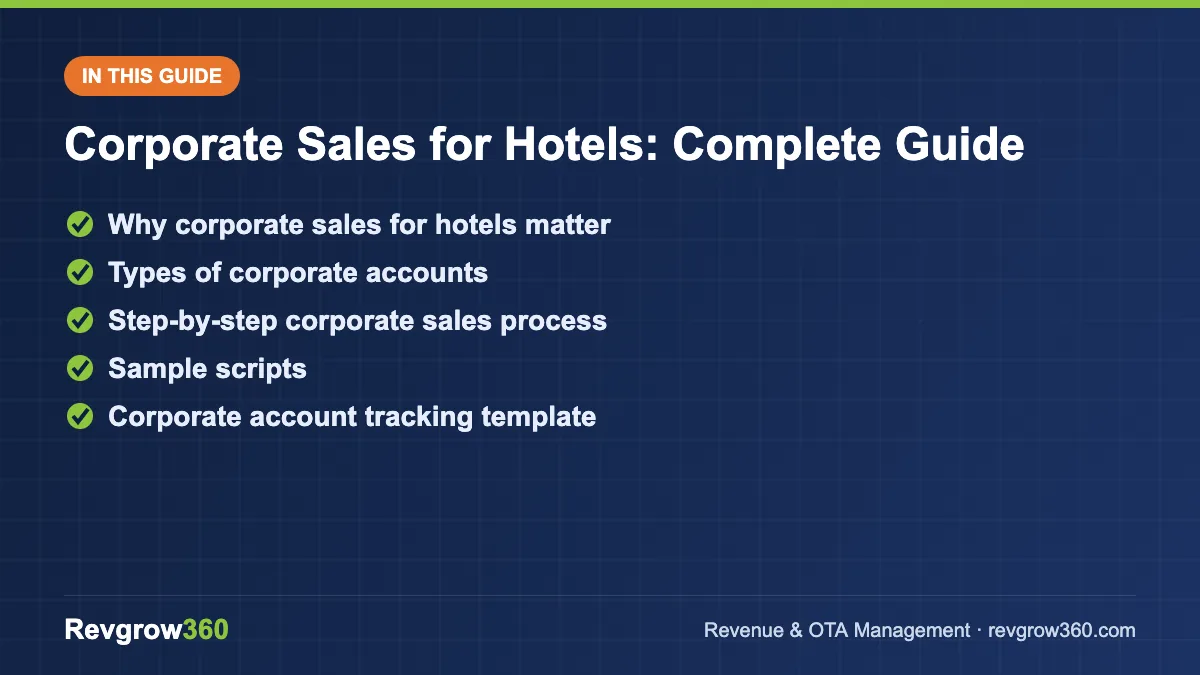
- Target accounts and bookers
- Proposal, follow-up, trial stay
- Track production monthly
Corporate sales is a relationship business. The goal is not just to sign a rate agreement, but to become the first hotel a company thinks of when someone has to travel.
Why corporate sales for hotels matter
- Midweek demand: business travellers often stay Monday to Thursday, when leisure demand is low.
- Repeat business: one good account can bring bookings every month for years.
- Extra revenue: meetings, training programmes, events and F&B add to room revenue.
- Lower commission: direct corporate bookings avoid OTA commission. See hotel distribution strategy.
- Forecast support: regular volume makes forecasting easier. See hotel demand forecasting.
Find the right room rate for your costs and profit.
Types of corporate accounts
| Account type | Examples | Typical need |
|---|---|---|
| Local companies | Factories, offices, banks, hospitals, colleges | Visitor accommodation, training stays, meetings |
| Regional and national firms | Sales teams, audit and consulting firms, project teams | Frequent individual travel with negotiated rates |
| Travel management companies (TMCs) | Agencies managing travel for many clients | Lists of preferred hotels, standard rates |
| Government and PSU | Departments, public sector units | Approved rates, formal tenders, documentation |
| Event and MICE planners | Conference organisers, wedding planners | Group rooms, halls, catering |
| Project and contract teams | Construction, power, telecom | Long stays, monthly rates |
Revenue Health Score · free
Free tool: check your hotel’s revenue health
Answer a few quick questions about your rooms, rates, OTAs and reviews. Get a score out of 100, your weakest revenue areas and the first actions to fix them.
Step-by-step corporate sales process
Step 1: Define your target accounts
List companies within a 10 to 20 km radius or those that bring visitors to your city. Rank them by likely room nights, ease of access and fit with your hotel’s price and facilities. A 50-room business hotel near an industrial area might target ten manufacturing firms, three banks and two training institutes.
Step 2: Find the right contact
Aim for the person who books or approves travel: admin head, travel desk, HR, procurement, executive assistants or department heads. Use LinkedIn, local business directories, existing guest records and referrals.
Step 3: Prepare your offer
Create a one-page corporate offer: your hotel name and location, distance to key business areas, room types and facilities, Wi-Fi, breakfast, meeting rooms, parking, laundry, airport pick-up and a sample rate. Decide your floor rate before you approach. For rate negotiation tips, see our guide on hotel revenue management.
Step 4: Reach out
Use a mix of calls, WhatsApp, email and visits. A short message works better than a long brochure. Offer a property visit and a complimentary lunch for the decision maker.
Step 5: Host a site visit
Walk the contact through the best rooms, the breakfast area and the meeting room. Show them what a business traveller would see at 7 am: breakfast, Wi-Fi speed, desk space and quick checkout.
Step 6: Send a proposal
Offer a clear rate by room type, with inclusions, validity period, cancellation terms and booking process. Avoid very complex offers. Mention a quick contact person for urgent bookings.
Step 7: Follow up
Follow up within two to three days, then weekly for a month. Ask whether any questions or objections remain, and offer a trial stay for the travel desk or a manager.
Step 8: Onboard the account
After agreement, load the rate in your PMS and booking channels, brief reservations and the front desk, and set up billing details. Give the company a simple booking method: a dedicated email, WhatsApp number or booking link.
Step 9: Manage and grow
Review production monthly: room nights, revenue, average rate, cancellations and no-shows. Meet the travel desk every quarter. Ask what could improve, and cross-sell meeting rooms, banquets and events.
Sample scripts
Cold call opening
“Good morning, this is Anita from Hotel Example, a 50-room hotel near the Sector V business district. I am calling to introduce our corporate rates for visitors and employees. May I know who handles your travel bookings? I would like to share a short offer and invite you for a free lunch to see our rooms.”
Follow-up message
“Hello Mr Ghosh, thank you for visiting us on Tuesday. As discussed, our corporate rate is ₹3,900 (about $42) including breakfast and Wi-Fi, valid until 31 March. A trial stay for your team is available at no cost. May I call you on Friday to hear your feedback?”
Corporate account tracking template
| Field | Example |
|---|---|
| Company and industry | ABC Pharma, manufacturing |
| Contact and role | Ms Rao, admin manager |
| Source and date added | Referral, 5 January |
| Estimated room nights per year | 300 |
| Stage | Prospect, visit, proposal, negotiation, won, lost |
| Rate offered and terms | ₹3,900 with breakfast; 24-hour cancellation |
| Next action and date | Follow up call, 12 January |
| Actual room nights and revenue | Updated monthly |
Example: building a corporate base in a 50-room hotel
A hypothetical 50-room hotel in Pune has average weekday occupancy of 45 percent. The sales manager targets 20 companies. After three months:
| Stage | Count (example) |
|---|---|
| Companies contacted | 60 |
| Meetings or site visits | 20 |
| Proposals sent | 12 |
| Accounts won | 6 |
| Average room nights per account per month | 20 |
| Added room nights per month | 120 |
| Revenue at ₹3,800 average | ₹4,56,000 per month |
These are illustrative numbers. The real conversion rates depend on your market and hotel. The lesson is that consistent outreach and follow-up produce results over time.
Handling common objections
| What the buyer says | A helpful response |
|---|---|
| “We already have a preferred hotel” | “That is fine. Many companies keep a second option for sold-out nights or for visitors. May we be your backup, with the same rate and no commitment?” |
| “Your rate is higher than others” | Compare what is included: breakfast, Wi-Fi, parking, location and cancellation terms. Offer a trial stay. |
| “We book on OTAs anyway” | Explain direct benefits: consistent rate, flexible cancellation, invoicing and one contact for problems. |
| “We have no volume to commit” | Offer a no-commitment rate with a review after three months, and a better rate if volume grows. |
| “Send me an email” | Send a short proposal the same day and ask for a specific time to call back. |
Handle every objection with respect, listen fully and avoid criticising other hotels. A calm, helpful tone is part of the sale.
Corporate guest service: what business travellers value
Corporate guests judge a hotel by small practical things. They want a quick check-in, a clean quiet room, fast Wi-Fi, a proper work desk, reliable hot water, early breakfast and a fast, accurate invoice with company details. If your service delivers these basics every time, the travel desk will notice through feedback and repeat bookings. Consider a dedicated corporate check-in desk or pre-registration for frequent guests, and keep a record of each guest’s preferences, such as floor, pillow type or newspaper.
Common mistakes in corporate sales
- Giving the lowest rate without checking displacement or volume. Read hotel dynamic pricing strategy for the principles.
- Making one visit and never following up.
- Poor service for corporate guests: slow check-in, weak Wi-Fi or inconsistent breakfast.
- No tracking of production against promises.
- No easy booking method for the travel desk.
- Ignoring employees who stay; their feedback decides renewals.
Tools and weekly routine
- Use a simple CRM or spreadsheet for accounts and follow-ups.
- Set a weekly target: for example 10 calls, 3 visits and 2 proposals.
- Review accounts every month and make a list of dormant accounts to revive.
- Collect feedback from corporate guests and share it with the team.
- Keep your online listings strong, since business travellers also check reviews. See hotel online reputation management.
Key takeaways
- Corporate sales for hotels builds steady midweek demand through relationships and reliable service.
- Target companies by fit, approach the booking decision maker and offer a simple proposal.
- Follow up consistently, track accounts and review production monthly.
- Protect rate with a floor price and clear terms.
Need help building a corporate account pipeline? Book a free consultation with Revgrow360 or request a free hotel audit.
For more background, see this Google Business Profile Help.
Frequently asked questions
How do hotels get corporate clients?
Hotels list nearby and relevant companies, find the travel or admin decision maker, send a short offer, host a site visit, follow up consistently and offer a trial stay. Referrals, LinkedIn, existing guest records and local business groups all help.
What should a corporate rate proposal include?
Include room types and rates, inclusions such as breakfast and Wi-Fi, validity period, cancellation terms, booking process, payment terms and a contact person. Keep it to one or two pages and avoid complex conditions.
How often should corporate accounts be reviewed?
Review production monthly, comparing room nights and revenue with expectations, and meet key accounts quarterly. Check cancellations, no-shows and guest feedback, and decide whether to adjust the rate or terms at renewal.
What is a good weekly corporate sales routine?
Set simple weekly targets such as around 10 calls, 3 visits and 2 proposals, update the CRM or spreadsheet daily, and spend time on follow-ups. Consistency matters more than the exact numbers.
More Hotel Marketing guides
Hotel Loyalty Program Ideas: Complete Guide
Practical hotel loyalty program ideas for independent hotels, with a step-by-step setup, a cost example and a launch checklist.
Hotel Branding: Complete Guide for Independent Hotels
A practical hotel branding guide covering positioning, identity, signature touches and consistency across OTAs, website and social media.
Influencer Marketing for Hotels: Complete Guide
A practical guide to influencer marketing for hotels: selecting creators, briefing, tracking direct bookings and measuring return.

Hotel Content Marketing: Complete Guide
A practical guide to hotel content marketing, from audience research and content types to a monthly calendar and measuring direct bookings.

Local SEO for Hotels: Complete Guide
A complete guide to local SEO for hotels covering Google Business Profile, location pages, reviews, citations and measurement.
Hotel SEO Guide: How to Rank a Hotel Website on Google
A step-by-step hotel SEO plan covering technical setup, on-page content, local SEO and links, focused on the searches independent hotels can actually…
Related guide: Best Hotel marketing company in India
Free PDF checklist
Where is your hotel losing money?
27 quick checks on pricing, OTAs, reviews and direct bookings, with the first fix for every leak.
Get the free checklist →