 By Md Arif Ahamed
Quick summary: Build a hotel distribution strategy that balances OTAs, direct bookings, GDS and wholesalers, with net-revenue examples and a monthly channel checklist.
A hotel distribution strategy is your plan for where your rooms are sold, at what price and through which partners. Most hotels today sell through a mix of OTAs, their own website, phone and walk-ins, travel agents, wholesalers and sometimes the GDS. Each channel brings different guests, costs and risks. Without a plan, hotels often drift into over-dependence on one or two channels, paying more in commission than necessary or leaving demand untapped. This guide explains each distribution channel, how to calculate the true cost of a booking, and how to build a balanced channel mix step by step.
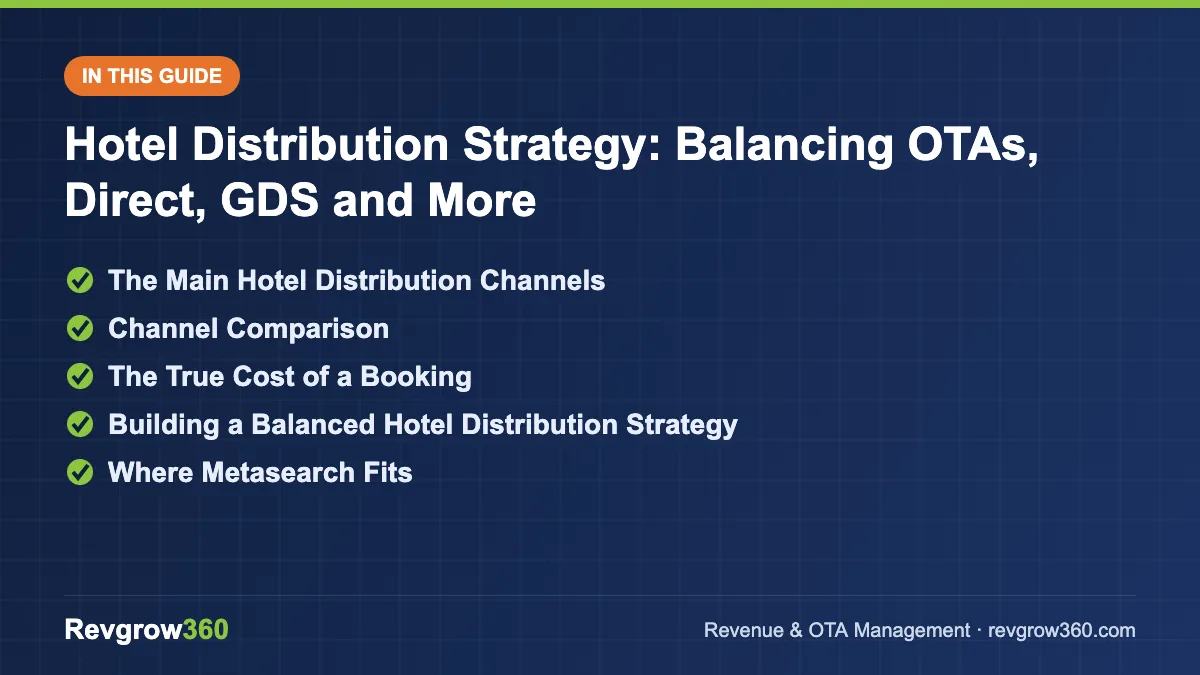
- Compare channels by net ADR
- Shift priorities by season
- Avoid single-channel risk
The Main Hotel Distribution Channels
Online travel agencies (OTAs)
OTAs such as Booking.com, Expedia, Agoda and MakeMyTrip give hotels global visibility and access to travellers who may never have found the property otherwise. They charge commission on each booking, typically somewhere in the range of 15–25% depending on the platform, market and any visibility programmes. For most independent hotels, OTAs are an essential source of demand, especially for new properties and international guests.
Direct channels
Direct bookings come through your website booking engine, phone, email, WhatsApp, walk-ins and social media. They usually carry the lowest acquisition cost and give you the guest relationship and data. Building direct business takes investment in your website, booking engine, search visibility and guest communication.
Global distribution systems (GDS)
The GDS connects hotels to travel agents and corporate travel management companies worldwide. It matters most for business hotels, city hotels and properties that want corporate and travel-agent business. Access is usually through a GDS representation company or a channel manager connection, with transaction and setup fees.
Wholesalers and bed banks
Wholesalers buy rooms at net (discounted) rates and resell them to tour operators, travel agents or online sellers, often packaged with flights or transfers. They can fill low-demand periods and reach markets you cannot reach alone. The risk is rate leakage: net rates sometimes appear publicly at prices lower than your own, which undermines rate parity and direct bookings.
Tour operators and travel agents
Offline and online agents, including domestic tour operators, sell packages and group trips. Contracts may involve allocations, release periods and seasonal rates.
Corporate and group sales
Negotiated corporate rates, MICE and wedding business are distribution channels too, managed by your sales team rather than technology.
Find the right room rate for your costs and profit.
Channel Comparison
| Channel | Typical cost | Strengths | Watch-outs |
|---|---|---|---|
| OTAs | Commission, typically 15–25% | Reach, visibility, international demand | Cost, dependency, cancellation rates |
| Direct (website, phone) | Booking engine, marketing, staff time | Lower cost, guest data, loyalty | Needs ongoing marketing investment |
| GDS | Transaction and representation fees | Corporate and travel-agent access | Setup effort; less useful for leisure |
| Wholesalers / bed banks | Discount off rack, typically net rates | Fills low-demand periods, new markets | Rate leakage, low ADR |
| Tour operators / agents | Commission or net rates | Packages, groups, repeat contracts | Allocations and release dates |
| Corporate and groups | Sales team cost, negotiated discounts | Volume, base occupancy midweek | Displacement of higher-paying guests |
The True Cost of a Booking
Comparing channels by commission alone is misleading. Use net revenue instead:
Net revenue per booking = Room revenue − Commission or discount − Payment fees − Other channel costs
Then compare channels using net ADR or net RevPAR.
Consider a hypothetical 40-room hotel in Goa selling a room at ₹6,000 per night:
- OTA booking at 18% commission: ₹6,000 − ₹1,080 = ₹4,920 net.
- Direct booking: ₹6,000 − about 2% payment gateway fee (₹120) − estimated marketing cost per booking (say ₹400) = ₹5,480 net.
- Wholesaler at a 30% net discount: ₹4,200 net, but sold mainly in low season when the room might otherwise stay empty.
The wholesaler booking looks worst, but if it fills a room on a night forecast at 40% occupancy, it is still incremental revenue. The OTA booking costs more than direct, but may come from a guest who would never have found the hotel otherwise. Distribution strategy is about using each channel where it adds the most net value. A useful rule of thumb is to ask, for every booking source, whether that room would otherwise have sold through a cheaper channel on the same night. If yes, the channel is displacing better business; if no, it is adding revenue.
Building a Balanced Hotel Distribution Strategy
- Audit your current mix. Pull 12 months of data by channel: room nights, ADR, commission, cancellation rate and average length of stay.
- Calculate net ADR by channel. This often changes which channels you value most.
- Set target mix by season. In peak periods, prioritise direct and higher-net channels. In low season, open wholesale and promotional OTA rates to build base occupancy.
- Use a reliable channel manager. Rates, availability and restrictions must update everywhere instantly to avoid overbooking and parity issues. See our guide to the best channel manager for hotels.
- Protect rate integrity. Agree rules with wholesalers about where net rates can be shown, and monitor OTA rates for undercutting.
- Invest in direct. Strong website content, a mobile-friendly booking engine, a clear direct-booking benefit and quick responses on WhatsApp and phone.
- Optimise OTA presence. Good photos, accurate content, competitive rates and strong reviews improve ranking and conversion without needing heavy discounts.
- Review monthly. Track mix, net ADR and cancellations by channel, and adjust.
Where Metasearch Fits
Metasearch platforms, such as Google Hotel Ads and other price-comparison sites, are not booking channels in the traditional sense. They show a hotel’s prices from several sellers side by side and send the guest to the chosen seller to complete the booking. For hotels, metasearch is valuable because it can place your own website next to the OTAs at the moment a traveller is comparing prices. To benefit, you need a booking engine that connects to metasearch, rates that are at least equal to OTA prices, and a fast, mobile-friendly booking flow. Metasearch also makes rate disparity visible to guests, so parity problems become conversion problems very quickly.
Reducing Dependence on a Single Channel
If one OTA delivers a very large share of your bookings, reduce the risk gradually rather than cutting it off:
- Strengthen a second and third OTA that suit your guest profile, with complete content and competitive rates.
- Give guests a reason to book direct, such as breakfast, a flexible cancellation policy or a room upgrade on availability.
- Collect guest contacts from every stay, with consent, and stay in touch with useful offers.
- Build repeat business from corporate clients, travel agents and past guests.
- Track the share monthly and set a realistic target for the next 12 months.
Common Distribution Mistakes
- Relying on one OTA. A ranking drop or policy change can affect a large share of your business overnight.
- Opening every channel at once. More channels mean more management. Add channels that serve a clear segment.
- Uncontrolled wholesale rates. Net rates leaking onto public sites undercut your own prices.
- Same strategy all year. Peak and low seasons need different channel priorities.
- Neglecting the website. Many guests check the hotel’s own website after finding it on an OTA. A weak site sends them back to the OTA.
- Ignoring cancellations. High-cancellation channels make forecasting harder and can justify different policies.
Distribution by Property Type
- City business hotels: corporate rates, GDS and OTAs, with direct channels for repeat business travellers.
- Leisure resorts: OTAs and direct for individual travellers, tour operators and wholesalers for packages and low season.
- Homestays and B&Bs: a small number of well-managed OTAs and home-rental platforms plus strong direct and repeat business; GDS is usually unnecessary.
- Hostels: specialist hostel platforms plus major OTAs and direct, often with social media playing a big role.
Monthly Distribution Review Checklist
- Room nights, ADR and net ADR by channel versus last year.
- Share of business from your largest single channel.
- Cancellation and no-show rates by channel.
- Rate parity checks across major OTAs and metasearch.
- Wholesale rate leakage spot-checks.
- Direct website conversion and booking engine performance.
- OTA ranking, review score and content quality.
Our OTA management team runs this kind of review for independent properties as part of an overall hotel revenue management plan.
Key takeaways
- A hotel distribution strategy decides which channels sell your rooms, when and at what net value.
- Compare channels on net revenue, not headline commission alone.
- OTAs bring reach, direct brings margin, wholesalers and agents fill gaps; each has a role.
- Change channel priorities by season and protect rate integrity.
- Avoid over-dependence on any single channel and review the mix monthly.
Revgrow360 helps hotels, resorts and homestays build balanced distribution across 50+ OTAs and direct channels, and has supported 500+ hotels so far. Request a free hotel audit to see how your current channel mix compares with a balanced plan.
For more background, see this online travel agency overview on Wikipedia.
Frequently asked questions
What is a hotel distribution strategy?
A hotel distribution strategy is a plan for which channels sell your rooms, at what rates and in what proportion. It covers OTAs, direct bookings, GDS, wholesalers, travel agents and corporate or group sales, and aims to maximise net revenue while reducing dependence on any single channel across different seasons.
What is a good channel mix for a hotel?
There is no universal ideal mix; it depends on location, property type and season. Most independent hotels aim to grow direct share over time while keeping OTAs for reach, and to avoid relying on one channel for a very large share of business. Compare channels by net ADR to set targets.
Do small hotels need the GDS?
Usually not. The GDS mainly serves corporate travel agents and travel management companies, so it is most valuable for business and city hotels. Leisure resorts, homestays and B&Bs typically get better returns from well-managed OTAs, direct bookings and tour operator relationships than from GDS fees and setup.
How do I stop wholesale rates undercutting my prices?
Set clear contract terms on where and how net rates can be sold, typically only in packages or closed user groups. Spot-check public sites and metasearch regularly for your hotel at lower prices, raise issues with the wholesaler promptly, and restrict or close wholesale allocations in peak periods.
More OTA Management guides
How to Improve Hotel Ranking on OTAs: Key Ranking Factors
OTA ranking follows a clear logic. Learn the factors Booking.com, MakeMyTrip, Agoda and Expedia reward, and a 90-day plan to move your…
Expedia Partner Central Guide for Hotels
Everything a hotel needs to know about Expedia Partner Central, from joining and payment models to promotions, analytics and a simple weekly…
How to List Hotel on EaseMyTrip: Step-by-Step Guide
A practical guide to listing your hotel on EaseMyTrip, with documents, onboarding steps, rate strategy, content tips and a launch checklist.
How to List Hotel on Cleartrip: Step-by-Step Guide
A step-by-step guide to listing your hotel on Cleartrip: documents, profile set-up, rates, policies, going live and getting bookings.
How to List Your Hotel on Agoda (YCS): Step-by-Step Guide
A complete walkthrough of listing a hotel, resort or homestay on Agoda and managing it in YCS, including promotions and the net-rate…
OTA Performance Report: How to Run a Monthly Channel Review
A simple monthly OTA performance report shows which channels really earn their place. Get the KPIs, formulas, a worked example and a…