 By Md Arif Ahamed
Quick summary: Use this kitchen closing checklist for hotels: food storage, gas and equipment shutdown, cleaning, waste, stock and sign-off with owners and timeline.
A kitchen closing checklist is the list of tasks the kitchen team completes at the end of service to secure food, clean equipment, shut off utilities and prepare for the next day. It protects food safety, prevents fire and pest risks, reduces waste and makes the morning opening faster. Use the template below for your hotel kitchen, and adapt it to your menu, equipment and shift timings.
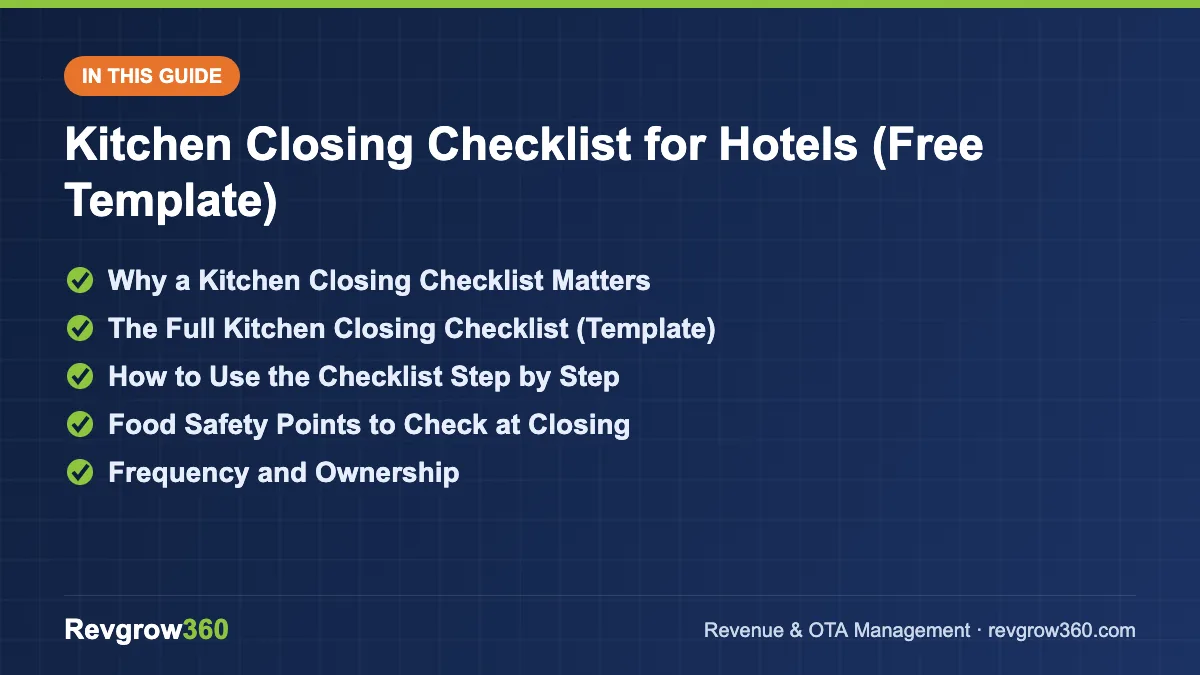
- Store and label food first
- Shut down gas and equipment
- Clean, record and sign off
Why a Kitchen Closing Checklist Matters
The end of a busy night is when mistakes happen. Staff are tired, orders are finished and everyone wants to go home. A gas valve left open, a fridge not closed properly, raw chicken stored above cooked food or grease left on a stove can cause serious problems, from food poisoning to fire.
A closing checklist makes the tasks visible, fixes responsibility and leaves a signed record. In a hotel with banquets, room service and an all-day restaurant, it also helps the next shift start with a clean, ready kitchen and fewer surprises.
What a good closing process delivers
- Safer food through correct storage, labelling and temperature control.
- Reduced fire, gas and electrical risks.
- Better hygiene and fewer pest problems.
- Accurate stock and ordering information.
- Lower waste and cost.
- A faster, calmer opening shift.
Work out food cost % and the right menu price.
The Full Kitchen Closing Checklist (Template)
Copy this table and adjust it. Each line should be initialled by the person responsible, and the chef or kitchen supervisor signs the whole sheet.
| Area | Task | Owner | Done |
|---|---|---|---|
| Food storage | All leftover food covered, labelled with item, date and time, and stored in the correct fridge or freezer | Cook | |
| Food storage | Raw items stored below cooked items; separate raw meat, fish and vegetables | Cook | |
| Food storage | Discard items past their safe holding time; follow FIFO rotation | Sous chef | |
| Temperature | Record fridge and freezer temperatures and check they are within limits | Supervisor | |
| Equipment | Turn off stoves, ovens, fryers, tandoor, grills and ensure they are cool and cleaned | Cook | |
| Gas | Close gas valves at appliances and the main line or cylinder valve as per procedure | Supervisor | |
| Electrical | Switch off non-essential equipment, such as mixers, slicers and ventilation as per policy; leave refrigeration on | Cook | |
| Cleaning | Degrease stoves and hoods, clean flat tops and fryer surfaces | Cook and steward | |
| Cleaning | Clean and sanitise worktables, chopping boards and knives | Cook | |
| Cleaning | Wash, rinse and sanitise utensils, pots and crockery; store dry and off the floor | Steward | |
| Cleaning | Sweep and mop floors; clear and clean drains | Steward | |
| Waste | Empty bins, tie bags, move to the waste area; clean bins and replace liners | Steward | |
| Pest control | Check for pests, close windows and doors, ensure no food left open | Supervisor | |
| Stock | Update stock sheet and requisition for tomorrow; note low items | Sous chef | |
| Safety | Check fire extinguishers and exits are clear; no flammables near heat | Supervisor | |
| Security | Lock storeroom, cold room and kitchen door; keys returned to the key box | Supervisor | |
| Handover | Write notes on prep needed, equipment faults and any incidents | Chef | |
| Sign-off | Chef or manager final walk-through and signature | Chef or F and B manager |
Revenue Health Score · free
Free tool: check your hotel’s revenue health
Answer a few quick questions about your rooms, rates, OTAs and reviews. Get a score out of 100, your weakest revenue areas and the first actions to fix them.
How to Use the Checklist Step by Step
- Announce closing. The chef or supervisor calls the last order time and informs staff of the closing sequence.
- Finish service. Complete outstanding orders and room service, then stop cooking new items.
- Secure the food first. Cover, label and store food before cleaning, to avoid time in the danger zone.
- Shut down equipment. Turn off heat sources and follow the gas and electrical procedure.
- Deep clean in order. Start with equipment and hoods, then work surfaces, then floors, so dirt falls downward and the final step is mopping.
- Manage waste and stock. Remove waste, record stock, and prepare the requisition.
- Inspect. The supervisor walks the kitchen with the checklist in hand and checks each item physically.
- Sign and secure. Sign the sheet, lock the kitchen and store keys.
Sample closing timeline for a kitchen closing at 11 pm
| Time | Activity |
|---|---|
| 10:30 pm | Last order, begin storing leftover food |
| 10:45 pm | Equipment cool-down and degreasing begins |
| 11:00 pm | Kitchen closes to orders; main cleaning starts |
| 11:30 pm | Floors, drains and waste handled |
| 11:50 pm | Stock sheet and handover notes completed |
| 12:00 am | Supervisor inspection, sign-off and lock-up |
Food Safety Points to Check at Closing
- Cooked food that will be stored is cooled quickly and covered. Follow the cooling method in your food safety plan.
- Do not leave food at room temperature overnight.
- Label with date and time so the morning team knows how long it can be kept.
- Keep raw and cooked items apart and avoid cross-contamination.
- Check licence and display requirements through the FSSAI website, and confirm details with your food safety consultant.
Frequency and Ownership
Complete the checklist every night, for every kitchen, including the main kitchen, bakery, bar prep area and banquet kitchen. The kitchen supervisor owns it, the chef verifies it, and the F and B manager reviews signed sheets at least weekly. Keep them on file for at least a month, longer if your auditor or licence requires.
Common Errors in Kitchen Closing
- Cleaning before food is stored, leaving food out for hours.
- Forgetting to close gas valves or check the hood switch.
- Unlabelled leftovers, which cause waste or risk.
- Skipping temperature logs.
- Pooled water on floors and clogged drains.
- Waste left inside overnight, attracting pests.
- Ticking the sheet without checking.
- No handover note for the next shift.
Linking Kitchen Discipline to Revenue and Reputation
A well-run kitchen supports guest reviews and cost control. Cleaner kitchens reduce food safety incidents, and tighter stock control reduces waste, which improves food cost. Food quality and hygiene also feed into your online ratings; see hotel online reputation management. For ideas to grow F and B revenue, read hotel upselling and ancillary revenue.
Closing Checklist Variations by Kitchen Type
| Kitchen type | Extra closing items |
|---|---|
| Main hotel kitchen | Hood and duct switch-off, cold room check, store requisition, all outlets’ orders closed |
| Banquet kitchen | Leftover disposal per event, hot boxes cleaned, extra equipment returned, event cost sheet |
| Bakery and pastry | Ovens off, dough covered and refrigerated, sugar and flour containers sealed, proofer cleaned |
| Tandoor and live counters | Charcoal or gas safely shut, skewers cleaned, ash removed per safety rules |
| Room service pantry | Trays and trolleys cleaned, beverage machines flushed, stock matched with orders |
Digital Records and Photo Proof
Many hotels now use a phone or tablet to record closing checks, with a time stamp and a photo of key points such as the closed gas valve or the clean hood. This helps the F and B manager review the kitchen remotely and creates a stronger audit trail. Paper still works well in smaller kitchens, provided sheets are filled on time and reviewed.
Training Staff to Close the Kitchen Properly
Do not assume new cooks and stewards know the closing order. Walk them through the checklist on their first week, explaining the reason behind each step, such as why gas valves are checked or why floors are mopped last. Pair them with an experienced person for three closings, then observe their first solo close. Reward kitchens that finish on time with clean sign-offs, and share any near misses openly so the team learns without blame.
Final Tip
Review this guide and your own process every quarter. Small improvements, such as clearer wording, better photos or a faster response routine, add up over a season. Keep notes on what changed and what result followed, so decisions rely on evidence instead of memory, and share the learning with the whole team.
Key Takeaways
- Secure and label food first, then shut down equipment and clean in a fixed order.
- Close gas valves and check electrical and fire safety every night.
- Record temperatures, stock and handover notes.
- Supervisor inspects and signs; managers review weekly.
- Adapt the template to your kitchen and keep signed records.
Revgrow360 helps hotels grow revenue and strengthen operations across rooms and F and B. Learn about our hotel revenue management service or request a free hotel audit.
Frequently asked questions
What is included in a kitchen closing checklist?
It covers storing and labelling food, recording fridge temperatures, shutting off equipment and gas, cleaning surfaces and floors, managing waste, updating stock, checking pests and fire safety, locking up and a supervisor sign-off with handover notes.
Who should complete the kitchen closing checklist?
Cooks and stewards complete assigned lines, the kitchen supervisor inspects and the chef or F and B manager signs. Each task should have a named owner and initials so that responsibility is clear and records are reliable.
How long does it take to close a hotel kitchen?
A typical close takes 45 to 90 minutes after the last order, depending on kitchen size, menu, equipment and staffing. Start food storage and equipment cool-down early so the main cleaning can finish on time.
How often should kitchen closing checklists be reviewed?
Supervisors should review them nightly, and managers should check signed sheets at least weekly. Look for repeated missed items, temperature issues or late completion, then retrain staff or change the process to fix the cause.
More Hotel Checklists & Formats guides
Banquet Event Checklist for Hotels (Free Template)
A copy-ready banquet event checklist with owners and deadlines for every stage, from booking to post-event feedback.
Restaurant Opening Checklist for Hotels (Free Template)
A copy-ready restaurant opening checklist for hotel outlets covering staff, tables, kitchen, buffet and safety, with timings and owners.
VIP Room Setup Checklist for Hotels (Free Template)
A copy-ready VIP room setup checklist with owners, timeline and personalisation ideas so every important guest gets a consistent welcome.
Guest Arrival Checklist for Hotels (Free Template)
A copy-ready guest arrival checklist covering pre-arrival, welcome, registration, room handover and follow-up, with owners and timing standards.
Hotel Pre-Opening Checklist for Hotels (Free Template)
A complete hotel pre-opening checklist covering licences, systems, people, supplies and marketing, with a timeline and owner for each task.
Housekeeping Daily Checklist for Hotels (Free Template)
A copy-ready housekeeping daily checklist with morning, mid-day and evening tasks, roles, cleaning order, timing standards and common errors.
Free PDF checklist
Where is your hotel losing money?
27 quick checks on pricing, OTAs, reviews and direct bookings, with the first fix for every leak.
Get the free checklist →