 By Md Arif Ahamed
Quick summary: How to start a hotel business in India: market study, hotel models, licences and approvals, cost categories, revenue forecasting and pre-opening OTA setup.
Starting a hotel business in India can be rewarding, but it is capital-intensive and heavily regulated, and the decisions you make before opening shape profitability for years. This guide explains how to start a hotel business in India in a structured way: assessing the market, choosing the right model, the licences and approvals you typically need, the cost categories to plan for, and how to set up distribution so rooms sell from the first day. Rules vary by state and city, so use this as a planning framework and confirm specifics with local authorities and professional advisers.
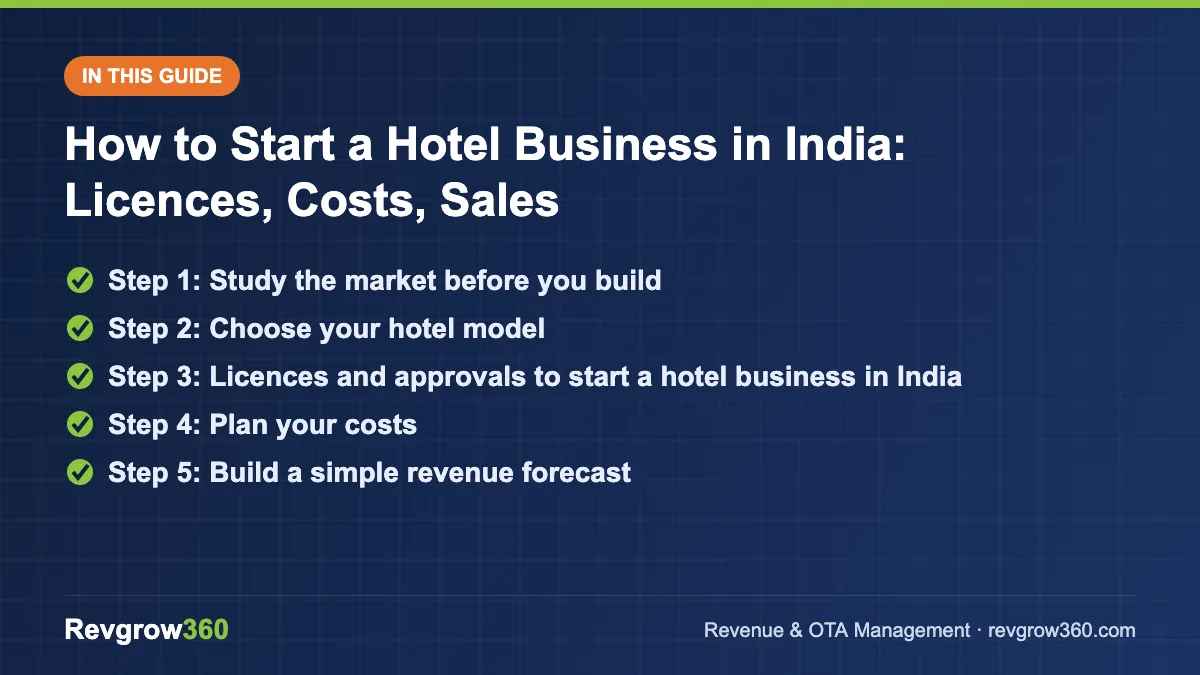
- Study demand and rates
- Plan licences early
- List on OTAs pre-opening
Step 1: Study the market before you build
Every hotel decision starts with demand. Ask who will stay, why they come to the area, and when.
- Demand generators: offices, industrial zones, hospitals, colleges, pilgrimage sites, tourist attractions, airports, highways and event venues.
- Seasonality: leisure destinations often have sharp peaks and long lean periods; business cities are busier on weekdays.
- Competition: list nearby hotels, their room counts, OTA review scores and rates on weekdays, weekends and peak dates.
- Gaps: is there a shortage of clean mid-scale rooms, family resorts, banquet venues or budget business hotels?
Check competitor rates on OTAs for a range of future dates. This gives you a realistic idea of the average daily rate (ADR) you can expect, which is the starting point of every financial plan.
Every licence you need, in one list.
Step 2: Choose your hotel model
| Model | Investment level | Control | Typical fit |
|---|---|---|---|
| Build and own an independent hotel | Highest | Full | Owners with land and long-term capital |
| Lease an existing building | Medium | High, within lease terms | Operators who want faster launch |
| Franchise or brand affiliation | Medium to high (plus fees) | Shared with brand standards | Owners wanting brand recognition and systems |
| Management contract with an operator | Owner invests; operator runs | Lower day-to-day control | Investors not running operations |
| Small boutique or guest house | Lower | Full | Niche locations, first-time hoteliers |
Also decide your positioning: budget, mid-scale, upscale, resort, business hotel or boutique. Positioning determines room size, facilities, staffing and the rate you can charge.
Revenue Health Score · free
Free tool: check your hotel’s revenue health
Answer a few quick questions about your rooms, rates, OTAs and reviews. Get a score out of 100, your weakest revenue areas and the first actions to fix them.
Step 3: Licences and approvals to start a hotel business in India
Exact requirements depend on your state, city, size and services. Commonly required items include:
- Business entity registration: proprietorship, partnership, LLP or private limited company, with PAN and a bank account.
- Land use and building approvals: approved building plan, and a completion or occupancy certificate from the local authority.
- Fire NOC: from the state fire service, depending on building height, area and occupancy.
- Pollution control consents: consent to establish and consent to operate from the State Pollution Control Board, depending on size and category.
- Trade or health licence: from the municipal corporation or local body.
- Police licences: many cities require lodging house and eating house licences or guest registration under local police rules.
- Food licence: FSSAI registration or licence for the restaurant and kitchen. See the FSSAI website for categories.
- GST registration: rates on room tariffs depend on declared tariff slabs and have changed in recent years, so confirm current rates with your chartered accountant.
- Shops and establishments registration under the state act.
- Liquor licence: from the state excise department if you plan a bar or serve alcohol.
- Lift licence, generator and electrical safety approvals as applicable.
- Labour registrations: EPF and ESI once you cross the applicable employee thresholds.
- Music and entertainment licences if you play copyrighted music in public areas or host events.
- Foreign guest reporting: Form C submission for foreign nationals.
- Optional star classification from the Ministry of Tourism, which some hotels pursue for credibility.
Start licensing early. Several approvals depend on others, and delays in one can push your opening date.
Step 4: Plan your costs
Costs vary enormously by city, land value, size and positioning, so build your own estimate with an architect and a hotel consultant. Plan for these categories:
Capital costs
- Land or lease deposit
- Construction or renovation, including MEP (mechanical, electrical, plumbing)
- Furniture, fixtures and equipment for rooms, restaurant and back-of-house
- Kitchen and laundry equipment
- Technology: PMS, channel manager, booking engine, POS, Wi-Fi, CCTV, door locks
- Approvals, professional fees and contingencies
Pre-opening costs
- Recruitment and training before opening
- Photography, website, OTA setup and launch marketing
- Operating supplies: linen, toiletries, crockery, uniforms
- Working capital for the first several months
Operating costs
Staff salaries, utilities, OTA commissions, maintenance, food costs, marketing, insurance, taxes and loan repayments.
Step 5: Build a simple revenue forecast
Use three core formulas:
- Room nights available = rooms × days in period
- Room revenue = room nights available × occupancy × ADR
- RevPAR = room revenue ÷ room nights available
Worked example
A hypothetical 30-room mid-scale hotel in Bhubaneswar estimates 60% occupancy in its first year and an ADR of ₹3,200 based on competitor rates.
- Room nights available = 30 × 365 = 10,950
- Room nights sold = 10,950 × 0.60 = 6,570
- Room revenue = 6,570 × ₹3,200 = ₹2,10,24,000
- RevPAR = ₹2,10,24,000 ÷ 10,950 ≈ ₹1,920
Next, subtract distribution costs, operating costs and debt service to see whether the project works. Run a conservative scenario too; new hotels often take time to build occupancy.
Step 6: Set up distribution before opening
Many new hotels lose months of revenue because their listings go live late. Start 60 to 90 days before opening:
- Choose a PMS, channel manager and booking engine that integrate with each other. See our guide to the best channel manager for hotels.
- Create OTA listings with professional photos, accurate descriptions and correct policies.
- Create and verify your Google Business Profile.
- Launch the website with a working booking engine.
- Set an opening pricing strategy that builds early reviews without underselling.
- Contact local companies, travel agents and event planners for early business.
Expert OTA management during launch helps a new property gain visibility while it has few reviews.
Step 7: Hire and train your team
Define roles for front office, housekeeping, food and beverage, maintenance, sales and revenue. Write standard operating procedures for check-in, room cleaning, complaint handling and cash management. Run mock check-ins and soft-opening stays with friends or local partners before accepting public bookings.
Key takeaways
- Base every decision on local demand, seasonality and competitor rates.
- Choose the model and positioning that match your capital and experience.
- Start licensing early; approvals vary by state and depend on each other.
- Plan capital, pre-opening and operating costs, plus working capital.
- Forecast with occupancy, ADR and RevPAR, including a conservative case.
- Set up OTAs, Google and your booking engine before opening day.
Revgrow360 has supported 500+ hotels with pre-opening distribution, pricing and revenue strategy. If you are planning a new hotel, book a free consultation to discuss your launch plan and forecast.
Frequently asked questions
What licences are needed to open a hotel in India?
Common requirements include business registration, building approvals and occupancy certificate, fire NOC, pollution control consents, municipal trade or health licence, police lodging and eating house licences where applicable, FSSAI food licence, GST registration, shops and establishments registration, and a liquor licence if serving alcohol. Requirements vary by state and city, so confirm with local authorities and advisers.
How much does it cost to start a hotel in India?
There is no single figure because costs depend on land value, city, number of rooms, positioning and whether you build, renovate or lease. Plan capital costs, pre-opening costs and working capital for the first several months. An architect, a cost consultant and a hotel feasibility study will help you build a realistic estimate for your project.
How long does it take for a new hotel to become profitable?
It varies widely with location, positioning, debt, opening pricing and how quickly the hotel builds reviews and repeat business. Many new hotels need time to ramp up occupancy. Build a conservative forecast using occupancy, ADR and RevPAR, include financing costs, and plan enough working capital to cover the ramp-up period.
When should a new hotel list on OTAs?
Start setting up listings around 60 to 90 days before opening, once your opening date is reasonably certain. Prepare professional photos, accurate descriptions and policies, connect a channel manager and booking engine, and verify your Google Business Profile. Early listings let you take advance bookings and start building reviews from the first weeks.
More Hotel Business guides

How to Start a Homestay Business in India: Step-by-Step
A practical framework for launching a homestay in India, from state registration and approvals to pricing, OTA listings and daily operations.
Airbnb House Rules: 30 Examples and How to Enforce Them
Copy 30 example Airbnb house rules, learn how to word them politely, add them to your listing under House rules and requests,…
Airbnb Welcome Book: What to Include, Page by Page
A practical, page-by-page guide to writing an Airbnb welcome book, with ready-to-copy quick-facts and check-out examples, digital vs printed tips and a…

How to Leave OYO and Run Your Hotel Independently in India (2026 Guide)
Quick summary: Step-by-step guide on how to leave OYO and run your hotel independently in India: exit the contract, list on OTAs…
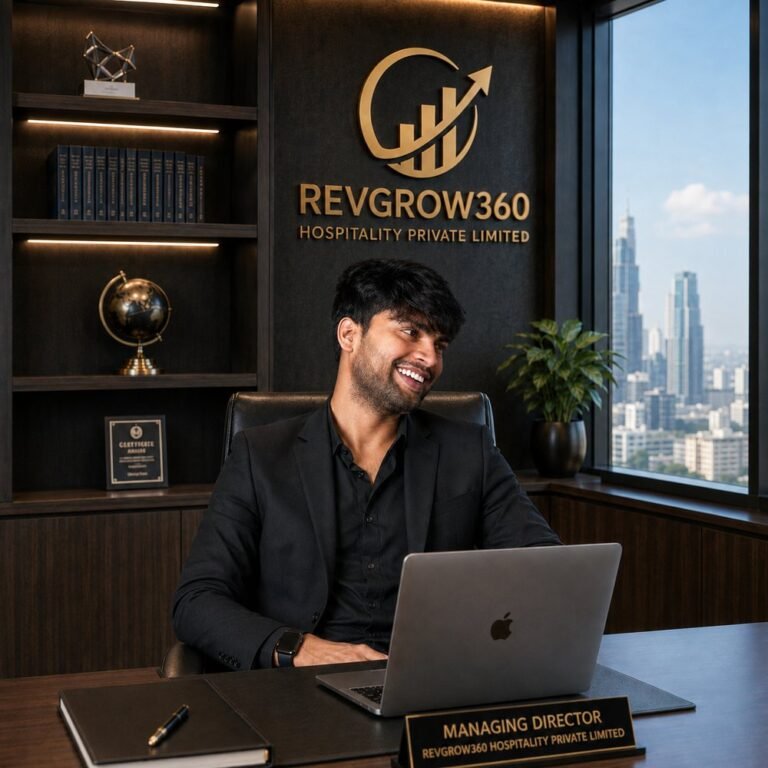
Md Arif Ahamed – Founder & MD of Revgrow360
Md Arif Ahamed is the Founder and Managing Director of Revgrow360 Hospitality, a hotel revenue and OTA management company that has served…