 By Md Arif Ahamed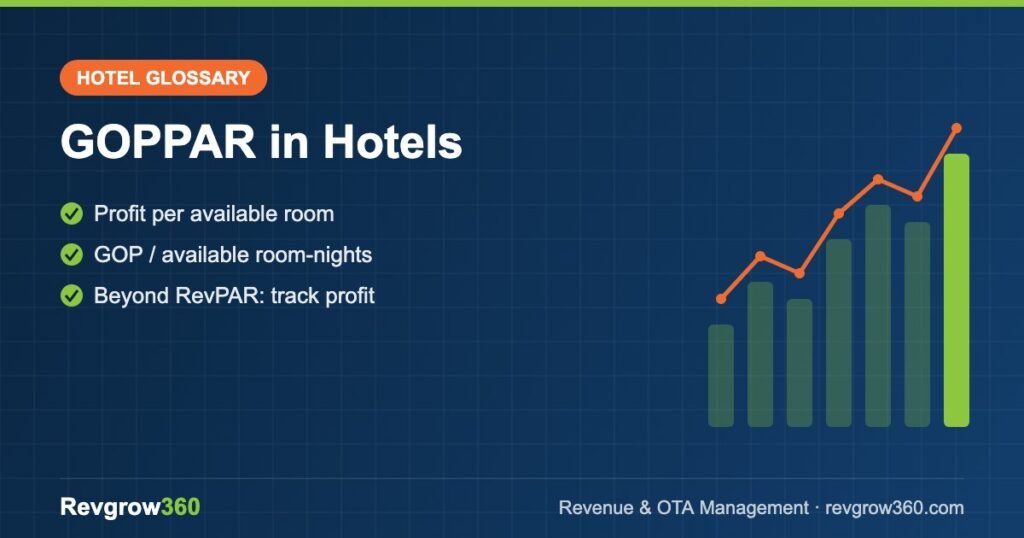
GOPPAR in hotel management means Gross Operating Profit per Available Room. It shows how much operating profit your hotel earns for every room you have available to sell, whether the room is sold or not. You calculate it by dividing gross operating profit (GOP) by the total number of available rooms in the period.
- Profit per available room
- GOP / available room-nights
- Beyond RevPAR: track profit
Where RevPAR tells you how well you sell rooms, GOPPAR tells you how much of that revenue you actually keep after running the hotel. That is why many owners treat it as a truer measure of performance than revenue alone.
What is GOPPAR in hotel accounting?
Gross Operating Profit is the money left after you subtract departmental costs and undistributed operating expenses (such as payroll, utilities, sales and marketing, repairs and maintenance, and administration) from total revenue. It is calculated before fixed charges such as property tax, insurance, depreciation, loan interest and management fees. GOPPAR then spreads that GOP across every available room.
“Available rooms” means room-nights you could have sold. A 40-room hotel has 40 x 30 = 1,200 available room-nights in a 30-day month. Rooms that are out of order for renovation are usually removed from the count, but you should be consistent in how you treat them.
GOP, margin and GOPPAR in seconds.
GOPPAR formula
GOPPAR = Gross Operating Profit / Total Available Rooms (room-nights) in the period
Some hotels also express it per occupied room, but the standard definition uses available rooms. Always state which period you used (a day, a month or a year), because a monthly GOPPAR and a daily GOPPAR cannot be compared.
GOPPAR worked example
Take a hypothetical 40-room hotel in Goa for one month of 30 days. These numbers are illustrative only.
| Item | Amount (₹) |
|---|---|
| Rooms revenue | 22,00,000 |
| Food and beverage revenue | 8,00,000 |
| Other revenue (spa, laundry, transfers) | 1,00,000 |
| Total revenue | 31,00,000 |
| Departmental costs (rooms, F&B, other) | 11,50,000 |
| Undistributed expenses (payroll, utilities, marketing, maintenance, admin) | 9,50,000 |
| Gross operating profit | 10,00,000 |
Available rooms = 40 x 30 = 1,200 room-nights.
GOPPAR = ₹10,00,000 / 1,200 = about ₹833 per available room per month-night.
Now compare with RevPAR. If rooms revenue is ₹22,00,000, RevPAR = ₹22,00,000 / 1,200 = about ₹1,833. The gap between ₹1,833 and ₹833 is the cost of running the hotel and the contribution of non-room revenue. Two hotels with the same RevPAR can have very different GOPPAR if one spends more to earn the same revenue.
How GOPPAR works in daily management
GOPPAR connects the revenue team and the operations team. A revenue manager can push occupancy and rate higher, but if the extra business arrives through channels with high commission, or needs extra staff and amenities, profit per room may not rise.
Think of it as a three-step chain:
- Revenue: rooms, F&B and other income, driven by occupancy, ADR and spend per guest.
- Cost: commissions, payroll, energy, supplies and marketing, many of which move with occupancy.
- Profit: what is left, divided by the rooms you have to offer.
Because it uses available rooms, GOPPAR also penalises empty inventory. A hotel with low occupancy still carries fixed payroll and utilities, so its GOPPAR drops sharply.
GOPPAR vs RevPAR vs TRevPAR
| Metric | What it measures | Includes costs? | Best used for |
|---|---|---|---|
| RevPAR | Rooms revenue per available room | No | Pricing and sales performance |
| TRevPAR | Total revenue per available room | No | Whole-hotel revenue strength |
| GOPPAR | Gross operating profit per available room | Yes | Profitability and cost control |
If you are new to the first one, read our guide on what is RevPAR. For the wider set of numbers owners track, see hotel KPIs.
Why GOPPAR matters for revenue and profit
Revenue can grow while profit shrinks. A hotel may fill rooms through deep discounts on high-commission OTA channels and see RevPAR rise, yet keep less money per room than before. GOPPAR exposes this.
It helps you decide:
- Whether a discount campaign was actually profitable after commission and extra service cost.
- Which channels deserve more inventory once acquisition cost is included. See OTA commission rates and hotel distribution strategy.
- Whether to push upselling and ancillary income, which usually carries a better margin than room rate cuts.
- Where payroll and utilities are out of line with the occupancy you really run.
Investors and asset managers also look at GOPPAR because it allows fair comparison between hotels of different sizes.
How to improve GOPPAR
Raise revenue quality, not just volume
Focus on ADR and on guests who spend on food, spa and experiences. Use dynamic pricing and increase direct bookings to cut commission.
Control variable costs
Match housekeeping and F&B staffing to forecast occupancy. Track cost per occupied room, energy use per room-night and linen cost. Small savings repeated across every room-night add up.
Protect fixed-cost leverage
Because fixed costs are spread over available rooms, filling shoulder-season gaps at a sensible rate often lifts GOPPAR more than holding out for a high rate and staying empty.
How to track GOPPAR every month
You do not need special software. A simple monthly routine works for most independent hotels:
- Take total revenue and GOP from your management accounts after the month closes.
- Count available room-nights using the same rule every month.
- Divide GOP by available room-nights and record the result beside RevPAR and occupancy.
- Compare with the same month last year and with budget, then note what changed.
- Pick one cost line and one revenue line to act on next month.
A 12-room homestay in Darjeeling can do this in a spreadsheet in ten minutes. The habit matters more than the tool, because it forces the owner to look at profit and not only at bookings.
Common GOPPAR mistakes
- Using sold rooms instead of available rooms. That gives a different metric and hides empty inventory.
- Mixing periods. Comparing a daily figure with a monthly one produces nonsense.
- Including fixed charges. Interest, depreciation and property tax belong below GOP.
- Inconsistent room counts. Decide how to treat out-of-order rooms and apply it every month.
- Ignoring seasonality. Compare with the same month last year, not the previous month.
Related terms
GOP margin (GOP divided by total revenue), RevPAR, TRevPAR, ADR (average daily rate), occupancy (hotel occupancy rate), cost per occupied room, and flow-through.
Key takeaways
- GOPPAR = gross operating profit divided by available room-nights.
- It measures profit, so it shows what RevPAR and TRevPAR cannot.
- Always use available rooms, one consistent period and the same room count rules.
- Improve it with better channel mix, upselling and tight variable cost control.
Want to see how your hotel’s GOPPAR compares and where profit is leaking? The team at Revgrow360 hotel revenue management can review your numbers during a free hotel audit.
Frequently asked questions
What does GOPPAR stand for?
GOPPAR stands for Gross Operating Profit per Available Room. It divides a hotel's gross operating profit by the number of room-nights available in the period, giving a profit figure that shows how efficiently the property turns its inventory into earnings.
How is GOPPAR different from RevPAR?
RevPAR measures rooms revenue per available room and ignores costs. GOPPAR measures operating profit per available room, so it includes departmental and undistributed expenses. A hotel can raise RevPAR through discounts and still see GOPPAR fall because costs and commissions rise.
What is a good GOPPAR for a hotel?
There is no single good number, because it depends on city, category, season and cost structure. The useful comparison is your own GOPPAR against last year's same period, your budget and similar nearby hotels, using the same calculation rules each time.
Does GOPPAR include fixed charges like loan interest?
No. Gross operating profit is calculated before fixed charges such as property tax, insurance, depreciation, loan interest and usually management fees. Those items sit below GOP, so including them would change the metric and make comparisons unreliable.
More Hotel Glossary guides
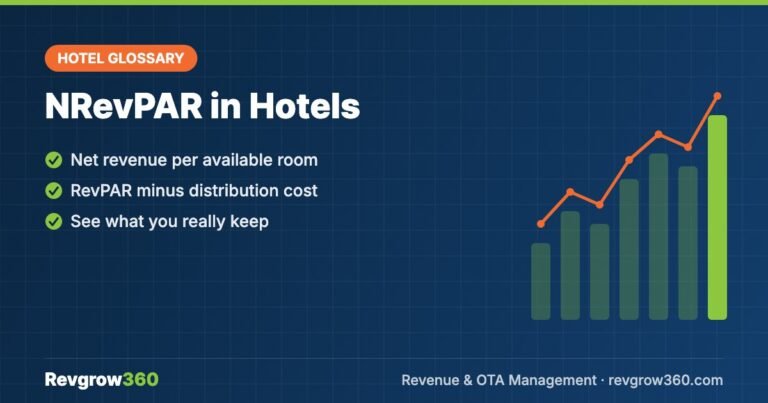
What is NRevPAR in Hotels? Meaning, Examples & Formula
NRevPAR shows room revenue per available room after distribution costs. See the formula, an example and ways to improve it.
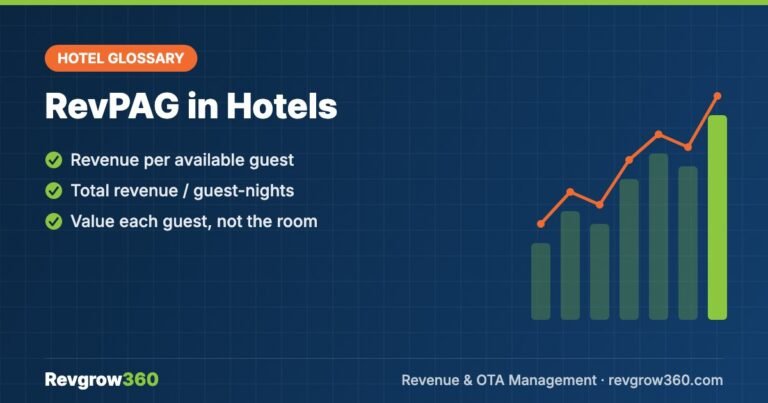
What is RevPAG in Hotels? Meaning, Examples & Formula
RevPAG measures hotel revenue per guest rather than per room. See the formula, an example and ways to improve it.
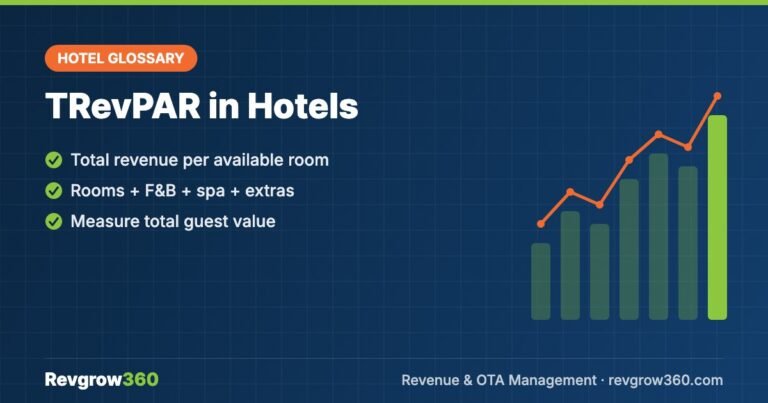
What is TRevPAR in Hotels? Meaning, Examples & Formula
TRevPAR measures all hotel revenue per available room, not just rooms. See the formula, an example and how to improve it.