 By Md Arif Ahamed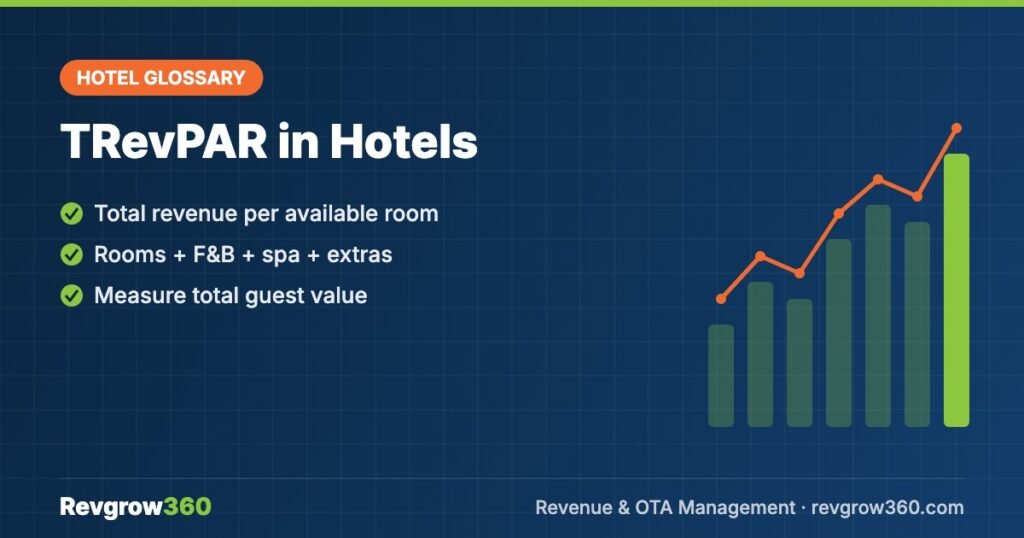
TRevPAR in hotel management means Total Revenue per Available Room. It measures all the revenue your hotel earns, from rooms, food and beverage, spa, events and other services, divided by the number of rooms available to sell. The formula is total revenue divided by available room-nights in the period.
- Total revenue per available room
- Rooms + F&B + spa + extras
- Measure total guest value
RevPAR only looks at rooms revenue. TRevPAR widens the lens, so it shows whether you are earning enough from each guest beyond the room rate. That matters most for resorts, banquet hotels and any property with strong restaurants or experiences.
What is TRevPAR in hotel reporting?
TRevPAR adds every revenue stream the hotel controls into one number and spreads it over available rooms. Typical streams include:
- Rooms revenue (nightly rates, including packages)
- Food and beverage (restaurant, bar, room service, banquets)
- Spa, wellness and recreation
- Transfers, tours and activities
- Laundry, parking, shop sales and other minor income
Use revenue before commission and after taxes are removed, and apply the same rule in every period. Available rooms are the room-nights you could sell: rooms x days.
Work out revenue per available room.
TRevPAR formula
TRevPAR = Total Revenue / Total Available Room-Nights
You can also write it as RevPAR plus non-room revenue per available room:
TRevPAR = RevPAR + (Non-room revenue / Available room-nights)
TRevPAR worked example
Imagine a hypothetical 50-room resort in Goa for a 30-day month. Available room-nights = 50 x 30 = 1,500.
| Revenue stream | Amount (₹) | Per available room (₹) |
|---|---|---|
| Rooms | 30,00,000 | 2,000 |
| Food and beverage | 12,00,000 | 800 |
| Spa and activities | 3,00,000 | 200 |
| Other | 1,50,000 | 100 |
| Total | 46,50,000 | 3,100 |
TRevPAR = ₹46,50,000 / 1,500 = ₹3,100. RevPAR is ₹2,000, so non-room revenue adds ₹1,100 per available room.
Now suppose the resort improves breakfast packages and spa bookings and adds ₹2,25,000 of non-room revenue with the same occupancy. TRevPAR rises by ₹150 to ₹3,250, while RevPAR does not move at all. A RevPAR-only view would call the month flat.
RevPAR vs TRevPAR
| Point | RevPAR | TRevPAR |
|---|---|---|
| Revenue counted | Rooms only | All departments |
| Best for | Pricing, channel and benchmark comparison | Total guest value and resort performance |
| Hides | Spend on F&B, spa, events | Cost and profit |
| Industry benchmark reports | Widely available | Less common, so compare with yourself |
Read our primer on what is RevPAR to see where TRevPAR fits. Neither includes costs, so pair them with a profit metric such as GOPPAR.
Why TRevPAR matters for revenue management
Modern revenue management is about total guest value, not only room rate. A guest who pays a slightly lower room rate but spends on dinner, a spa session and a transfer can be worth more than a guest who pays the highest rate and spends nothing.
TRevPAR supports better decisions on:
- Package pricing: bundling breakfast or an experience can justify a slightly lower room rate.
- Channel choice: a direct guest who dines in the hotel may be more valuable than an OTA guest who eats outside.
- Staffing and outlets: if restaurants are under-used, TRevPAR flags the gap.
- Upselling: see hotel upselling and ancillary revenue for ideas.
How to improve TRevPAR
Raise spend per occupied room
Offer pre-arrival add-ons such as airport pickup, candlelight dinner or late check-out. Train front desk staff to suggest one relevant extra at check-in.
Fill outlets, not only rooms
Local day visitors, weekend brunch and small events use fixed capacity. Even modest extra covers increase TRevPAR without adding rooms.
Align pricing with demand
Use dynamic pricing so high-demand dates earn a premium and low-demand dates carry attractive packages.
How a hotel can track TRevPAR step by step
- Export monthly revenue by department from your accounts or PMS: rooms, food and beverage, spa, events and other.
- Remove taxes and any pass-through charges you do not keep, using one rule every month.
- Add the departments to get total revenue.
- Multiply the number of rooms by the days in the month to get available room-nights.
- Divide total revenue by available room-nights.
- Record RevPAR and TRevPAR side by side, and calculate the gap. That gap is your non-room revenue per available room.
A 15-room boutique hotel in Kolkata with only breakfast and a small cafe can do this in a basic spreadsheet. The trend over six months tells you whether your extras are growing or standing still.
What a healthy mix looks like
There is no universal ideal ratio, because a city business hotel, a beach resort and a hill homestay earn very differently. Look at the share of non-room revenue in total revenue and watch its direction. If the share is rising while occupancy holds steady, you are earning more from each guest. If it is falling, guests may be eating and shopping elsewhere, or your offers are not visible at booking and check-in.
Ask three questions every quarter: which outlet is under-used, which add-on sells best when staff mention it, and which guest segment spends the most per stay. Then adjust offers and staff scripts for that segment.
Package or rate cut: a TRevPAR comparison
Suppose a 30-room hotel in Jaipur has a quiet midweek and two options for a room that would otherwise sit empty. Option A cuts the room rate from ₹4,500 to ₹3,800. Option B keeps ₹4,500 but includes dinner worth ₹700 at cost to the hotel of about ₹300.
Under option A the room earns ₹3,800 and nothing else. Under option B the room earns ₹4,500, and the dinner is part of the package. Option B protects your rate positioning, keeps the restaurant busy and lifts TRevPAR. The hotel should still check the margin, but TRevPAR makes the trade-off visible where RevPAR alone would not.
Common TRevPAR mistakes
- Counting only sold rooms. The denominator must be available room-nights.
- Mixing taxes. Include GST in one month and exclude it in another and the trend becomes meaningless.
- Counting external guest revenue inconsistently. Decide whether banquet and walk-in restaurant sales belong in the total, and keep the rule fixed.
- Chasing revenue without margin. A low-margin outlet can lift TRevPAR but hurt profit.
- Comparing with city averages that use another definition. Benchmark against your own history first.
Related terms
RevPAR, GOPPAR, ADR (average daily rate), occupancy rate, ancillary revenue, spend per occupied room, and hotel KPIs.
Key takeaways
- TRevPAR = total revenue divided by available room-nights.
- It captures food, spa, events and extras that RevPAR ignores.
- Use it with a profit metric, since revenue alone does not show margin.
- Keep taxes, period and room-count rules identical every time you calculate it.
If your resort or hotel earns well from rooms but leaves guest spend on the table, Revgrow360’s hotel revenue management team can help you build a plan. Start with a free consultation.
Frequently asked questions
What does TRevPAR stand for?
TRevPAR stands for Total Revenue per Available Room. It divides all hotel revenue, including rooms, food and beverage, spa and other services, by the number of room-nights available in the period, giving a whole-property revenue measure.
What is the difference between RevPAR and TRevPAR?
RevPAR counts only rooms revenue per available room. TRevPAR counts every revenue stream. A resort with strong dining and spa income can show modest RevPAR but high TRevPAR, so TRevPAR gives a fuller picture of guest value.
Should GST be included in TRevPAR?
Most hotels report revenue net of taxes such as GST so the figure reflects what the hotel actually earns. Whatever rule you choose, apply it consistently across months and years, otherwise trend comparisons will be misleading.
Is TRevPAR useful for small hotels without a restaurant?
It is less important if rooms are almost your only income, because it will be close to RevPAR. It becomes valuable the moment you sell breakfast, transfers, tours or events, since it shows whether those extras are growing.
More Hotel Glossary guides
What is NRevPAR in Hotels? Meaning, Examples & Formula
NRevPAR shows room revenue per available room after distribution costs. See the formula, an example and ways to improve it.
What is RevPAG in Hotels? Meaning, Examples & Formula
RevPAG measures hotel revenue per guest rather than per room. See the formula, an example and ways to improve it.
What is GOPPAR in Hotels? Meaning, Examples & Formula
GOPPAR shows how much operating profit a hotel keeps per available room. Learn the formula, a worked example and how to improve…