 By Md Arif Ahamed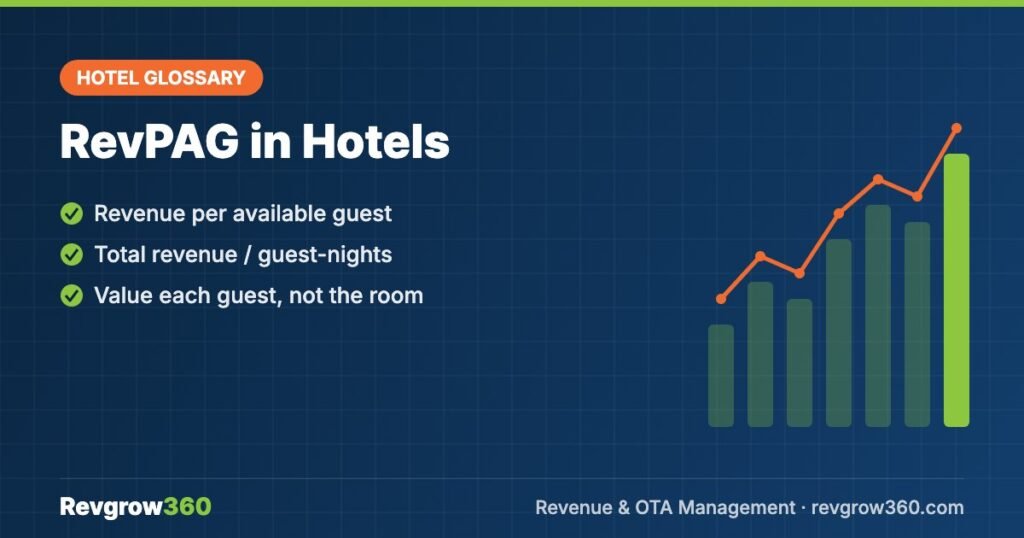
RevPAG in hotel revenue management means Revenue per Available Guest. It measures how much revenue your hotel earns per guest, instead of per room, so it shows the true value of each person who stays. A common way to calculate it is total revenue divided by the number of guest-nights in the period.
- Revenue per available guest
- Total revenue / guest-nights
- Value each guest, not the room
The definition varies slightly between hotels, which is why you must pick one method and use it consistently. This guide uses the guest-night version, since it is the easiest to track from a PMS and the most useful for pricing decisions.
What is RevPAG in hotel analysis?
Most hotel metrics are room-based: RevPAR, ADR and occupancy all count rooms. But rooms are sold to people, and a double room with two guests can generate more food, spa and activity revenue than the same room with one guest. RevPAG captures that difference by dividing revenue by guests.
It is especially useful for:
- Resorts and family hotels where party size changes a lot
- Properties that charge extra per person or sell meal plans
- Homestays and hostels with per-bed or per-head pricing
- Hotels comparing leisure groups, couples and solo business travellers
158 hotel terms explained in plain English.
RevPAG formula
RevPAG = Total Revenue / Total Guest-Nights
A guest-night is one guest staying one night. Two guests staying three nights equals six guest-nights. Some hotels use only room revenue in the numerator, which gives a room-revenue-per-guest figure. State clearly which one you are using.
You can also express guest-nights through room-nights: guest-nights = occupied room-nights x average guests per room.
RevPAG worked example
A hypothetical 20-room hotel in Darjeeling records the following for a 30-day month.
| Item | Value |
|---|---|
| Occupied room-nights | 420 |
| Average guests per occupied room | 2.2 |
| Guest-nights (420 x 2.2) | 924 |
| Rooms revenue | ₹16,80,000 |
| Food and other revenue | ₹4,20,000 |
| Total revenue | ₹21,00,000 |
RevPAG = ₹21,00,000 / 924 = about ₹2,273 per guest-night.
Compare with ADR: ₹16,80,000 / 420 = ₹4,000 per room. A guest-based view tells you each guest brings about ₹2,273 in total revenue, which helps you decide whether to charge for extra persons or offer a family package.
RevPAG vs RevPAR
| Metric | Divides revenue by | Question it answers |
|---|---|---|
| RevPAR | Available rooms | How well did we sell and price rooms? |
| TRevPAR | Available rooms | How much total revenue did each room earn? |
| RevPAG | Guests (guest-nights) | How much is each guest worth to us? |
Use it alongside RevPAR and ADR, not instead of them.
Why RevPAG matters for revenue
Two stays can look identical in ADR but differ in value. A solo traveller and a family of four may both pay the same room rate. If the family eats three meals and books activities, their value is much higher. RevPAG helps you see that.
It supports practical decisions:
- Extra person pricing: check whether the charge per additional guest covers breakfast, linen and amenities.
- Package design: build family or couple packages based on real spend per guest.
- Segment targeting: compare corporate, couples, families and groups by revenue per guest.
- Upselling: train staff to suggest add-ons that fit each guest type. See hotel upselling and ancillary revenue.
How to improve RevPAG
Capture guest count at booking
Ask for adults and children when the reservation is made. Many hotels only learn the real count at check-in, which spoils both planning and the data.
Price by occupancy where it makes sense
Offer a clear base rate for two guests and a fair extra-person charge. Avoid giving free extra beds across all channels, because that lowers revenue per guest on your busiest dates.
Sell experiences per person
Per-guest add-ons such as guided walks, cooking classes, sunset dinners and spa sessions scale with party size. Offer them in your booking confirmation and at check-in.
How to track RevPAG monthly
- Pull guest-nights from your PMS, or multiply occupied room-nights by average guests per room.
- Take total revenue (or rooms revenue, if that is your chosen method) for the same period.
- Divide revenue by guest-nights.
- Break the result down by segment and by channel.
- Compare with the same month last year.
This is part of a wider set of hotel KPIs that give a balanced view of performance.
Example: using RevPAG to price an extra person
Consider a 12-room homestay in Darjeeling that sells a double room at ₹3,500 including breakfast for two. A family asks to add a third guest. The hotel’s cost for the extra person is a mattress, linen, breakfast and extra water and electricity, perhaps ₹450 to ₹600 in total.
If the homestay’s usual RevPAG is around ₹1,900 per guest-night, charging only ₹300 for the extra person pulls the average down and may not cover costs. A fair extra-person charge, perhaps ₹700 to ₹900, brings the third guest close to the average and covers the cost. Without a guest-based metric, this decision is usually made by instinct.
Review the figure each quarter. If RevPAG drops while occupancy rises, you are probably filling rooms with more people at the same price.
Common RevPAG mistakes
- Mixing definitions. Total revenue per guest and room revenue per guest are different numbers.
- Bad guest data. If the front desk does not record guest counts accurately, the metric is unreliable.
- Counting children inconsistently. Decide whether infants count and keep the rule fixed.
- Ignoring costs. A guest who spends heavily on a low-margin service may not be more profitable.
- Using it for benchmarking against others. Few competitors publish it, so compare against your own history.
Related terms
RevPAR, TRevPAR, ADR, occupancy, average guests per room, ancillary revenue, spend per guest, and GOPPAR.
Limits of RevPAG
RevPAG is a useful lens, but it is not a complete answer. It depends on accurate guest counts, and it can be pushed up by high-spending guests who also cost more to serve. Read it together with margin metrics, and compare segments rather than relying on one blended number. Review it every month, and revisit your guest-count recording rules at least once a year.
Key takeaways
- RevPAG = revenue divided by guest-nights, so it values the guest rather than the room.
- Choose total revenue or room revenue as the numerator and never switch.
- It helps with extra-person pricing, packages and segment targeting.
- Accurate guest counts at booking are the foundation of reliable data.
If you want help pricing by guest, designing packages and building a reporting routine, Revgrow360 offers hotel revenue management support, and you can request a free hotel audit to get started.
Frequently asked questions
What does RevPAG stand for?
RevPAG stands for Revenue per Available Guest. It is commonly calculated as total revenue divided by guest-nights in a period, which shows how much each guest is worth to the hotel rather than how much each room earns.
How is RevPAG different from RevPAR?
RevPAR divides rooms revenue by available rooms, so it ignores how many people stay in each room. RevPAG divides revenue by guests, so a family of four and a solo traveller in the same room are valued differently.
Is there one standard RevPAG formula?
No. Some hotels use total revenue and others use only rooms revenue, and some divide by available guest capacity. Choose one definition, write it down and apply it consistently, because comparing numbers calculated differently gives misleading conclusions.
Which hotels benefit most from tracking RevPAG?
Resorts, family-oriented hotels, homestays and any property that charges per person or sells meal plans benefit most, because guest count changes revenue considerably. Business hotels with mostly single guests will see little difference from RevPAR.
More Hotel Glossary guides
What is NRevPAR in Hotels? Meaning, Examples & Formula
NRevPAR shows room revenue per available room after distribution costs. See the formula, an example and ways to improve it.
What is TRevPAR in Hotels? Meaning, Examples & Formula
TRevPAR measures all hotel revenue per available room, not just rooms. See the formula, an example and how to improve it.
What is GOPPAR in Hotels? Meaning, Examples & Formula
GOPPAR shows how much operating profit a hotel keeps per available room. Learn the formula, a worked example and how to improve…