 By Md Arif Ahamed
Quick summary: What a hotel booking engine is, the features that matter, how pricing works and a step-by-step checklist to choose the right one for your property.
A hotel booking engine is the software that lets guests check availability, choose a room and pay on your own website, without calling you or going through an OTA. It sits behind the “Book Now” button and is the single most important tool for direct sales. This guide explains what a hotel booking engine does, how it connects with your channel manager and PMS, which features matter, how pricing usually works, and a practical checklist to choose the right one for your property.
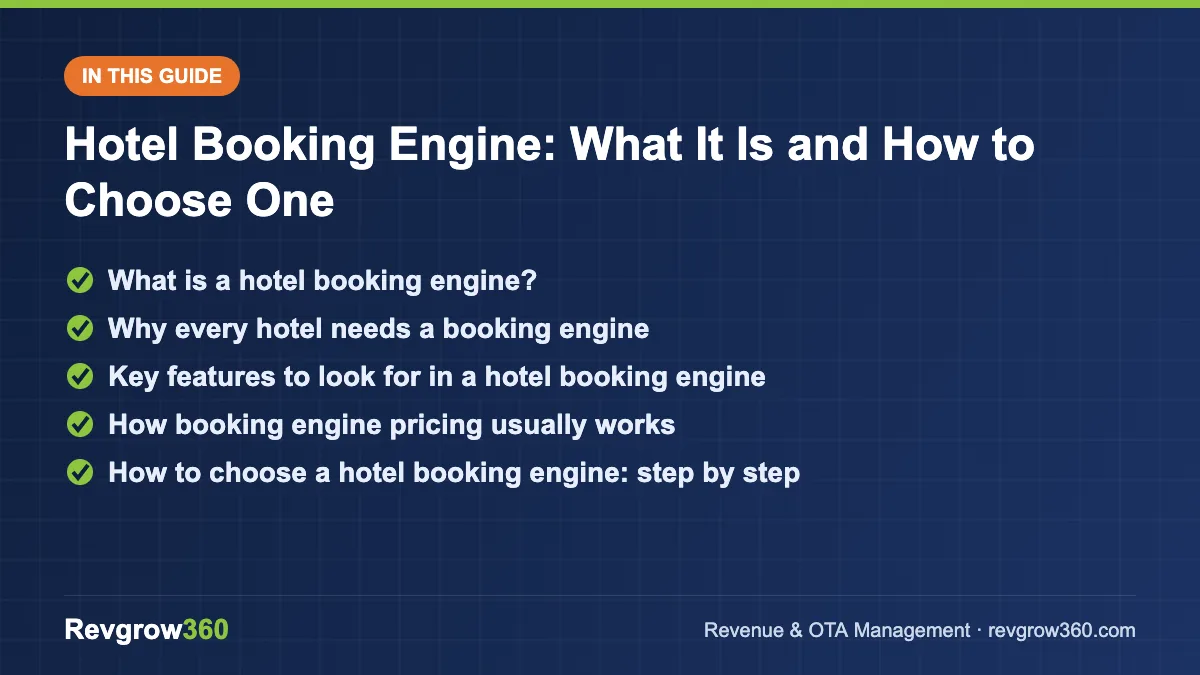
- Mobile-first, few steps
- UPI and channel sync
- Compare total yearly cost
What is a hotel booking engine?
A booking engine is a commission-free (or low-commission) reservation system that you embed on your website, social media pages and Google listing. When a guest selects dates, the engine shows live availability and rates, collects guest details, takes payment or a deposit, and sends confirmation emails to the guest and the hotel. The booking then flows into your inventory so the room is no longer available on other channels.
Think of it as your own private OTA. The difference is that you control the presentation, the rates, the policies and the guest data, and you keep most of the margin.
How it fits with your other systems
- Channel manager: keeps rates and availability synchronised across OTAs and your booking engine, so a room sold on your website closes on Booking.com, Agoda and others. Read more about choosing the best channel manager for hotels.
- PMS (property management system): manages check-in, folios, housekeeping and billing. A booking engine connected to your PMS removes manual re-entry.
- Payment gateway: processes cards, UPI, net banking and wallets.
- Google and metasearch: many engines can push your official rate to Google free booking links and paid hotel ads.
See what more direct bookings are worth per year.
Why every hotel needs a booking engine
Without a booking engine, website visitors must call, email or send a WhatsApp message to book. Many will not. They will open an OTA app instead and book there, often for the same price, and you pay commission on a guest who was already on your website. A booking engine captures that intent immediately.
It also works 24 hours a day. Guests plan trips late at night and on weekends. A booking engine sells rooms while the front desk is busy or the reservations team is offline.
Key features to look for in a hotel booking engine
Must-have features
- Mobile-first design: most hotel website traffic comes from phones. The engine must load quickly and work smoothly on small screens.
- Few steps to book: dates, room, guest details, payment, confirmation. Every extra page loses guests.
- Clear total price: show taxes and fees before the payment step to avoid drop-offs and complaints.
- Local payment options: for Indian hotels, UPI support is essential, along with cards and net banking.
- Two-way channel manager integration: real-time availability to prevent overbookings.
- Multiple rate plans: room only, with breakfast, non-refundable, long-stay and package rates.
- Promo codes and offers: for return guests, corporate partners and campaigns.
- Multi-currency and multi-language display: important for international markets.
Features that add revenue
- Upsells during booking: airport transfers, meal plans, spa or room upgrades.
- Length-of-stay and minimum-stay controls: useful on weekends and holidays.
- Abandoned booking recovery: follow-up emails to guests who started but did not finish.
- Google free booking links and metasearch connectivity.
- Analytics: conversion rate, booking window, top source markets and revenue by rate plan.
Features that protect you
- Secure payment processing compliant with card industry standards (ask the vendor about PCI DSS compliance)
- Configurable cancellation and deposit policies
- Guest data ownership written clearly in the contract
- Reliable support, ideally with a local phone number and fast response times
How booking engine pricing usually works
Vendors use a few common models. The right one depends on your size and booking volume.
| Pricing model | How it works | Suits | Watch out for |
|---|---|---|---|
| Fixed monthly subscription | Flat fee per month regardless of bookings | Hotels with steady direct volume | Paying for features you do not use |
| Per-booking commission | Small percentage of each direct booking | New or small properties | Cost rises as direct business grows |
| Per-room pricing | Monthly fee based on number of rooms | Mid-size and larger hotels | Minimum room counts in contracts |
| Bundled suite | Booking engine included with PMS or channel manager | Hotels wanting one vendor | Lock-in and weaker individual modules |
Also check payment gateway fees, which are separate from the engine’s fee, and any set-up or integration charges.
Worked example: subscription vs commission
Imagine a hypothetical 25-room boutique hotel in Udaipur expecting ₹30,00,000 a year in direct bookings through its website.
- Option A: a per-booking model at 3% would cost ₹90,000 a year.
- Option B: a subscription at ₹5,000 a month would cost ₹60,000 a year.
At this volume the subscription is cheaper. But if direct revenue were only ₹10,00,000, the commission model would cost ₹30,000 and be the better choice. Run this calculation with your own expected direct revenue before signing.
How to choose a hotel booking engine: step by step
- List your current systems. Note your PMS, channel manager and payment gateway. Shortlist engines that integrate with them.
- Define your must-haves. Use the feature list above and mark what is essential for your property type.
- Test the guest experience. Ask each vendor for a live hotel using their engine. Book a test room on your phone and time it.
- Check the admin side. Ask for a demo of how you change rates, create a package and pull a report. If it is confusing, your team will avoid using it.
- Confirm integrations in writing. “We integrate with X” should mean two-way, real-time connectivity, not a manual export.
- Compare total cost over a year including gateway fees, set-up and add-ons.
- Read the contract. Look at notice periods, data ownership and what happens to your guest data if you leave.
- Ask about support and onboarding. Who sets up rooms, photos and rate plans? How fast do they respond to problems on a Saturday night?
Common booking engine mistakes
- Hiding the booking button: it should be visible on every page, especially on mobile.
- Charging more on the website than on OTAs: guests notice and leave.
- Poor room content: one photo and two lines of text per room will not convert.
- Too many rate plans: ten options for one room confuse guests. Keep it to a few clear choices.
- Ignoring analytics: if 1,000 people reach the engine and only a handful book, something in the flow is broken.
Measuring booking engine performance
Track these numbers monthly:
- Booking engine conversion rate = bookings ÷ booking engine sessions × 100
- Website-to-engine click rate = engine sessions ÷ website sessions × 100
- Direct revenue share = direct room revenue ÷ total room revenue × 100
- Average booking value and how it changes with upsells
- Abandonment points: which step loses the most guests
Improving any of these, even slightly, compounds across the year. A booking engine is never “set and forget”; it needs regular checks on content, rates and the guest flow. Our guide to booking engine setup covers more detail.
Key takeaways
- A hotel booking engine lets guests book and pay directly on your website, with low or no commission.
- It must be mobile-first, simple, transparent on price and support UPI and cards for Indian guests.
- Two-way integration with your channel manager and PMS prevents overbookings and manual work.
- Compare pricing models using your own expected direct revenue, plus gateway fees.
- Test the real guest booking flow on a phone before you choose.
- Track conversion and abandonment every month to keep improving.
Choosing and configuring a booking engine is easier with experienced help. Revgrow360 has supported 500+ hotels with direct booking, channel management and revenue strategy. Book a free consultation and we will help you pick and set up an engine that fits your property.
For more background, see this Google Business Profile Help.
Frequently asked questions
What is the difference between a booking engine and a channel manager?
A booking engine takes reservations directly on your own website and social pages. A channel manager distributes your rates and availability to OTAs and other channels and keeps them synchronised. Most hotels need both, connected with two-way integration, so that a room sold on your website immediately closes on every OTA and overbookings are avoided.
How much does a hotel booking engine cost?
Pricing varies by vendor and model. Common options are a fixed monthly subscription, a small commission per booking, per-room monthly pricing, or a bundle with a PMS or channel manager. Payment gateway fees are usually extra. Compare the total yearly cost using your expected direct revenue to see which model is cheaper for you.
Can a small homestay use a booking engine?
Yes. Many vendors offer plans for small properties, often on a per-booking commission so you pay only when you get bookings. Even a five-room homestay benefits from letting guests book and pay online at any hour, and from connecting the engine to Google free booking links to appear when people search the property name.
Which payment methods should an Indian hotel booking engine support?
At minimum, UPI, debit and credit cards, and net banking. Many guests in India prefer UPI for its speed. If you sell to international travellers, make sure the gateway accepts foreign cards and that the engine can display prices in other currencies. Always confirm that payment processing is secure and compliant with card industry standards.
More Hotel Marketing guides
Hotel Website Design Best Practices: Complete Guide
Practical hotel website design best practices covering mobile layout, speed, photos, booking flow, SEO and tracking to win more direct bookings.
Google Business Profile for Hotels: Complete Guide
How to claim, verify and optimise a Google Business Profile for your hotel, with photo, review and routine tips to win more…
How to Increase Direct Bookings for Hotels: A Practical Plan
A step-by-step plan to shift more bookings to your own website and phone lines without starting a price war with your OTA…
WhatsApp Marketing for Hotels: Complete Guide
How hotels can use WhatsApp Business to answer enquiries fast, confirm bookings, upsell and bring guests back, with scripts, rules and metrics.
Hotel Email Marketing: Complete Guide
A complete guide to hotel email marketing: building a list, automated and campaign emails, writing, measuring results and avoiding common mistakes.
Guest Communication Plan: Booking to Post-Stay Timeline
Plan every guest message from booking to post-stay: what to send, when and on which channel, with response-time targets, a tone guide…