 By Md Arif Ahamed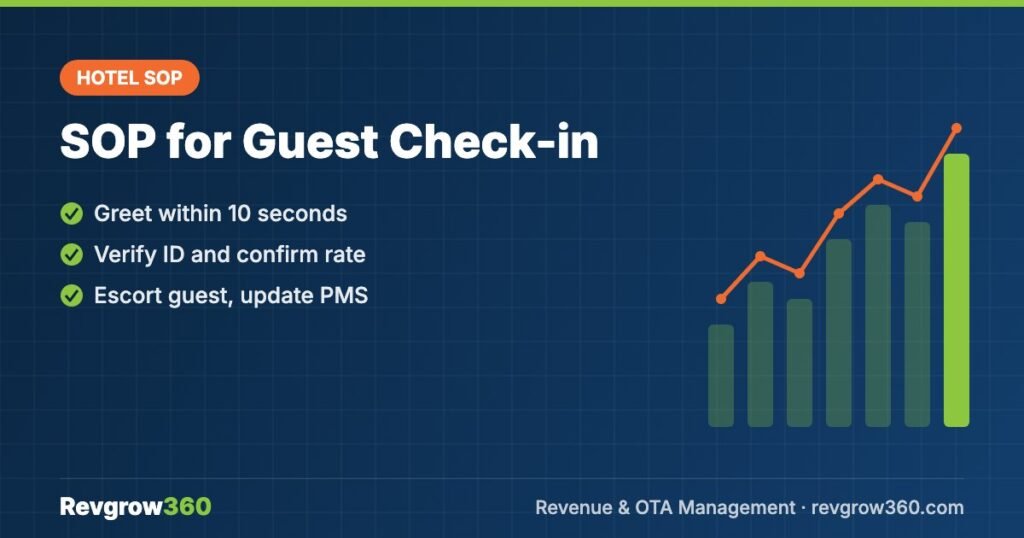
A good SOP for guest check-in sets out exactly how your front desk welcomes a guest, verifies identity, confirms the booking, collects payment, issues keys and sends the guest to the room, all within about five minutes. Written clearly, it removes guesswork, reduces errors at the desk and creates the first impression that shapes the guest’s review.
- Greet within 10 seconds
- Verify ID and confirm rate
- Escort guest, update PMS
This guide gives you a ready-to-use check-in procedure with timings, scripts, dos and don’ts and a checklist. Adapt the details to your property size, PMS and local legal requirements.
Purpose of the SOP for guest check-in
The purpose of this SOP is to make every arrival smooth, accurate, safe and welcoming. Specifically, it should:
- Verify the guest’s identity and booking correctly
- Capture the information the hotel needs, legally and operationally
- Collect payment or a deposit according to policy
- Assign the right room and hand over keys securely
- Give the guest the information they need and a chance to buy extras
- Pass the right information to housekeeping, F&B and other teams
Download 30 ready SOPs in Word or PDF.
Scope and responsibility
This SOP applies to all arrivals: pre-booked guests, OTA guests, corporate guests, groups handled individually and walk-ins (see the separate walk-in procedure). It applies to every front desk agent, the duty manager and the night auditor if they perform check-ins.
| Role | Responsibility |
|---|---|
| Front desk agent | Performs the check-in steps, records data accurately, offers upsell |
| Bell staff | Escorts guest, handles luggage, explains the room briefly |
| Front office manager or duty manager | Handles exceptions, approves room moves, special rates and VIP arrivals |
| Housekeeping supervisor | Confirms rooms are inspected and ready |
| Revenue or reservations team | Provides correct rate, rate plan and special requests in the PMS |
Preparation before arrival
A fast check-in starts before the guest walks in. Do this each morning and again at midday:
- Print or open the arrivals list and mark VIPs, repeat guests, special requests and early arrivals.
- Pre-assign rooms where possible. Match requests such as high floor, connecting rooms or quiet side.
- Confirm with housekeeping which rooms are ready and which are priority.
- Check that registration cards, key cards and pens are stocked and the key encoder works.
- Review unpaid or partially paid bookings and note deposits to collect.
Step-by-step guest check-in procedure
- Greet within 10 seconds. Stand, smile, make eye contact and welcome the guest. Offer a welcome drink or cool towel if your property provides one.
- Find the reservation. Ask for the guest’s name or booking reference. Confirm the name, dates, number of guests and room type aloud.
- Verify identity. Check an original government-approved photo ID for every adult guest, and record the details as required. For foreign nationals, follow the current legal requirements for passport, visa and the C-Form reporting, and confirm the exact rules with the official source or your legal adviser.
- Complete the registration card. Capture name, address, contact number, email, purpose of visit, vehicle number if parking is used, arrival and expected departure. Ask the guest to sign.
- Confirm the rate and inclusions. State the room rate, tax treatment, meal plan, check-out time and any extra-person charge. Avoid surprises.
- Collect payment or deposit. Collect advance, security deposit or card authorisation according to policy. Explain what is charged and when it is refunded. For prepaid OTA bookings, confirm what the guest still has to pay at the hotel, such as taxes or extras.
- Offer an upgrade or add-on. If a better room is available at a fair price, or if breakfast, airport transfer or spa packages suit the guest, make one relevant offer. Do not push.
- Assign the room and issue keys. Programme the key cards, put them in a folder that shows the room number only on the back or in your system, and do not say the room number aloud in a crowded lobby.
- Explain essentials. Breakfast timings and place, Wi-Fi details, check-out time, lift and room location, emergency contact number for the front desk.
- Escort the guest. Call the bell staff to take luggage and show the room. Wish the guest a pleasant stay.
- Update systems. Mark the room occupied in the PMS, notify housekeeping, post the advance payment, attach ID scans and note special requests.
Standards and timings
| Standard | Target |
|---|---|
| Greeting after guest reaches the desk | Within 10 seconds |
| Total check-in time for an individual guest | 3 to 5 minutes |
| Bell staff at the lobby after call | Within 2 minutes |
| Luggage in room after guest arrives in room | Within 5 minutes |
| Follow-up call to room | Within 15 to 30 minutes of arrival, where practical |
| Standard check-in time | As per hotel policy, typically afternoon |
Sample script
“Good afternoon, welcome to our hotel. May I have your name or booking reference, please? Thank you, Mr Sen. I can see you are with us for two nights in a deluxe room with breakfast. May I take a photo ID for each guest, please? Here is a short registration form. Your rate includes breakfast from 7 to 10 in the restaurant on the ground floor. Check-out tomorrow week is at 11 am. Your room is on the third floor, and Ravi will take your bags. Please call extension 9 if you need anything. Enjoy your stay.”
Handling common situations
Room not ready
Apologise, explain the expected time, offer to store luggage and provide a drink or breakfast voucher. Message the guest when the room is ready. Never leave the guest waiting without information.
Early arrival
Check housekeeping status first. If a room is ready, offer early check-in, with a fair charge if your policy applies. If not, store luggage and offer facilities.
Overbooked hotel
Follow your overbooking policy: arrange an equal or better alternative at a nearby hotel, cover transfer and the difference, and have the manager speak to the guest. Read more in our overbooking strategy guide.
Booking mismatch
If the guest’s booking differs from the PMS, such as a different room type or dates, call the reservations team or manager and check the OTA extranet or channel manager before you promise anything.
Dos and don’ts
| Do | Do not |
|---|---|
| Look at the guest and use their name | Keep typing without looking up |
| Verify ID for every adult | Accept photocopies or photos without approval |
| State the full rate and deposit upfront | Hide charges until check-out |
| Speak the room number quietly or write it | Announce the room number loudly |
| Escalate problems early | Argue with the guest or promise what you cannot deliver |
Check-in checklist
- Arrivals list reviewed and rooms pre-assigned
- ID verified and registration card signed
- Rate, meal plan and check-out time confirmed
- Payment or deposit collected and posted
- Keys programmed and tested
- Guest told about breakfast, Wi-Fi and emergency number
- Bell staff called and room status updated in the PMS
Check-in and revenue
The front desk is a revenue point. A short, friendly offer at check-in for a room upgrade, early check-in, breakfast or a late check-out can add real income over a month. Staff should record each accepted offer, so you can measure the result. For ideas, see hotel upselling and ancillary revenue. A clean arrival process also protects your rating, which supports ranking on OTAs. Read hotel online reputation management for the connection.
How to train and audit the check-in SOP
A written SOP only works if people practise it. Run a 20-minute role-play at the start of each month, with one person as the guest and one as the agent. Rotate roles, and give feedback on greeting, eye contact, accuracy and upsell.
Audit by observation. The front office manager should watch five check-ins each week and score them against the checklist. Review a few registration cards for missing signatures or IDs, and check for mismatches between the PMS and the card. Share results openly, praise good practice and fix gaps quickly.
Key takeaways
- A check-in SOP should cover greeting, ID, registration, rate, payment, keys, orientation and system updates.
- Aim for 3 to 5 minutes per guest and a greeting within 10 seconds.
- Prepare arrivals and room status before the guest arrives.
- Check legal ID and foreign-guest rules with the current official source or an adviser.
- Use the desk to offer one relevant upgrade or add-on, not several.
Want standard operating procedures and revenue systems built for your property? Revgrow360 works with hotels across India, and you can book a free consultation to discuss your front office and revenue goals.
Frequently asked questions
How long should hotel check-in take?
A standard individual check-in should take about three to five minutes when the guest has a reservation. Preparing arrivals, pre-assigning rooms and having key cards and forms ready beforehand is the best way to keep it within that time.
What documents are needed for guest check-in in India?
Hotels generally require a valid government-approved photo ID for adult guests and a signed registration card. Foreign nationals involve passport and visa details and the C-Form reporting. Rules change, so confirm current requirements with the official source or a legal adviser.
What should staff do if the room is not ready at check-in?
Apologise sincerely, give an honest expected time, store the luggage safely and offer a drink, breakfast or lounge access. Inform housekeeping to prioritise the room and tell the guest as soon as it is ready.
Who is responsible for the check-in process?
The front desk agent performs it, with bell staff, housekeeping and reservations supporting. The front office or duty manager handles exceptions such as room moves, special rates, VIPs and complaints, and checks that the SOP is followed.
More Hotel SOP guides
SOP for Walk-in Guest Handling in Hotels (Step-by-Step)
A step-by-step SOP for handling walk-in guests, with rate rules, ID and risk checks, scripts and a front desk checklist.
SOP for Guest Check-out in Hotels (Step-by-Step)
A step-by-step SOP for guest check-out covering billing, payment, deposits, feedback and a printable checklist for front desk teams.