 By Md Arif Ahamed
Quick summary: Build a safe hotel overbooking strategy: calculate wash rates, set overbooking levels, and write a walk policy that protects guests, reviews and revenue.
A hotel overbooking strategy is a deliberate plan to accept slightly more reservations than you have rooms, because you know from experience that some guests will cancel late or simply not turn up. Done well, it protects revenue on nights that would otherwise finish with empty rooms despite being “sold out”. Done badly, it leaves a tired guest at the front desk at midnight with nowhere to sleep. This guide explains how to calculate a safe overbooking level, when to use it, and how to write a walk policy so that, on the rare occasion you cannot honour a booking, the guest is looked after properly and your reputation stays intact.
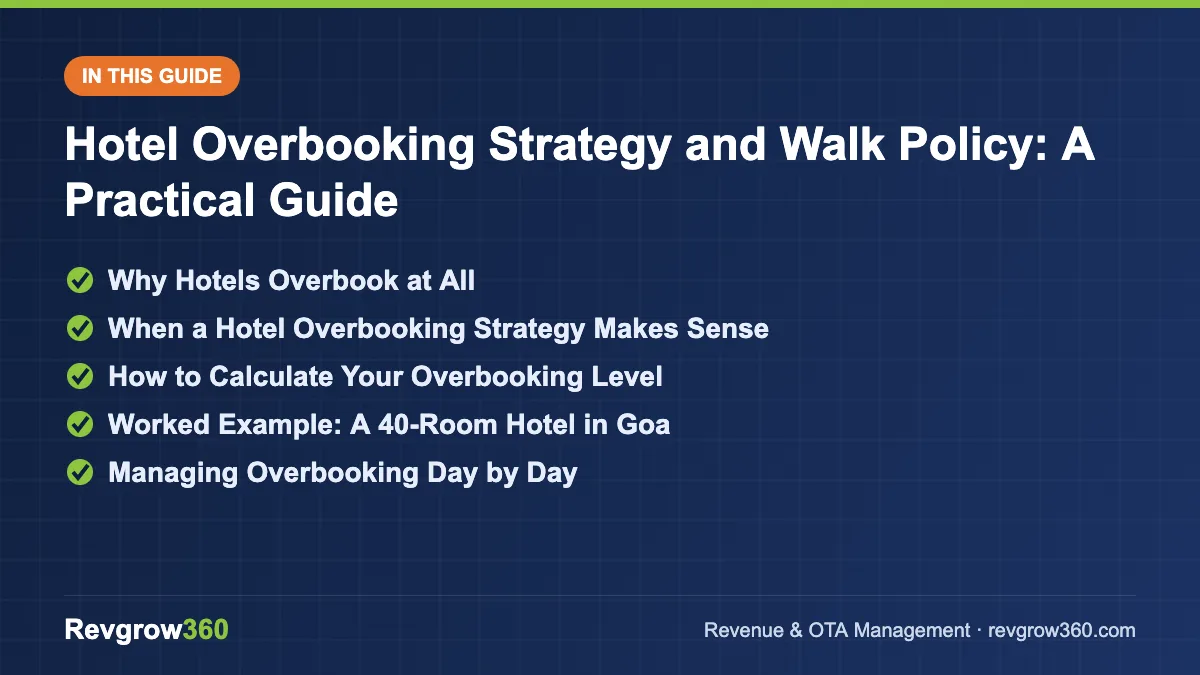
- Base it on your wash rate
- Keep levels modest, round down
- Have a walk policy ready
Why Hotels Overbook at All
Every hotel has a “sold out” night that ends with empty rooms. Guests cancel inside the free-cancellation window, flights are delayed, plans change and some bookings never show up. For a 40-room hotel, two or three empty rooms on a peak night at a peak rate is a meaningful loss that can never be recovered, because a room night is perishable.
Overbooking simply offsets that predictable loss. The aim is not to squeeze in extra guests; it is to finish the night as close to 100% occupancy as possible while keeping the risk of turning someone away very low.
The key terms you will use:
- No-show: a guest with a reservation who neither arrives nor cancels.
- Late cancellation: a cancellation received too late for you to resell the room.
- Wash: the total rooms that drop out between now and arrival (cancellations plus no-shows).
- Walk: relocating a confirmed guest to another hotel because you have no room for them.
Find how many extra rooms you can safely sell.
When a Hotel Overbooking Strategy Makes Sense
Overbooking is not for every hotel or every night. It works best when:
- The date has strong demand and you expect to sell out.
- A large share of bookings come with free cancellation, which is common on OTAs.
- You have reliable history on cancellations and no-shows for that type of date.
- There are comparable hotels nearby that you can relocate guests to if needed.
It makes much less sense when most bookings are prepaid and non-refundable, when you are in a remote location with no alternative accommodation, or on dates dominated by events such as weddings where guests are certain to arrive.
How to Calculate Your Overbooking Level
The starting point is your historical wash rate for similar dates. Pull at least six to twelve months of data from your PMS and calculate, for comparable nights, how many confirmed rooms did not materialise.
Wash rate (%) = (Late cancellations + No-shows) ÷ Rooms reserved on the morning of arrival × 100
Then:
Rooms to overbook = Capacity × Expected wash rate, rounded down
Rounding down, and often applying a further safety margin, keeps the risk of walking guests low. Most independent hotels that overbook keep the level modest, typically one to five percent of inventory, and only on high-demand nights.
Segment your wash rate
A single average hides useful detail. Calculate wash separately for:
- Channel: OTA free-cancellation bookings usually wash more than prepaid direct or corporate bookings.
- Lead time: bookings made months ahead tend to cancel more than those made a few days out.
- Day of week and season: business weekdays and leisure weekends behave differently.
- Rate type: non-refundable rates should have close to zero wash.
If your on-the-books mix for a date is heavy in high-wash bookings, you can justify a slightly higher overbooking level; if it is mostly prepaid, reduce it.
Worked Example: A 40-Room Hotel in Goa
A hypothetical 40-room hotel in Goa looks at the last twelve Saturdays in peak season. On average, on the morning of arrival it had 40 rooms reserved and finished with 37 occupied: 2 late cancellations and 1 no-show.
Wash rate: 3 ÷ 40 × 100 = 7.5%
Raw overbooking level: 40 × 7.5% = 3 rooms
The revenue manager applies a safety margin and decides to overbook by 2 rooms, not 3. The hotel accepts up to 42 reservations for peak Saturdays.
Now compare the outcomes. If the room rate is ₹8,000 and the cost of walking a guest (alternative room, transport, a goodwill gesture) is estimated at ₹12,000:
- Without overbooking, the hotel typically loses 3 room nights: ₹24,000 of unsold rooms.
- With 2 rooms overbooked, it usually recovers 2 of those room nights (₹16,000). On a night when everyone turns up, it walks 2 guests at a cost of ₹24,000 plus some goodwill risk.
If full turnout happens rarely, the strategy pays off over the season. If it happens often, the overbooking level is too high or the history no longer reflects current guest behaviour, and the hotel should reduce it.
| Booking mix on the date | Typical wash | Overbooking approach |
|---|---|---|
| Mostly OTA, free cancellation | Higher | Modest overbooking on peak nights, monitor daily |
| Mixed OTA and direct | Moderate | Small overbooking, reduce as arrival nears |
| Mostly prepaid / non-refundable | Low | Little or no overbooking |
| Groups, weddings, events | Very low | Avoid overbooking |
| Corporate with guaranteed bookings | Low to moderate | Small, only if history supports it |
Managing Overbooking Day by Day
Overbooking is not a one-time setting. It needs active management as arrival approaches.
- Set limits per date. Decide the overbooking level in your weekly revenue meeting and record it against each date in your forecast sheet.
- Control it through your channel manager. Most channel managers and PMS systems let you allow a small number of extra rooms to sell. Keep the setting visible and owned by one person.
- Review daily in the final week. Check cancellations, reconfirm late arrivals and look for duplicate bookings, which are a common hidden source of wash.
- Close extra inventory early if needed. If wash is lower than expected, stop selling the overbooked rooms rather than hoping for cancellations.
- Prepare the night before. If you are still oversold the evening before arrival, identify which reservation would be walked and line up a partner hotel in advance.
Accurate forecasting is the foundation of all of this. If you have not yet built one, our guide to demand forecasting and our hotel revenue management service explain how bookings and cancellations feed into rate and inventory decisions.
Writing a Hotel Walk Policy
Even a careful overbooking strategy will occasionally produce a night when every guest arrives. A written walk policy turns a stressful moment into a controlled, respectful process.
Who should be walked
Decide in advance which guests should never be walked and which are the most suitable. Typically:
- Avoid walking: guests staying multiple nights, repeat guests, guests booked direct, VIPs, guests with special needs, families with small children, and anyone on a long journey arriving late.
- Most suitable: single-night stays, guests arriving early enough to travel comfortably, and guests whose plans are flexible.
Walking a guest should be decided on fairness and guest impact, not on which booking channel pays the most commission.
What the hotel provides
A good walk policy should cover, at minimum:
- A room of the same or higher standard at a nearby partner hotel, paid by your hotel.
- Transport to the other hotel, and back the next day if the guest is returning.
- A sincere apology delivered in person by a senior staff member.
- A goodwill gesture, such as a complimentary meal or a discount on a future stay.
- Updating the guest’s booking channel so the reservation is not marked as a no-show.
Script for the front desk
Train staff to be honest, calm and quick. A simple approach: acknowledge the problem, apologise without blaming anyone, explain exactly what has been arranged, and confirm the details in writing. Never make a guest wait in the lobby while you search for a room; the partner hotel should already be confirmed.
Protecting Your Reputation and OTA Standing
Walking a guest affects more than one stay. Guests who are relocated without care often leave negative reviews, and OTAs generally treat relocations as a serious service issue. Each platform has its own rules for relocations, so read your partner terms carefully; for example, see the guidance in the Booking.com Partner Hub. Handle every walk professionally, respond to any review that follows, and keep an internal log of walks so you can see whether your overbooking levels are too aggressive. Our online reputation management team regularly helps hotels respond to difficult reviews constructively.
Reducing the Need to Overbook
The best overbooking strategy is one you need less often. Ways to reduce wash at the source include:
- Offering an attractive non-refundable or prepaid rate alongside flexible rates.
- Tightening cancellation deadlines on peak dates.
- Sending pre-arrival messages that ask guests to reconfirm or cancel.
- Taking deposits for direct bookings during high season.
- Cleaning up duplicate reservations promptly.
Overbooking Strategy Checklist
- Calculate wash rates by channel, lead time and day of week.
- Overbook only on high-demand nights with reliable history.
- Round down and keep a safety margin.
- Assign one owner for overbooking settings in the channel manager.
- Agree relocation arrangements with two or three nearby hotels.
- Write and train a walk policy before you need it.
- Log every walk and review overbooking levels monthly.
Key takeaways
- A hotel overbooking strategy offsets predictable late cancellations and no-shows on high-demand nights.
- Base your overbooking level on historical wash rates, segmented by channel, lead time and rate type.
- Keep levels modest, round down and manage them daily as arrival approaches.
- A clear walk policy with a partner hotel, transport and a sincere apology protects guests and reviews.
- Prepaid rates, firmer cancellation deadlines and reconfirmation reduce the need to overbook.
Revgrow360 helps independent hotels, resorts and homestays set inventory and cancellation strategies that protect peak-night revenue without risking guest goodwill, and has supported 500+ hotels so far. Book a free consultation to review your overbooking and cancellation approach with our team.
Frequently asked questions
Is overbooking legal for hotels?
Overbooking is a common industry practice, but rules on consumer protection and booking-platform terms vary by country and channel. Whatever the local position, a hotel that cannot honour a confirmed booking should relocate the guest to comparable accommodation at its own cost. Check your OTA partner agreements and local regulations before adopting an overbooking policy.
How do I calculate how many rooms to overbook?
Start with your wash rate for similar nights: late cancellations plus no-shows divided by rooms reserved on the morning of arrival. Multiply that rate by your room count and round down, then apply a safety margin. A 40-room hotel with a 7.5% wash rate might overbook by two rooms rather than three.
What does walking a guest mean?
Walking a guest means relocating a confirmed guest to another hotel because no room is available. A professional walk includes a comparable or better room paid for by your hotel, transport, a personal apology from a senior staff member and a goodwill gesture such as a meal or future-stay discount.
Which guests should not be walked?
Most hotels avoid walking multi-night guests, repeat and loyalty guests, direct bookers, VIPs, families with young children, guests with special needs and anyone arriving very late after long travel. Single-night guests who arrive early and have flexible plans are usually the least affected if relocation becomes unavoidable.
More Revenue Management guides
Revenue Management for Boutique Hotels: A Practical Guide
A practical guide to pricing and distribution for small, distinctive hotels, including room-type pricing, restrictions, channels and a weekly checklist.
Short Term Rental KPIs: 10 Metrics with Formulas
The 10 short term rental KPIs every host should track, each with a formula and a worked example, plus how to set…

Airbnb Income and Expense Tracking: A Simple System
Learn what to record for every booking and expense, how payouts differ from gross revenue, which categories to use and a monthly…
Revenue Management for Resorts: A Practical Guide
How resorts can manage rates, groups, packages and non-room revenue to maximise total income per guest, with a worked example and checklist.
Revenue Management for Homestays: A Practical Guide
A practical, step-by-step guide to pricing, channels and add-on income for small homestays, with a worked example and a 30-minute weekly routine.
Hotel Rate Parity: What It Is and How to Maintain It
Rate parity keeps your price consistent across OTAs, metasearch and your website. Learn what causes disparity and a practical daily routine to…