 By Md Arif Ahamed
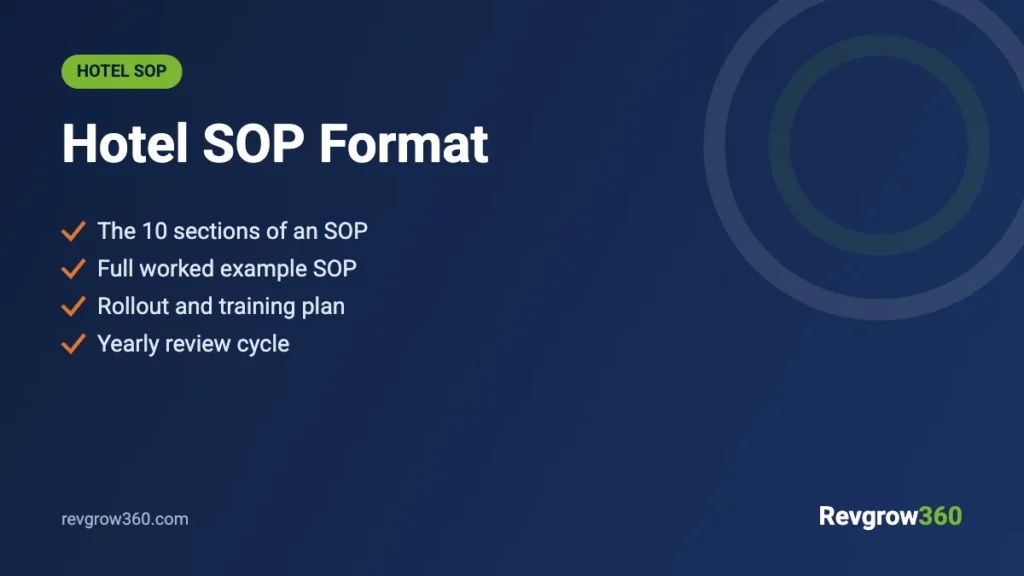
A good hotel SOP format uses the same ten sections for every procedure: purpose, scope, responsibility, frequency, steps, standards, do-nots, records, KPI, and version and approval. When every SOP follows one format, staff know where to find the answer, managers can audit it, and updates are easy. Below you will learn what each section should contain, see a full worked example, and get a simple plan to roll out, train and review your SOPs.
What is an SOP in a hotel?
An SOP (standard operating procedure) is a written instruction that explains how one task is done, by whom, to what standard, and how you check it was done. In a hotel, SOPs cover everything from guest check-in and room cleaning to cash handling and fire evacuation.
An SOP is not the same as a policy or a checklist:
| Document | Answers | Example |
|---|---|---|
| Policy | What we do and why (the rule) | “We verify the identity of every adult guest at check-in.” |
| SOP | How we do it, step by step, and to what standard | “SOP: Guest check-in” with steps, timings and records |
| Checklist | Did we do it? (tick list for daily use) | Front office opening checklist |
| Form or format | Where we record it | Guest registration card, handover log |
A strong SOP links to the policy above it and the checklists and forms below it. If you want to see how this looks in practice, browse the hotel SOP library.
Download 30 ready SOPs in Word or PDF.
Why the format matters
Many hotels have SOPs that nobody reads. The usual reasons are that each one looks different, the steps are vague (“greet the guest properly”), and nobody knows which version is current. A fixed format fixes all three:
- Findability. Staff always know that the steps are in section 5 and the do-nots are in section 7.
- Completeness. Empty sections show what is missing. You cannot forget the KPI if there is a box for it.
- Auditability. Standards and records make each SOP measurable, so supervisors can check it.
- Control. Version numbers and approval dates stop old copies from staying in use.
If your hotel follows a quality management system, the guidance standard ISO 10013:2021 (Quality management systems — Guidance for documented information) is a useful reference for how documented procedures can be structured and controlled. You do not need certification to borrow the ideas.
The 10 sections of a good hotel SOP format
Use these ten sections, in this order, for every SOP. Keep each SOP to one to three pages where possible. If it is longer, it is probably two SOPs.
1. Purpose
One or two sentences: why this procedure exists and what outcome it protects. Example: “To issue duplicate room keys quickly while making sure keys are only given to registered guests.”
2. Scope
Where and when the SOP applies, and what it does not cover. Name the department, the areas and any exceptions.
3. Responsibility
Who does the task, who supervises it, and who owns the SOP. Use job titles, not names, so the SOP stays correct when people change.
4. Frequency or trigger
When the procedure happens: every shift, daily, weekly, or when an event occurs (a guest request, an alarm, a complaint).
5. Steps
Numbered, one action per step, starting with a verb. Write in the order the task actually happens. Include the words to say to the guest where it matters.
6. Standards
The measurable quality level: time limits, accuracy, appearance, tone. “Within 3 minutes” is a standard. “Quickly” is not.
7. Do-nots
The common mistakes and the actions that are never allowed. This section prevents the most expensive errors, so keep it short and clear.
8. Records
What must be written down or entered in the system, where, and how long it is kept. Name the form or log.
9. KPI
How you measure whether the SOP is working. Choose one to three indicators and show the formula. For broader measures, see our guide to hotel KPIs.
10. Version and approval
SOP number, version, effective date, next review date, prepared by, approved by. This is how you control changes.
Full worked example: SOP for issuing a duplicate room key
The example below is fictional and generic. Adjust the steps to your property management system, your key system and local laws on guest identification and data protection.
SOP No.: FO-014 · Title: Issuing a duplicate room key · Department: Front Office · Version: 1.0
1. Purpose. To issue duplicate or replacement room keys quickly, while making sure keys are only given to guests registered to that room.
2. Scope. Applies to all front desk staff on all shifts, for in-house guests requesting an extra, lost or faulty key card. Does not cover master keys or staff keys (see SOP FO-015).
3. Responsibility. Front desk agent issues the key. Duty manager handles any case where identity cannot be confirmed. Front office manager owns and reviews this SOP.
4. Frequency or trigger. Every time a guest requests a key at the desk, by phone or through another department.
5. Steps.
- Greet the guest and ask how you can help.
- Ask the guest to tell you their name and room number. Do not say the room number aloud yourself.
- Open the reservation in the system and check the name matches a registered guest for that room.
- Ask for photo ID and compare it with the registration record.
- If the ID matches, ask whether the old key was lost. If lost, encode a new key that cancels previous keys, according to your key system.
- Encode the key and test it on the encoder if your system allows.
- Hand over the key in a key card folder without the room number written on it. Point to the number discreetly or write it inside the folder.
- Record the issue in the key log or system notes.
- If the ID does not match or the guest has no ID, politely explain the policy and call the duty manager.
- For phone requests, never send a key to a room by a runner without first confirming the guest’s identity with your property’s phone verification method.
6. Standards. Key issued within 3 minutes of the guest reaching the desk (when ID matches). Polite, discreet tone. Room number never spoken aloud in public areas. 100% of keys recorded.
7. Do-nots.
- Do not issue a key to anyone not registered to the room, including family members, without manager approval and the registered guest’s consent.
- Do not say the room number aloud.
- Do not write the room number on the outside of the key folder.
- Do not skip the ID check because the desk is busy.
8. Records. Key log entry (date, time, room, guest name, reason, agent initials) or system note. Kept for [period required by local law or hotel policy].
9. KPI. Key issue time (target: 95% within 3 minutes). Key security compliance rate = checks done correctly ÷ total checks audited × 100 (target: 100%). Measured by monthly mystery check or log audit.
10. Version and approval. Prepared by: [Front office manager]. Approved by: [General manager]. Effective: [Date]. Next review: [Date + 12 months].
You can build SOPs like this faster with the free hotel SOP generator, or start from a finished set. The Hotel SOP Master Kit includes 150 SOPs across 8 departments, already in this kind of structure, as PDF and editable Word files.
How to write an SOP for hotels: writing tips
- Write with the person who does the job. Watch the task, then write it. The best SOPs describe what really happens, then improve it.
- Start every step with a verb. “Check”, “Ask”, “Record”, “Call”.
- One action per step. If a step has “and” in it twice, split it.
- Use numbers. Times, quantities and temperatures make standards clear.
- Use simple words. Many hotel teams work in a second language. Short sentences help everyone.
- Link the forms. Name every form or log. Keep printable formats together, as in our hotel checklists and formats collection.
- Check local law. Guest registration, ID checks, data protection, fire safety and food safety rules differ by country and region. Make sure your SOPs match them.
How to roll out and train SOPs
A written SOP only helps when staff use it. Follow this rollout plan:
- Pick the first 10 SOPs. Start with high-risk and high-frequency tasks, such as guest check-in, check-out, cash handling, room cleaning and fire evacuation.
- Draft and test. Ask one experienced staff member to follow the draft exactly for a few shifts and note what is unclear.
- Approve and number. Give each SOP a code (FO for front office, HK for housekeeping, FB for food and beverage), version 1.0 and an effective date.
- Train in small groups. Explain the purpose, demonstrate the steps, then let each person practise while a trainer watches.
- Sign off. Each staff member signs a training record for each SOP they are trained on.
- Make it easy to find. Keep a controlled master copy (digital or a binder) in each department and remove old versions.
- Check in practice. Supervisors observe the task during the first weeks and give feedback on the spot.
- Measure. Track the KPI in section 9 and discuss the results in department briefings.
The SOP review cycle
SOPs go out of date when systems, prices, laws or layouts change. Set a review cycle:
| When | What to do |
|---|---|
| Every 12 months (at minimum) | Scheduled review of every SOP by its owner |
| After a new system or equipment | Update steps and screenshots before go-live |
| After an incident or repeated complaint | Review the SOP within days; check whether the steps or training failed |
| After a change in law or brand standards | Update and retrain the affected staff |
| When KPI results drop | Observe the task, find the cause, update the SOP or training |
Every change gets a new version number (1.0 to 1.1 for small edits, 2.0 for a major rewrite), a new effective date and new approval. Retrain staff on changed steps and record it.
FAQ
What is the best SOP format for a hotel?
A format that is the same for every department and covers ten sections: purpose, scope, responsibility, frequency, steps, standards, do-nots, records, KPI, and version and approval. Consistency matters more than design.
How long should a hotel SOP be?
Usually one to three pages. If an SOP is much longer, split it into separate procedures and link them.
How many SOPs does a hotel need?
It depends on size and services. A small hotel may start with 30–50 core SOPs. A full-service hotel with restaurants, events and a spa will need many more. Start with high-risk and high-frequency tasks.
Who should write hotel SOPs?
The department head should own each SOP, but write it together with the staff who do the task. The general manager or an assigned quality lead should approve it.
How often should SOPs be reviewed?
At least once a year, and also after any new system, incident, law change or drop in KPI results.
Conclusion
The right hotel SOP format is simple: ten fixed sections, clear numbered steps, measurable standards and strict version control. Write SOPs with the people who do the work, train them properly, measure the results and review them at least once a year. That is how SOPs move from a shelf into daily practice.
If you want the complete set of ready-to-use procedures for every department, see the Hotel SOP Master Kit.
More Hotel SOP guides
Front Office SOP List: 30 Essential Front Desk Procedures
A list of 30 essential front office SOPs grouped by stage of the guest journey, with a one-line purpose for each and…

SOP for VIP Arrival in Hotels (Step-by-Step)
A step-by-step SOP for VIP arrival covering flagging, room set-up, private check-in, timings, scripts and a department checklist.
SOP for Group Check-in in Hotels (Step-by-Step)
Learn how to check in tour groups, wedding parties and corporate teams smoothly with a step-by-step SOP, timings, scripts and a checklist.
SOP for Reservation Handling in Hotels (Step-by-Step)
A practical step-by-step SOP for reservation handling covering new bookings, changes, cancellations, timings, scripts and a daily checklist.
SOP for Walk-in Guest Handling in Hotels (Step-by-Step)
A step-by-step SOP for handling walk-in guests, with rate rules, ID and risk checks, scripts and a front desk checklist.
SOP for Guest Check-out in Hotels (Step-by-Step)
A step-by-step SOP for guest check-out covering billing, payment, deposits, feedback and a printable checklist for front desk teams.