 By Md Arif Ahamed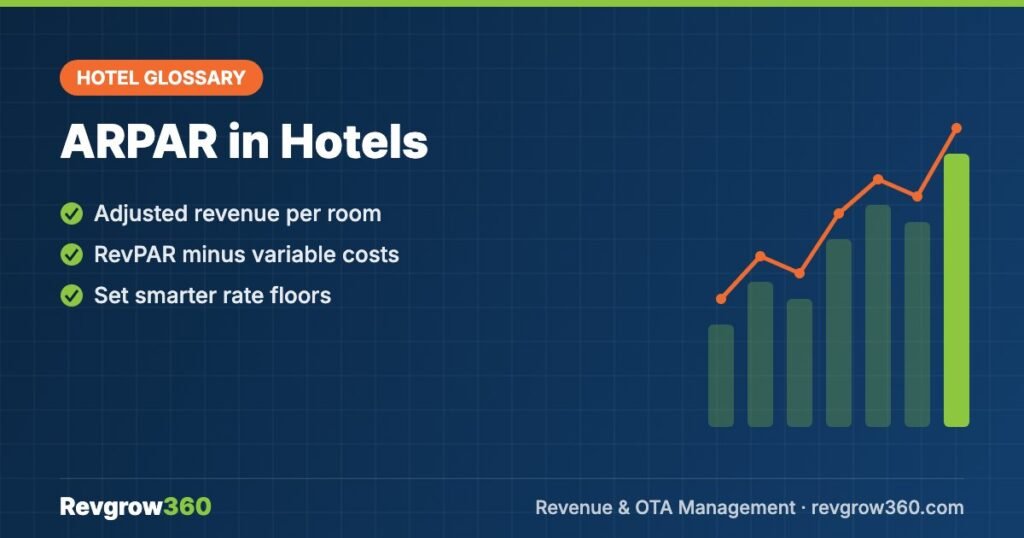
ARPAR in hotel revenue management usually means Adjusted Revenue per Available Room. It starts with RevPAR and then deducts the variable cost of selling and servicing each occupied room, such as commission, housekeeping supplies, laundry and breakfast. The result shows the contribution each available room makes, not just the revenue it earns.
- Adjusted revenue per room
- RevPAR minus variable costs
- Set smarter rate floors
A word of caution first: the abbreviation is not fully standardised. Some hotels use ARPAR for “Average Revenue per Available Room” and treat it like RevPAR. This guide uses the adjusted, contribution-based meaning because it is the one that adds real analytical value. Whichever version you choose, write down the definition and use it consistently.
What is ARPAR in hotel analysis?
RevPAR is easy to calculate, but it treats every rupee of room revenue as equal. A rupee earned from a heavily discounted, high-commission booking that needs a free breakfast and extra cleaning is worth much less than a rupee from a direct booking. ARPAR corrects for this by subtracting the variable costs that rise with every room sold.
Typical variable costs per occupied room include:
- OTA and agent commissions and payment fees
- Housekeeping labour tied to room turnover, linen and laundry
- Guest amenities, toiletries and consumables
- Complimentary breakfast or meal plan cost
- Utilities that rise with occupancy, where you can measure them
Fixed costs such as salaries of permanent staff, property tax and rent are left out, because they do not change when one more room is sold.
158 hotel terms explained in plain English.
ARPAR formula
ARPAR = (Rooms Revenue – Variable Costs of Rooms Sold) / Total Available Room-Nights
The same idea in per-room terms:
ARPAR = (ADR – Variable cost per occupied room) x Occupancy
This means ARPAR is the contribution per available room, and it is always lower than RevPAR.
ARPAR worked example
A hypothetical 40-room hotel in Goa has 1,200 available room-nights in a 30-day month and sells 780 of them (65% occupancy). All figures are illustrative.
| Item | Amount |
|---|---|
| Rooms revenue (excl. GST) | ₹26,00,000 |
| ADR (26,00,000 / 780) | ₹3,333 |
| RevPAR (26,00,000 / 1,200) | ₹2,167 |
| Commissions and payment fees | ₹3,90,000 |
| Housekeeping, laundry, amenities (₹300 per occupied room) | ₹2,34,000 |
| Complimentary breakfast (₹150 per occupied room) | ₹1,17,000 |
| Total variable cost | ₹7,41,000 |
| Contribution (26,00,000 – 7,41,000) | ₹18,59,000 |
ARPAR = ₹18,59,000 / 1,200 = about ₹1,549, against a RevPAR of about ₹2,167. About 29% of room revenue is absorbed by the cost of selling and servicing rooms.
ARPAR vs RevPAR vs NRevPAR
| Metric | What is deducted | Best question it answers |
|---|---|---|
| RevPAR | Nothing | How strongly did rooms sell? |
| NRevPAR | Distribution costs only | Which channels leave us the most revenue? |
| ARPAR (adjusted) | All variable costs of a sold room | What does each available room contribute? |
| GOPPAR | All operating costs | What operating profit does each room earn? |
You can read about the base metric in what is RevPAR and see how it fits other measures in hotel KPIs.
Why ARPAR matters for pricing and revenue
Revenue managers often face this question: should we accept a low-rate booking to fill a room? RevPAR says yes if the rate is above zero. ARPAR asks whether the rate covers the variable cost of that room. If a booking pays ₹1,800 and costs ₹1,100 in commission, breakfast and cleaning, the contribution is only ₹700.
That information helps you:
- Set a sensible floor rate for each room type and channel.
- Decide whether to include breakfast in discounted offers.
- Judge when a deeply discounted room-night is still worth selling to cover fixed costs, and when it is not.
- Compare segments by contribution instead of by revenue.
It fits naturally with dynamic pricing, where you change rates by demand and need a clear lower limit.
How to calculate your own ARPAR
- List the costs that rise when a room is sold. Ignore costs that stay the same.
- Estimate each cost per occupied room, using last quarter’s records.
- Add the commission and fees for each channel.
- Subtract the total variable cost from rooms revenue for the month.
- Divide by available room-nights.
- Review the number monthly and update your cost estimates twice a year.
Precision is less important than consistency. A reasonable estimate used the same way every month still shows the trend.
How to improve ARPAR
Lower variable cost per room
Review linen and laundry, amenity quality and breakfast cost. Switch complimentary breakfast to a paid add-on where guests accept it.
Shift channel mix
Move volume to direct and corporate bookings. See how to increase direct bookings.
Raise rate on high-demand dates
Every extra rupee of rate on a date you would sell anyway flows almost fully into contribution, because the variable cost does not change.
Common ARPAR mistakes
- Adding fixed costs. Permanent salaries and rent do not belong in variable cost.
- Using a single average cost for every booking. Costs differ by channel and rate plan.
- Mixing definitions. Do not compare your adjusted figure with someone else’s “average revenue” ARPAR.
- Never updating estimates. Laundry, food and commission rates change.
- Using it as the only KPI. Read it with occupancy, ADR and GOPPAR.
Related terms
RevPAR, NRevPAR, GOPPAR, ADR (average daily rate), contribution margin, cost per occupied room and flow-through.
A quick rate-floor example
Using the 40-room example above, variable cost per occupied room is about ₹950: ₹500 for commission and fees (averaged), ₹300 for housekeeping and amenities, and ₹150 for breakfast. A last-minute booking at ₹1,500 from a channel with a 15% commission costs ₹225 in commission, ₹300 in housekeeping and ₹150 for breakfast, leaving a contribution of about ₹825.
That room would otherwise earn nothing, so on a very quiet night it may still be worth selling. But if the same room could be sold at ₹3,000 on a busy date, accepting ₹1,500 for it would waste ₹1,500 of revenue. ARPAR thinking gives you the lowest acceptable rate for quiet dates and a clear reason to hold the line on busy ones.
Key takeaways
- ARPAR (adjusted) = rooms revenue minus variable cost of rooms sold, divided by available room-nights.
- It shows contribution per available room and is always below RevPAR.
- Leave out fixed costs and be consistent with the definition you adopt.
- Use it to set rate floors and judge discounted or high-commission bookings.
Revgrow360 helps hotels turn these numbers into decisions on rates, channels and offers. Learn more about our hotel revenue management service or ask for a free hotel audit.
Frequently asked questions
What does ARPAR stand for in hotels?
In revenue management ARPAR usually means Adjusted Revenue per Available Room, which is RevPAR after deducting the variable costs of rooms sold. Some hotels use it for Average Revenue per Available Room, so always confirm which definition a report uses.
How is ARPAR different from NRevPAR?
NRevPAR deducts only distribution costs such as commissions and payment fees. Adjusted ARPAR deducts all variable costs tied to a sold room, including housekeeping, laundry, amenities and complimentary meals, so it shows a fuller contribution per available room.
Which costs should be included in ARPAR?
Include costs that rise when a room is sold: commissions, payment fees, laundry, consumables, complimentary breakfast and occupancy-driven utilities. Exclude fixed costs such as permanent salaries, rent, property tax, insurance and depreciation.
Why is ARPAR useful for setting minimum room rates?
A minimum rate should at least cover the variable cost of selling the room. ARPAR thinking makes you calculate that cost by channel and rate plan, so you avoid accepting bookings that fill rooms but leave almost nothing after costs.
More Hotel Glossary guides
What is NRevPAR in Hotels? Meaning, Examples & Formula
NRevPAR shows room revenue per available room after distribution costs. See the formula, an example and ways to improve it.
What is RevPAG in Hotels? Meaning, Examples & Formula
RevPAG measures hotel revenue per guest rather than per room. See the formula, an example and ways to improve it.
What is TRevPAR in Hotels? Meaning, Examples & Formula
TRevPAR measures all hotel revenue per available room, not just rooms. See the formula, an example and how to improve it.
What is GOPPAR in Hotels? Meaning, Examples & Formula
GOPPAR shows how much operating profit a hotel keeps per available room. Learn the formula, a worked example and how to improve…