 By Md Arif Ahamed
A complete front office SOP set covers every stage of the guest journey at the desk: arrival, stay, departure, cash, night shift and emergencies. Below is a list of 30 essential front desk SOPs, grouped by stage, with a one-line purpose for each and links to our detailed guides where they exist. Use it as a gap check: tick the SOPs you already have, and plan the rest.
What a front office SOP should contain
Each front office SOP should follow the same structure, so staff can find information fast. A practical format has ten sections: purpose, scope, responsibility, frequency or trigger, steps, standards, do-nots, records, KPI, and version and approval. Steps should be numbered, start with a verb and include measurable standards such as “answer the phone within three rings”.
The list below gives you the hotel front office procedures to write. Not every property needs all 30 on day one. A small hotel or guest house can merge some of them; a large hotel may split them further.
Download 30 ready SOPs in Word or PDF.
How to use this front desk SOP list
- Audit what you have. Go through the 30 SOPs below and mark each one as “written and current”, “written but outdated” or “missing”.
- Prioritise by risk and frequency. Check-in, check-out, cash handling, night audit and fire evacuation come first.
- Write in batches. Five SOPs a week is realistic for most front office managers alongside daily work.
- Train and sign off. Train each SOP, observe it in practice and record who is trained.
- Review yearly. Update after any system change, incident or new legal requirement.
Arrival SOPs (1–8)
Arrival is where first impressions and most errors happen: wrong rates, wrong rooms, missing ID, unclear deposits. These eight SOPs protect the start of every stay.
| # | SOP | Purpose |
|---|---|---|
| 1 | Reservation handling | Take, confirm, amend and cancel bookings accurately across phone, email, website and OTAs. |
| 2 | Pre-arrival checks and arrivals list | Review tomorrow’s arrivals for special requests, VIPs, payment status and room readiness. |
| 3 | Room allocation and blocking | Assign the right room type and features before arrival and avoid double allocation. |
| 4 | Guest check-in | Register guests, verify ID, confirm rate and departure date, and issue keys within a set time. |
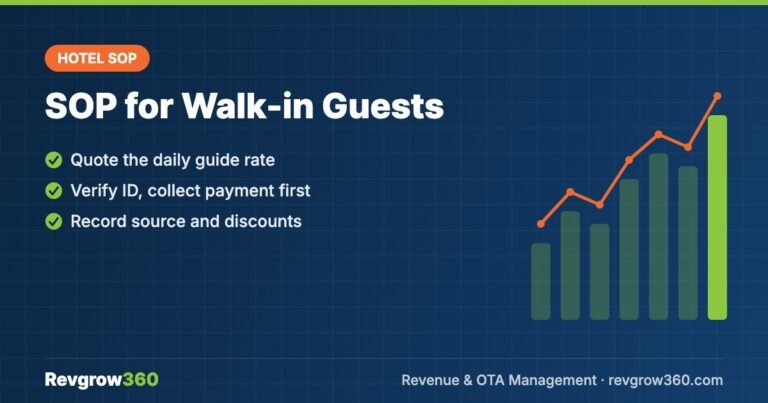
| 5 | Walk-in guest handling | Sell available rooms to guests without a booking, at the right rate, with payment secured. |
| 6 | Group check-in | Check in groups fast with pre-assigned rooms, pre-printed keys and one group leader contact. |
| 7 | VIP arrival | Deliver a personalised, pre-planned arrival for VIP and repeat guests. |
| 8 | Early arrival and early check-in | Handle guests who arrive before check-in time fairly, with clear rules on charges and luggage storage. |
Detailed guides for this stage:
- SOP for reservation handling in hotels
- SOP for guest check-in in hotels
- SOP for walk-in guest handling in hotels
- SOP for group check-in in hotels
- SOP for VIP arrival in hotels
Stay SOPs (9–15)
During the stay, the front desk is the guest’s main contact. These SOPs keep service consistent and protect guest privacy and security.
| # | SOP | Purpose |
|---|---|---|
| 9 | Room change | Move a guest to another room with correct system, key, billing and housekeeping updates. |
| 10 | Key card issue and duplicate keys | Issue keys only to registered guests after identity checks, and record every key issued. |
| 11 | Guest messages and wake-up calls | Record, deliver and confirm messages and wake-up calls on time, every time. |
| 12 | Guest complaint handling | Listen, apologise, solve and follow up, with clear limits on who can offer what compensation. |
| 13 | Lost and found | Log, store, return or dispose of found items with a full record trail. |
| 14 | Extension of stay | Check availability and rate, update the reservation and payment, and inform housekeeping. |
| 15 | Guest privacy and room number confidentiality | Never share guest names, room numbers or details with callers or visitors without consent. |
Complaint handling depends on skills as much as steps. For SOP 12, train staff on listening, calm language and clear limits of authority, and role-play common complaints such as noise, cleanliness and billing errors.
Departure SOPs (16–20)
A smooth departure protects revenue (no unpaid charges) and reviews (the last impression is often what guests write about).
| # | SOP | Purpose |
|---|---|---|
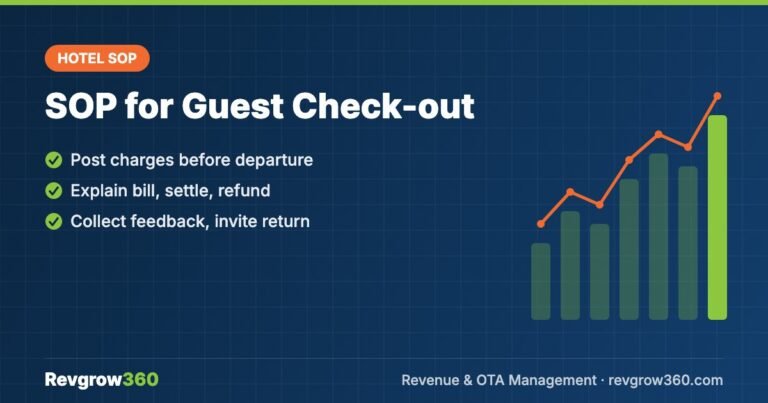
| 16 | Guest check-out | Settle the bill accurately, collect keys, ask for feedback and update the room status. |
| 17 | Late check-out requests | Approve, charge or decline late check-outs based on occupancy and housekeeping capacity. |
| 18 | Express and group check-out | Pre-prepare bills so groups and early departures leave without queues. |
| 19 | Luggage storage | Store guest luggage safely with tagged receipts and a controlled storage room. |
| 20 | Guest feedback and review request | Ask for feedback at departure and invite satisfied guests to leave a review. |
Detailed guide: SOP for guest check-out in hotels.
Cash and payment SOPs (21–25)
Cash and card handling is where weak procedures cost real money. These SOPs should be strict and audited.
| # | SOP | Purpose |
|---|---|---|
| 21 | Shift opening | Count the float, read the handover log, check arrivals and confirm systems work before the shift starts. |
| 22 | Advance deposits and pre-authorisation | Secure payment at booking or check-in according to your policy and record it correctly. |
| 23 | Cash handling, float and foreign exchange | Accept, count, record and secure cash; apply approved exchange rates if you offer currency exchange. |
| 24 | Card payments and card data security | Process cards safely and never store card security codes or full card numbers on paper. |
| 25 | Shift closing and cash handover | Balance cash and card totals, write the handover, and hand over the float with two signatures. |
For SOP 24, base your rules on the card industry standard. The PCI Security Standards Council’s PCI data storage do’s and don’ts states that the card verification code must never be stored after authorisation and that card numbers should be masked when displayed. Ask your payment provider which requirements apply to your property.
Detailed guides: front office opening checklist (SOP 21) and front office closing checklist (SOP 25).
Night shift SOPs (26–28)
The night team often works alone, so the night shift needs the clearest procedures of all.
| # | SOP | Purpose |
|---|---|---|
| 26 | Night audit | Post room charges, check all transactions, balance the day and run end-of-day reports. |
| 27 | Late arrivals and no-shows | Hold guaranteed rooms, check in late guests safely, and apply the no-show policy correctly. |
| 28 | Night security rounds and lobby control | Control building access, patrol at set times and record anything unusual. |
Emergency SOPs (29–30)
The front desk is usually the control point in an emergency. These two SOPs are the minimum; many hotels add power failure, system outage and bomb threat procedures.
| # | SOP | Purpose |
|---|---|---|
| 29 | Fire alarm and evacuation | Respond to alarms, call emergency services, print the in-house list and guide guests to the assembly point. |
| 30 | Medical emergency | Call for help fast, give first aid only if trained, guide responders and record the incident. |
Fire and life safety rules differ by country and city. Write these SOPs with your local fire authority’s requirements and your building’s fire plan, and practise them with drills.
Example: one SOP from the list, in short form
To show how a list item becomes an SOP, here is a short, fictional version of SOP 15.
SOP FO-015: Guest privacy and room number confidentiality
Purpose: To protect guests’ safety and privacy.
Steps: 1. When a caller asks for a guest, ask for the guest’s full name. 2. If the guest is in-house, say “Let me connect you” and transfer the call without saying the room number. 3. If the guest has asked for no calls, say “I’m sorry, I’m unable to connect you. May I take a message?” 4. For visitors, call the guest’s room first and ask permission before giving any directions. 5. Record messages in the message log.
Do-nots: Never confirm whether a guest is staying with you if they have requested privacy. Never say room numbers aloud.
KPI: 100% compliance in monthly mystery calls.
If you would rather start with finished procedures than write all 30 yourself, the Hotel SOP Master Kit includes front office SOPs alongside seven other departments, in PDF and editable Word.
Common gaps in front office SOPs
- No standards. Steps without time limits or quality levels cannot be audited.
- No do-nots. Most costly front desk errors (giving out room numbers, skipping ID checks, writing down card details) are “never do” rules. Write them down.
- Night shift forgotten. Many hotels write day procedures and assume the night auditor knows the rest.
- No local law check. Guest registration, ID copies, police or foreigner reporting, and data protection rules vary widely. In some countries, foreign guest reporting is mandatory within set times. Check what applies to you.
- Old versions in use. Number and date every SOP, and remove old copies from the desk.
FAQ
How many SOPs does a front office need?
Most hotels need about 25–40 front office SOPs, depending on size and services. The 30 in this list cover the core stages: arrival, stay, departure, cash, night and emergencies.
Which front office SOPs should I write first?
Start with the highest-risk and highest-frequency tasks: check-in, check-out, cash handling and shift closing, night audit, and fire evacuation.
Who is responsible for front office SOPs?
The front office manager usually owns them, writes or approves them with the team, and trains staff. The general manager approves the final versions.
What is the difference between a front office SOP and a checklist?
An SOP explains how to do a task step by step and to what standard. A checklist is a short tick list used daily to confirm the steps were done, such as the opening and closing checklists linked above.
How often should front office SOPs be updated?
Review them at least once a year, and straight away after a new system, a change in law, a serious incident or repeated complaints.
Conclusion
Thirty well-written front office SOPs cover almost everything that happens at the desk, from the first reservation to the fire alarm. Use this list to find your gaps, write the high-risk procedures first, train every person and review the set every year. Clear front office procedures make your service consistent, protect revenue and keep guests safe.
If you want the complete set of ready-made front office SOPs plus 7 other departments, see the Hotel SOP Master Kit.
More Hotel SOP guides
Hotel SOP Format: 10 Sections Every SOP Needs (With Example)
The 10 sections of a good hotel SOP, a full worked example you can copy, and a simple plan to roll out,…

SOP for VIP Arrival in Hotels (Step-by-Step)
A step-by-step SOP for VIP arrival covering flagging, room set-up, private check-in, timings, scripts and a department checklist.
SOP for Group Check-in in Hotels (Step-by-Step)
Learn how to check in tour groups, wedding parties and corporate teams smoothly with a step-by-step SOP, timings, scripts and a checklist.
SOP for Reservation Handling in Hotels (Step-by-Step)
A practical step-by-step SOP for reservation handling covering new bookings, changes, cancellations, timings, scripts and a daily checklist.
SOP for Walk-in Guest Handling in Hotels (Step-by-Step)
A step-by-step SOP for handling walk-in guests, with rate rules, ID and risk checks, scripts and a front desk checklist.
SOP for Guest Check-out in Hotels (Step-by-Step)
A step-by-step SOP for guest check-out covering billing, payment, deposits, feedback and a printable checklist for front desk teams.