 By Md Arif Ahamed
Quick summary: Guest service excellence for hotels: standards, training method, scripts, role-plays and measures to raise reviews, repeat stays and revenue.
Guest service excellence means consistently meeting and exceeding what guests expect, at every touchpoint from booking to check-out and after the stay. It is built from clear standards, trained people, fast problem-solving and small personal touches, not from occasional grand gestures. This guide shows how to train a team for guest service excellence, with objectives, methods, scripts, role-plays and ways to measure results.
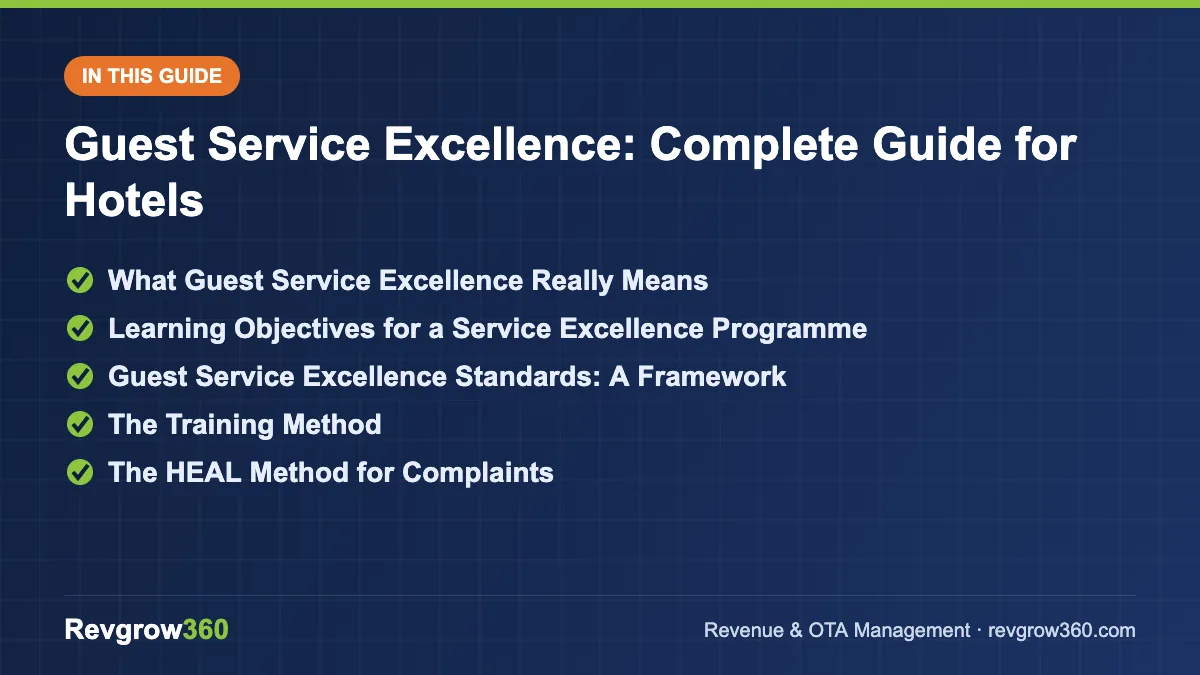
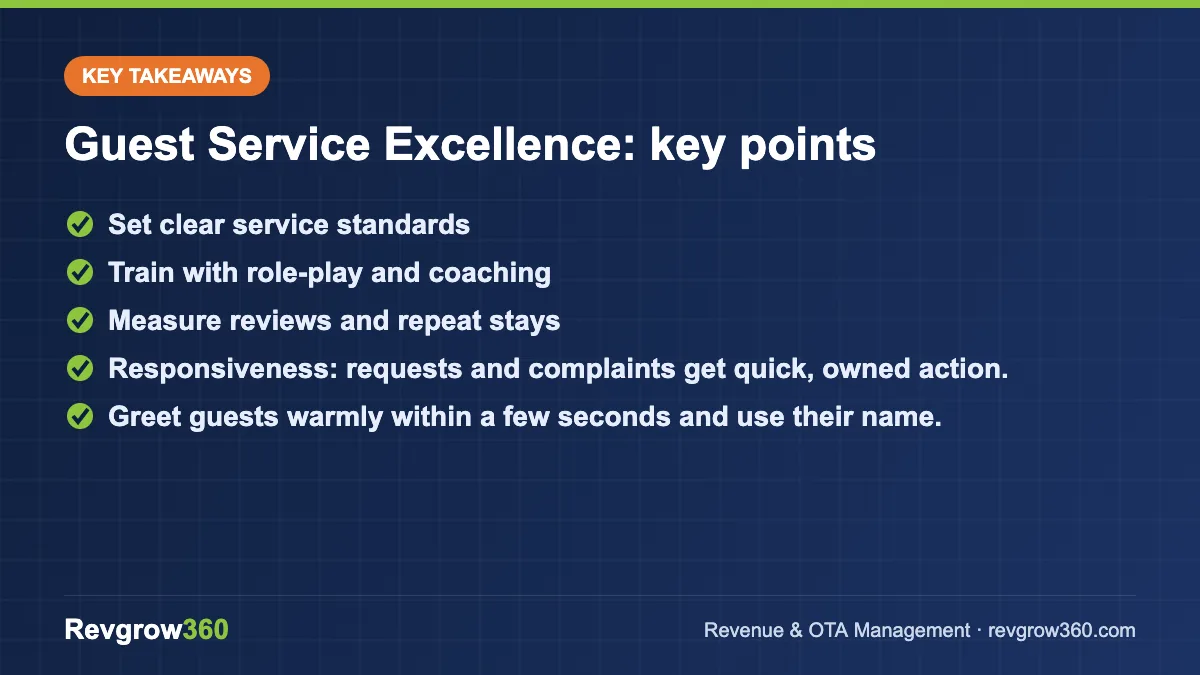
- Set clear service standards
- Train with role-play and coaching
- Measure reviews and repeat stays
What Guest Service Excellence Really Means
Service excellence is not luxury. A budget hotel in Siliguri can deliver it as well as a five-star in Mumbai. It means the guest feels welcomed, understood and cared for, and that promises made are kept.
Three ideas sit underneath it:
- Reliability: the basics are right every time: clean room, working Wi-Fi, hot water, on-time breakfast.
- Responsiveness: requests and complaints get quick, owned action.
- Personal care: staff notice the guest as an individual, using their name and remembering preferences.
Excellent service drives reviews, repeat stays and referrals, which lift occupancy and rates. See how this connects with hotel online reputation management and with performance measures in our guide to hotel KPIs.
Monthly training calendar.
Learning Objectives for a Service Excellence Programme
After training, each team member should be able to:
- Greet guests warmly within a few seconds and use their name.
- Listen actively and confirm what the guest needs.
- Handle a complaint using a clear recovery method.
- Anticipate needs and offer help before being asked.
- Communicate clearly when something cannot be done and offer alternatives.
- Work with other departments to finish a request without passing the guest around.
- Know the service standards and timings for their role.
Revenue Health Score · free
Free tool: check your hotel’s revenue health
Answer a few quick questions about your rooms, rates, OTAs and reviews. Get a score out of 100, your weakest revenue areas and the first actions to fix them.
Guest Service Excellence Standards: A Framework
Start by writing simple, measurable standards for each touchpoint.
| Touchpoint | Sample standard |
|---|---|
| Arrival | Guest greeted within 30 seconds, luggage assistance offered, welcome drink where applicable |
| Check-in | Completed within about 5 minutes when room is ready, with clear explanation of facilities |
| Room | Clean, working, and prepared per checklist before arrival |
| Requests | Acknowledge immediately; deliver within agreed time; call back if delayed |
| Restaurant | Seated and menu offered within a minute; orders served within the stated time |
| Complaints | Acknowledge, apologise, act and follow up on the same day |
| Check-out | Bill accurate, completed within a few minutes, farewell by name, feedback requested |
Adjust the numbers to your property and test whether the team can meet them in busy periods.
The Training Method
- Set the why. Show real guest comments, positive and negative, so staff see the impact.
- Teach the standards. Explain what is expected at each touchpoint, and why.
- Demonstrate. A senior team member performs the behaviour, such as a greeting or a complaint response.
- Role-play. Staff practise in pairs with a coach who gives feedback.
- Coach on the job. Supervisors watch real interactions and give feedback on the spot.
- Recognise. Praise good examples publicly; share guest compliments in briefings.
- Refresh. Repeat short sessions monthly and retrain new joiners.
The HEAL Method for Complaints
A simple structure helps staff stay calm. Use four steps:
- Hear: let the guest finish without interrupting.
- Empathise: acknowledge the feeling and apologise sincerely.
- Act: offer a solution you can deliver, with a time.
- Look back: follow up to check the guest is satisfied, and record the issue.
Sample scripts
Greeting: “Good evening, Mr. Banerjee, welcome back to our hotel. May I help you with your bags?”
Complaint, AC not cooling: “I am very sorry about the room temperature, ma’am. I will send an engineer right now, and if it is not fixed within 15 minutes, I will move you to another room with help for your luggage. May I call you in ten minutes to confirm?”
Saying no with an alternative: “I am sorry, we cannot arrange a 6 am breakfast in the restaurant, but I can have a packed breakfast and hot tea ready at 5:45 am. Would that help?”
Role-Play Exercises
- The late arrival: a guest arrives at 1 am and the booked room is not ready. Practise the apology, the options and the follow-up.
- The noisy neighbour: a guest complains about noise from the next room. Practise tone, action and timing.
- The billing dispute: a guest disagrees with a restaurant charge. Practise checking facts and resolving politely.
- The special occasion: a guest mentions an anniversary. Practise how to turn the remark into a small gesture.
After each, ask the group what worked, what to change and which phrase to avoid, such as “That is not my department”.
Empowerment and Service Recovery
Staff cannot deliver excellence if they must ask a manager for every small gesture. Give front-line employees limited authority, for example the ability to offer a complimentary dessert, tea, late check-out up to an hour when available, or a room change, within a set value. Record each use, review monthly and adjust.
Service recovery works when it is fast. A quick apology and fix often leaves a guest more loyal than if nothing had gone wrong.
Linking Service to Revenue
Better service supports higher guest scores, more repeat stays and lower discounting. It also helps upsell: guests who trust staff are more likely to accept a room upgrade or dinner package. Read our guide to hotel upselling and ancillary revenue to turn goodwill into income, and see how service feeds visibility in improving hotel ranking on OTAs.
How to Measure Guest Service Excellence
| Measure | Method |
|---|---|
| Guest review score and sentiment | OTA and Google reviews, tracked monthly |
| Net promoter or satisfaction score | Short post-stay survey |
| Complaint resolution time | Log time from complaint to closure |
| Repeat guest percentage | PMS guest history |
| Mystery guest score | Internal or external service audit |
| Training completion and role-play scores | HR or training records |
Common Mistakes
- Training only front-desk staff and forgetting housekeeping, restaurant, security and engineering.
- Using scripts that sound robotic. Teach intent, not word-for-word memorisation.
- Blaming staff without fixing broken processes, such as slow room cleaning.
- No recognition for good service, so effort fades.
- Collecting feedback but never acting on it.
- Leaving managers out of training so they cannot coach.
Building a Service Culture, Not Just a Programme
Training sessions fade within weeks unless managers live the standards. Culture is built by what leaders notice, praise and correct every day.
- Open every shift with a two-minute briefing that includes one service focus.
- Share one guest compliment and one complaint, with what was learned, each week.
- Let managers walk the floor and greet guests instead of staying in offices.
- Reward behaviours, such as solving a problem without escalation, not just good scores.
- Involve staff in fixing process problems, since they see them first.
Example: A 40-Room Hotel in Goa
A manager notices that reviews often mention slow breakfast and unclear check-in. The team writes three standards: greet within 30 seconds, offer a welcome drink and explain breakfast timing at check-in, and refresh the buffet every 20 minutes during peak. Over two months, the supervisor watches ten check-ins a week and gives feedback. Review comments about breakfast and welcome are tracked monthly. No result is guaranteed, but a visible standard and weekly coaching give the team something clear to improve.
Handling Guests From Different Backgrounds
Hotels host foreign tourists, corporate travellers, large families and elderly guests, each with different expectations. Teach staff to ask rather than assume, to speak slowly and clearly, to respect dietary and cultural needs and to use simple language. Learn key phrases in common guest languages and keep translated information cards at the front desk.
Daily Service Habits Worth Building
Excellence is mostly small habits repeated: smile and eye contact, use the guest’s name, walk guests to a location instead of pointing, close every request with “Is there anything else I can help with?” and never leave a guest waiting without an update.
Key Takeaways
- Service excellence is consistent basics plus quick response and personal care.
- Write measurable standards for each touchpoint.
- Train with demonstration, role-play and on-the-job coaching.
- Empower staff with limited authority for service recovery.
- Measure through reviews, surveys, resolution time and repeat guests.
Revgrow360 helps hotels turn better guest experience into stronger ratings and revenue. Explore our online reputation management service or book a free consultation.
For more background, see this customer service overview on Wikipedia.
Frequently asked questions
What is guest service excellence in a hotel?
It is consistently meeting and exceeding guest expectations at every touchpoint through reliable basics, quick responses, personal care and effective problem-solving. It depends on clear standards, trained and empowered staff, and regular measurement of guest feedback.
How do you train hotel staff in guest service?
Share the purpose, teach written standards, demonstrate behaviours, run role-plays, coach staff on the job and recognise good examples. Repeat short refreshers monthly and include every department, not only the front desk.
How should staff handle an angry guest?
Listen without interrupting, empathise and apologise sincerely, offer a solution they can deliver with a time frame, then follow up. Record the issue so managers can fix the cause. Avoid arguing, blaming others or making promises the hotel cannot keep.
How do you measure service excellence?
Track review scores and sentiment, post-stay survey results, complaint resolution time, repeat guest rate and mystery guest audits. Combine these with training completion and role-play scores to see whether improvements come from changes in staff behaviour.
More Hotel Training guides
Food Safety Training for Hotel Staff: Complete Guide
A practical guide to food safety training for hotel staff, with modules, role-play scripts, a schedule and ways to measure results.
Hotel Housekeeping Training: Complete Guide
A full hotel housekeeping training plan with objectives, a four-week schedule, cleaning sequence, role-plays and measurement methods.
Grooming Standards for Hotel Staff: Complete Guide
Clear grooming standards for hotel staff with department-wise rules, a daily checklist, a training method and measures of success.
Telephone Skills for Hotel Staff: Complete Guide
A practical training guide on telephone skills for hotel staff, with greetings, scripts, a six-step call routine, role-plays and performance measures.
Upselling at Front Desk: Complete Guide
A practical training guide for upselling at front desk, with objectives, a five-step method, scripts, role-plays and ways to measure results.
Handling Angry Guests: Complete Guide
A practical hotel training guide to handling angry guests with a five-step method, scripts, role-plays and service recovery limits.
Related guide: Front Desk Communication Skills: Complete Guide