 By Md Arif Ahamed
Quick summary: Learn how to improve hotel ranking on OTAs like Booking.com, MakeMyTrip and Agoda: key ranking factors, content and pricing fixes, and a 90-day action plan.
Most guests never scroll past the first page of search results on an OTA. If your property sits on page four for your city, it hardly matters how good your rooms are. The good news is that OTA ranking is not random. Booking.com, MakeMyTrip, Goibibo, Agoda and Expedia all use algorithms that reward a similar set of signals: conversion, price competitiveness, content quality, reviews, availability and commercial participation. This guide explains how to improve hotel ranking on OTAs, what each ranking factor means in practice, and a step-by-step plan you can follow over the next 90 days.
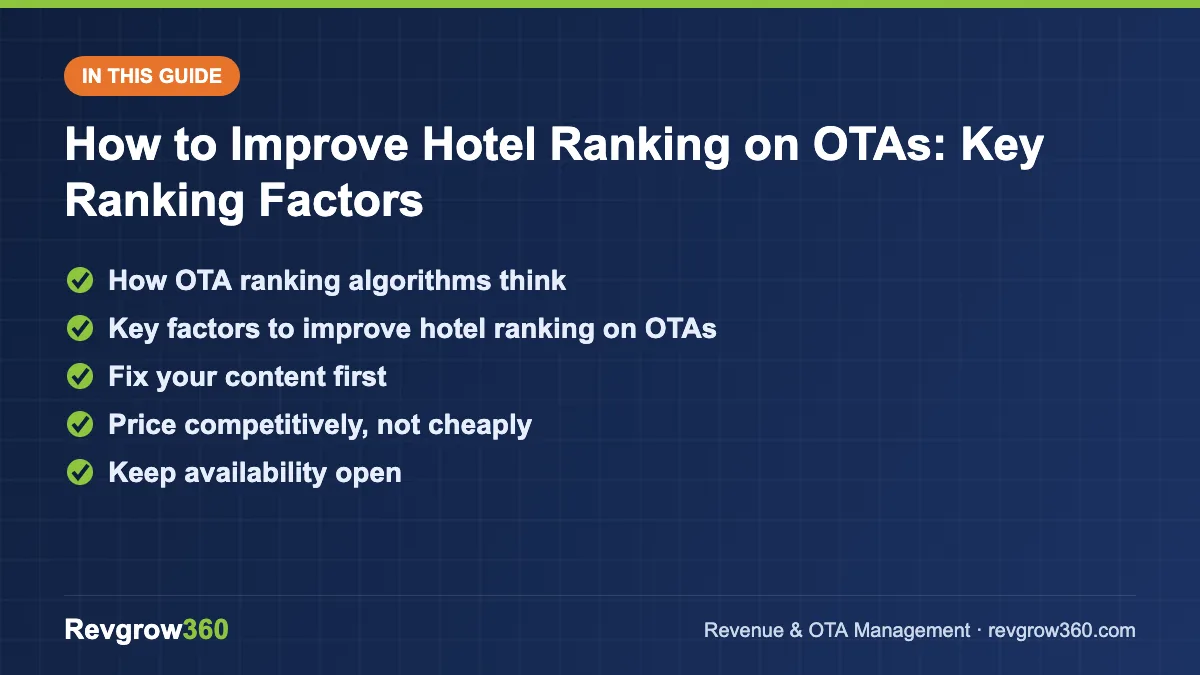
- Key OTA ranking factors
- Content, price and review fixes
- A 90-day action plan
How OTA ranking algorithms think
OTAs earn money only when a guest books and stays. Their algorithms therefore try to show the properties most likely to be booked by that particular searcher, and to generate revenue for the platform. Exact formulas are not public and change regularly, but the logic is consistent: the more likely you are to convert a search into a completed stay, the higher you tend to appear.
A useful way to think about it is a simple funnel:
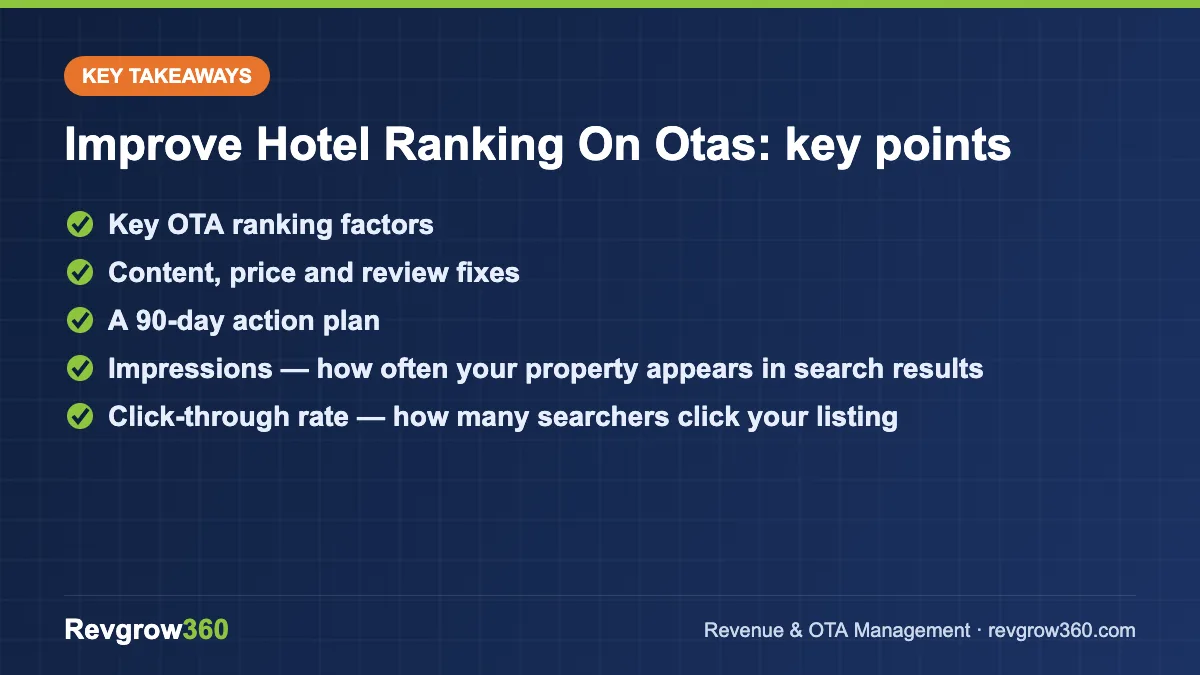
- Impressions — how often your property appears in search results
- Click-through rate — how many searchers click your listing
- Conversion — how many visitors to your listing book
- Completed stays — how many bookings are not cancelled
Improving any stage feeds the algorithm positive signals, which brings more impressions, and the cycle repeats.
Score your OTA listing and get the top fixes.
Key factors to improve hotel ranking on OTAs
| Ranking factor | What the OTA sees | What you can do |
|---|---|---|
| Conversion rate | Bookings ÷ listing views | Better photos, clear rooms, competitive price, flexible options |
| Price competitiveness | Your price vs competitors and other channels | Maintain parity; price in line with value |
| Availability | Open dates and room types | Keep 12 months open; avoid frequent stop-sells |
| Content score | Completeness of photos, facilities, policies | Fill every field; 25+ quality photos |
| Review score and volume | Average rating, number and recency of reviews | Service consistency; reply to every review |
| Cancellation rate | Bookings that do not turn into stays | Balanced policies, accurate content |
| Commission and programmes | Revenue per booking for the OTA | Use visibility programmes selectively |
| Responsiveness | Message replies, booking confirmations | Reply quickly to guest messages |
1. Fix your content first
Content is the easiest factor to control and affects both click-through and conversion.
Photos
- Upload at least 25–30 high-resolution, horizontal, well-lit images.
- Choose a main photo that works as a small thumbnail on a phone: a bright room or a striking exterior or view.
- Show every room type separately, including bathrooms.
- Remove dark, blurry, outdated or watermarked images.
Facilities and room details
Tick every real facility, because guests filter by parking, pool, breakfast, Wi-Fi, family rooms and more. Check maximum occupancy so family and group searches can find you. Fill in languages, accessibility, nearby attractions and property highlights. Our OTA content management team sees missing facilities as one of the most common causes of lost visibility.
Descriptions and room names
Write clear, factual descriptions focused on location, room features and what guests can do nearby. Room names should be understandable at a glance: “Deluxe King Room with Balcony” is better than “Ruby Room”.
2. Price competitively, not cheaply
OTAs compare your price with similar properties and with your own prices on other channels. If you are visibly more expensive than comparable hotels with better reviews, your conversion drops, and so does your rank. If another channel shows a lower price, OTAs may reduce your visibility or flag a parity issue.
- Maintain rate parity across channels (see our guide on hotel rate parity).
- Track a competitive set of 5–8 similar properties and review prices for key dates weekly.
- Offer a non-refundable rate at a modest discount to capture price-sensitive guests.
- Use dynamic pricing based on demand rather than flat seasonal rates.
Price competitiveness does not mean being the cheapest. It means being clearly good value for your review score, location and product.
3. Keep availability open
A property that is closed on many dates or regularly stops sale sends a weak signal. Keep at least 12 months of inventory open, offer all room types where possible, and use length-of-stay restrictions on peak dates instead of closing completely. A channel manager with pooled inventory helps you stay open on every OTA without overbooking risk.
4. Build reviews and protect your score
Review score, number of reviews and recency all influence ranking and conversion. To improve them:
- Fix recurring complaints first: cleanliness, Wi-Fi, hot water, noise and check-in delays are common.
- Train front office staff to ask happy guests to share feedback.
- Reply to every review within a few days, especially negative ones, with a calm and specific response.
- Make sure listing content matches reality so expectations are met.
A structured approach to online reputation management helps maintain a steady flow of recent reviews.
5. Reduce cancellations
High cancellation rates lower completed stays, which can hurt your ranking. Common causes include very lenient policies attracting speculative bookings, misleading photos, and confusing room descriptions. Offer both flexible and non-refundable options, and on peak dates consider a cancellation window of a few days before arrival rather than free cancellation until the last minute.
6. Use OTA programmes and promotions wisely
Every major OTA offers ways to buy or earn extra visibility:
- Booking.com: promotions (early booker, last-minute, mobile, country rates), Genius discounts for loyal travellers, and commission-based programmes such as Preferred Partner and Visibility Booster for eligible properties.
- MakeMyTrip and Goibibo: deals and offers created in InGo-MMT, and platform-led campaigns and sales events.
- Agoda: YCS promotions and optional growth/visibility programmes.
- Expedia: promotions, member pricing, commission-based visibility tools and sponsored listings.
Use these on specific dates where you need demand. Calculate the net rate after discount and commission each time:
Net rate = Selling rate × (1 − discount %) × (1 − commission %)
If you already fill a date at full price, extra visibility there is wasted margin.
7. Be responsive
Reply to guest messages quickly, confirm bookings that need confirmation, and handle special requests promptly. Many OTAs track response times, and slow replies also reduce conversion directly.
Worked example: a 30-room hotel in Jaipur
A hypothetical 30-room heritage hotel in Jaipur appears on page three for its area on two major OTAs. An audit finds:
- Only 11 photos, several dark and outdated
- Pool and parking not ticked on one OTA
- Family rooms set to a maximum of 2 adults
- Price on one OTA ₹400 higher than on another due to a missed manual update
- No replies to reviews from the last six months
The 90-day plan: a new photo shoot with 32 images, all facilities corrected, family room occupancy fixed, a channel manager connected to keep prices consistent, a policy of replying to every review within 48 hours, and a targeted promotion only for weekday arrivals in the low season. These are the actions most directly linked to the factors OTAs reward.
90-day OTA ranking plan
- Week 1–2: full listing audit on every OTA; fix facilities, occupancy, policies and room names.
- Week 2–4: refresh photos; reorder images with the strongest first.
- Week 3–4: connect or check the channel manager; confirm parity and 12-month availability.
- Month 2: start a review response routine; fix the top three recurring complaints.
- Month 2–3: test selective promotions for low-demand dates; measure results.
- Ongoing: weekly competitor price review and monthly content check.
Key takeaways
- OTA algorithms reward properties most likely to convert searches into completed stays.
- Content, price competitiveness, availability, reviews, cancellations and commercial participation are the core ranking factors.
- Fix content first: photos, facilities, occupancy and clear room names.
- Maintain rate parity and keep 12 months of inventory open.
- Use promotions and visibility programmes on specific need dates after checking net rate.
- Reply to reviews and guest messages consistently.
Improving OTA ranking is a steady process of small, correct actions across many settings. Revgrow360 has supported 500+ hotels with listing audits, content, pricing and promotion strategy. Explore our OTA management services or request a free hotel audit to see where your listing is losing visibility.
For more background, see this online travel agency overview on Wikipedia.
Frequently asked questions
What affects hotel ranking on Booking.com and other OTAs?
OTA rankings are generally driven by conversion rate, price competitiveness, availability, content completeness, review score and volume, cancellation rate, responsiveness and commercial participation such as visibility programmes. Exact formulas are not public and change over time, but properties that convert searches into completed stays tend to rank higher.
Does lowering my price improve OTA ranking?
Price competitiveness matters, but being the cheapest is not the goal. OTAs compare your value with similar properties and your own prices on other channels. Keeping parity, pricing in line with your reviews and location, and offering a non-refundable option often works better than cutting rates across the board.
How long does it take to improve OTA ranking?
Content and parity fixes can affect conversion within weeks, while review score and volume take longer to build. A focused 90-day plan covering content, photos, pricing, availability and review responses is a realistic timeframe to see meaningful movement, though results vary by market and competition.
Are OTA visibility programmes worth joining?
They can help on dates where you need demand, but they cost extra commission or discounts. Calculate your net rate after discount and commission before joining. Avoid using them on dates you already fill at full price, and review their results regularly rather than leaving them on permanently.
More OTA Management guides
Expedia Partner Central Guide for Hotels
Everything a hotel needs to know about Expedia Partner Central, from joining and payment models to promotions, analytics and a simple weekly…
How to List Hotel on EaseMyTrip: Step-by-Step Guide
A practical guide to listing your hotel on EaseMyTrip, with documents, onboarding steps, rate strategy, content tips and a launch checklist.
How to List Hotel on Cleartrip: Step-by-Step Guide
A step-by-step guide to listing your hotel on Cleartrip: documents, profile set-up, rates, policies, going live and getting bookings.
How to List Your Hotel on Agoda (YCS): Step-by-Step Guide
A complete walkthrough of listing a hotel, resort or homestay on Agoda and managing it in YCS, including promotions and the net-rate…
OTA Performance Report: How to Run a Monthly Channel Review
A simple monthly OTA performance report shows which channels really earn their place. Get the KPIs, formulas, a worked example and a…
How to Reduce OTA Dependence: A 90-Day Plan for Hotels
Keep OTAs for reach while you grow direct bookings. Learn the billboard effect, set a channel mix target and follow a practical…