 By Md Arif Ahamed
Quick summary: Grooming standards for hotel staff: department-wise rules, daily inspection checklist, training method, supervisor phrases and ways to measure compliance.
Grooming standards for hotel staff are the written rules on uniform, hair, hands, nails, footwear, jewellery, hygiene and personal presentation that every employee follows on duty. Good grooming standards make the team look professional, protect food and hygiene safety, and signal quality to guests before a word is spoken. They work only when they are specific, fair, taught and checked every day.
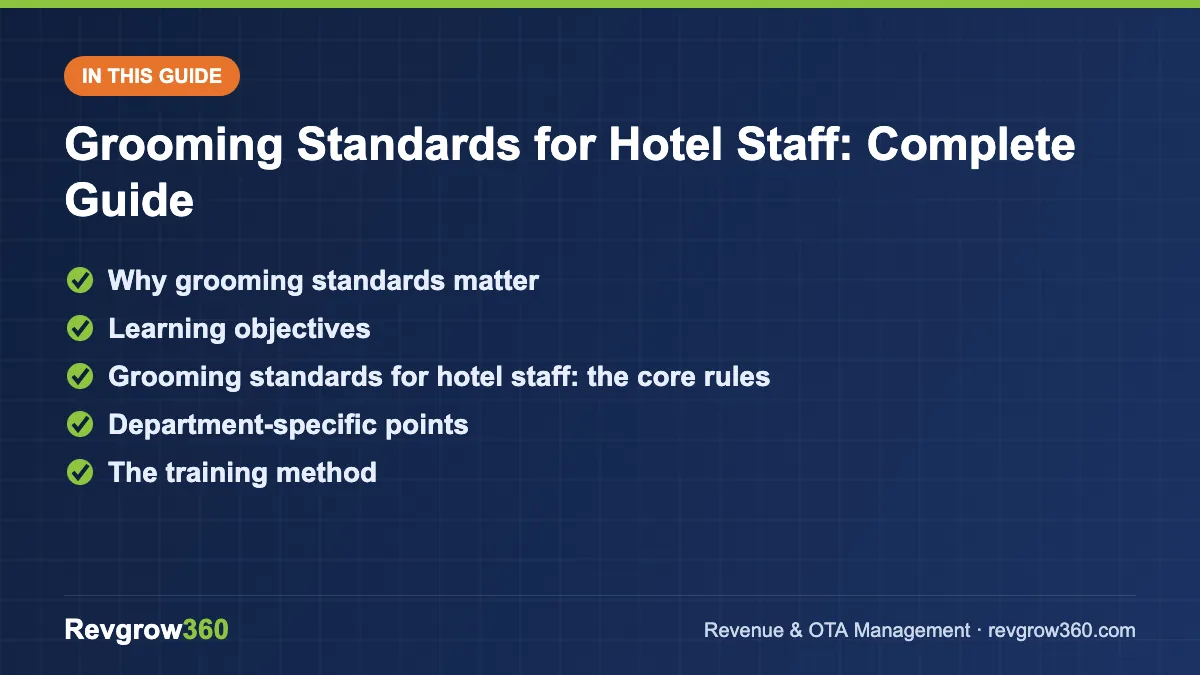
- Written, fair, specific rules
- Daily two-minute inspection
- Correct privately, praise often
This guide gives training objectives, a department-wise grooming table, a daily inspection checklist, sample phrases for supervisors, ways to handle non-compliance respectfully and how to measure results. Adapt the details to your hotel’s brand, climate and local culture, and apply them equally to all staff.
Why grooming standards matter
Guests judge a hotel through its people. A neat, clean and confident team suggests that the rooms, kitchen and billing are managed with the same care. The reverse is also true: a stained uniform at the front desk makes guests doubt cleanliness elsewhere.
Grooming is also a hygiene and safety matter. Clean hands and nails, tied hair and correct footwear reduce food contamination and slips in kitchens and housekeeping. For food areas, check the current rules from the Food Safety and Standards Authority of India and your local authority.
Finally, consistent grooming builds team pride. When everyone knows the standard, supervisors stop arguing about opinions and start checking against a shared list.
Monthly training calendar.
Learning objectives
After training, each staff member should be able to:
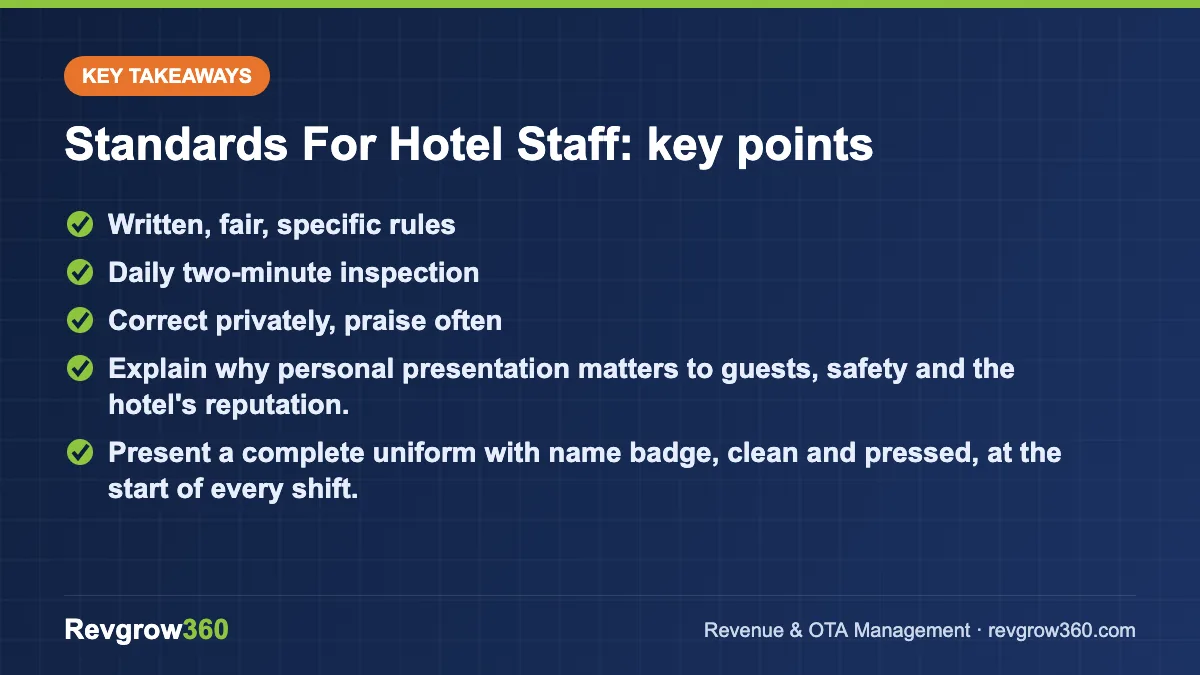
- Explain why personal presentation matters to guests, safety and the hotel’s reputation.
- Present a complete uniform with name badge, clean and pressed, at the start of every shift.
- Maintain personal hygiene, including hand washing at the right moments.
- Follow the hair, nail, jewellery, make-up and footwear rules for their department.
- Check themselves and a colleague using the grooming checklist.
Grooming standards for hotel staff: the core rules
| Area | Standard for all staff |
|---|---|
| Uniform | Clean, pressed, correct size, no missing buttons, no stains; name badge worn on the right side or as per hotel rule |
| Hair | Clean, neatly combed and tied back where required; natural colours; no loose strands over the face in food or guest contact areas |
| Facial hair | Clean-shaven or neatly trimmed as per policy; beards covered in food areas where required; religious practice respected within safety rules |
| Hands and nails | Clean, short, trimmed nails; no nail polish in food areas; wash hands regularly |
| Jewellery | Minimal: a wedding ring or simple watch where allowed; no dangling items in food, housekeeping or machinery areas |
| Make-up and fragrance | Light and natural; mild fragrance only; no strong perfume |
| Footwear | Clean, polished, closed, non-slip shoes; correct socks or stockings |
| Teeth and breath | Brush daily, use mouth freshener; avoid strong-smelling food before duty |
| Body odour | Daily bath, clean undergarments, deodorant |
| Posture and manner | Stand straight, smile, avoid chewing gum, keep hands out of pockets |
Department-specific points
| Department | Extra standards |
|---|---|
| Front office | Formal attire, neat hair, minimal accessories, name badge visible, hands visible and clean |
| Housekeeping | Clean uniform, covered hair if required, closed non-slip shoes, gloves for cleaning chemicals, no strong perfume |
| Food and beverage service | Fresh uniform each shift, polished shoes, hair tied, nails trimmed, clean apron and napkin |
| Kitchen | Clean chef whites, hair cover or cap, apron, safety shoes, no jewellery, covered cuts, daily hygiene check |
| Bell desk and security | Pressed uniform, polished shoes, cap or gloves where used, upright posture |
| Engineering | Clean work uniform, safety shoes and equipment, tools carried tidily |
The training method
- Explain the why. Spend the first ten minutes on guest impact and hygiene, with a real example, not a lecture on rules.
- Demonstrate. Have a well-groomed senior staff member show the standard from head to toe, then show a poorly groomed example with the faults circled.
- Practise. Pair staff to check each other against the checklist.
- Role-play. Practise giving and receiving grooming feedback politely.
- Display. Place a grooming mirror and a photo standard at the staff entrance.
- Inspect daily. Supervisors run a two-minute check before each shift.
- Reinforce. Recognise the best-groomed staff each month.
Daily grooming inspection checklist
| Item | Pass | Fix |
|---|---|---|
| Uniform clean, pressed, name badge on | ||
| Hair neat and tied as required | ||
| Facial hair trimmed or covered | ||
| Nails short and clean | ||
| Jewellery within policy | ||
| Shoes clean and suitable | ||
| Hands washed, cuts covered | ||
| Fresh breath, no strong perfume | ||
| Posture and smile |
Sample supervisor phrases
Positive: “Your uniform looks sharp today, Ravi. That is exactly the standard we want at the front desk.”
Correction in private: “Anita, your name badge is missing. Please collect one from HR before you start on the floor. If you need a replacement, let me know today.”
Role-play for staff: A colleague notices a missing button on a team member’s jacket. They say, “You have a loose button. Let me help you fix it before the shift starts.” Practise this kindly, so peers support each other.
Handling non-compliance
- Correct privately and politely, not in front of guests or colleagues.
- Explain the specific item that needs to change and by when.
- Provide help, such as an extra uniform set or laundry facilities, where the issue is practical.
- Record repeated breaches and follow your HR disciplinary process consistently.
- Respect religious, medical and cultural needs, and discuss adjustments with HR that still meet safety rules.
How to measure results
| Measure | How |
|---|---|
| Daily inspection pass rate | Percentage of staff who pass the checklist at shift start |
| Monthly audit score | Manager walks through each department with a scoring sheet |
| Guest comments | Mentions of staff appearance and cleanliness in reviews. See hotel online reputation management |
| Uniform replacement requests | Shows whether uniforms are sufficient and well kept |
| Hygiene incidents | Number of food safety or hygiene observations |
Link the audit to your wider hotel KPIs, so grooming results sit next to guest satisfaction and complaint data.
Training session outline (60 minutes)
| Time | Activity |
|---|---|
| 0 to 10 minutes | Why grooming matters: guest comments, hygiene and pride |
| 10 to 25 minutes | Trainer demonstration of the standard, head to toe, with before and after examples |
| 25 to 40 minutes | Pair practice using the checklist, with trainers walking around |
| 40 to 50 minutes | Role-play of polite grooming feedback |
| 50 to 60 minutes | Questions, sign-off on the standard and next inspection date |
Repeat a shorter refresher each quarter and whenever you change uniforms or standards.
Practical support for staff
Standards are easier to meet when the hotel helps. Provide at least two uniform sets per employee so one can be washed, offer laundry or ironing support where possible, give clean changing rooms with mirrors and lockers, and keep spare name badges, shoe polish and sewing kits at the staff entrance. Replace worn uniforms on a schedule rather than waiting for complaints. When staff see the hotel investing in their presentation, compliance usually rises without conflict.
Include grooming expectations in job offers and in your induction pack, so no one learns the rule for the first time on a bad day. Good grooming habits also form part of your hotel marketing story, because guests notice and photograph neat, confident teams.
Grooming for hot, humid or hill climates
Standards must be realistic for the local climate. In coastal and humid places such as Goa or Kerala, staff may need breathable fabrics, spare shirts for long shifts and clear guidance on managing perspiration. In hill stations such as Darjeeling, add approved jackets or sweaters in the uniform policy, so staff stay warm without breaking the dress code. Write these exceptions into the policy rather than leaving them to individual judgement.
Common mistakes
- Unwritten standards that depend on each supervisor’s taste.
- Not providing enough uniform sets or laundry arrangements.
- Applying rules unevenly to junior and senior staff.
- Correcting staff publicly.
- Ignoring comfort, such as hot kitchens or uncomfortable shoes.
- Training once and never checking again.
Key takeaways
- Written, specific and fair grooming standards protect your brand and food safety.
- Set department-specific rules on top of the core standard.
- Train with explanation, demonstration, practice and role-play.
- Inspect daily, correct privately and recognise good grooming.
- Measure with checklists, audits and guest comments.
Strong service standards help ratings and repeat bookings. To connect guest experience with revenue, explore Revgrow360 online reputation management or book a free consultation.
Frequently asked questions
What are grooming standards for hotel staff?
They are written rules on uniform, hair, nails, jewellery, footwear, hygiene and posture that staff follow while on duty. They create a professional image, support food safety and hygiene, and give supervisors a fair, consistent standard to check against.
How do you train hotel staff on grooming?
Explain why it matters, demonstrate the standard, let staff practise with a checklist and role-play polite feedback. Place a mirror and photo standard at the staff entrance, inspect daily for two minutes before shifts and recognise well-groomed staff regularly.
How should supervisors handle grooming breaches?
Correct privately and politely, name the specific issue, give a deadline and help if the cause is practical, such as a missing uniform. Record repeated breaches and apply your HR process consistently. Respect religious, medical and cultural needs within safety rules.
How do you measure grooming compliance?
Use a daily pass rate from shift-start inspections, a monthly department audit score, guest review comments about staff appearance, uniform replacement requests and hygiene observations. Review the numbers in team meetings and set improvement actions.
More Hotel Training guides
Telephone Skills for Hotel Staff: Complete Guide
A practical training guide on telephone skills for hotel staff, with greetings, scripts, a six-step call routine, role-plays and performance measures.

Upselling at Front Desk: Complete Guide
A practical training guide for upselling at front desk, with objectives, a five-step method, scripts, role-plays and ways to measure results.
Handling Angry Guests: Complete Guide
A practical hotel training guide to handling angry guests with a five-step method, scripts, role-plays and service recovery limits.
Front Desk Communication Skills: Complete Guide
A practical training guide to front desk communication skills with scripts, positive wording, role-plays and ways to measure results.