 By Md Arif Ahamed
Quick summary: Telephone skills for hotel staff: greetings, a six-step call routine, scripts for bookings, holds and complaints, role-plays and how to measure call quality.
Telephone skills for hotel staff are the habits of speaking, listening and handling calls that make a guest feel welcome and confident within the first thirty seconds. A hotel that answers quickly, speaks clearly and solves problems on the call wins more reservations, avoids complaints and builds trust. This training guide covers objectives, a simple call method, scripts for common situations, role-play exercises and ways to measure performance.
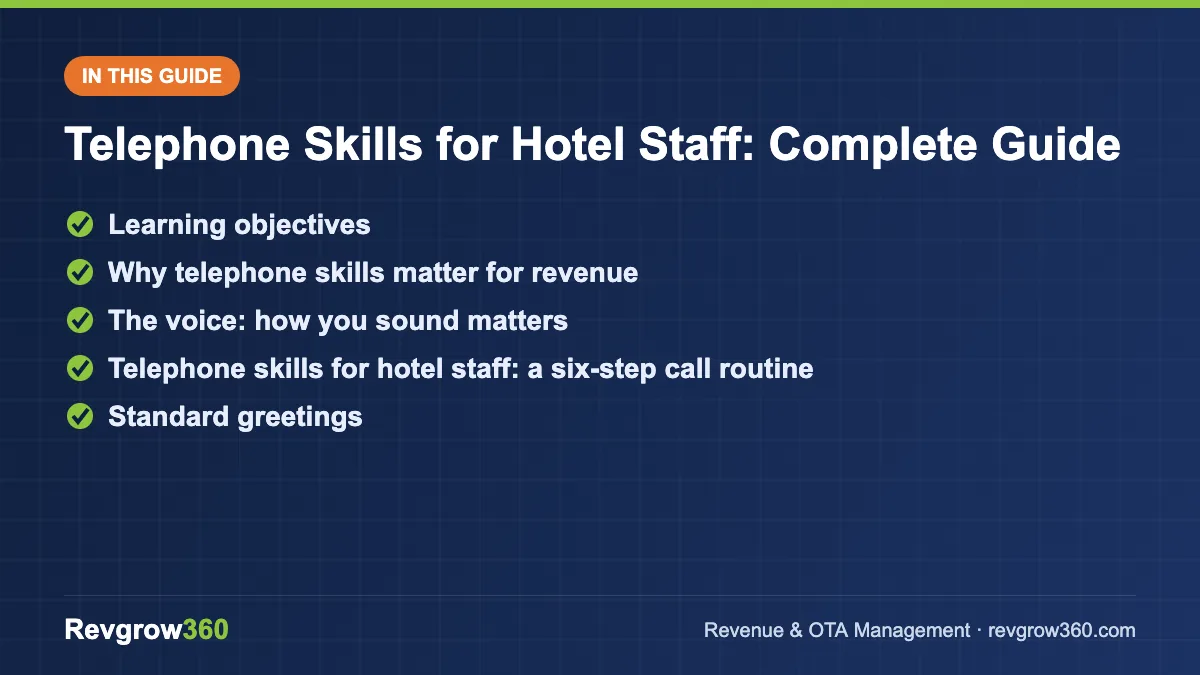
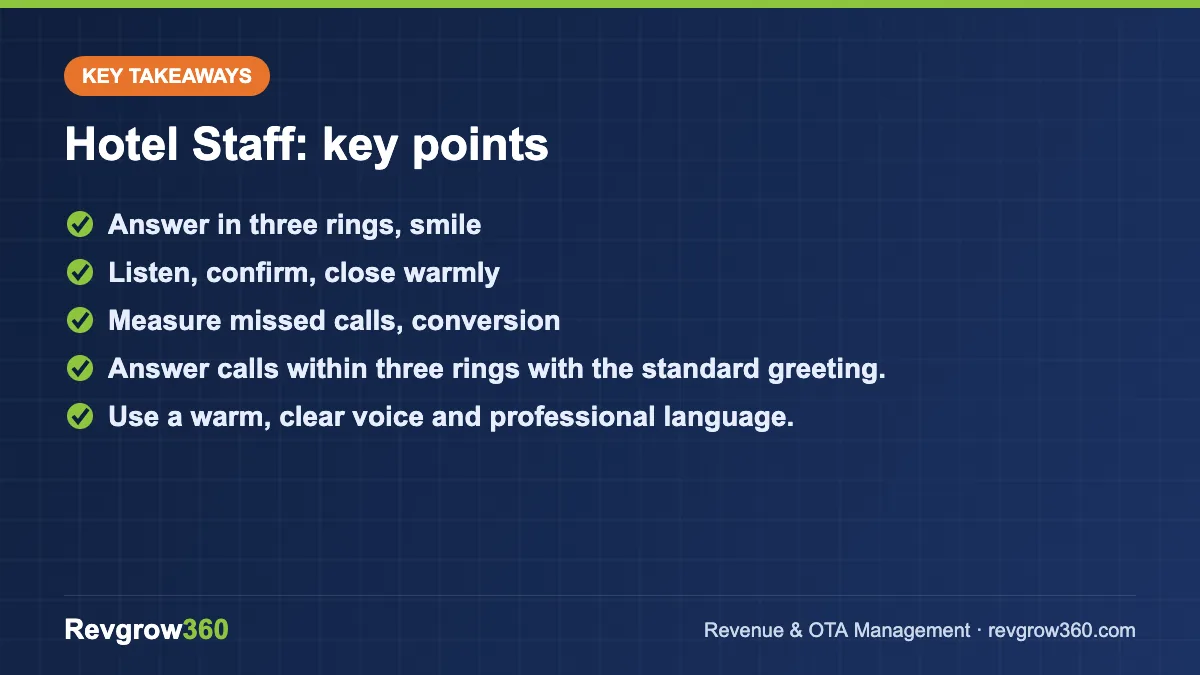
- Answer in three rings, smile
- Listen, confirm, close warmly
- Measure missed calls, conversion
Learning objectives
After this training, staff should be able to:
- Answer calls within three rings with the standard greeting.
- Use a warm, clear voice and professional language.
- Take accurate messages and bookings.
- Transfer calls correctly and politely.
- Handle complaints, angry callers and difficult questions calmly.
- Close each call with a summary and a courteous goodbye.
Monthly training calendar.
Why telephone skills matter for revenue
For many hotels, the phone is still a direct booking channel, especially for older guests, groups, corporate clients and families. A missed or badly handled call is a lost booking that may go to an OTA, or to a competitor. A good reservation call turns an enquiry into a direct booking, saves commission and gives you the chance to offer a better room or package. See how to increase direct bookings.
The phone also shapes guest impressions during the stay: room service, housekeeping requests and wake-up calls all depend on telephone manners.
The voice: how you sound matters
| Element | What to do |
|---|---|
| Smile | Smile before you pick up; the guest can hear it |
| Tone | Warm, calm, friendly; never bored or rushed |
| Pace | Slightly slower than normal speech, especially for names and numbers |
| Volume | Clear without shouting; hold the handset correctly |
| Pronunciation | Speak clearly; spell out names and confirm digits |
| Language | Use simple English or the guest’s language; avoid slang and jargon |
Telephone skills for hotel staff: a six-step call routine
- Answer promptly. Pick up within three rings. Stop other work and give the caller your full attention.
- Greet and identify. Say the greeting, the hotel name, your name and offer help.
- Listen and note. Let the caller finish. Take notes. Do not interrupt.
- Respond and solve. Answer clearly. If you need to check something, ask permission to put the caller on hold and tell them how long it will take.
- Confirm. Repeat the key details: dates, numbers, names, times and rates.
- Close warmly. Thank the caller, tell them what happens next and let the caller hang up first where possible.
Standard greetings
| Time or department | Sample greeting |
|---|---|
| Main operator (morning) | “Good morning, Hotel Lakeview, this is Priya. How may I help you?” |
| Reservations | “Reservations, Hotel Lakeview, this is Arun. How may I assist you?” |
| Front desk (in-house line) | “Front desk, this is Neha. How may I help you, Mr Rao?” |
| Housekeeping | “Housekeeping, this is Salma. How may I help you?” |
| Night | “Good evening, Hotel Lakeview, this is Rahul speaking. How may I help you?” |
Scripts for common situations
Reservation enquiry
“Certainly, sir. May I have your check-in and check-out dates, and how many guests will be staying? … Thank you. For those dates, I can offer a Deluxe Room at ₹4,500 plus taxes with breakfast, or a Premier Room with a balcony for ₹5,400. Which would you prefer?”
Putting a caller on hold
“May I place you on hold for about one minute while I check that for you? … Thank you for holding, Mrs Das. I have the information.”
Transferring a call
“I will connect you to our restaurant, madam. If the call disconnects, you can reach them directly on extension 305. One moment, please.”
Taking a message
“Mr Sharma is not available right now. May I take a message? Could I have your name, number and the best time to call back? … Let me repeat that to confirm.”
Handling an upset caller
“I am sorry for the inconvenience, Mr Mehta. I understand how frustrating this is. Let me note the details and check this right now. May I call you back within 15 minutes with an update?”
Saying no politely
“I am sorry, we do not have a sea-view room on those dates. I can offer a garden-view room or the same sea-view room for the following weekend. Would either work for you?”
Handling difficult calls
- Stay calm. Do not take the anger personally.
- Let the caller speak. Do not argue or interrupt.
- Acknowledge feelings. “I understand this is upsetting.”
- Take ownership. Say what you will do and by when.
- Escalate if needed. Hand over to the duty manager with a short brief so the caller need not repeat the story.
- Follow up. Call back at the promised time, even if there is no final answer.
Numbers, names and spelling: avoiding errors
Many booking mistakes start on the phone. Teach staff a simple confirmation habit.
- Ask for the guest’s name and the spelling: “Could you spell your surname, please?”
- Read phone numbers back in groups of three or four digits.
- Repeat dates with the day and month in words: “Friday, 14 November to Sunday, 16 November”.
- Use the phonetic alphabet for email addresses when needed: “A for Apple, N for Nancy”.
- Write the details in the PMS while speaking, not afterwards from memory.
Call etiquette for busy times
When two lines ring at once, finish the first greeting, ask the first caller politely to hold for a moment, then answer the second. Never let a phone ring while you are talking to a guest at the counter; excuse yourself with “Please excuse me for one moment” and answer it, or arrange backup so that calls are covered. A hotel with a busy lobby benefits from a clear plan: who takes calls, who handles the counter and who covers breaks.
Rules for in-house calls and room service
- Address guests by name once you know it.
- Repeat room service orders and confirm the delivery time and price.
- Confirm wake-up calls by repeating the time and room number, and log them.
- Do not give out a guest’s room number to a caller. Offer to connect or take a message.
Role-play exercises
Exercise 1: The price-conscious caller
A caller asks, “What is your lowest rate for this weekend?” The trainee must ask about dates and needs, quote correctly and offer value before discounts. Rate rules are explained in hotel dynamic pricing.
Exercise 2: The angry guest on the in-house line
A guest calls to complain about noise at night. The trainee follows the six-step routine and offers a solution.
Exercise 3: The group enquiry
A school teacher calls for 30 rooms. The trainee collects key details and promises a callback from sales within a set time.
Give each trainee feedback on voice, listening, accuracy and closing.
Measuring telephone performance
| Measure | Target example | How to check |
|---|---|---|
| Answered within 3 rings | 90% or more | Phone system report or mystery calls |
| Missed call rate | Under 5% | Call log |
| Call-to-booking conversion (reservations) | Track against your own baseline | Booking source report |
| Greeting and closing quality | Score 8 out of 10 or higher | Monthly mystery call or recorded sample, with staff aware |
| Message accuracy | Zero missed or wrong messages | Message log audit |
Link these to hotel KPIs so that telephone quality is seen as part of revenue and service, not an extra.
Common telephone mistakes
- Answering with “Hello?” or without the hotel name.
- Eating, chewing or talking to colleagues during a call.
- Leaving callers on hold without explanation.
- Transferring callers repeatedly.
- Promising callbacks and not making them.
- Not noting the caller’s number and name.
Key takeaways
- Telephone skills for hotel staff directly affect bookings, guest satisfaction and reputation.
- Answer within three rings with a standard greeting, smile and listen first.
- Use a six-step routine: answer, greet, listen, respond, confirm, close.
- Practise scripts and role-plays for bookings, holds, transfers and complaints.
- Measure answer speed, missed calls and conversion, and coach every month.
Revgrow360 helps hotels turn enquiries into direct bookings through hotel revenue management and distribution support. You are welcome to request a free hotel audit.
For more background, see this customer service overview on Wikipedia.
Frequently asked questions
Why are telephone skills important for hotel staff?
Phone calls are still a key route for direct bookings, group enquiries and in-house requests. A prompt, warm and accurate call wins reservations, avoids complaints and shapes the guest's first impression, while a missed or poorly handled call can send business to a competitor or an OTA.
How should hotel staff answer the phone?
Answer within three rings, smile, and say the greeting, hotel name, your name and an offer of help, for example: Good morning, Hotel Lakeview, this is Priya, how may I help you? Then listen without interrupting and take notes.
How do you handle an angry caller at a hotel?
Stay calm, let the caller finish, acknowledge their feelings, apologise sincerely, say what you will do and by when, and escalate to the duty manager if needed. Always call back at the promised time, even if the final solution is not yet ready.
How can hotels measure telephone performance?
Track the share of calls answered within three rings, the missed call rate, call-to-booking conversion for reservations, greeting and closing quality from mystery or sampled calls, and message accuracy. Review monthly and coach staff with specific examples.
More Hotel Training guides
Upselling at Front Desk: Complete Guide
A practical training guide for upselling at front desk, with objectives, a five-step method, scripts, role-plays and ways to measure results.
Handling Angry Guests: Complete Guide
A practical hotel training guide to handling angry guests with a five-step method, scripts, role-plays and service recovery limits.
Front Desk Communication Skills: Complete Guide
A practical training guide to front desk communication skills with scripts, positive wording, role-plays and ways to measure results.