 By Md Arif Ahamed
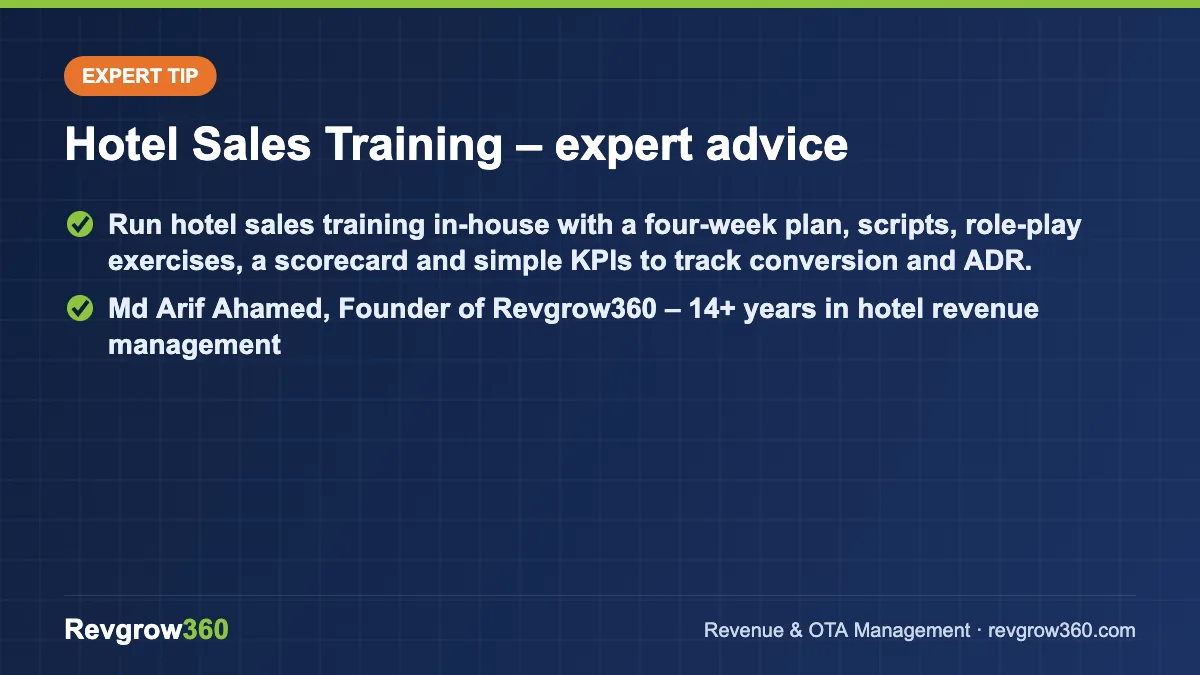
Quick summary: Run hotel sales training in-house with a four-week plan, scripts, role-play exercises, a scorecard and simple KPIs to track conversion and ADR.
Hotel sales training teaches hotel staff to find enquiries, understand guest needs, present the property, handle objections and close bookings, while protecting rate and service quality. The best programmes are short, practical and repeated: scripts, role-play and weekly coaching on real enquiries rather than long lectures. This guide gives a full training plan that a hotel owner or manager can run in-house.
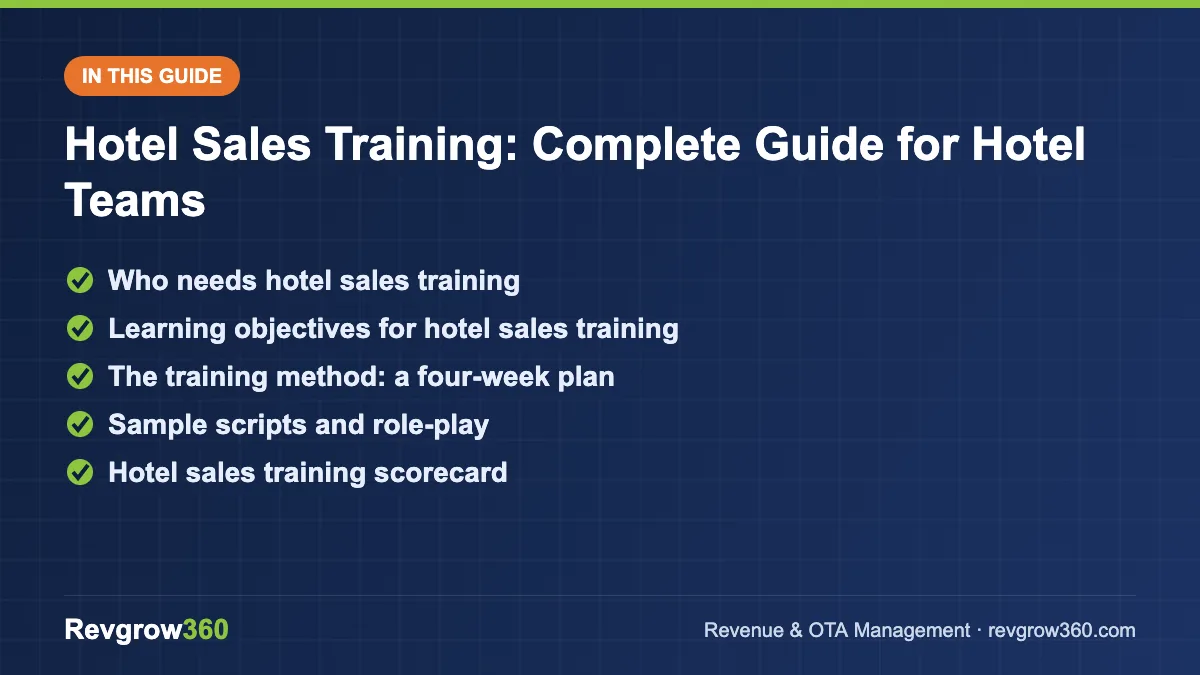
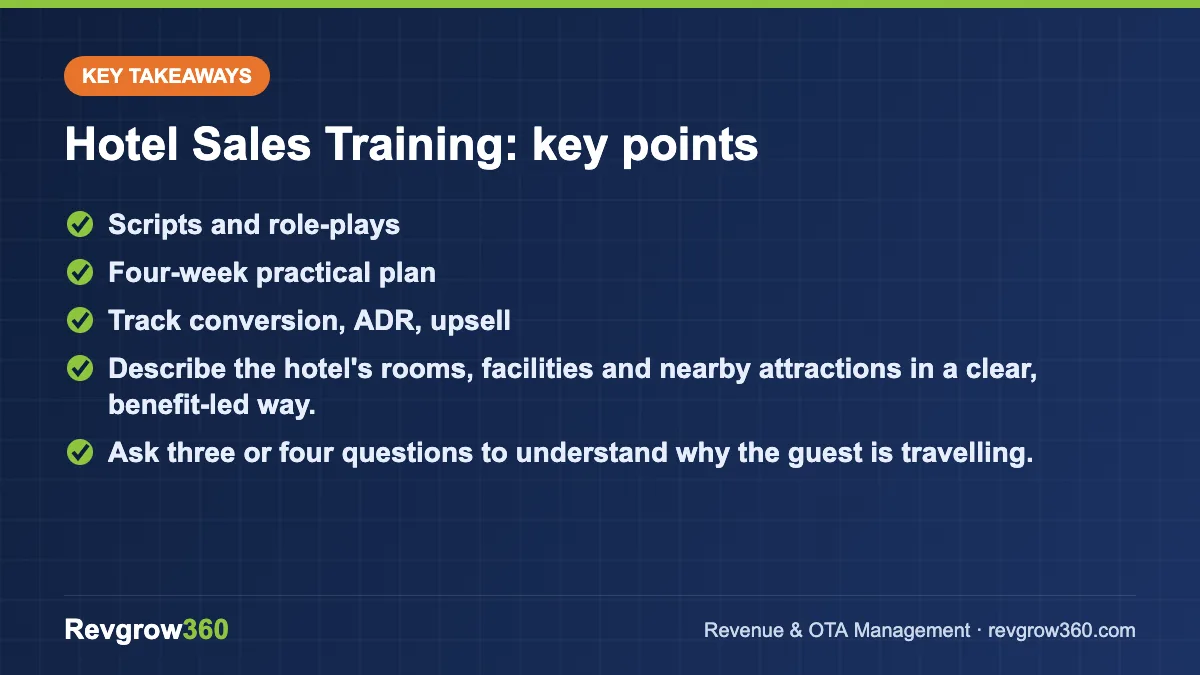
- Scripts and role-plays
- Four-week practical plan
- Track conversion, ADR, upsell
It covers front office, reservations and the sales team, because a booking is often won or lost at the first phone call, WhatsApp message or walk-in.
Who needs hotel sales training
| Team | Sales moments | Main skill |
|---|---|---|
| Sales and marketing | Corporate accounts, groups, weddings, travel agents | Prospecting, proposals, negotiation |
| Reservations | Phone, email and WhatsApp enquiries | Quick response, questioning, closing |
| Front desk | Walk-ins, upgrades, extensions, direct rebooking | Upselling, rate confidence |
| Restaurant and banquet | Table and event bookings | Recommending, packaging, follow-up |
| Owner or GM | Key accounts, local partnerships | Relationship and decision-making |
Monthly training calendar.
Learning objectives for hotel sales training
By the end of the programme, each participant should be able to:
- Describe the hotel’s rooms, facilities and nearby attractions in a clear, benefit-led way.
- Ask three or four questions to understand why the guest is travelling.
- Quote a rate with confidence and explain the value.
- Handle common objections such as “your price is high” or “the other hotel is cheaper”.
- Offer an upgrade, package or add-on without pressure.
- Follow up on every unconverted enquiry within a set time.
- Record each enquiry accurately so it can be measured.
Revenue Health Score · free
Free tool: check your hotel’s revenue health
Answer a few quick questions about your rooms, rates, OTAs and reviews. Get a score out of 100, your weakest revenue areas and the first actions to fix them.
The training method: a four-week plan
Week 1: Know the product and the guest
Walk the property as a guest. Each staff member must be able to describe every room type, the differences between them, nearby places and the main guest groups. Build a one-page product sheet with features, benefits and proof. Example: “Our deluxe room has a balcony facing the garden, which is quiet in the evening, ideal for couples.”
Week 2: Questioning and presenting
Teach the sequence: greet, ask, listen, match, quote, check. Practise using open questions: “What is the occasion?”, “Who is travelling with you?”, “What matters most: location, quiet or budget?” Role-play five minutes in pairs, then swap.
Week 3: Rates, objections and closing
Explain rate logic so staff do not feel they must discount. Share the reasons behind your pricing, such as season, demand and room type; our guide to hotel dynamic pricing strategy is a useful reference. Practise objection handling and asking for the booking.
Week 4: Follow-up, upselling and tracking
Teach follow-up timing, the use of a simple enquiry log, and upselling at check-in and checkout. See hotel upselling and ancillary revenue for offer ideas.
Sample scripts and role-play
Phone enquiry for a weekend stay
“Thank you for calling Hotel Example, this is Riya. Are you planning a weekend getaway? May I know the dates and how many guests will be travelling? … For two adults and a child, I would suggest our Family Room with a garden view. It is ₹4,800 a night including breakfast for all three. Shall I hold it for you for the next two hours while you confirm?”
Handling “your price is high”
“I understand price matters. May I tell you what is included? The rate has breakfast for two, free parking and a late checkout until 1 pm. If budget is a concern, our Standard Room at ₹3,900 does not have the balcony but has the same breakfast and parking. Which would suit you better?”
Role-play exercise
Divide staff into groups of three: caller, receiver and observer. The observer scores greeting, questions asked, benefit mentioned, price confidence and closing attempt. Rotate roles every five minutes, and record one improvement per person.
Walk-in and upgrade script at the front desk
“Welcome to Hotel Example, Mr Sen. Your Standard Room is ready. For just ₹700 more per night, I can offer a Deluxe Room on a higher floor with a quieter view and a bathtub. Since you are here for your anniversary, many guests prefer it. Would you like me to show you the room first?”
WhatsApp enquiry reply
“Hello, thank you for contacting Hotel Example. For 12 to 14 December for two adults, our Deluxe Room is ₹4,200 per night with breakfast. It has a private balcony. Is this a holiday or a work trip? I can suggest the best option once I know. I can also hold the room for you until 6 pm today.”
Notice what these scripts share: a friendly opening, a question about the guest’s purpose, a clear price with inclusions, and a next step. Staff should adapt the words to their own style, but they should always include these four parts.
Ten common objections and a helpful approach
| Guest says | Helpful approach |
|---|---|
| “Your price is high” | Explain what is included and offer a lower room type or package |
| “I will think and call back” | Offer to hold the room for a short time and ask what they need to decide |
| “Booking.com is cheaper” | Mention direct benefits such as free breakfast, flexible cancellation or late checkout, without criticising the OTA |
| “Do you give a discount?” | Offer value first, then a pre-approved offer if suitable |
| “Is it far from the station?” | Give exact distance, travel time and pickup options |
| “Can I get a free upgrade?” | Offer a paid upgrade at a small, clear price |
Hotel sales training scorecard
| Skill | What good looks like | Score 1 to 5 |
|---|---|---|
| Greeting and tone | Warm, clear, within three rings or two minutes online | |
| Questions | At least three relevant questions before quoting | |
| Product knowledge | Accurate, benefit-led description | |
| Rate presentation | Confident, value stated before price | |
| Objection handling | Acknowledge, explain, offer alternative | |
| Closing | Asks for the booking or next step | |
| Follow-up and logging | Enquiry recorded; follow-up date set |
How to measure whether hotel sales training works
- Enquiry conversion rate: bookings divided by enquiries, tracked weekly by channel.
- Response time: average time to first reply on calls, WhatsApp and email.
- ADR achieved: check that conversion has not been bought by discounts. See hotel KPIs.
- Upsell revenue: upgrades, breakfast add-ons and package sales per month.
- Mystery enquiry scores: have a friend call or message and score the experience using the scorecard.
- Direct booking share: a rise shows staff are converting guests who would otherwise book on OTAs.
Compare the figures a month before training and a month after. Do not expect large jumps in the first week; improvement usually grows with coaching.
Ongoing coaching routine
- Hold a ten-minute sales huddle once a week to review three real enquiries: one won, one lost, one pending.
- Listen to or read two enquiries per person each month and give feedback.
- Share one new script or objection every week.
- Recognise the best sales moment of the month with a small reward.
- Refresh training every quarter and for every new joiner.
Training different learners
Not everyone learns the same way. Senior staff may resist role-play, while new joiners may be shy about speaking on a call. Start with small groups, let confident staff go first and praise specific behaviours, such as asking a good question or mentioning a benefit. Keep language simple and allow staff to practise in Hindi, Bengali or their local language if that is how guests speak to them. The goal is natural conversation, not memorised lines.
Give every trainee a small notebook or a shared sheet where they write one thing learned and one thing they will try that week. Review it in the weekly huddle.
Common training mistakes
- Training once and never reinforcing it.
- Telling staff to discount instead of teaching value.
- Skipping product knowledge and jumping to closing techniques.
- Not recording enquiries, so no one knows what was lost.
- Training only the sales team while front desk and reservations handle most enquiries.
Key takeaways
- Hotel sales training should be practical, short and repeated.
- Teach product knowledge, questioning, rate confidence, objection handling and follow-up.
- Use scripts, role-play and a scorecard.
- Measure conversion, response time, ADR and upsell revenue before and after.
- Coach weekly using real enquiries.
Revgrow360 helps hotels combine sales training with hotel revenue management so staff sell at the right rate. Book a free consultation to discuss your team.
For more background, see this customer service overview on Wikipedia.
Frequently asked questions
What should hotel sales training cover?
It should cover product knowledge, asking questions, presenting rooms by benefit, quoting rates with confidence, handling objections, upselling, closing and follow-up. Include role-play practice and a scorecard so trainers can give specific feedback.
How long should hotel sales training take?
A basic programme can run over four weeks with short weekly sessions of 45 to 60 minutes plus practice. The real gains come from weekly ten-minute coaching using actual enquiries, with a refresher each quarter and for every new joiner.
Should front desk staff get sales training?
Yes. Front desk and reservations teams handle most enquiries, walk-ins and upgrade opportunities. Training them in questioning, rate confidence and upselling often raises conversion and ancillary revenue without any extra marketing spend.
How do I measure hotel sales training results?
Compare enquiry conversion rate, response time, ADR, upsell revenue and direct booking share before and after training. Add mystery enquiries scored on a simple checklist. Make sure conversion gains are not coming only from discounts.
More Hotel Training guides
Guest Service Excellence: Complete Guide for Hotels
A complete guide to guest service excellence in hotels, with service standards, a training method, scripts, role-plays and metrics.
Food Safety Training for Hotel Staff: Complete Guide
A practical guide to food safety training for hotel staff, with modules, role-play scripts, a schedule and ways to measure results.
Hotel Housekeeping Training: Complete Guide
A full hotel housekeeping training plan with objectives, a four-week schedule, cleaning sequence, role-plays and measurement methods.
Grooming Standards for Hotel Staff: Complete Guide
Clear grooming standards for hotel staff with department-wise rules, a daily checklist, a training method and measures of success.
Telephone Skills for Hotel Staff: Complete Guide
A practical training guide on telephone skills for hotel staff, with greetings, scripts, a six-step call routine, role-plays and performance measures.
Upselling at Front Desk: Complete Guide
A practical training guide for upselling at front desk, with objectives, a five-step method, scripts, role-plays and ways to measure results.
Related guide: Front Desk Communication Skills: Complete Guide
Free PDF checklist
Where is your hotel losing money?
27 quick checks on pricing, OTAs, reviews and direct bookings, with the first fix for every leak.
Get the free checklist →