 By Md Arif Ahamed
Quick summary: A practical SOP for handling guest complaints: the LAST method, step-by-step procedure, escalation levels, timings, scripts and a complaint log template.
An SOP for handling guest complaints is a written procedure that tells every staff member how to listen to, resolve, record and follow up on guest dissatisfaction, from a cold shower to a billing dispute. A guest complaint handled well can leave a guest more loyal than one who never had a problem. A guest complaint handled badly becomes a one-star review. This guide gives you a complete procedure, timings, scripts, escalation levels and a log format.
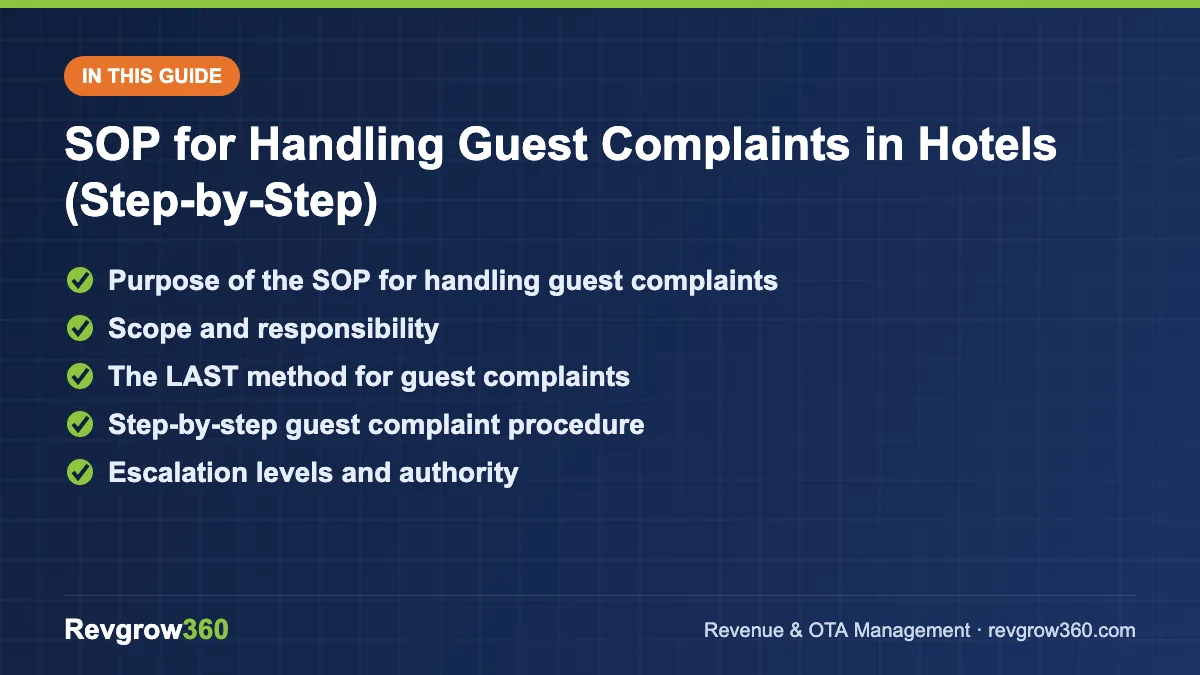
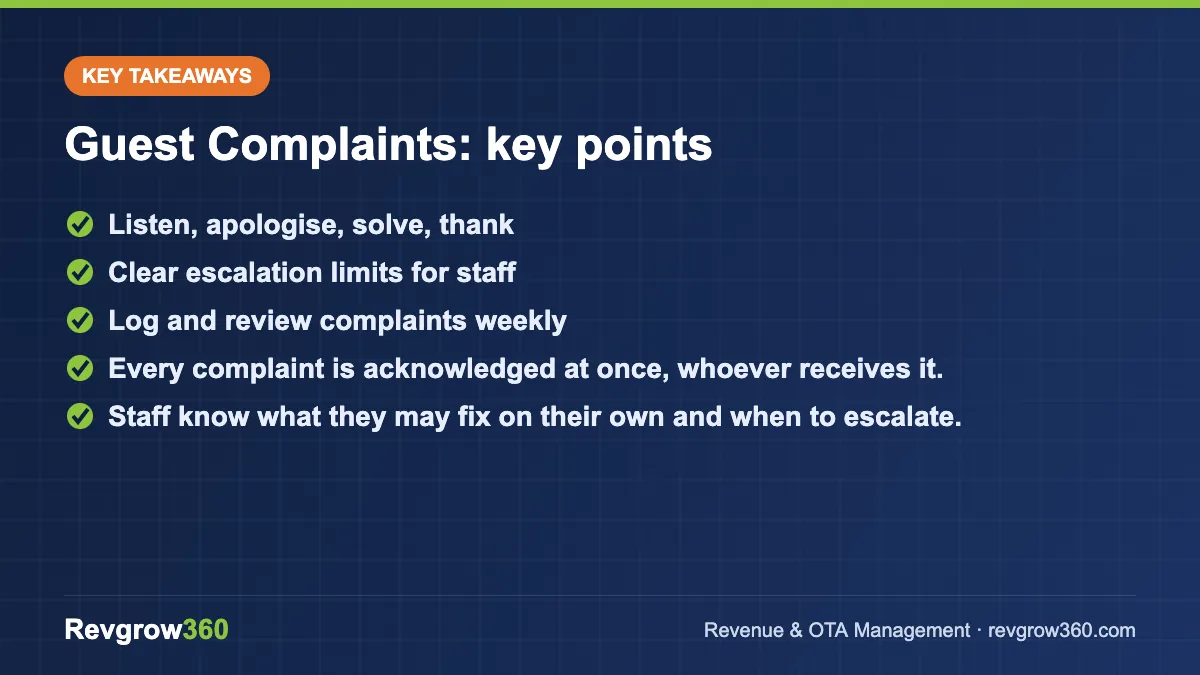
- Listen, apologise, solve, thank
- Clear escalation limits for staff
- Log and review complaints weekly
Purpose of the SOP for handling guest complaints
The purpose is to solve guest problems quickly, fairly and consistently, and to learn from them. The SOP should make sure that:
- Every complaint is acknowledged at once, whoever receives it.
- Staff know what they may fix on their own and when to escalate.
- Guests receive a clear solution and a follow-up.
- All complaints are recorded and reviewed for patterns.
- The hotel protects its reputation, including online reviews.
Answer guest complaints professionally.
Scope and responsibility
This SOP applies to all departments and all complaint channels: face to face, phone, WhatsApp, email, feedback form, OTA messaging and public review sites.
| Role | Responsibility |
|---|---|
| Any staff member | Listens, apologises, takes ownership of the first response and informs the right person |
| Department supervisor | Solves complaints in their area within set limits |
| Duty manager | Handles serious complaints, approves compensation within limits, monitors the log |
| General manager | Handles major incidents, reviews trends, approves policy changes |
| Reputation owner | Responds to online reviews and tracks themes. See hotel online reputation management |
The LAST method for guest complaints
Many hotels use a simple memory aid known as LAST, plus a follow-up.
| Letter | Step | What to do |
|---|---|---|
| L | Listen | Let the guest finish. Do not interrupt. Take notes. |
| A | Apologise | Say sorry for the experience. Do not blame or make excuses. |
| S | Solve | Offer a solution or options. Say what you will do and by when. |
| T | Thank | Thank the guest for raising it, because it helps the hotel improve. |
| + | Follow up | Check back to confirm the guest is satisfied. |
Step-by-step guest complaint procedure
- Stay calm and give full attention. Stop what you are doing. Make eye contact or, on the phone, give a clear verbal response. Move to a quiet area if the guest is upset in public.
- Listen without interrupting. Let the guest tell the whole story. Note key facts: name, room number, time, what happened and what the guest wants.
- Apologise and show empathy. Use a sincere sentence such as “I am sorry this happened. I understand how frustrating it is.”
- Repeat the problem. Summarise it to confirm you understood. This shows respect and avoids mistakes.
- Take ownership. Say “I will take care of this” instead of “that is not my department”.
- Solve it or escalate. If it is within your authority, fix it immediately. If not, call the supervisor or duty manager and give a short brief so the guest does not need to repeat the story.
- Offer a solution with a time. For example, “An engineer will check your AC within 15 minutes. If it is not fixed, I will move you to another room.”
- Act on it. Deliver exactly what you promised, on time.
- Follow up. Check back with the guest after the solution, in person or by phone, within 30 to 60 minutes for urgent problems or by the next day for others.
- Record the complaint. Enter it in the complaint log with details, action and outcome.
- Review patterns. At weekly meetings, review the log and fix root causes.
Escalation levels and authority
| Level | Type of complaint | Who decides | Example action |
|---|---|---|---|
| 1 | Minor, immediate fix | Any staff member or supervisor | Replace towels, fix TV remote, re-make order |
| 2 | Moderate, service failure | Department head or duty manager | Move room, remove a charge within limit, complimentary item |
| 3 | Serious, repeated or public | Duty manager and general manager | Compensation, refund approval, written apology |
| 4 | Safety, legal or medical | General manager, security, and authorities as needed | Emergency response, incident report |
Set clear limits in rupees for what each level may offer, so staff can act quickly without fear. Any compensation should be reasonable, recorded and approved as per policy.
Standards and timings
| Activity | Standard |
|---|---|
| Acknowledge a complaint | Immediately, face to face or on a call; within 15 minutes on messaging |
| Urgent room faults | Attend within 15 minutes |
| Written complaint response | Within 24 hours |
| Follow-up | Within 30 to 60 minutes for urgent; next day for others |
| Log entry | Same shift |
| Review of the log | Weekly |
Dos and don’ts
Do
- Thank the guest for the feedback.
- Use the guest’s name.
- Keep your voice calm and low.
- Offer options where possible.
- Do what you promise, and say when it will be done.
Don’t
- Do not argue, blame the guest or another department.
- Do not say “it is the policy” without offering an alternative.
- Do not promise what you cannot deliver.
- Do not discuss the complaint publicly or with other guests.
- Do not ignore a complaint because the guest is polite.
Sample scripts
“Mrs Iyer, I am sorry the breakfast was not as you expected. Thank you for telling us. I would like to arrange a fresh meal for you right now, and I will also speak to the kitchen manager. Would you prefer to be served in the restaurant or in your room?”
“Mr Khan, I understand the bill is not what you expected. Let me check each charge with you now. If there is an error, I will correct it immediately.”
“I am sorry about the noise last night. I have moved you to a quiet room on the fifth floor and I have informed security to check the area. I will call you this evening to make sure all is well.”
Complaint log format
| Field | Example |
|---|---|
| Date and time | 12 Nov, 9:40 pm |
| Guest and room | Mr Rao, 412 |
| Department | Engineering (AC) |
| Complaint | AC not cooling |
| Received by | Front desk |
| Action taken | Engineer attended; fault could not be fixed; guest moved to 505 |
| Compensation | Welcome drink; no charge |
| Follow-up | Call at 10:30 pm; guest satisfied |
| Root cause | Gas leak in unit; scheduled repair |
| Closed by and date | Duty manager, 12 Nov |
Handling different complaint types
| Complaint type | First response | Typical solution |
|---|---|---|
| Room cleanliness | Apologise, send housekeeping supervisor at once | Re-clean within 15 minutes or move the guest |
| Noise | Apologise, ask where the noise comes from | Security check, move room, adjust rules for events |
| Billing error | Review the bill with the guest calmly | Correct the charge, show the corrected bill |
| Slow check-in | Apologise, offer a welcome drink | Speed up, call another agent, review staffing |
| Food quality | Offer a replacement and inform the chef | Replace, remove the charge within limit |
| Staff behaviour | Listen, apologise, inform the duty manager | Manager meets the guest, coaches the staff member |
Angry or aggressive guests
Keep your voice lower than the guest’s, avoid arguing and give the guest space to speak. If the guest becomes abusive or threatening, politely say that you want to help but need a calm conversation, and call the duty manager or security. Staff safety comes first, and no employee should be expected to accept abuse.
Turning complaints into improvement
A complaint log is only useful if someone reads it. Once a week, group complaints by theme: room faults, noise, cleanliness, staff behaviour, billing, food and beverage, check-in delays. If five complaints mention the same lift or the same room, fix the cause. Track the number of complaints per 100 occupied rooms and aim to see it fall over time.
Complaints also show up in public. Many guests post reviews before they speak to staff. Reply to every review calmly and factually, invite the guest to contact the hotel and never argue publicly. See how to improve hotel ranking on OTAs, where review score has a strong effect on visibility and conversion.
Finally, link service recovery with revenue. A guest who is treated well after a problem is more likely to book again directly; see increase hotel direct bookings.
Common mistakes in complaint handling
- Waiting for the guest to complain a second time.
- Giving no authority to front-line staff.
- Not logging complaints, so patterns remain hidden.
- Offering compensation without fixing the cause.
- Forgetting to follow up.
- Responding to online reviews in a defensive tone.
Key takeaways
- Use LAST: Listen, Apologise, Solve, Thank, and then follow up.
- Give staff clear limits so they can solve problems at once.
- Escalate serious, repeated, safety or legal issues to management.
- Log every complaint and review patterns weekly.
- Reply to online reviews calmly and learn from them.
Revgrow360 helps hotels turn guest feedback into better ratings and higher revenue through online reputation management. You can request a free hotel audit any time.
For more background, see this standard operating procedure on Wikipedia.
Frequently asked questions
What is an SOP for handling guest complaints?
It is a written procedure that tells staff how to listen to, resolve, escalate, record and follow up on guest complaints. It sets response times and authority limits so that problems are solved quickly and consistently, and complaint patterns can be reviewed and fixed.
What is the LAST method in hotels?
LAST stands for Listen, Apologise, Solve and Thank. Staff listen fully, say sorry sincerely, offer a solution with a time, thank the guest for the feedback and then follow up. It is an easy way to remember how to handle most complaints calmly.
Should front-line staff be allowed to compensate guests?
Yes, within clear limits. Set rupee limits for each level so staff can resolve minor issues at once with an apology, a replacement or a small gesture, and escalate larger compensation to the duty manager or GM. Record every case in the log.
How should a hotel respond to online complaints?
Reply calmly, thank the reviewer, apologise for the experience, state briefly what is being done and invite them to contact the hotel directly. Never argue or reveal private details publicly. Review online complaints with your internal log to find patterns.
More Hotel SOP guides
SOP for Lost Key Card in Hotels (Step-by-Step)
A step-by-step SOP for lost key card cases: identity verification, cancelling the old card, issuing a replacement, special situations, scripts and a…
SOP for Room Change in Hotels (Step-by-Step)
A step-by-step SOP for room change covering reasons, procedure, timings, sample scripts, billing and inventory updates, and a checklist.
Front Office SOP List: 30 Essential Front Desk Procedures
A list of 30 essential front office SOPs grouped by stage of the guest journey, with a one-line purpose for each and…
Hotel SOP Format: 10 Sections Every SOP Needs (With Example)
The 10 sections of a good hotel SOP, a full worked example you can copy, and a simple plan to roll out,…
SOP for VIP Arrival in Hotels (Step-by-Step)
A step-by-step SOP for VIP arrival covering flagging, room set-up, private check-in, timings, scripts and a department checklist.
SOP for Group Check-in in Hotels (Step-by-Step)
Learn how to check in tour groups, wedding parties and corporate teams smoothly with a step-by-step SOP, timings, scripts and a checklist.