 By Md Arif Ahamed
Quick summary: Net rate in hotel pricing explained: what it means, how partners add markup, a worked example, parity risks and best practice for contracts.
Net rate in hotel pricing is the confidential wholesale price a hotel gives to a travel partner, such as a tour operator or travel agent, with no commission included. The partner adds a margin on top and sells the room to the guest at a higher price. The hotel receives the net amount, and the partner keeps the difference. This page explains the meaning, a worked example, risks and best practice.
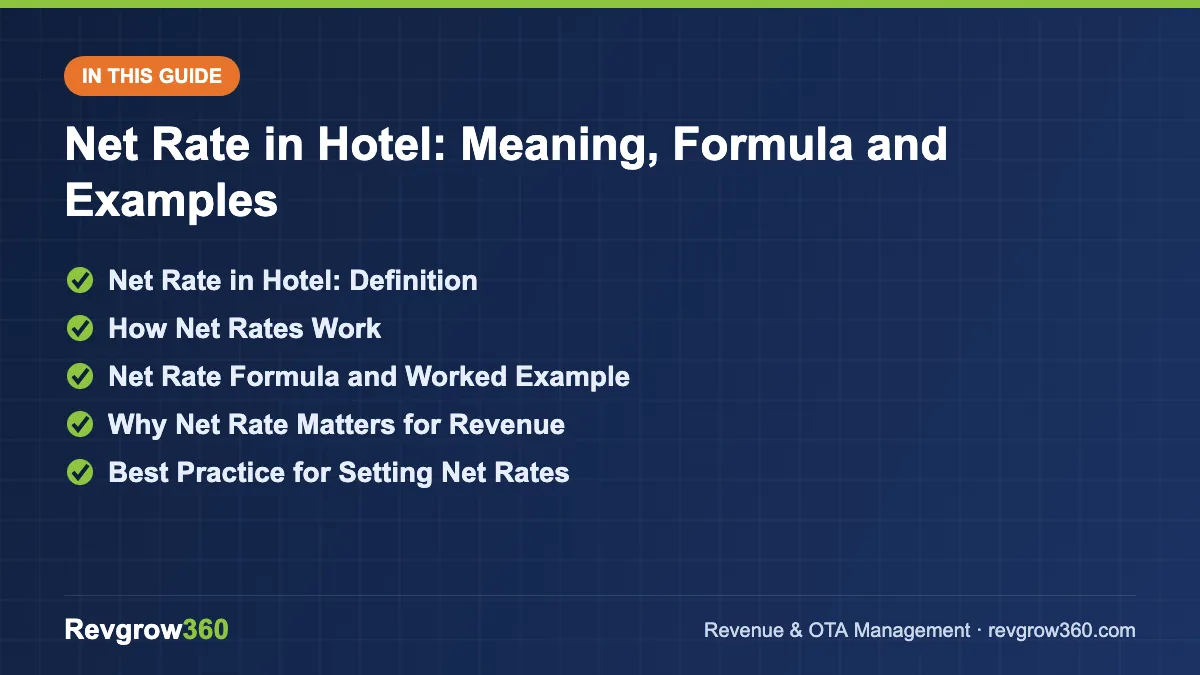
- Wholesale price, no commission
- Partner adds its own markup
- Protect parity with contracts
Net Rate in Hotel: Definition
A net rate is “net” because it is the amount the hotel expects to receive after the distributor’s share is taken out. Unlike a public rate, it is not shown to guests. It is given to travel agents, tour operators, wholesalers, destination management companies and some online travel partners under a contract.
For example, a 50-room hotel in Goa agrees to give a tour operator a net rate of ₹4,000 for a deluxe room. The operator packages the room with transfers and sightseeing, and sells to the customer at ₹5,200 for the room component. The hotel earns ₹4,000. The operator earns ₹1,200 as margin, though this is the operator’s business decision.
Net rate versus commissionable rate
| Point | Net rate | Commissionable rate |
|---|---|---|
| Price to the partner | Fixed amount with commission already removed | Higher public-style amount from which commission is deducted |
| Who sets the selling price | The partner, within contract limits | Usually the hotel |
| Margin | Partner’s markup | Percentage commission paid by hotel |
| Visibility | Confidential | Often public |
Read our linked guide on the commissionable rate in hotel contracts for the other side of the comparison.
Net rate, markup and selling price.
How Net Rates Work
- The hotel and partner sign a contract that lists room types, net rates, validity dates, blackout periods, allotments and payment terms.
- The partner loads the net rate in their system, adds a markup and sells to customers.
- The partner sends a booking to the hotel with a voucher or confirmation.
- The guest stays, and the hotel bills the partner for the net amount, or collects on the partner’s behalf according to the contract.
Net rates are commonly used with wholesalers and bed banks that sell to many travel agents. They allow the partner to price for different markets while the hotel gets a stable income per room.
Revenue Health Score · free
Free tool: check your hotel’s revenue health
Answer a few quick questions about your rooms, rates, OTAs and reviews. Get a score out of 100, your weakest revenue areas and the first actions to fix them.
Net Rate Formula and Worked Example
Selling price = Net rate + Partner markup
Net rate = Selling price divided by (1 + markup percentage) when the markup is a percentage of the net rate.
| Item | Value |
|---|---|
| Hotel net rate | ₹4,000 |
| Partner markup | 25 percent of net |
| Partner selling price | ₹5,000 |
| Hotel’s public BAR for the same night | ₹4,800 |
In this example the partner’s selling price is higher than the hotel’s BAR. This is a rate parity problem. A guest comparing prices may find the hotel cheaper online and book direct, and the partner may lose sales or cause a dispute. Use clear contract terms to prevent partners from publishing net-based prices below your public rate, and check hotel rate parity practices.
The numbers are illustrative. The tax treatment of net rate bookings, including GST on the rate and invoicing, should be confirmed with a CA.
Why Net Rate Matters for Revenue
- Volume in low season: partners can fill rooms that direct channels do not reach.
- No commission calculation: the hotel knows its income per room upfront.
- Market reach: overseas operators and wholesalers help with international demand.
- Risk of price leakage: if the net rate leaks to the public, it can undercut your own pricing and harm ADR.
Net rate business should be part of a wider hotel distribution strategy, not an uncontrolled add-on.
Best Practice for Setting Net Rates
- Start with BAR and decide the maximum discount you can afford by season.
- Set net rates so that the likely public selling price remains at or above your BAR.
- Use different rates for peak, shoulder and low seasons.
- Define blackout dates and release periods for allotments.
- State in the contract that net rates are confidential and not to be published as stand-alone room-only rates below BAR.
- Track production by partner and cancel under-performing contracts.
Common Mistakes with Net Rates
- Leaving the net rate unchanged all year despite seasonal demand.
- Letting partners display net rates publicly, creating parity problems.
- Giving wide allotments with no release dates, which blocks inventory from better channels.
- Not adding clear cancellation and no-show terms.
- Forgetting taxes and invoicing details in the contract.
- Failing to compare partner production with OTA business.
Related Terms
- Commissionable rate: a rate from which commission is deducted.
- BAR and rack rate: public pricing references; see BAR in hotel pricing.
- Wholesale rate: a net or discounted rate for bulk sellers.
- Allotment: rooms reserved for a partner.
- Markup: the amount or percentage the partner adds.
Net Rate in Practice: Scenarios
Scenario 1: Monsoon low season. A resort in Kerala wants more weekday business in July. It offers a tour operator a net rate of ₹3,600 for rooms with breakfast, with a cap of eight rooms a night and a release period of seven days before arrival. Unsold rooms return to the hotel’s own inventory, so the allotment does not block better demand.
Scenario 2: Peak season. In December the same hotel sells most rooms at BAR. It closes net rates for the peak dates or raises them sharply, because partner business at the low net price would displace better revenue.
Scenario 3: Leakage. A guest finds the hotel listed on a third-party site at ₹3,900, below the hotel’s public price. The hotel asks the partner, citing the contract, to correct the display, and reviews whether the partner still deserves access to net rates.
Net Rate Contract Checklist
- Room types, meal plan and net rate for each season.
- Validity dates, blackout dates, allotment size and release period.
- Payment terms, cancellation and no-show rules.
- Confidentiality and parity clause.
- Tax and invoicing details.
Key Takeaways
- A net rate is a confidential price to a travel partner with commission already removed.
- The partner sets the selling price by adding markup, so parity needs control.
- Set seasonal net rates tied to BAR and cap allotments.
- Write confidentiality, cancellation and tax terms into the contract.
- Review production by partner regularly.
Revgrow360 helps hotels balance wholesale, OTA and direct channels. Learn about our OTA management service or request a free hotel audit.
For more background, see this hotel industry overview on Wikipedia.
Frequently asked questions
What is a net rate in a hotel?
A net rate is the confidential wholesale price a hotel gives to a travel agent, tour operator or wholesaler with no commission included. The partner adds a markup and sells at a higher price, while the hotel receives the net amount.
What is the difference between net rate and commissionable rate?
With a net rate the partner receives a lower price and decides the selling price and markup. With a commissionable rate the hotel sets a higher price and pays the partner a percentage commission. The hotel often controls the selling price in the commissionable model.
Why are net rates confidential?
Public net rates would undercut the hotel's own pricing and cause rate parity problems. Contracts usually say net rates must not be shown publicly or sold below the hotel's public price, so partners can package them but not undercut direct channels.
How do hotels set net rates?
Start from BAR and seasonal demand, decide the discount the hotel can afford, and set a rate so that the partner's likely selling price does not go below public prices. Add blackout dates, allotment limits and review production regularly.
More Hotel Glossary guides
Commissionable Rate in Hotel: Meaning and Examples
A commissionable rate includes a commission paid to the agent or OTA who sells the room. See the formula, an example and…
Corporate Rate in Hotel: Meaning, Example and Tips
A corporate rate is a negotiated hotel room rate for company travellers. See how it works, a worked example and how to…
Rack Rate in Hotel: Meaning, Formula and Examples
Rack rate is the standard published full price of a hotel room. Learn how it works, how it differs from BAR and…
BAR (Best Available Rate) in Hotel: Meaning and Examples
BAR, or Best Available Rate, is the lowest flexible public rate for a room and date. Learn how it works, with an…
What is Wash Factor in Hotel? Meaning, Examples & Formula
Wash factor is the share of a group room block that goes unused. Learn the formula, an example and how to use…
What is Break-Even Occupancy in Hotel? Meaning & Formula
Break-even occupancy is the occupancy at which hotel revenue equals total costs. Learn the formula, an example and how to lower it.