
 By Md Arif Ahamed
Quick summary: Hotel rate parity explained: what it means, why OTAs and metasearch care, common causes of rate disparity, and a step-by-step routine to keep prices consistent.
A guest finds your hotel on Booking.com at ₹5,200, checks Google, and sees the same room on another site for ₹4,650. Who do they book with? Not you directly, and possibly not the channel you prefer. Hotel rate parity is the practice of keeping the same price for the same room, dates and conditions across every channel where you sell. It sounds simple, but in practice parity breaks every day because of manual errors, wholesale leakage, OTA discounts and currency conversions. This guide explains what rate parity means today, why it matters for your ranking and revenue, what causes disparity, and a practical routine to maintain it.
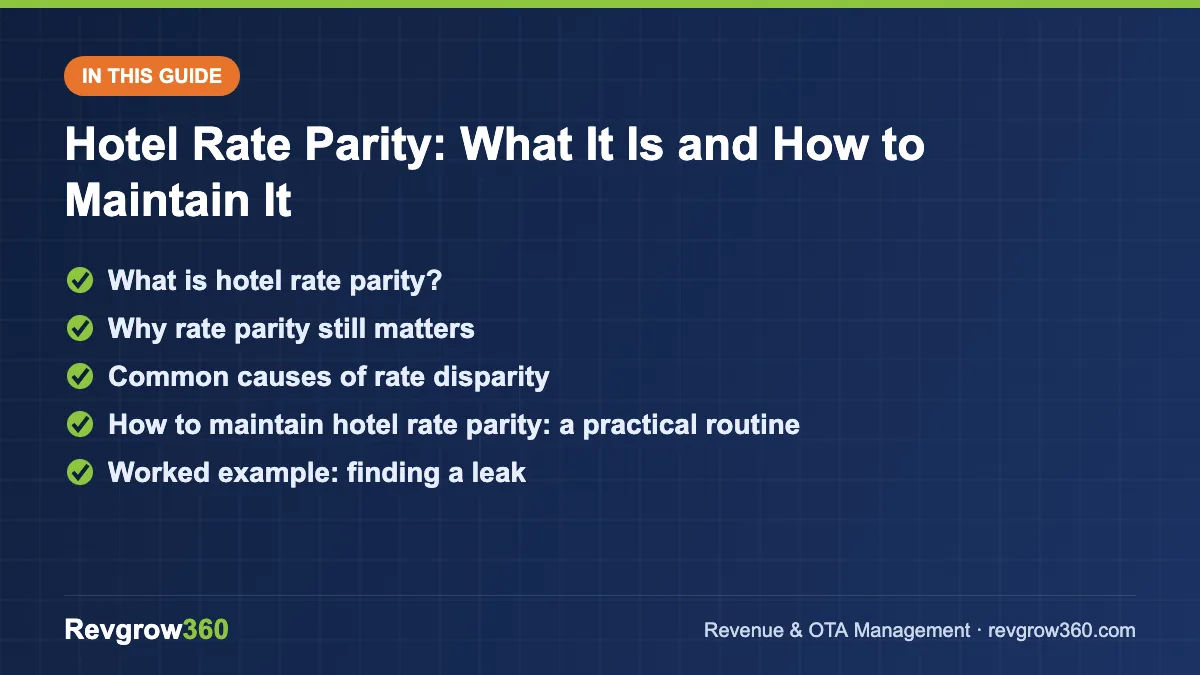
- Same room, same dates, same price
- Find and fix rate leakage
- Daily parity checklist
What is hotel rate parity?
Rate parity means that a guest searching for the same room type, the same stay dates, the same occupancy and the same conditions (meal plan, cancellation policy) sees the same total price whether they look on an OTA, a metasearch engine or your own website.
The key word is “same conditions”. A non-refundable rate that is 10% cheaper than a flexible rate is not a parity breach, because the product is different. A breakfast-included rate costing more than room-only is also fine. Parity is about like-for-like comparison.
Wide parity vs narrow parity
Historically, some OTA contracts required “wide” parity, meaning the hotel could not offer a lower price on any other channel. Many markets have since moved to “narrow” parity or removed parity clauses altogether, often after competition authority reviews. Under narrow parity, a hotel may still be expected not to publicly undercut the OTA on its own website, but can offer different prices on other OTAs or offline channels. The exact terms depend on your contract and country, so read your OTA agreement carefully and do not assume.
Find where OTAs undercut your website rate.
Why rate parity still matters
Even where contracts are relaxed, parity has real commercial consequences.
- OTA ranking: most OTAs monitor price competitiveness. If they detect your hotel cheaper elsewhere, they may reduce your visibility, flag your listing or ask you to correct it.
- Metasearch performance: on Google Hotels, Trivago and similar platforms, guests see all prices side by side. If a wholesaler’s leaked rate is lowest, it often wins the click instead of your website.
- Guest trust: a guest who paid more than someone else for the same room, or who sees a lower price at check-in, is more likely to complain or leave a negative review.
- Revenue control: disparity usually means a cheaper rate is leaking through an uncontrolled channel, so you lose margin without gaining demand.
Common causes of rate disparity
| Cause | What happens | How to fix |
|---|---|---|
| Manual extranet updates | One OTA is updated, another is missed | Update only through the channel manager |
| Wholesale/B2B rate leakage | Net rates meant for packages appear publicly on smaller OTAs | Audit contracts, add rate-use clauses, close leaking partners |
| OTA-funded discounts | An OTA reduces price using its own commission or loyalty budget | Understand which programmes you joined; ask the OTA if unclear |
| Mobile or member-only deals | Opted-in promotions show lower prices to some users | Track all active promotions in one list |
| Currency conversion | Foreign-currency displays differ due to exchange rates | Usually minor; monitor large gaps |
| Tax display differences | One channel shows tax-inclusive price, another excludes it | Check tax settings in every extranet |
| Wrong mapping | A cheaper room or plan is mapped to a higher category | Re-check room and rate mapping |
How to maintain hotel rate parity: a practical routine
Step 1: Use a single source of truth
All public rates should come from one place, usually your channel manager, which pushes them to OTAs and your booking engine. Our article on choosing the best channel manager for hotels explains what features help with this. Once connected, stop editing prices directly in OTA extranets.
Step 2: Build a clean rate structure
Define a Best Available Rate (BAR) for each room type, then derive all public plans from it with fixed rules:
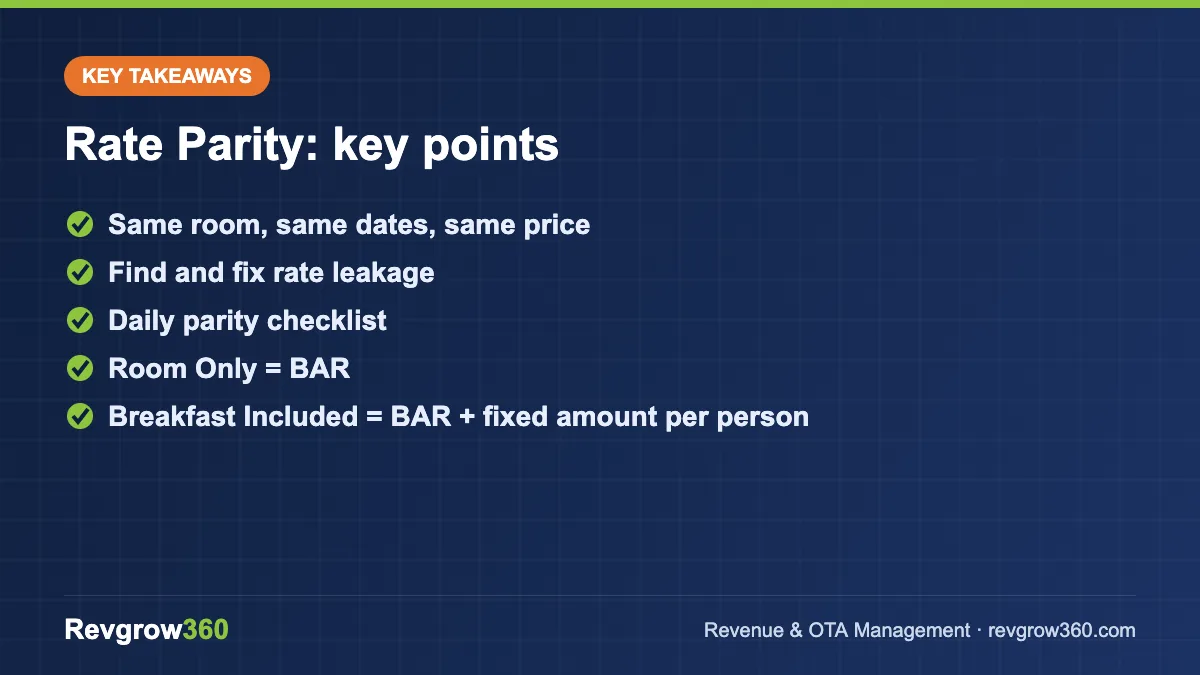
- Room Only = BAR
- Breakfast Included = BAR + fixed amount per person
- Non-Refundable = BAR − 8% to 15% (your choice)
- Long stay = BAR − a fixed percentage for 5+ nights
When every channel uses the same derivation rules, parity becomes automatic.
Step 3: Check tax and fee settings
In India, room GST depends on the tariff slab, and some OTAs display prices tax-inclusive while others show taxes separately at checkout. Make sure the base price you push is treated the same way on each channel, so the final amount the guest pays is identical.
Step 4: Control your B2B and wholesale rates
Net rates given to travel agents, bed banks and tour operators are meant to be packaged or marked up, not sold publicly below your BAR. Leakage often happens when a wholesaler passes your net rate to smaller websites. Protect yourself by:
- Adding a clear clause that net rates cannot be sold room-only to the public below BAR.
- Giving net rates at a sensible discount, not so deep that leakage is tempting.
- Using test bookings or rate-shopping tools to identify which partner the leaked rate comes from.
- Closing or renegotiating with repeat offenders.
Step 5: Keep a promotions register
Many parity “breaches” are actually promotions you joined months ago and forgot: a mobile deal on one OTA, a member discount on another, a country-specific rate. Keep a simple sheet listing every active promotion, channel, discount, dates and who approved it. Review it monthly.
Step 6: Monitor daily
Check your rates on your top three to five channels and on Google Hotels for the next 30 days, focusing on weekends and peak dates. A rate-shopping tool makes this faster, but even a manual check of 5–10 dates a day catches most problems.
Step 7: Respond to OTA parity alerts quickly
OTAs often send parity notifications with a screenshot or link. Investigate the source the same day, correct it, and reply with what you changed. Ignoring alerts can affect your visibility.
Worked example: finding a leak
A hypothetical 30-room business hotel in Bengaluru has a BAR of ₹4,800 for its Deluxe room. On Google Hotels, a small OTA shows the room at ₹4,250 for the same dates. The revenue manager checks:
- Is the hotel connected to that OTA directly? No.
- Which partners have net rates? Two wholesalers, both at ₹4,000 net.
- A test booking through the small OTA arrives via one of the wholesalers.
The hotel contacts the wholesaler, refers to the rate-use clause, and the public listing is removed within a few days. The net rate is also reviewed, and future B2B rates are loaded only for packaged products.
Parity and your direct booking strategy
Parity does not mean your website has to be identical in every way. Depending on your contracts, you can often add value without lowering the headline price:
- Free breakfast upgrade or welcome drink for direct guests
- Flexible check-in or check-out, subject to availability
- Member-only rates behind a login (check your contract terms first)
- Free airport pickup for stays above a certain length
This approach keeps you safe on parity while still giving guests a reason to book on your direct booking engine.
Parity checklist
- All public rates pushed from one channel manager
- Rate plans derived from BAR with fixed rules
- Tax display consistent across channels
- Room and rate mapping verified on every OTA
- B2B contracts include rate-use clauses
- Promotions register updated monthly
- Daily rate check on top channels and metasearch
- Parity alerts resolved within 24 hours
Key takeaways
- Hotel rate parity means the same price for the same room, dates and conditions across all channels.
- Contract terms vary by OTA and country; read yours rather than assuming wide parity applies.
- Most disparity comes from manual updates, wholesale leakage, forgotten promotions and tax display differences.
- Use one channel manager, a derived rate structure and a promotions register to keep control.
- Monitor metasearch daily, because that is where guests compare prices side by side.
- Add value to direct bookings instead of undercutting OTAs on price.
Rate parity is a daily discipline, and it is much easier with a clear rate structure and someone watching the market. Revgrow360 has supported 500+ hotels with rate management, OTA audits and parity monitoring as part of our revenue management services. If you suspect your rates are leaking, request a free hotel audit and we will help you trace the source.
For more background, see this hospitality industry overview on Wikipedia.
Frequently asked questions
What does rate parity mean for hotels?
Rate parity means offering the same total price for the same room type, dates, occupancy and conditions across all channels where you sell, including OTAs, metasearch and your own website. Different products, such as non-refundable or breakfast-included rates, can be priced differently without breaking parity because the conditions are not the same.
Is rate parity a legal requirement?
It is not a law; it is usually a contractual term between a hotel and an OTA. Many markets have narrowed or removed parity clauses after competition reviews, so terms vary by country and contract. Always read your own OTA agreement to understand what applies to your property before changing your pricing approach.
Why is my hotel showing cheaper on another website?
The most common reasons are a missed manual update, a wholesale or B2B net rate leaking to public sites, an OTA-funded promotion, a member or mobile deal you joined, currency conversion, or a tax display difference. A test booking through the cheaper site often reveals which partner the rate came from.
How can I offer better value on my website without breaking parity?
Instead of lowering the headline price, add value for direct guests, such as free breakfast, a welcome drink, flexible check-in or airport pickup. Some contracts also permit member-only rates behind a login. Check your OTA agreements first, then promote these benefits clearly on your booking engine.
More Revenue Management guides
Revenue Management for Boutique Hotels: A Practical Guide
A practical guide to pricing and distribution for small, distinctive hotels, including room-type pricing, restrictions, channels and a weekly checklist.
Short Term Rental KPIs: 10 Metrics with Formulas
The 10 short term rental KPIs every host should track, each with a formula and a worked example, plus how to set…
Airbnb Income and Expense Tracking: A Simple System
Learn what to record for every booking and expense, how payouts differ from gross revenue, which categories to use and a monthly…
Revenue Management for Resorts: A Practical Guide
How resorts can manage rates, groups, packages and non-room revenue to maximise total income per guest, with a worked example and checklist.
Revenue Management for Homestays: A Practical Guide
A practical, step-by-step guide to pricing, channels and add-on income for small homestays, with a worked example and a 30-minute weekly routine.
Outsource Hotel Revenue Management vs In-House vs RMS Software
In-house hire, software or an outsourced team? Compare the three ways to run hotel revenue management and find the model that fits…
Pingback: Revenue Management for Homestays: Free 2026 Guide
Pingback: Reduce OTA Dependence: 90-Day Plan for Hotels
Pingback: Revenue Management for Boutique Hotels: Free 2026 Guide