 By Md Arif Ahamed
Quick summary: Commissionable rate in hotel pricing explained: meaning, commission formula with a worked example, comparison with net rate and mistakes to avoid.
Commissionable rate in hotel pricing is a room rate that includes a commission for the travel agent, OTA or other seller who brings the booking. The hotel sets the selling price, the guest pays it, and the hotel pays the agreed percentage to the seller after the stay. Most OTA bookings work this way. This page explains the meaning, the maths with an example, why it matters and mistakes to avoid.
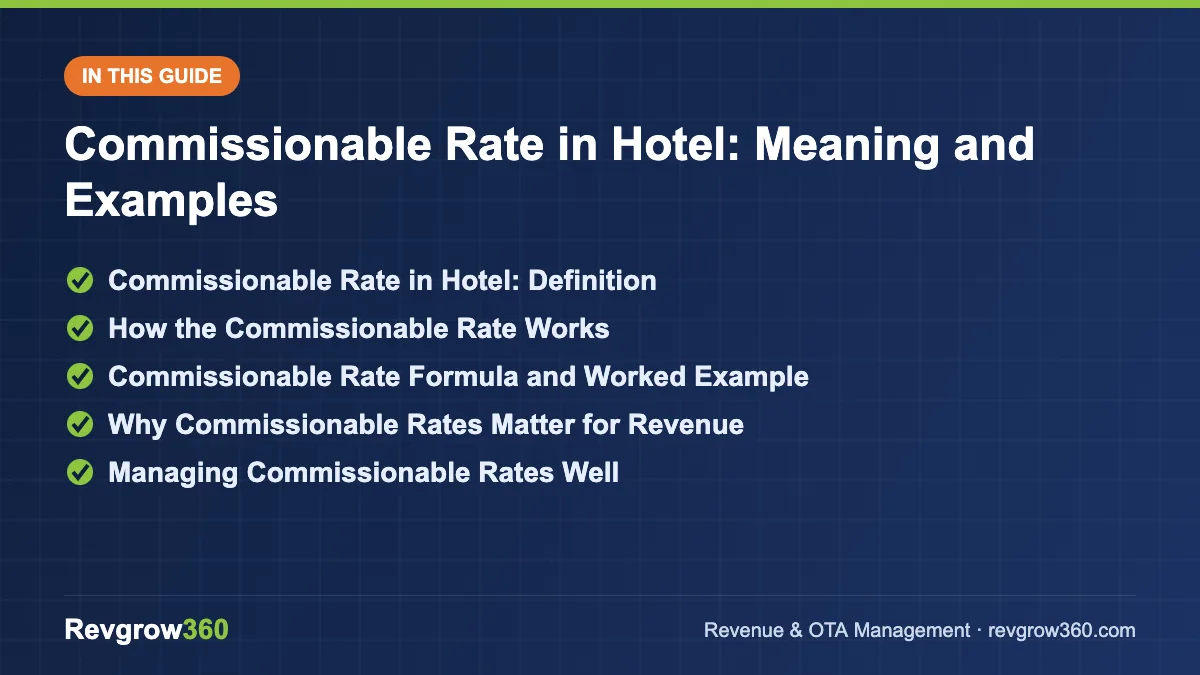
- Rate includes seller commission
- Hotel pays after the stay
- Judge channels on net revenue
Commissionable Rate in Hotel: Definition
A commissionable rate is a rate that is open to commission payment. If a booking comes through a travel agent at a commissionable rate of ₹5,000 with a 10 percent commission, the hotel pays ₹500 to the agent and keeps ₹4,500, before taxes.
The guest sees the full rate. The commission is a business cost to the hotel, not an extra charge to the guest. OTAs such as Booking.com, MakeMyTrip and Agoda also use commissionable models, though they often call it a commission percentage rather than a commissionable rate. Our guide on OTA commission rates for hotels covers typical structures.
Commissionable rate versus net rate
| Point | Commissionable rate | Net rate |
|---|---|---|
| Who sets the selling price | Hotel | Partner, based on net plus markup |
| Hotel pays | Commission percentage on the booking | Nothing extra; receives net |
| Visibility to guest | Rate visible and usually the same across channels | Confidential to the partner |
| Parity control | Easier | Needs contract controls |
See the matching glossary entry on net rate in hotel pricing.
See what you really earn from each OTA booking.
How the Commissionable Rate Works
- The hotel publishes a rate that agents and OTAs can sell, with a stated commission percentage.
- The agent or OTA sells the room to the guest at that price.
- The guest stays and pays the hotel or the OTA, depending on the payment model.
- After the stay, the commission is paid to the seller or deducted from the OTA payout. Terms are usually monthly.
Commission is generally paid on the room revenue amount stated in the contract. Whether it applies to taxes, meals and extras depends on the agreement, so define it clearly. Check GST and invoicing treatment with a CA.
Revenue Health Score · free
Free tool: check your hotel’s revenue health
Answer a few quick questions about your rooms, rates, OTAs and reviews. Get a score out of 100, your weakest revenue areas and the first actions to fix them.
Commissionable Rate Formula and Worked Example
Commission = Booking value x Commission percentage
Net revenue to hotel = Booking value minus Commission
| Item | Value |
|---|---|
| Rate per night | ₹5,000 |
| Length of stay | 2 nights |
| Booking value (room only) | ₹10,000 |
| Commission at 15 percent | ₹1,500 |
| Net revenue to hotel | ₹8,500 |
| Effective net ADR | ₹4,250 |
Now compare a direct booking at the same ₹5,000 rate. The hotel keeps the full ₹10,000 less any payment gateway fee. The difference of ₹1,500 on this single booking shows why direct booking growth matters. Read how to increase hotel direct bookings.
The figures are an illustration only. Actual commission percentages differ by partner, market and agreement.
Why Commissionable Rates Matter for Revenue
- Cost of distribution: commission reduces the revenue you keep, so you must compare channels on net revenue, not gross.
- Channel mix: a mix of direct and commissionable business helps balance volume and margin.
- Pricing decisions: if one channel costs 15 percent, you may need to price differently, within parity limits, or promote direct benefits.
- Visibility: OTAs may rank properties with competitive rates and good conversion higher. See how to improve hotel ranking on OTAs.
- Agent relationships: reliable, timely commission payment keeps local travel agents loyal.
Managing Commissionable Rates Well
- List all channels and their commission percentages.
- Calculate net revenue per booking for each channel, including cancellations and no-shows.
- Decide which channels to push in low demand and which to restrict at peak.
- Keep rates consistent so there is no price conflict between channels.
- Reconcile commission invoices monthly against actual stays.
- Dispute errors promptly and in writing.
Example of reconciliation
An OTA invoices a 30-room hotel in Pune for ten bookings. The hotel finds two bookings were no-shows. If the contract says commission is not due on no-shows, or is due only on the first night charge, the hotel disputes the invoice and asks for a corrected statement. A monthly check like this recovers money that is easily lost.
Common Mistakes with Commissionable Rates
- Looking at gross room revenue and ignoring commission cost.
- Paying commission on cancelled or no-show bookings without checking the contract.
- Not agreeing whether commission applies to taxes and extras.
- Leaving the same commission with every agent regardless of production.
- Raising rates for OTAs only, which breaks parity.
- Failing to track commission payable in accounts.
Related Terms
- Net rate: a rate with commission already removed.
- Rate parity: consistent prices across channels; see hotel rate parity.
- Commission percentage: the share of booking value paid to the seller.
- Net ADR: average rate after distribution costs.
- Cost of acquisition: the total cost of getting a booking.
Commissionable Rate in Practice: Scenarios
Scenario 1: Local travel agent. A 20-room hotel in Digha gives a local agent a 10 percent commissionable rate and agrees to pay it within 30 days of check-out. The agent brings steady weekend families. Because the commission is lower than most OTA percentages and the agent also sends repeat business, the hotel keeps the relationship.
Scenario 2: Peak weekend. The hotel is nearly sold out, so it closes discounted commissionable rates on some channels and keeps availability only on the best-performing ones. Selling a room through a 15 percent channel when a direct guest would have booked later is a real cost.
Commission Tracking Checklist
- A sheet listing each channel, commission percentage and payment terms.
- Monthly net revenue per channel after commission.
- Reconciliation of invoices against stays, cancellations and no-shows.
- Notes on disputed amounts and resolution dates.
Quick Tips for Owners
Ask every partner for a monthly commission statement, and compare it with your own PMS report. Keep a short list of preferred partners who bring profitable guests, and review percentages once a year. When you negotiate, offer volume tiers, such as a lower percentage up to a set number of bookings and a higher one beyond it, so the agent has a reason to grow business with you.
Key Takeaways
- A commissionable rate includes a percentage the hotel pays to the seller after the stay.
- Always judge channels on net revenue after commission.
- Agree in writing what commission covers and when it is payable.
- Reconcile commission invoices every month.
- Grow direct bookings to reduce commission costs over time.
Revgrow360 helps hotels manage OTA commissions, rates and channel mix. Explore our OTA management service or book a free consultation.
For more background, see this hotel industry overview on Wikipedia.
Frequently asked questions
What is a commissionable rate in a hotel?
It is a room rate sold through an agent or OTA where the hotel pays an agreed commission percentage after the stay. The guest pays the listed price, and the commission is a distribution cost to the hotel, deducted or invoiced according to the contract.
How do you calculate commission on a hotel booking?
Multiply the booking value that the contract covers by the commission percentage. For example, ₹10,000 at 15 percent is ₹1,500 commission, leaving ₹8,500 to the hotel. Check whether taxes, meals and extras are included in the base.
Is commission charged on no-shows and cancellations?
It depends on the contract or OTA terms. Some agreements charge commission on a no-show or cancellation fee that the hotel collects, others do not. Read the terms, check monthly invoices against actual stays and raise disputes promptly in writing.
How can a hotel reduce commission costs?
Grow direct bookings through a good website and booking engine, local SEO, repeat guest offers and Google visibility, while keeping rates consistent. Review commission percentages by channel and focus on partners that bring profitable business after costs.
More Hotel Glossary guides
Net Rate in Hotel: Meaning, Formula and Examples
A net rate is a confidential price given to travel partners with no commission. See how it works, a worked example and…
Corporate Rate in Hotel: Meaning, Example and Tips
A corporate rate is a negotiated hotel room rate for company travellers. See how it works, a worked example and how to…
Rack Rate in Hotel: Meaning, Formula and Examples
Rack rate is the standard published full price of a hotel room. Learn how it works, how it differs from BAR and…
BAR (Best Available Rate) in Hotel: Meaning and Examples
BAR, or Best Available Rate, is the lowest flexible public rate for a room and date. Learn how it works, with an…
What is Wash Factor in Hotel? Meaning, Examples & Formula
Wash factor is the share of a group room block that goes unused. Learn the formula, an example and how to use…
What is Break-Even Occupancy in Hotel? Meaning & Formula
Break-even occupancy is the occupancy at which hotel revenue equals total costs. Learn the formula, an example and how to lower it.
Related guide: What is GOPPAR in Hotels? Meaning, Examples & Formula