 By Md Arif Ahamed
Quick summary: Corporate rate in hotel pricing explained: meaning, fixed vs BAR-linked rates, a worked example, how to set it and common mistakes. Protect your ADR.
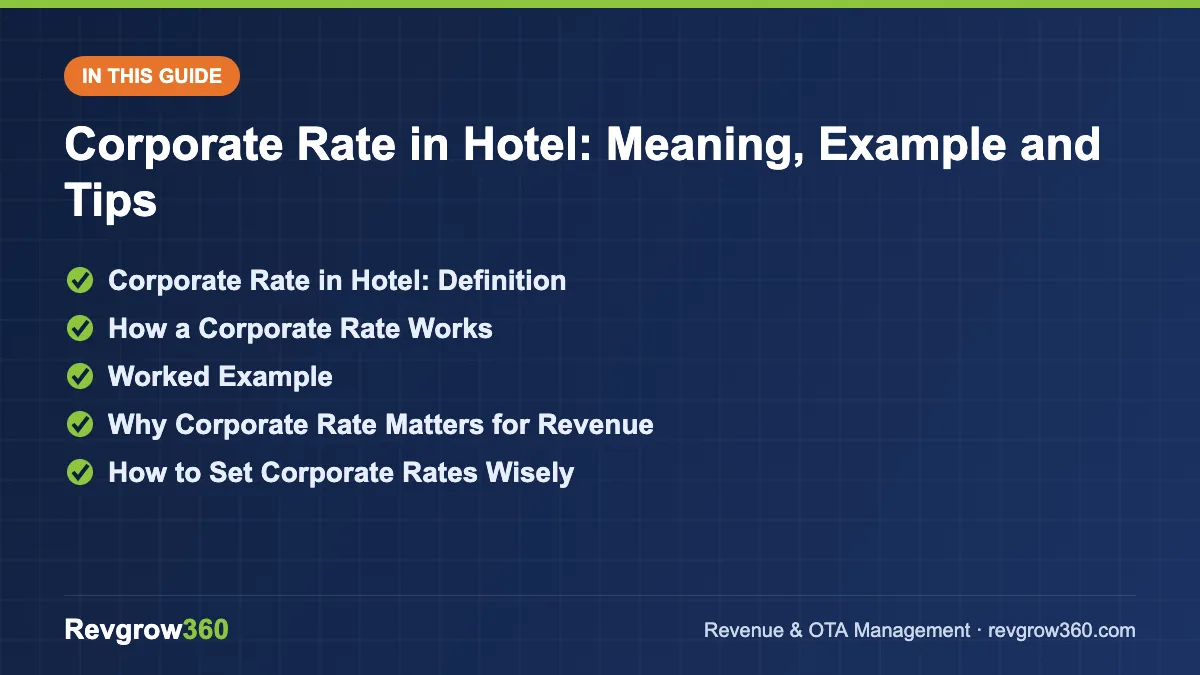
Corporate rate in hotel pricing is a discounted or negotiated room rate offered to a company’s employees in return for expected business volume. It is usually valid for a year, linked to a contract, and offered to guests travelling on business. Used well, it brings steady weekday occupancy. Used badly, it fills rooms at rates below what the market would pay. This page covers the meaning, a worked example and the mistakes to avoid.
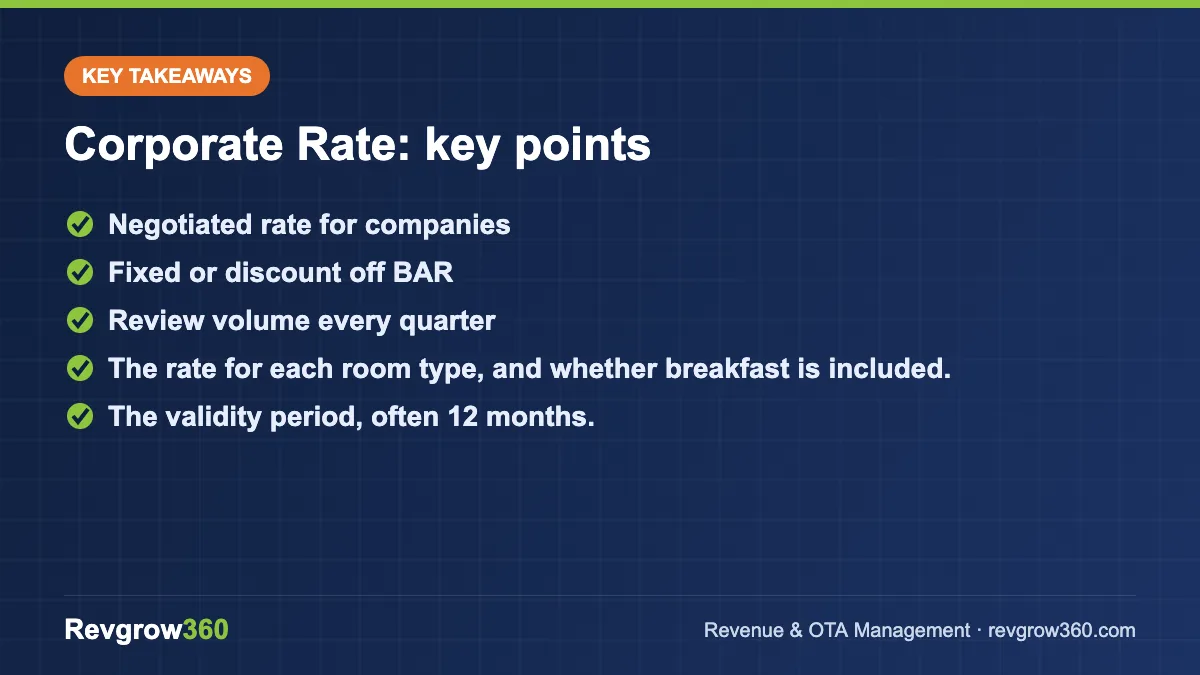
- Negotiated rate for companies
- Fixed or discount off BAR
- Review volume every quarter
Corporate Rate in Hotel: Definition
A corporate rate is agreed between the hotel and a company, a travel management company or a corporate booking platform. The company’s employees receive a fixed rate or a discount off the public rate when they book, often through a code, a dedicated link or by calling the sales team.
Typical elements of a corporate agreement include:
- The rate for each room type, and whether breakfast is included.
- The validity period, often 12 months.
- Any blackout dates when the rate does not apply, such as peak events or festivals.
- Cancellation and no-show terms.
- Payment terms and billing details, including GST invoicing.
- A commitment or target of room nights, if agreed.
A ready corporate rate contract.
How a Corporate Rate Works
There are two common structures.
| Structure | How it works | Pros and cons |
|---|---|---|
| Fixed rate | The company pays a set rate for the year, for example ₹4,200 for a deluxe room | Simple and predictable, but can be too low during peak demand |
| Discount off BAR | The company gets a percentage off the best available rate, for example 15 percent | Moves with demand, but needs clear caps and floors |
Many hotels use “last room availability” only for a small number of key accounts, and a “subject to availability” approach for others. Terms vary, so each hotel should decide what it can offer and put it in writing.
Who gets a corporate rate
Corporate rates suit companies with regular travel to your location: nearby offices, factories, consulting firms, banks, government contractors and event organisers. A 60-room business hotel near Salt Lake in Kolkata may have accounts with IT companies and banks, while a resort in Goa is more likely to have a few conference and incentive clients.
Revenue Health Score · free
Free tool: check your hotel’s revenue health
Answer a few quick questions about your rooms, rates, OTAs and reviews. Get a score out of 100, your weakest revenue areas and the first actions to fix them.
Worked Example
Suppose a 60-room hotel has a BAR of ₹5,500 for a deluxe room on weekdays. A company promises 600 room nights a year.
| Item | Value |
|---|---|
| BAR (weekday average) | ₹5,500 |
| Corporate discount offered | 15 percent |
| Corporate rate | ₹4,675 |
| Expected room nights a year | 600 |
| Expected room revenue | ₹28,05,000 |
Compare this with the alternative. If those rooms would otherwise sell at a lower weekday rate because demand is weak, the corporate account adds value by filling empty nights. If those nights would have sold at BAR anyway, the discount gives away ₹825 per night, which is ₹4,95,000 over 600 nights. The decision depends on forecast demand, not on the discount alone.
The impact is measured through ADR and RevPAR, and the figures above are illustrative only.
Why Corporate Rate Matters for Revenue
- Base occupancy: corporate guests fill weekday nights when leisure demand is lower.
- Lower acquisition cost: direct contracts avoid OTA commissions. Compare with OTA commission rates.
- Ancillary revenue: business guests often spend on food, laundry and meeting rooms.
- Repeat business: satisfied travellers return and recommend the hotel.
- Forecast stability: known room nights help planning.
The risk is dilution. Too many corporate accounts at low rates can pull down ADR and displace higher-paying guests during busy periods. Read our hotel distribution strategy guide to balance channels.
How to Set Corporate Rates Wisely
- Review last year’s data. Look at weekday occupancy, ADR and demand by month.
- Decide your floor. Calculate the minimum rate that still covers cost and gives a margin.
- Segment accounts. Give the best rates to those with proven volume, and smaller discounts to occasional accounts.
- Add blackout dates. Exclude peak events and festival dates where demand is high.
- Link to BAR. A percentage off BAR with a cap protects you in peak periods.
- Set terms. Document cancellation, payment, GST invoice details and review dates.
- Review quarterly. Compare promised and actual room nights; adjust or end under-performing contracts.
Common Mistakes with Corporate Rates
- Giving a corporate rate without any volume expectation or review.
- Offering fixed rates for a full year with no blackout dates.
- Letting rates drift below your cost or below what the OTA price shows, which damages parity.
- Not tracking production by account.
- Offering the same discount to every company.
- Leaving rates loaded in the system after a contract has ended.
- Poor billing support, which frustrates company accounts teams.
Related Terms
- BAR: the best available public rate; see BAR (Best Available Rate) in hotel pricing.
- Rack rate: the full published price.
- Net rate and commissionable rate: distribution terms.
- Last room availability: a promise to sell a rate until the last room.
- Blackout dates: dates when a special rate does not apply.
Corporate Rate in Practice: Tips for Sales Teams
When a company asks for a rate, do not start with your lowest number. Ask about expected room nights, travel days, average stay, preferred room type and payment terms. A company sending staff for four-night training stays is different from one that books a single night occasionally.
Offer value beyond discount: complimentary breakfast, early check-in when available, Wi-Fi, a meeting room hour or late check-out can be worth more to the guest than a small price cut and cost the hotel less.
Corporate Rate Review Checklist
- List all active corporate accounts with rate, validity and blackout dates.
- Compare room nights booked with the promised volume each quarter.
- Check the corporate rate against the current BAR on key dates.
- Confirm that billing details, GST numbers and contacts are correct.
Key Takeaways
- A corporate rate is a negotiated rate for company travellers, usually linked to volume and a yearly contract.
- Choose between fixed rates and a discount off BAR with caps.
- Use blackout dates and review production at least every quarter.
- Balance corporate volume against ADR and peak-night demand.
- Put terms in writing, including GST invoicing details.
Revgrow360 helps hotels set rates, contracts and channel mix that protect revenue. Read about our revenue management service or request a free hotel audit.
For more background, see this hotel industry overview on Wikipedia.
Frequently asked questions
What is a corporate rate in a hotel?
A corporate rate is a negotiated or discounted room price agreed with a company, usually for a year, in exchange for expected room nights. It may be a fixed rate or a percentage off the best available rate, with terms such as blackout dates.
How much discount should a hotel give on corporate rates?
There is no fixed number. It depends on volume, weekday demand, your cost floor and BAR. Many hotels give a modest discount to occasional accounts and a larger one only for proven volume, then review the contract against actual room nights.
Should corporate rates have blackout dates?
Usually yes. Blackout dates exclude peak events, festivals or high-demand periods when you could sell rooms at a higher price. They protect ADR and prevent corporate rates from displacing better-paying guests on your busiest nights.
How do I know if a corporate account is worth keeping?
Compare actual room nights, average rate, ancillary spend and displacement of higher-rated demand against the contract promise. Review quarterly. Renegotiate or end accounts that give low volume, deep discounts or frequent peak-night requests.
More Hotel Glossary guides
Commissionable Rate in Hotel: Meaning and Examples
A commissionable rate includes a commission paid to the agent or OTA who sells the room. See the formula, an example and…
Net Rate in Hotel: Meaning, Formula and Examples
A net rate is a confidential price given to travel partners with no commission. See how it works, a worked example and…
Rack Rate in Hotel: Meaning, Formula and Examples
Rack rate is the standard published full price of a hotel room. Learn how it works, how it differs from BAR and…
BAR (Best Available Rate) in Hotel: Meaning and Examples
BAR, or Best Available Rate, is the lowest flexible public rate for a room and date. Learn how it works, with an…
What is Wash Factor in Hotel? Meaning, Examples & Formula
Wash factor is the share of a group room block that goes unused. Learn the formula, an example and how to use…
What is Break-Even Occupancy in Hotel? Meaning & Formula
Break-even occupancy is the occupancy at which hotel revenue equals total costs. Learn the formula, an example and how to lower it.