 By Md Arif Ahamed
Quick summary: Learn what the rate index in hotel benchmarking means, the ARI formula, a worked example, how to read it with MPI and RGI, and common mistakes to avoid.
The rate index in hotel benchmarking, also called the Average Rate Index (ARI), compares your hotel’s ADR with the average ADR of your competitive set. It is calculated as your ADR divided by the set’s ADR, multiplied by 100. A rate index of 100 means you charge the same average rate as your competitors; above 100 means you price higher, and below 100 means you price lower.
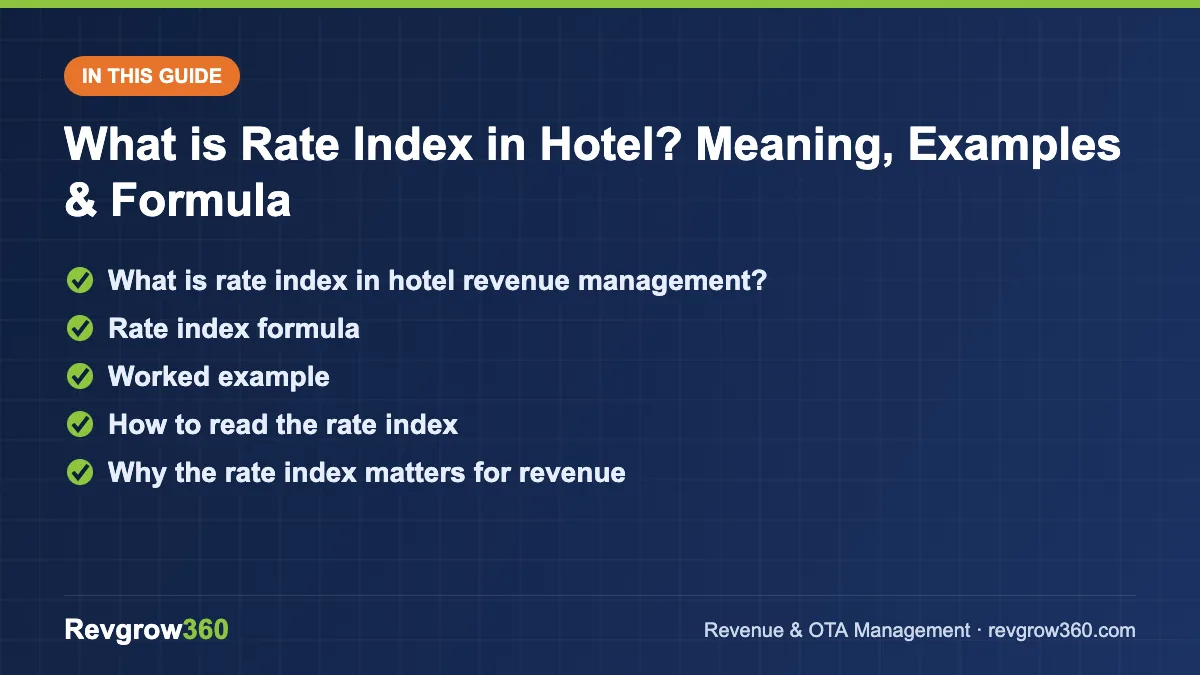
- Your ADR / set ADR x 100
- Above 100 = priced higher
- Read with MPI and RGI
This guide explains the rate index meaning, the formula, a worked example, how to read the number alongside occupancy and revenue indexes, and the mistakes that make the index misleading.
What is rate index in hotel revenue management?
The rate index shows your pricing position in the market. It answers one question: on average, do guests pay more or less to stay with you than with your competitors? It is one of three standard benchmarking indexes, alongside the Market Penetration Index (MPI) for occupancy and the Revenue Generation Index (RGI) for RevPAR.
It is based on ADR, not on published rates. That means it reflects the rates guests actually paid after discounts, packages and channel mix. Learn more about the underlying measure in average daily rate (ADR).
Find the right room rate for your costs and profit.
Rate index formula
Rate index (ARI) = (Your hotel ADR / Competitive set ADR) x 100
The competitive set ADR is the average ADR of the competing hotels, usually weighted by rooms sold, so larger hotels have more influence. A benchmarking provider normally calculates it. If you track it manually from rate shopping, treat the result as an estimate.
Worked example
A hypothetical 40-room hotel in Jaipur compares itself with its competitive set for one month.
| Item | Your hotel | Competitive set |
|---|---|---|
| ADR | ₹5,200 | ₹4,800 |
| Occupancy | 60% | 66% |
| RevPAR | ₹3,120 | ₹3,168 |
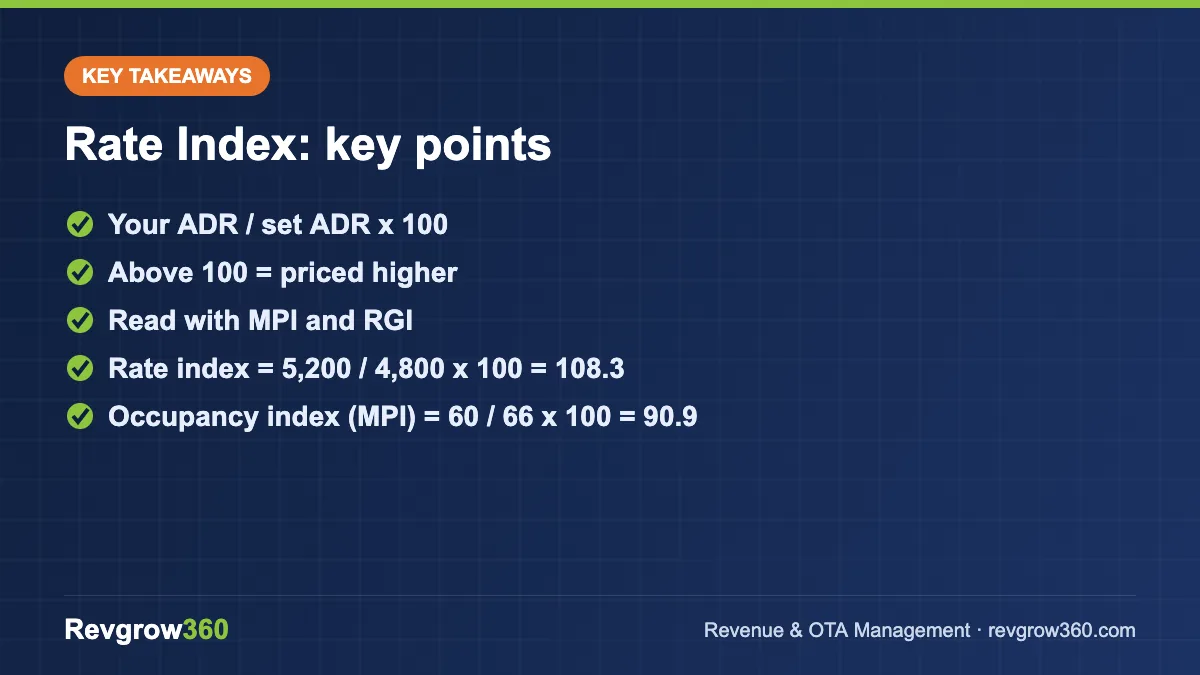
- Rate index = 5,200 / 4,800 x 100 = 108.3
- Occupancy index (MPI) = 60 / 66 x 100 = 90.9
- Revenue index (RGI) = 3,120 / 3,168 x 100 = 98.5
The hotel prices about 8 percent above the set, but sells fewer rooms. Its revenue share is just under fair share. The question is whether the higher rate is justified by the product and reviews, or whether it is costing volume.
How to read the rate index
| Rate index | Interpretation |
|---|---|
| Above 110 | Strong premium to the set; confirm that quality, reviews and brand support it |
| 100 to 110 | Mild premium; typical for a better-than-average hotel |
| About 100 | Priced at par with the set |
| 90 to 100 | Mild discount; check whether your product deserves a lower position |
| Below 90 | Deep discount; investigate heavy promotions, channel mix or weak positioning |
These bands are rules of thumb, not standards. A heritage boutique may deliberately run above 120 while a budget hotel may sit below 90 by design. What matters is whether the index fits your strategy and produces a healthy revenue index.
Reading it with the other two indexes
- High rate index, low occupancy index: you may be priced too high for your demand. Test lower rates on soft days.
- Low rate index, high occupancy index: you are buying volume with price. Test higher rates on strong days.
- Both above 100: you outperform the set; protect the position.
- Both below 100: review product, reviews and distribution as well as price.
Our guide to how to read STR reports shows how all three indexes fit together.
Why the rate index matters for revenue
A small change in rate has a large effect on revenue and profit, because extra price falls almost entirely to the bottom line, while extra volume brings extra cost. The rate index shows you whether you are leaving rate on the table.
- Pricing decisions: if your index is far below the set on peak dates, you are probably underpriced.
- Positioning: it checks that your rate position matches your quality position.
- Channel and promotion control: a falling index while occupancy is flat suggests heavy discounting.
- Owner reporting: it gives owners an objective view of pricing power.
See how rates are set dynamically in hotel dynamic pricing strategy.
Rate index by day type
An average monthly index can hide opposite stories. Split it by day of week and season. A resort in Goa might show a rate index of 112 on weekends but 91 midweek. That tells you the weekend premium is healthy while midweek discounting is running deep. Review the index by month, by weekday and by key event dates, and compare against the same period last year to see the trend.
Common mistakes
- Using published rates instead of ADR. The index must use achieved ADR, not rack rates.
- Weak competitive set. A set of mismatched hotels gives a meaningless number. Read how to choose a competitive set.
- Chasing 100. A rate index of 100 is not a goal; the right figure depends on your strategy.
- Ignoring occupancy. A high rate index with collapsing occupancy usually lowers total revenue.
- Looking only at monthly averages. Weekday and weekend indexes can tell opposite stories.
- Comparing across different markets. A rate index is only valid against its own set.
How to improve a low rate index
- Check which dates and channels pull ADR down.
- Remove or fence the deepest discounts.
- Raise rates on high-demand dates and test the response.
- Improve photos, reviews and room descriptions to support a higher price.
- Sell better room types and packages through upsell.
- Shift mix towards direct and higher-value segments.
Related terms
- MPI (Market Penetration Index): your occupancy compared with the set.
- RGI (Revenue Generation Index): your RevPAR compared with the set.
- ADR: room revenue divided by rooms sold.
- RevPAR: room revenue divided by rooms available.
- Competitive set: the hotels you benchmark against.
- Rate parity: consistent pricing across channels.
Key takeaways
- The rate index equals your ADR divided by the competitive set’s ADR, multiplied by 100.
- Above 100 means you price above the set; below 100 means below.
- Always read it with the occupancy and revenue indexes.
- Use achieved ADR and a well-chosen competitive set.
- Match the index to your strategy rather than chasing 100.
If you want an expert view on your pricing position, explore Revgrow360 revenue management or request a free hotel audit.
For more background, see this hotel industry overview on Wikipedia.
Frequently asked questions
What is the rate index in a hotel?
The rate index, or Average Rate Index (ARI), compares your hotel's ADR with the average ADR of your competitive set, multiplied by 100. A figure above 100 means you earn a higher average rate than competitors, and below 100 means a lower one.
How do you calculate rate index?
Divide your hotel's ADR by the competitive set's ADR and multiply by 100. For example, ₹5,200 divided by ₹4,800 equals 1.083, so the rate index is about 108.3. Use achieved ADR for the same period, not published rates.
What is a good rate index for a hotel?
There is no single good number. Hotels with stronger product and reviews often run above 100, while value hotels may sit below it by design. A good rate index fits your strategy and, together with occupancy, produces a healthy revenue index.
How is rate index different from RGI?
The rate index (ARI) compares ADR with your competitive set, while the revenue generation index (RGI) compares RevPAR. ARI shows pricing position only. RGI shows total revenue share because it combines rate and occupancy, so read both together.
More Hotel Glossary guides
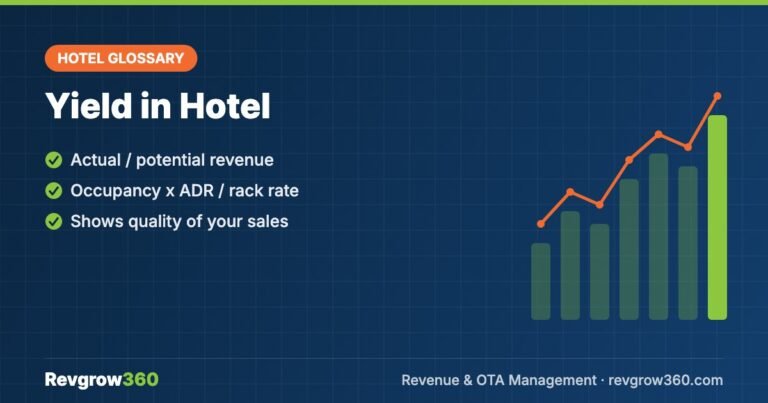
What is Yield in Hotel? Meaning, Examples & Formula
Yield shows how much of your potential room revenue you earn. Learn the formula, a worked example and practical ways to improve…
What is Room Night in Hotel? Meaning, Examples & Formula
A room night is one room occupied for one night. Learn how it is counted, the formulas that use it and why…
What is Lead Time in Hotels? Meaning, Examples & Formula
Lead time is the number of days between booking and check-in. Learn how to calculate it and use it to time rates,…

What is Booking Window in Hotels? Meaning, Examples & Formula
The booking window is the time between booking and arrival. Learn how to calculate it and use it to time rates, offers…
What is Pickup Report in Hotels? Meaning, Examples & Formula
A pickup report shows net new room nights booked in a set period for each future date, helping revenue managers change rates…
What is Booking Pace in Hotels? Meaning, Examples & Formula
Booking pace shows how quickly rooms are being booked for a future date compared with the same point last year or forecast,…