 By Md Arif Ahamed
Quick summary: Learn what yield in hotel means, the formula (actual revenue over potential revenue), a worked example, how it differs from RevPAR and how to improve it.
Yield in hotel revenue management measures how much of your potential room revenue you actually earn. It is calculated as actual room revenue divided by potential room revenue, expressed as a percentage. Potential revenue is what you would earn if every available room sold at your full rack rate. A higher yield means you are selling rooms at better rates and in a better mix, not just filling them.
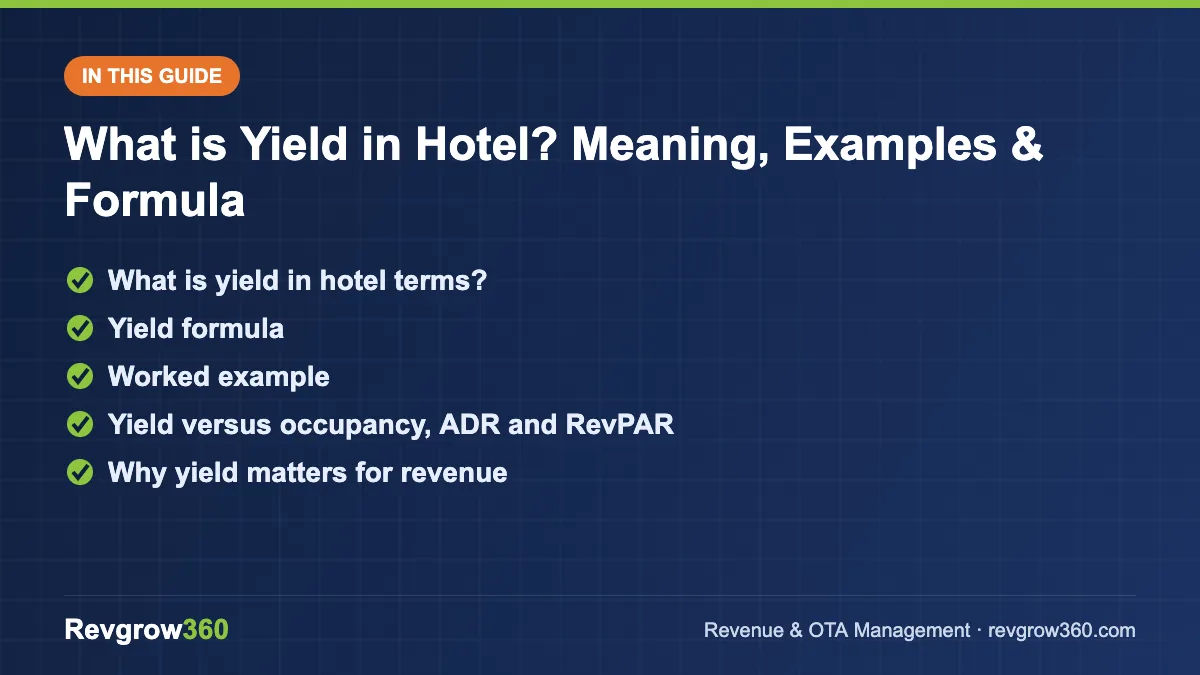
- Actual / potential revenue
- Occupancy x ADR / rack rate
- Shows quality of your sales
This guide explains the yield meaning, the formula, a worked example, how yield differs from occupancy and RevPAR, why it matters, and the mistakes that distort it. The term “yield management” is also used loosely for dynamic pricing, so we clarify both uses below.
What is yield in hotel terms?
Hotels have a limited number of rooms and each unsold night is lost forever. Occupancy tells you how many rooms you filled, and ADR tells you the average price, but neither tells you how close you came to your best possible outcome. Yield combines both into a single percentage of potential.
The idea has an older cousin: yield management, a method of varying prices and restrictions to maximise revenue from perishable inventory. Today most hotels call this revenue management; see our hotel revenue management guide. When someone says “yield” in a report, check whether they mean the percentage metric or the pricing method.
158 hotel terms explained in plain English.
Yield formula
Yield = Actual room revenue / Potential room revenue x 100
Potential room revenue = Rooms available x Rack rate (or maximum achievable rate)
Many hotels also use a version in terms of occupancy and rate:
Yield = Occupancy % x (ADR / Rack rate)
The definition of potential revenue matters. Some hotels use the published rack rate for each room type, others use a target ADR, and some use the maximum rate sold in the period. Choose one definition and keep it constant, otherwise comparisons across months become meaningless.
Worked example
A hypothetical 25-room hotel in Mumbai, in a 30-day month, uses a rack rate of ₹8,000 as the full rate.
| Item | Value |
|---|---|
| Rooms available | 25 x 30 = 750 room nights |
| Potential revenue | 750 x ₹8,000 = ₹60,00,000 |
| Rooms sold | 525 (occupancy 70%) |
| ADR | ₹5,600 |
| Actual room revenue | 525 x ₹5,600 = ₹29,40,000 |
| Yield | 29,40,000 / 60,00,000 = 49% |
Check with the second formula: 70% x (5,600 / 8,000) = 0.70 x 0.70 = 0.49, or 49 percent. The hotel earned about half of its theoretical maximum.
Yield versus occupancy, ADR and RevPAR
| Metric | What it tells you | Limit |
|---|---|---|
| Occupancy | Share of rooms sold | Ignores price |
| ADR | Average price per sold room | Ignores unsold rooms |
| RevPAR | Revenue per available room | Gives a rupee value, not a percentage of potential |
| Yield | Revenue as a percentage of potential | Depends on how potential is defined |
RevPAR and yield move together: in the example above, RevPAR is ₹3,920 (₹29,40,000 / 750), which is 49 percent of the ₹8,000 rack rate. If you want to read more, see what is RevPAR and hotel occupancy rate.
Why yield matters for revenue
- It shows quality of sales. A hotel at 90 percent occupancy with deep discounts may have a lower yield than one at 70 percent with strong rates.
- It balances volume and price. Raising rate may lower occupancy, but yield tells you whether the trade was worth it.
- It highlights discount leakage. A low yield with high occupancy points to over-discounting or poor channel mix.
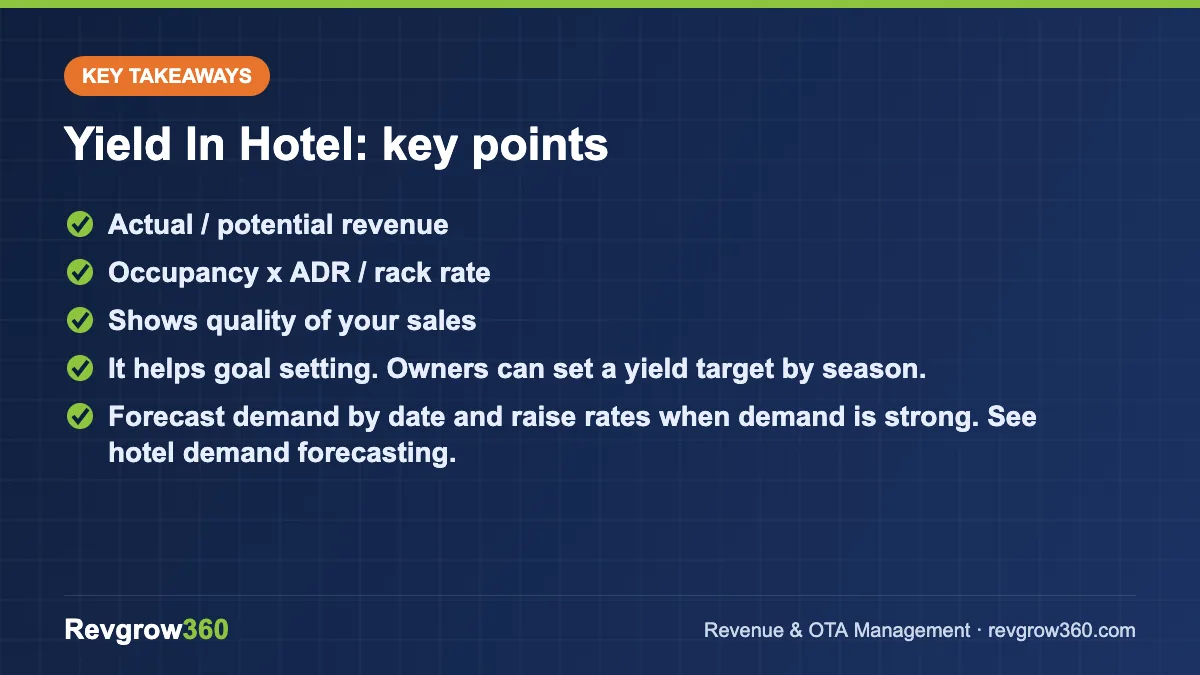
- It helps goal setting. Owners can set a yield target by season.
- It supports decisions on restrictions. Minimum stays and fenced rates raise yield on high-demand dates; see length of stay restrictions.
How to improve yield
- Forecast demand by date and raise rates when demand is strong. See hotel demand forecasting.
- Close or limit the lowest rate plans on peak dates.
- Use rate fences such as non-refundable and advance purchase for discounts.
- Shift channel mix towards lower-cost, higher-rate sources.
- Upsell better rooms and packages.
- Manage groups carefully so they do not displace higher-rate transient business.
Setting a sensible target
There is no universal good yield figure, because it depends on how you define potential revenue. Start by calculating your yield for each month of the past year. Then set targets by season: a higher number for peak months, where you can hold rate, and a more modest one for low season. Review the result monthly alongside occupancy and ADR, and adjust the target when your rack rate or product changes, such as after a renovation.
A short example: if your monsoon yield was 35 percent last year and you target 40 percent, you can reach it by raising ADR about 14 percent at the same occupancy, or by lifting occupancy about 14 percent at the same ADR, or by a mix of both. The yield formula lets you test these options before you decide.
Common mistakes
- Changing the definition of potential revenue. Keep one standard.
- Using an inflated rack rate. A rack rate that nobody pays makes yield look artificially low.
- Chasing occupancy alone. A full hotel is not always a profitable hotel.
- Ignoring costs. Revenue yield does not include commission, so check net results too. See OTA commission rates for hotels.
- Confusing yield with interest yield. In finance, yield means something different; in a hotel, check the context.
- Comparing different room types without weighting. Use room-type-level potential revenue for accuracy.
Related terms
- Yield management: varying prices and restrictions to maximise revenue.
- Rack rate: the published full price of a room.
- RevPAR: revenue per available room.
- ADR: average daily rate.
- Occupancy: share of rooms sold.
- Rate fences: conditions that separate discounted from full-price guests.
Key takeaways
- Yield is actual room revenue as a percentage of potential room revenue.
- It equals occupancy multiplied by ADR divided by rack rate.
- It shows the quality of your sales, not just the volume.
- Define potential revenue once and use it consistently.
- Improve yield through forecasting, fences, mix management and upselling.
Revgrow360 helps hotels raise yield through pricing, distribution and OTA management. Explore hotel revenue management or book a free consultation.
For more background, see this hotel industry overview on Wikipedia.
Frequently asked questions
What is yield in a hotel?
Yield is actual room revenue divided by potential room revenue, shown as a percentage. Potential revenue is rooms available multiplied by a full or rack rate. It shows how well a hotel converts its inventory into revenue, combining both occupancy and rate in one number.
How do you calculate hotel yield?
Divide actual room revenue by potential room revenue and multiply by 100. You can also multiply occupancy percentage by ADR divided by rack rate. For example, 70 percent occupancy and an ADR of ₹5,600 against an ₹8,000 rack rate gives 49 percent.
What is the difference between yield and RevPAR?
RevPAR is room revenue per available room, shown in rupees. Yield is revenue as a percentage of potential revenue. They move together, but yield needs a defined potential or rack rate, which makes it sensitive to how a hotel sets that benchmark.
What is yield management in hotels?
Yield management is the practice of adjusting prices and restrictions to maximise revenue from perishable room inventory. Most hotels now call it revenue management, which also includes distribution, forecasting and segmentation, not only price changes.
More Hotel Glossary guides
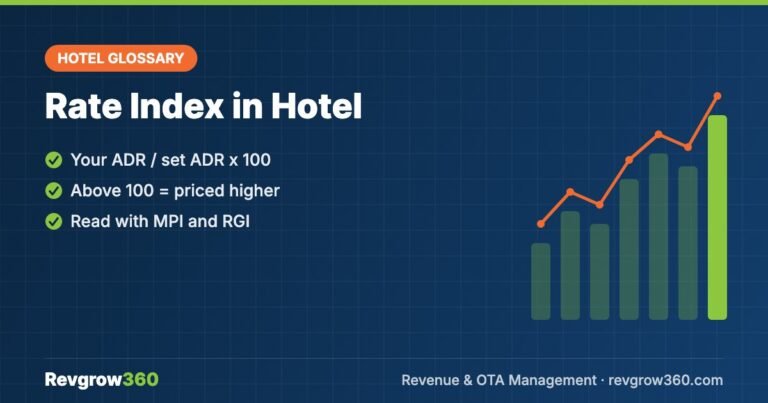
What is Rate Index in Hotel? Meaning, Examples & Formula
The rate index compares your hotel's ADR with your competitive set. Learn the formula, a worked example and how to act on…
What is Room Night in Hotel? Meaning, Examples & Formula
A room night is one room occupied for one night. Learn how it is counted, the formulas that use it and why…
What is Lead Time in Hotels? Meaning, Examples & Formula
Lead time is the number of days between booking and check-in. Learn how to calculate it and use it to time rates,…

What is Booking Window in Hotels? Meaning, Examples & Formula
The booking window is the time between booking and arrival. Learn how to calculate it and use it to time rates, offers…
What is Pickup Report in Hotels? Meaning, Examples & Formula
A pickup report shows net new room nights booked in a set period for each future date, helping revenue managers change rates…
What is Booking Pace in Hotels? Meaning, Examples & Formula
Booking pace shows how quickly rooms are being booked for a future date compared with the same point last year or forecast,…