 By Md Arif Ahamed
Quick summary: OTA commission rates for hotels explained: typical ranges on Booking.com, Expedia, Agoda and MMT, how to calculate effective cost, and how to reduce dependency.
For many independent hotels, OTA commission is now one of the largest costs after payroll and utilities. Yet few owners know their true effective commission once promotions, visibility programmes, taxes and payment charges are added. This guide explains OTA commission rates for hotels: how commission works, the typical ranges on major platforms, how to calculate what you really pay per booking, and practical ways to reduce dependency on OTAs without losing the demand they bring.
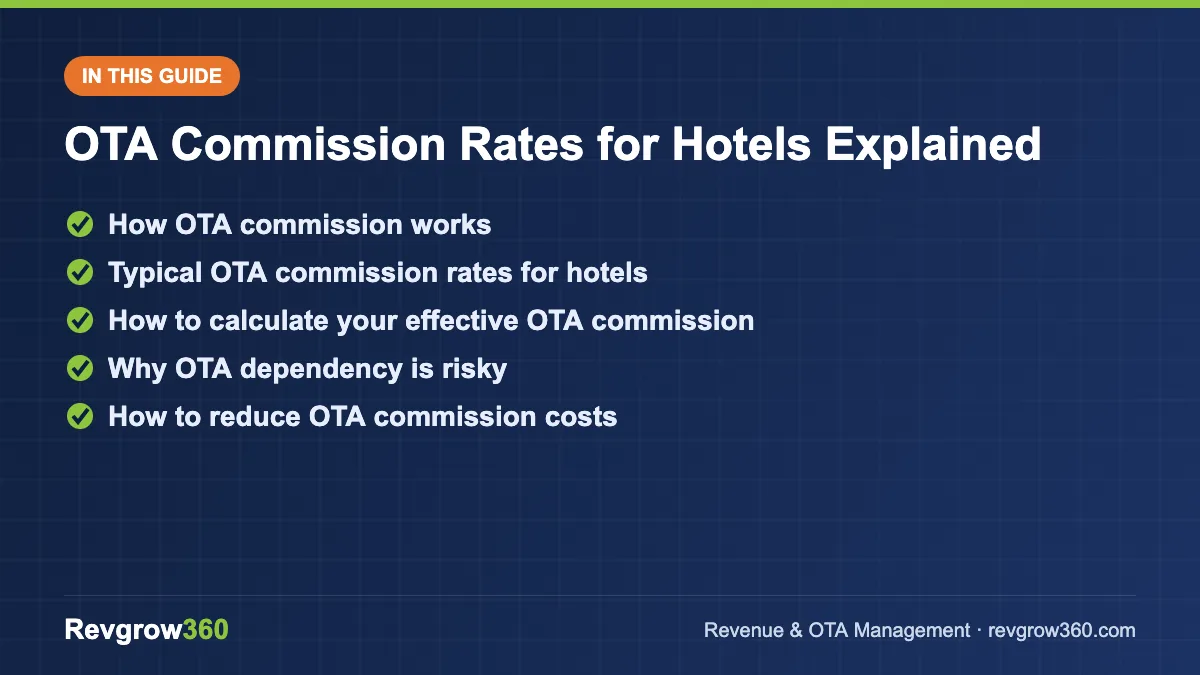
- Typical ranges by platform
- Calculate effective commission
- Ways to cut OTA dependency
How OTA commission works
Most OTAs work on one of two models:
- Agency (commission) model: the guest books on the OTA, usually pays at the hotel or the hotel charges the card, and the OTA invoices the hotel a percentage of the room revenue after the stay.
- Merchant model: the OTA collects payment from the guest at booking and pays the hotel a net amount, keeping its margin. The effect is similar to a commission, but deducted before you receive the money.
Many OTAs now offer both, sometimes letting the guest choose. In either case, the cost is usually a percentage of the room rate, not a fixed fee.
What commission is usually calculated on
Commission is generally charged on the room revenue of the booking, which may or may not include taxes and meals depending on the platform and contract. In India, GST is typically charged on the commission invoice itself, which adds to your real cost. Check your agreement to see exactly what amount the percentage applies to.
See what you really earn from each OTA booking.
Typical OTA commission rates for hotels
Rates vary by country, property type, contract, negotiation and programmes you join. The ranges below are commonly cited general ranges, not fixed prices. Your contract is the only reliable source for your property.
| Platform | Typical base commission range | What can increase it |
|---|---|---|
| Booking.com | Typically around 15–18% in many markets | Visibility programmes (e.g. Preferred, Visibility Booster); some promotions |
| Expedia Group | Typically around 15–25% | Commission-based visibility tools; sponsored listings are extra |
| Agoda | Typically around 15–20% | Optional growth/visibility programmes |
| MakeMyTrip / Goibibo | Varies widely by contract; often mid-to-high teens or more | Campaigns, sale events, preferred placements |
| Airbnb | Split-fee model with a small host fee, or host-only fee typically around 14–16% | Depends on fee structure and region |
| Wholesalers/bed banks | Net-rate model; margin set by mark-up | Depth of net discount you give |
The headline percentage is only part of the story. Discounts you fund, extra visibility commission and payment processing add to the effective cost.
How to calculate your effective OTA commission
Use this formula for each OTA, monthly:
Effective commission % = (Total commission + programme fees + GST on commission + payment charges) ÷ Gross room revenue from that OTA × 100
And to understand the impact of promotions, compare against your undiscounted rate:
Net rate = Selling rate × (1 − discount %) × (1 − commission %)
Worked example: a 40-room hotel in Goa
A hypothetical 40-room hotel in Goa earns ₹20,00,000 in room revenue from one OTA in a month.
- Base commission at 18%: ₹3,60,000
- Visibility programme adding 3% on some bookings worth ₹8,00,000: ₹24,000
- GST at 18% on commission (₹3,84,000): ₹69,120
- Payment and card charges on prepaid bookings: say ₹15,000
Total cost: ₹4,68,120, or about 23.4% of room revenue. And if many of these bookings also carried a 10% promotion, the hotel gave up additional revenue before commission was even calculated. Seeing the full number is the first step to managing it.
Why OTA dependency is risky
OTAs are valuable. They provide global reach, marketing, trust and booking technology that most independent hotels could never build alone. The problem is not using OTAs; it is relying on them for almost all bookings.
- Margin pressure: every booking carries a sizable acquisition cost.
- Limited guest relationship: guest contact details and repeat-booking opportunities are often restricted.
- Exposure to algorithm and policy changes: a change in ranking or commission terms can affect revenue quickly.
- Weaker negotiation position: high dependency limits your options.
How to reduce OTA commission costs
1. Review and negotiate your contract
Know your base rate, what it is calculated on, and the cost of each programme you have joined. Properties with strong performance sometimes have room to discuss terms with their market manager. Even if the base does not change, removing unnecessary programmes can lower your effective rate.
2. Use visibility programmes only where needed
Switch commission-based visibility on for low-demand periods and off for dates that fill naturally. Review this monthly.
3. Audit promotions
Stacked promotions and permanent discounts quietly increase your effective acquisition cost. Keep a promotions register and remove anything that is not filling a specific gap.
4. Grow direct bookings
Direct bookings usually carry the lowest cost per booking, even after website, booking engine and marketing costs. Practical steps:
- A fast, mobile-friendly website with a reliable direct booking engine
- An accurate Google Business Profile and free booking links on Google Hotels
- Clear direct-booking benefits that respect your parity terms: breakfast, late check-out, welcome drink
- Collecting guest emails and phone numbers at check-in, with consent, for future offers
- WhatsApp and phone enquiries handled quickly by trained staff
- Consistent social media and digital brand building
5. Convert OTA guests into repeat direct guests
Deliver an excellent stay, then invite guests to book directly next time with a simple benefit. Respect OTA policies on guest communication, but on-property service and brand recall are entirely in your hands.
6. Build corporate and group business
Local corporate contracts, wedding and event groups, and travel agents can provide steady volume at a predictable cost.
7. Measure cost of acquisition by channel
Compare channels on net revenue, not gross. A booking from an OTA at ₹6,000 with 23% effective cost leaves ₹4,620. A direct booking at ₹5,700 with an estimated 8% marketing and booking engine cost leaves ₹5,244. The direct guest paid less and you earned more.
What a healthy channel mix can look like
There is no single correct mix; it depends on your location, segment and season. A city business hotel may rely more on corporate and direct business, while a leisure resort may depend more on OTAs during its first years. The goal is to move gradually toward a mix where no single channel controls your business, and where direct and repeat bookings grow every year.
Key takeaways
- OTA commission rates for hotels typically fall in a range of around 15–25%, depending on platform, market and contract.
- Your effective commission includes programmes, GST on commission, discounts and payment charges.
- Calculate effective commission monthly for each OTA using a simple formula.
- Reduce cost by auditing programmes and promotions, negotiating where possible and growing direct bookings.
- Compare channels on net revenue per booking, not headline price.
- Aim for balance: keep OTAs for reach, while steadily building direct and repeat business.
Reducing OTA dependency is about balance, not cutting OTAs off. Revgrow360 has supported 500+ hotels in managing OTAs, building direct channels and tracking net revenue by channel. Learn more about our hotel revenue management approach, or book a free consultation to review your commission costs.
For more background, see this revenue management overview on Wikipedia.
Frequently asked questions
What is the typical OTA commission for hotels?
Commission typically falls somewhere around 15 to 25 percent of room revenue, depending on the platform, country, property type and contract. Visibility programmes and promotions can raise the effective cost further. Your own OTA agreement is the only reliable source for your exact rate, so check it rather than relying on general figures.
Is GST charged on OTA commission in India?
Yes, OTAs generally charge GST on their commission invoices, which adds to your real cost per booking. Whether you can claim input tax credit depends on your GST registration and the tax slab of your room tariffs. Speak with your chartered accountant to understand the exact impact for your property.
How do I calculate my effective OTA commission?
Add total commission, programme fees, GST on commission and payment charges for one OTA over a month, then divide by gross room revenue from that OTA and multiply by 100. This shows the true percentage you pay, which is often higher than the headline commission rate in your contract.
How can hotels reduce OTA dependency?
Keep OTAs for reach but grow other channels. Improve your website and booking engine, use Google Hotels free links, offer value-added direct benefits within parity terms, build corporate and group business, and turn OTA guests into repeat direct guests through great service. Track net revenue per channel to measure progress.
More Revenue Management guides
Revenue Management for Boutique Hotels: A Practical Guide
A practical guide to pricing and distribution for small, distinctive hotels, including room-type pricing, restrictions, channels and a weekly checklist.
Short Term Rental KPIs: 10 Metrics with Formulas
The 10 short term rental KPIs every host should track, each with a formula and a worked example, plus how to set…
Airbnb Income and Expense Tracking: A Simple System
Learn what to record for every booking and expense, how payouts differ from gross revenue, which categories to use and a monthly…
Revenue Management for Resorts: A Practical Guide
How resorts can manage rates, groups, packages and non-room revenue to maximise total income per guest, with a worked example and checklist.
Revenue Management for Homestays: A Practical Guide
A practical, step-by-step guide to pricing, channels and add-on income for small homestays, with a worked example and a 30-minute weekly routine.
Hotel Rate Parity: What It Is and How to Maintain It
Rate parity keeps your price consistent across OTAs, metasearch and your website. Learn what causes disparity and a practical daily routine to…