 By Md Arif Ahamed
Quick summary: Inventory control in hotel operations explained: how room availability is managed across channels, a worked example, a daily routine and mistakes to avoid.
Inventory control in hotel operations means managing how many rooms are available to sell on every date, on every channel and at every rate, so that no room is oversold or left empty without reason. A hotel’s room inventory is perishable: a room unsold tonight cannot be sold tomorrow. Strong inventory control in hotel revenue management keeps the PMS, channel manager and OTAs in sync and protects both occupancy and guest experience.
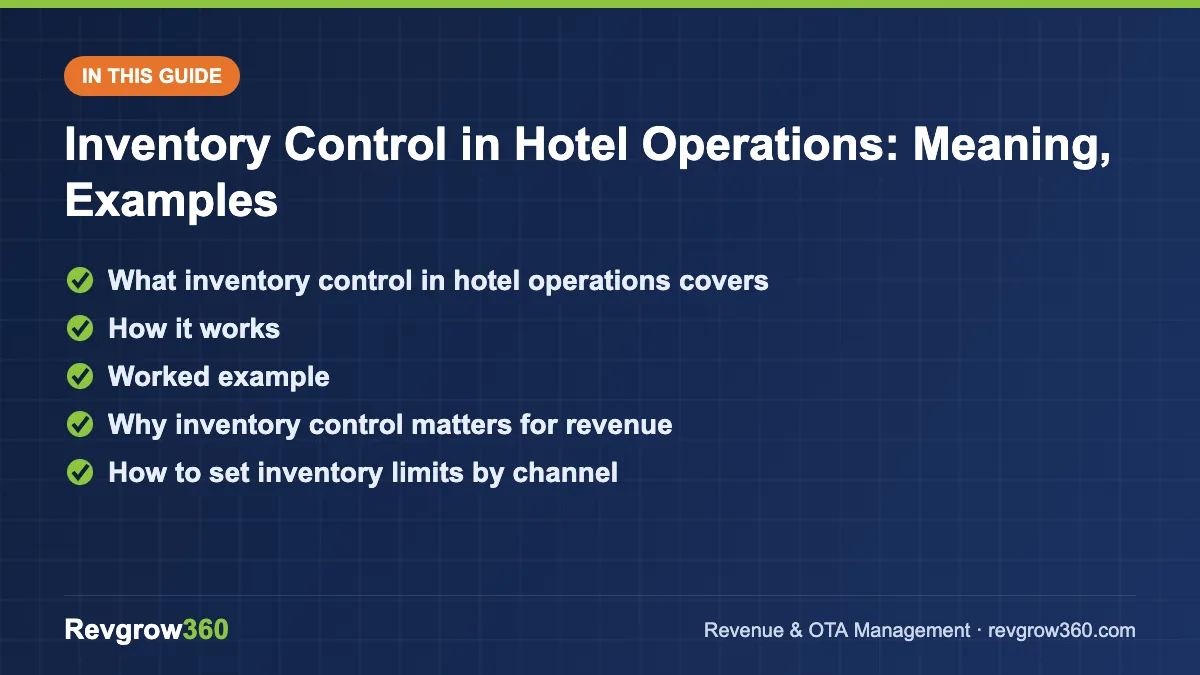
- One master room count
- Sync PMS, channel manager, OTAs
- Check next 30 days daily
What inventory control in hotel operations covers
Inventory is the number of sellable room units by date and room type. Control means deciding how many of those units each channel may sell, updating them in real time, and acting when demand changes. It covers four things:
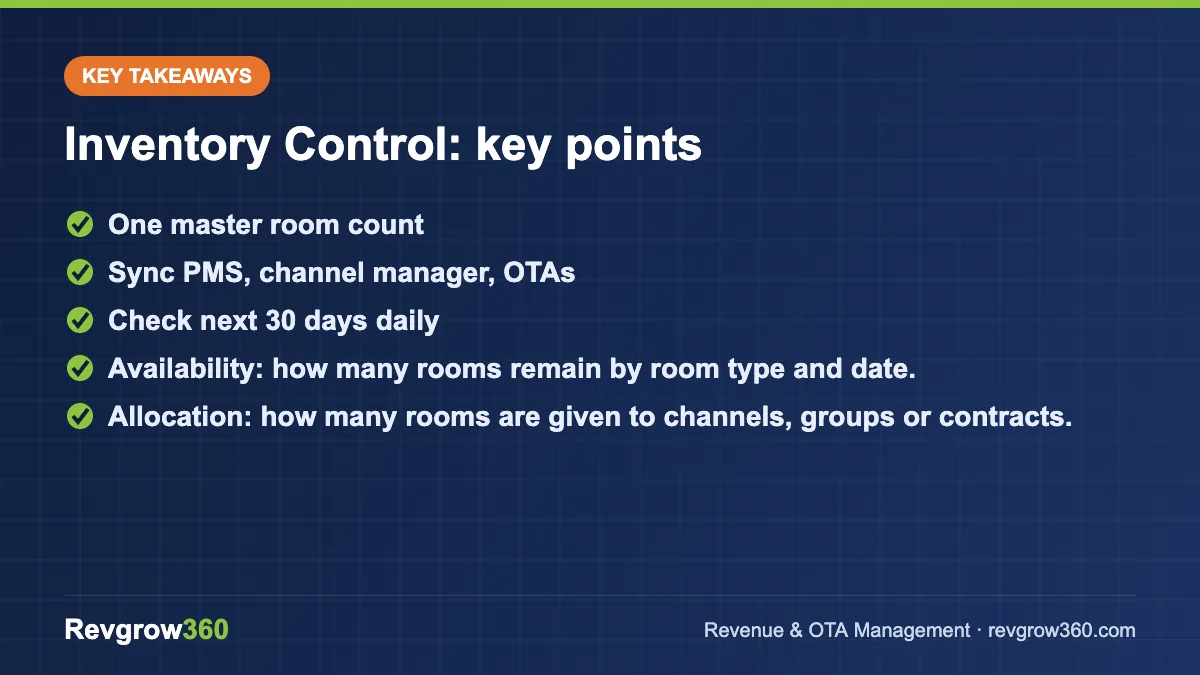
- Availability: how many rooms remain by room type and date.
- Allocation: how many rooms are given to channels, groups or contracts.
- Restrictions: minimum stay, closed to arrival, stop sell.
- Synchronisation: making sure every system shows the same number.
Some people also use “inventory” for housekeeping and F&B stock. In revenue management, it refers to rooms.
158 hotel terms explained in plain English.
How it works
Your PMS holds the master count. A channel manager reads it and pushes availability to each OTA. When a booking comes in on any channel, the PMS reduces the count, and the channel manager updates every other channel within seconds. Without this link, you rely on manual updates in each extranet, which is slow and error-prone.
Types of inventory arrangements
| Arrangement | Meaning | Best used for |
|---|---|---|
| Shared (pooled) inventory | All channels sell from one common pool | Most hotels, simple and flexible |
| Allotment (fixed allocation) | A set number of rooms reserved for a channel or agent | Contracted tour operators, corporate deals |
| Free sale | Partner may sell while availability exists, no fixed number | Trusted partners, normal OTA connection |
| Group block | Rooms held for an event with a cut-off date | Weddings, conferences |
Revenue Health Score · free
Free tool: check your hotel’s revenue health
Answer a few quick questions about your rooms, rates, OTAs and reviews. Get a score out of 100, your weakest revenue areas and the first actions to fix them.
Worked example
A 30-room hotel in Jaipur has 20 Deluxe rooms and 10 Suites. For a Saturday, 18 Deluxe rooms are already sold. The remaining 2 Deluxe rooms are visible on three OTAs and the hotel’s own booking engine.
- Two guests book the last Deluxe rooms on two different OTAs within a minute.
- If systems are connected, the second booking reduces availability to zero and every channel closes Deluxe for that date.
- If one OTA is updated by hand, it may still show 2 rooms and accept a third booking. The hotel is now overbooked by one room.
The cost of one oversold room can include a relocation to another hotel, compensation and a poor review. For a deeper view, read our guide on hotel overbooking strategy.
A simple measure is the inventory accuracy rate:
Inventory accuracy % = (dates with matching availability across systems / total dates checked) x 100
If you check 30 dates and 27 match, accuracy is 90 percent. Aim for 100 percent on the next 30 days.
Why inventory control matters for revenue
- Prevents overbooking: avoids walk costs and review damage.
- Prevents underselling: if a channel closes by mistake, you lose bookings quietly.
- Protects rate integrity: you can close cheaper channels when demand is high and keep inventory for higher-rated sales.
- Supports forecasting: clean inventory data shows true occupancy and pace. See hotel demand forecasting.
- Improves occupancy and RevPAR: rooms are sold at the right time, to the right channel. Read what is RevPAR.
How to set inventory limits by channel
Pooled inventory is the default, but you can still control how aggressively each channel sells. Many hotels use a simple rule set that changes with demand.
| Demand level (forecast occupancy) | Typical action |
|---|---|
| Below about 50 percent | Keep all channels open, consider promotions and longer visibility on OTAs |
| About 50 to 80 percent | Keep all channels open, raise rates gradually, watch pace daily |
| Above about 80 percent | Close discounted rate plans, apply minimum stay, keep last rooms for direct and higher-rated sales |
| Near full | Close low-yield channels first, keep a small buffer for cancellations and no-shows |
These bands are examples only. Set yours from your own history. The aim is to protect your last rooms for the guests willing to pay the most, without turning away demand too early.
Inventory and overbooking buffers
Some hotels deliberately sell slightly above capacity because of expected cancellations and no-shows. This is a risk decision, not an accident, and it requires a clear walk policy and a partner hotel. Never do it by default or without data.
Daily inventory control routine
- Open the next 30 days of availability by room type in the PMS.
- Compare with the channel manager and two or three top OTAs.
- Check for stop-sell or closed dates that are no longer needed.
- Release or reduce group blocks past their cut-off date.
- Close or restrict low-yield channels on high-demand dates.
- Record any mismatch and its cause, such as a manual booking not entered.
Common mistakes
- Entering walk-in and phone bookings in a notebook and not in the PMS.
- Updating OTAs by hand instead of using a channel manager.
- Leaving group blocks open after the cut-off, so rooms stay locked.
- Keeping an unrealistically large allotment with a single agent.
- Forgetting out-of-order rooms. A room under repair must be removed from inventory.
- Not mapping room types correctly, so one OTA room draws from the wrong pool.
Who owns inventory control
In a small hotel the owner or front office manager usually owns it. In a larger property the revenue manager sets restrictions and allocations, while reservations staff enter bookings correctly. Whoever owns it, name one person for each day so that nothing is left to chance.
Related terms
Overbooking, allotment, stop sell, room type mapping, channel manager, parity, availability, pace and group block. Your overall approach should sit within a clear hotel distribution strategy.
Key takeaways
- Inventory control in hotel operations is about selling the right room, to the right channel, at the right time.
- A PMS and channel manager sharing one pool avoids most overbooking.
- Check the next 30 days daily and track an accuracy rate.
- Remove out-of-order rooms and expired group blocks promptly.
- Correct room type mapping is a prerequisite for accurate inventory.
Revgrow360 helps hotels set up connected inventory and manage OTA listings every day. Explore our OTA management service or request a free hotel audit.
For more background, see this hotel industry overview on Wikipedia.
Frequently asked questions
What is inventory control in a hotel?
It is the management of how many rooms are available to sell by date, room type and channel. The goal is to avoid overselling or leaving rooms unsold by accident, and to keep the PMS, channel manager and OTAs showing the same availability.
How does a channel manager help inventory control?
A channel manager reads availability from your PMS and pushes it to every OTA and booking engine in near real time. When a booking arrives on one channel, it reduces availability on the others, which greatly lowers the risk of double bookings.
What is the difference between allotment and free sale?
An allotment reserves a fixed number of rooms for a partner, who sells only from that number. Free sale lets a partner sell while the hotel has availability, with no fixed quota. Free sale is flexible, while allotment gives the partner certainty.
How often should hotel inventory be checked?
Check the next 30 days every day, comparing the PMS with the channel manager and main OTAs. Also review group blocks at their cut-off dates and remove out-of-order rooms immediately. Frequent checks catch mismatches before they become overbookings.
More Hotel Glossary guides
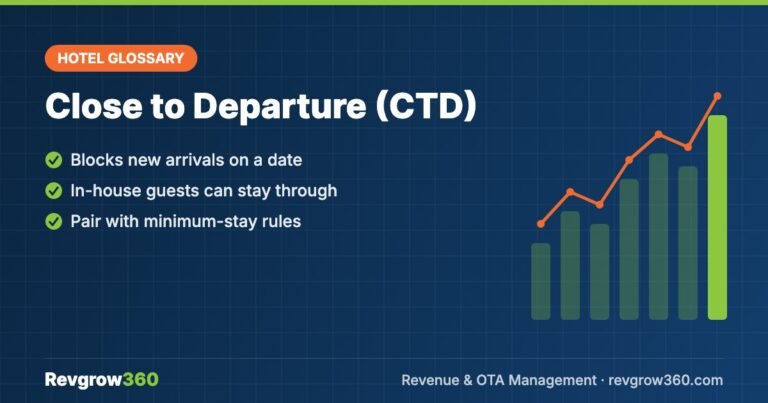
Close to Departure (CTD) in Hotel: Meaning and Examples
Learn what close to departure (CTD) means in hotel revenue management, how it blocks new arrivals on key dates and how to…
What is Close to Arrival (CTA) in a Hotel? Meaning
Close to arrival blocks check-ins on a chosen date while still letting guests stay through it. Learn when and how to use…
What is Stop Sell in a Hotel? Meaning and Examples
Stop sell closes a date, room type, rate or channel to new bookings. Learn when to use it, how it differs from…
What is Hotel Allotment? Meaning, Formula and Examples
A hotel allotment holds rooms for a travel partner until a release date. Learn how it works, how to measure pick-up and…
What is Non-Refundable Rate in a Hotel? Meaning, Examples
A non-refundable rate gives guests a lower price in exchange for no cancellation. Learn the meaning, pricing logic and when to use…
What is Package Rate in a Hotel? Meaning and Examples
A package rate bundles a room with meals or experiences at one price. Here is the meaning, formula, example and common mistakes.
Related guide: What is GOPPAR in Hotels? Meaning, Examples & Formula
Free PDF checklist
Where is your hotel losing money?
27 quick checks on pricing, OTAs, reviews and direct bookings, with the first fix for every leak.
Get the free checklist →