 By Md Arif Ahamed
Quick summary: Hotel total revenue management explained: TRevPAR, GOPPAR, segment spend, packages, outlet capacity and a step-by-step method with a worked rupee example.
Hotel total revenue management is the practice of managing pricing, demand and profit across every source of income in the property, not just rooms. It includes food and beverage, banquets, spa, parking, activities, retail and other services, and treats the guest’s whole spend as the goal. The idea is to maximise total profit per available room or per guest, instead of selling rooms at the highest rate while leaving money on the table elsewhere.
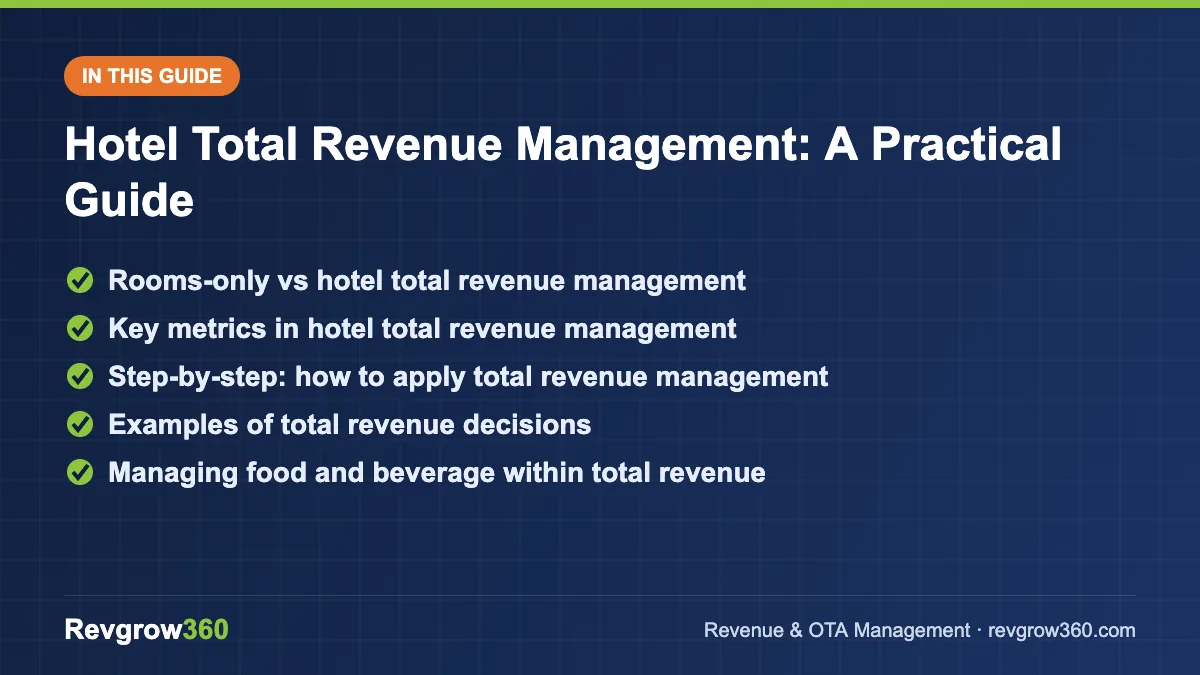
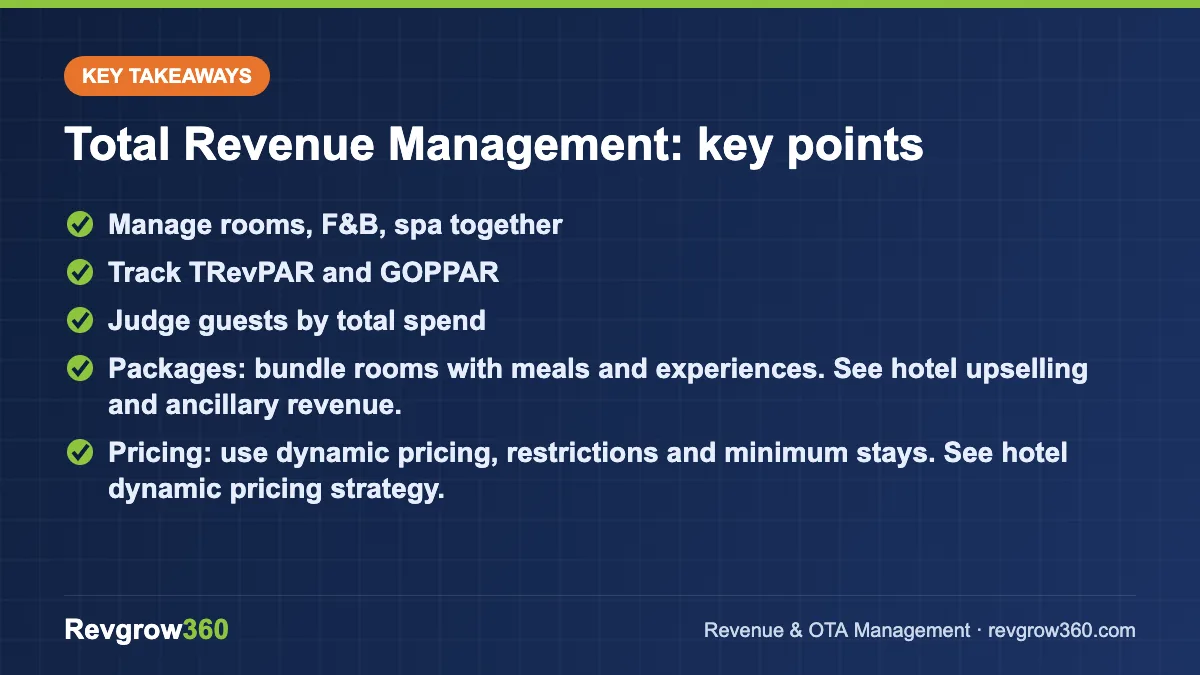
- Manage rooms, F&B, spa together
- Track TRevPAR and GOPPAR
- Judge guests by total spend
This guide explains how total revenue management works for Indian hotels and resorts, with a practical method, an example and the metrics to track.
Rooms-only vs hotel total revenue management
| Aspect | Rooms-only revenue management | Total revenue management |
|---|---|---|
| Focus | Rate and occupancy of rooms | Profit across all departments |
| Main metrics | ADR, occupancy, RevPAR | TRevPAR, GOPPAR, spend per guest |
| Decisions | Room rate and restrictions | Which guests and packages produce the best total profit |
| Departments | Revenue and front office | Rooms, F&B, banquets, spa, activities, sales |
| Risk | Filling rooms with low-spend guests | Complexity; needs data from all outlets |
If you are new to the basics, read the hotel revenue management guide and what is RevPAR first.
Score your OTA listing and get the top fixes.
Key metrics in hotel total revenue management
TRevPAR
TRevPAR = Total revenue / Available rooms
Total revenue includes rooms, F&B, spa and other income. It shows how well all departments earn from your room inventory.
GOPPAR
GOPPAR = Gross operating profit / Available rooms
GOPPAR adds cost to the picture. It prevents a strategy that raises revenue but lowers profit.
Total revenue per occupied room
Total revenue divided by occupied room nights helps you understand the spend of the average in-house guest.
Worked example
A 50-room resort in Goa, over 30 days in a month, has 1,500 available room nights.
| Item | Amount (hypothetical) |
|---|---|
| Rooms revenue | ₹45,00,000 |
| F&B revenue | ₹15,00,000 |
| Spa and activities | ₹3,00,000 |
| Other revenue | ₹2,00,000 |
| Total revenue | ₹65,00,000 |
| RevPAR (rooms only) | ₹45,00,000 / 1,500 = ₹3,000 |
| TRevPAR | ₹65,00,000 / 1,500 = ₹4,333 |
A rooms-only view shows ₹3,000. The total view shows that each available room contributes ₹4,333, and highlights how much of the performance depends on non-room revenue. Compare this with other hotel KPIs each month.
Revenue Health Score · free
Free tool: check your hotel’s revenue health
Answer a few quick questions about your rooms, rates, OTAs and reviews. Get a score out of 100, your weakest revenue areas and the first actions to fix them.
Step-by-step: how to apply total revenue management
Step 1: Map all revenue streams
List every source: rooms, restaurant, bar, room service, banquets, spa, laundry, transport, tours, parking, retail and events. Record revenue, cost and capacity for each.
Step 2: Collect clean data
Connect your PMS, POS and spa or activity software where possible. At minimum, tag each F&B and spa bill to a room or guest so that you know how much each guest segment spends. Without segment-level data, total revenue decisions are guesses.
Step 3: Segment guests by total value
Examine the average spend of segments such as corporate, leisure couples, families, groups, wedding guests and OTA guests. A family that pays a lower room rate but spends heavily on meals and activities may be worth more than a guest who books the highest rate and eats elsewhere.
Step 4: Identify capacity limits
Find the constraints in each outlet: restaurant seats, spa slots, banquet halls and kitchen capacity. The strongest strategy for rooms is useless if the restaurant cannot serve the guests.
Step 5: Create strategies by segment and date
- Packages: bundle rooms with meals and experiences. See hotel upselling and ancillary revenue.
- Pricing: use dynamic pricing, restrictions and minimum stays. See hotel dynamic pricing strategy.
- Outlet management: offer happy-hour offers, fixed menus on slow days, dynamic spa slots and event nights.
- Group and banquet evaluation: accept events based on total value, including room revenue and displacement.
- Channel selection: prioritise channels that bring higher total spend guests.
Step 6: Align departments and incentives
Hold a weekly revenue meeting with rooms, F&B, sales and spa heads. Share the forecast, events, offers and constraints. Avoid reward systems that push one department to profit at the expense of the hotel’s total result.
Step 7: Measure and refine
Review TRevPAR, GOPPAR, spend per occupied room and segment profitability monthly. Remove offers that do not work and expand those that do.
Examples of total revenue decisions
| Situation | Rooms-only decision | Total revenue decision |
|---|---|---|
| Wedding group requests discounted rooms | Reject if rate is below BAR | Accept if banquet and F&B profit covers displacement |
| Slow Tuesday | Discount rooms | Sell a package with dinner and spa to fill rooms and outlets |
| Weekend rush | Raise rate | Raise rate and add pre-booked dinner slots to manage kitchen load |
| Corporate account | Judge by rate | Include meeting room, breakfast and coffee spend |
| OTA vs direct | Compare commission | Compare commission and total spend, including repeat visits |
Managing food and beverage within total revenue
F&B is usually the largest non-room income stream, and it has its own capacity and cost issues. Treat it like inventory: seats and meal periods are limited and perishable. A few practical ideas:
- Pre-sell dining: offer dinner packages with room bookings so the kitchen can plan portions.
- Manage peaks: use reservations or timed slots at the restaurant during busy weekends, and move some guests to later seatings.
- Fill slow periods: set theme nights, brunches, kids’ menus and local-resident offers on low-demand days.
- Control cost: track food cost percentage and wastage daily. A rise in covers is not helpful if margin falls.
- Menu engineering: promote dishes with a high margin and good popularity.
Spa, activities and other outlets
Spa and activity slots are also perishable. Offer discounted off-peak slots to in-house guests, sell treatments at check-in and include a spa credit in packages. For resorts, experiences such as local tours, cooking classes, safaris or yoga can raise spend per guest and give you something to promote on social media. For smaller properties, simple add-ons like airport transfers, laundry, packed breakfasts and late checkout can add up over a month. See the hotel marketing ideas guide for promotion methods.
Whichever outlet you manage, define a clear owner, a daily sales target and a way to track conversion from in-house guests. Small, steady additions across many guests often matter more than one large sale.
Common mistakes
- Applying total revenue ideas without cost data, which can raise revenue but lower profit.
- Discounting rooms to fill them when the restaurant has no capacity for the extra guests.
- Keeping departments in silos with no shared meeting or targets.
- Offering packages that are too cheap and cannibalise normal sales.
- Ignoring guest experience: over-selling extras can reduce satisfaction.
- Not tracking segment-level spend, which makes it impossible to compare channels.
Where to start in the first 30 days
You do not need a large system to begin. In the first month, choose one segment and one outlet. For example, study how much leisure couples spend at the restaurant compared with OTA business guests. Create one package for the slowest weekday and track it for four weeks. Share the results in a short meeting with all department heads. This builds habits and shows the owner what total revenue thinking can achieve.
Tools and checklist
Many hotels start with spreadsheets that combine PMS and POS data. As complexity grows, consider a revenue management system, a PMS with a reporting module and a channel manager that supports packages. Read about the best channel manager for hotels if you are choosing one.
- List all revenue streams and capacities.
- Connect PMS and POS data and tag guest spend.
- Calculate TRevPAR and spend per occupied room.
- Rank segments by total profit.
- Create packages and outlet offers for slow dates.
- Hold a weekly cross-department revenue meeting.
- Review monthly and adjust.
Key takeaways
- Hotel total revenue management looks at profit from every department, not only rooms.
- Use TRevPAR, GOPPAR and spend per occupied room to see the full picture.
- Judge groups, corporate accounts and channels by total value.
- Align departments with a weekly meeting and shared goals.
Want to build a total revenue plan for your hotel or resort? Learn about Revgrow360 revenue management or book a free consultation.
For more background, see this revenue management overview on Wikipedia.
Frequently asked questions
What is total revenue management in a hotel?
It is the practice of managing pricing, demand and profit across every revenue stream, including rooms, food and beverage, banquets, spa, activities and other services. The goal is the highest total profit per available room or guest, not just the highest room rate.
What is TRevPAR?
TRevPAR, or total revenue per available room, equals total hotel revenue divided by available rooms for the period. It includes rooms, F&B, spa and other income, so it shows how well all departments earn from the room inventory.
What is the difference between TRevPAR and GOPPAR?
TRevPAR measures total revenue per available room. GOPPAR measures gross operating profit per available room, so it includes costs. GOPPAR shows whether a strategy that raises revenue also raises actual profit.
Can small hotels use total revenue management?
Yes. Start by tracking spend per guest, tagging restaurant and activity bills to rooms and comparing segments. Packages, slow-day offers and weekly meetings between rooms and F&B often deliver gains without expensive software.
More Revenue Management guides
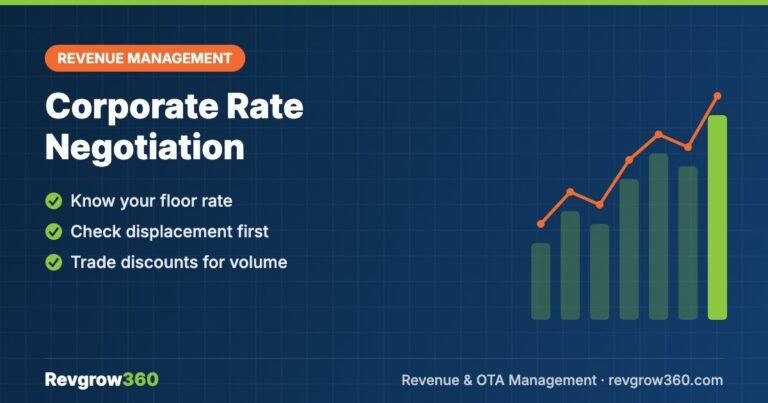
Corporate Rate Negotiation (RFP Season): Practical Guide
How to prepare for RFP season, price corporate accounts, negotiate without giving away margin and manage accounts after signing.
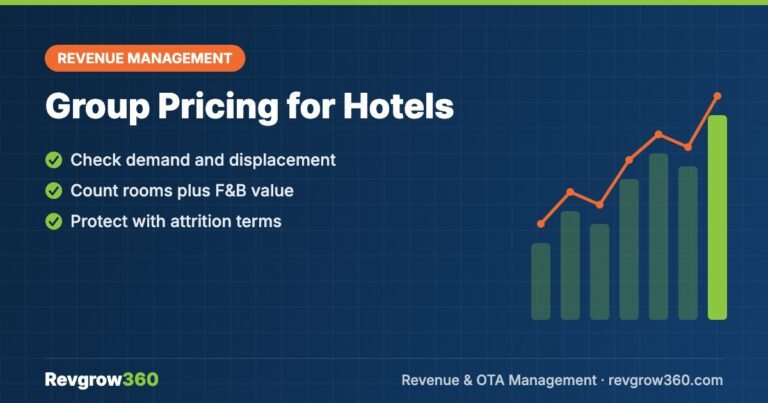
Group Pricing for Hotels: A Practical Guide
A practical method for pricing hotel groups: check demand, calculate displacement, add total value and protect the rate with contract terms.
Hotel Promotions That Don’t Hurt ADR: A Practical Guide
Learn hotel promotions that don't hurt ADR: add value, target segments, cap inventory and measure RevPAR, with a worked example and checklist.
Early Bird Discount Strategy: A Practical Guide for Hotels
A practical early bird discount strategy for hotels: when to use it, how to set the window, discount and room cap, and…
Last Minute Pricing for Hotels: A Practical Guide
A practical guide to last minute pricing for hotels, with triggers, a floor price, targeted offers and a worked example using real…
What Does a Hotel Revenue Manager Do? Role, Skills and Routine
Forecasting, pricing, inventory and distribution: here is what a hotel revenue manager actually does, the skills it takes and a realistic daily…
Related guide: Best Revenue Management Company In India 2026
Free PDF checklist
Where is your hotel losing money?
27 quick checks on pricing, OTAs, reviews and direct bookings, with the first fix for every leak.
Get the free checklist →