 By Md Arif Ahamed
Quick summary: Hotel promotions that don’t hurt ADR: add value, target and cap offers, with a worked example, options table and checklist to grow RevPAR safely.
Hotel promotions that don’t hurt ADR are offers that bring extra guests or extra spend without lowering your average daily rate. The main techniques are adding value instead of cutting price, targeting the offer to a specific segment, limiting inventory and dates, and bundling services with a healthy margin. This guide explains how to design such promotions step by step, with an example, a table of options and a checklist.
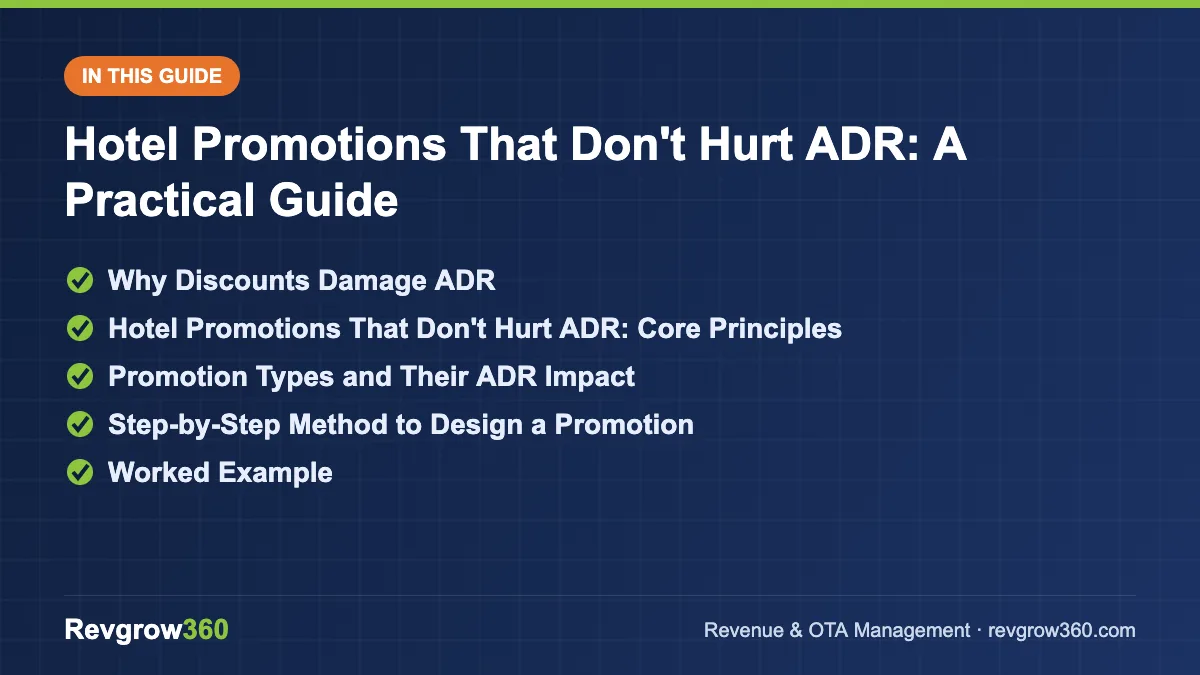
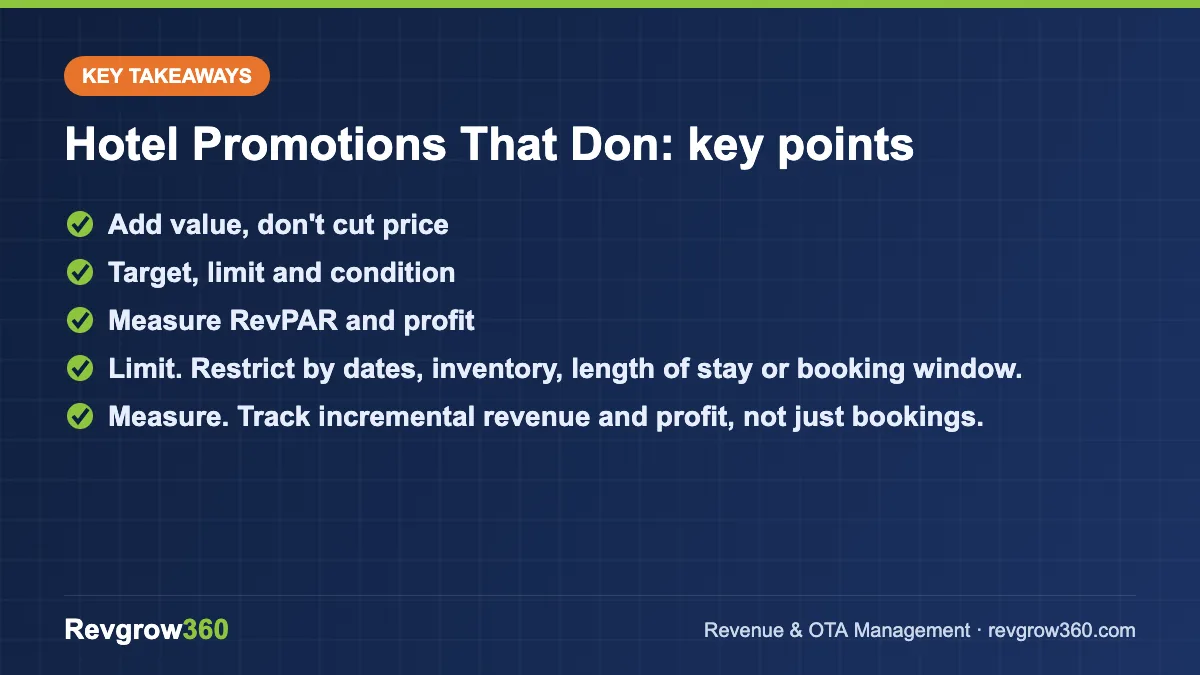
- Add value, don't cut price
- Target, limit and condition
- Measure RevPAR and profit
Why Discounts Damage ADR
ADR is room revenue divided by rooms sold. When you give a flat percentage off to everyone, every room sold at the lower rate drags the average down, even guests who would have paid full price. Lower ADR also affects RevPAR, guest expectations and negotiating power with corporate accounts. See our explanation of average daily rate (ADR) and RevPAR.
The aim is to sell more or earn more per guest while keeping the room rate intact. That is possible when promotions rely on perceived value, not price.
Calculate your average daily rate.
Hotel Promotions That Don’t Hurt ADR: Core Principles
- Add, do not subtract. Include breakfast, a spa credit, a late check-out or a dinner in the package, so the room rate stays at BAR while the guest sees extra value.
- Target, do not broadcast. Offer to members, past guests, a corporate group or a local area rather than the whole market.
- Limit. Restrict by dates, inventory, length of stay or booking window.
- Condition. Require something in return: a longer stay, advance booking, a direct booking or prepayment.
- Measure. Track incremental revenue and profit, not just bookings.
Revenue Health Score · free
Free tool: check your hotel’s revenue health
Answer a few quick questions about your rooms, rates, OTAs and reviews. Get a score out of 100, your weakest revenue areas and the first actions to fix them.
Promotion Types and Their ADR Impact
| Promotion | How it works | ADR effect | Best use |
|---|---|---|---|
| Value-added package | Room plus breakfast, dinner or experience at BAR plus a package price | Neutral or positive | Weekends, leisure travellers |
| Stay more, get more | Third night free or 20 percent off third night | Slightly lower on average, but fills gaps | Midweek and shoulder season |
| Member-only rate | Small discount for logged-in direct guests | Small impact, shifts guests from OTAs | Direct booking growth |
| Early bird or advance purchase | Discount for early, non-refundable booking | Moderate; protect with caps | Soft periods |
| Upgrade promotion | Pay a small amount for a better room | Positive | Low-occupancy days with unsold higher categories |
| Local resident offer | Special price or F and B credit for nearby residents | Low, if limited | Staycations and weekday gaps |
| Ancillary bundle | Spa, tour or transfer included | Positive | Resorts and leisure hotels |
For more ideas on added revenue per guest, see hotel upselling and ancillary revenue.
Step-by-Step Method to Design a Promotion
- Find the problem. Identify days or room types that are unsold, or a segment you want to grow, using occupancy and pace reports.
- Know your floor. Calculate the minimum margin per occupied room, including costs and commission.
- Choose the lever. Pick a value-added package, a length-of-stay incentive or a targeted rate rather than a blanket cut.
- Cost the add-ons. Value the inclusions at your cost, not at menu price. A ₹600 breakfast may cost ₹250 to deliver, so the perceived value is higher than your real cost.
- Set limits. Specify dates, number of rooms, minimum stay and booking window.
- Choose channels. Prefer direct, member and mobile channels where you control who sees it. Check parity; see hotel rate parity.
- Launch and communicate. Use clear names, such as “Weekend Escape with dinner”, not “30 percent off”.
- Monitor. Review pickup and ADR twice a week during the promotion.
- Stop or adjust. If rooms sell too easily, reduce the cap or end the offer early.
- Review after. Compare results with a similar period without the promotion.
Worked Example
A 40-room hotel in Jaipur has a Sunday-to-Thursday occupancy of 48 percent in July. BAR is ₹4,500. The manager considers a 20 percent discount, which would lower the rate to ₹3,600 for all weekday bookers.
| Option | Rate | Extra rooms per night (assumed) | Comment |
|---|---|---|---|
| Blanket 20 percent discount | ₹3,600 for all weekday bookings | 5 | Existing weekday guests also get the lower rate, so ADR falls |
| Package: room at ₹4,500 with breakfast and a ₹500 spa credit | ₹4,500 room revenue | 3 | ADR held; added food cost about ₹350 and spa credit used partially |
| Third night at 50 percent off, midweek only | Average ₹3,750 over three nights | 2 to 3 | Fills gaps, longer stays, limited to those who stay three nights |
The numbers are assumptions, not forecasts. They show a pattern: the package keeps ADR at ₹4,500, while the blanket discount cuts the rate for everyone. Run your own test and compare RevPAR and gross operating profit, not only occupancy.
Where to Promote Without Hurting ADR
Direct channels
Your website, email and WhatsApp lists let you target past guests and members. Offers shown here are not visible to everyone, so there is less risk of price leakage. Read our guide on increasing direct bookings.
OTAs
Use OTA promotions carefully. Select programmes that let you choose dates and room types, and avoid blanket site-wide discounts. Review our guide to OTA management and commission rates before joining a campaign.
Local partnerships
Partnering with a gym, a corporate office or a wedding planner for exclusive packages can bring guests who would not book on an OTA.
Common Mistakes
- Using a percentage discount for every slow day.
- Making promotions visible to all channels without controls.
- Counting the full menu price of inclusions as a cost, or ignoring their real cost.
- Running offers without a floor price or inventory cap.
- Measuring bookings only, not revenue and profit.
- Repeating the same promotion so often that guests wait for it.
- Promising inclusions the team cannot deliver, which leads to bad reviews.
Promotion Checklist
| Check | Done |
|---|---|
| Clear problem and target segment identified | |
| Floor price and margin calculated | |
| Add-ons costed at actual cost | |
| Dates, inventory and minimum stay set | |
| Channels chosen with parity checked | |
| Team briefed on inclusions | |
| Results review scheduled |
Examples for Different Property Types
City business hotel
Midweek is strong, weekends are weak. Create a “Weekend Staycation” package for local residents with breakfast and late check-out at the standard weekend BAR, rather than a price cut. Corporate weekday rates stay untouched.
Beach or hill resort
In the monsoon, bundle a spa session and a candlelight dinner with a two-night stay. The package price is higher than the room rate alone, but the guest sees more value than a small discount. Resort teams can cost the spa and food at actual cost, which is lower than menu prices.
Homestay or small property
Offer a free local experience, such as a village walk, cooking session or bonfire evening, to guests who stay three nights. It costs little, builds reviews and keeps your nightly rate stable.
How Promotions Fit With the Rest of Pricing
Promotions work best when your base is sound. Start with the right BAR, sound forecasting and a clear channel plan. Read our hotel demand forecasting guide, and keep promotions as targeted adjustments rather than a permanent discount state.
Training the Team to Sell the Promotion
Front desk, reservations and restaurant staff must understand each offer, or guests will get mixed messages. Brief them on the inclusions, dates, terms and how to post charges. Teach them to describe value: “Your package includes breakfast for two and a spa credit worth ₹500” sounds better than “It is a discount rate”. Staff who understand the offer will also upsell it to walk-in guests.
Review Cadence
Hold a short monthly promotion review with the GM, revenue lead and F and B head. List live offers, results, costs and complaints, then decide to continue, change or retire each one. Retiring an offer that no longer works is as important as launching a new one.
Key Takeaways
- Protect ADR by adding value instead of cutting price.
- Target, limit and condition every promotion.
- Cost inclusions at your actual cost and keep a floor price.
- Use direct and member channels to control who sees offers.
- Judge success by RevPAR and profit.
Revgrow360 designs promotions and rate plans that grow revenue without eroding ADR. Learn about our revenue management service or book a free consultation.
For more background, see this revenue management overview on Wikipedia.
Frequently asked questions
How can a hotel run promotions without lowering ADR?
Add value instead of cutting the room rate, such as breakfast, dinner or a spa credit, and target specific segments with limited dates and inventory. Use direct, member or mobile channels so only intended guests see the offer.
Why do discounts hurt ADR?
ADR is room revenue divided by rooms sold. A blanket discount lowers the rate on every room sold, including bookings that would have paid full price. That reduces average rate, RevPAR and your negotiating position.
Are packages better than percentage discounts?
Often yes. A package keeps the room rate at BAR while giving the guest perceived value, and extras usually cost less to deliver than their menu price. Still, cost the inclusions carefully and make sure the team can deliver them well.
How do I measure if a promotion worked?
Compare RevPAR, ADR, occupancy and gross profit against a similar period without the promotion. Check how many bookings were truly additional, and include the cost of inclusions and commission, not just the number of bookings.
More Revenue Management guides
Early Bird Discount Strategy: A Practical Guide for Hotels
A practical early bird discount strategy for hotels: when to use it, how to set the window, discount and room cap, and…
Last Minute Pricing for Hotels: A Practical Guide
A practical guide to last minute pricing for hotels, with triggers, a floor price, targeted offers and a worked example using real…
What Does a Hotel Revenue Manager Do? Role, Skills and Routine
Forecasting, pricing, inventory and distribution: here is what a hotel revenue manager actually does, the skills it takes and a realistic daily…
Hotel Rate Fences Explained: A Practical Guide
Rate fences are conditions that let hotels discount for price-sensitive guests without cutting prices for everyone. Learn types, design and testing.
Open Pricing vs BAR Pricing: A Practical Guide
Compare open pricing with BAR pricing for hotels, with a worked example and a practical guide to choosing or combining the two…
How to Choose a Competitive Set: A Practical Guide
A practical method to choose a hotel competitive set using criteria, scoring and review, so benchmarking and pricing decisions are reliable.
Related guide: Best Revenue Management Company In India 2026
Free PDF checklist
Where is your hotel losing money?
27 quick checks on pricing, OTAs, reviews and direct bookings, with the first fix for every leak.
Get the free checklist →