 By Md Arif Ahamed
Quick summary: Early bird discount strategy for hotels: when to use it, how to set the window, discount and cap, with a worked example and a checklist to protect ADR.
An early bird discount strategy rewards guests who book well in advance with a lower rate, in exchange for commitment, usually through a non-refundable or limited-flexibility rate plan. Done well, it brings cash early, builds a base of bookings and gives you better visibility of demand. Done badly, it gives away rate on dates that would have sold at full price anyway. This guide explains how to design it step by step.
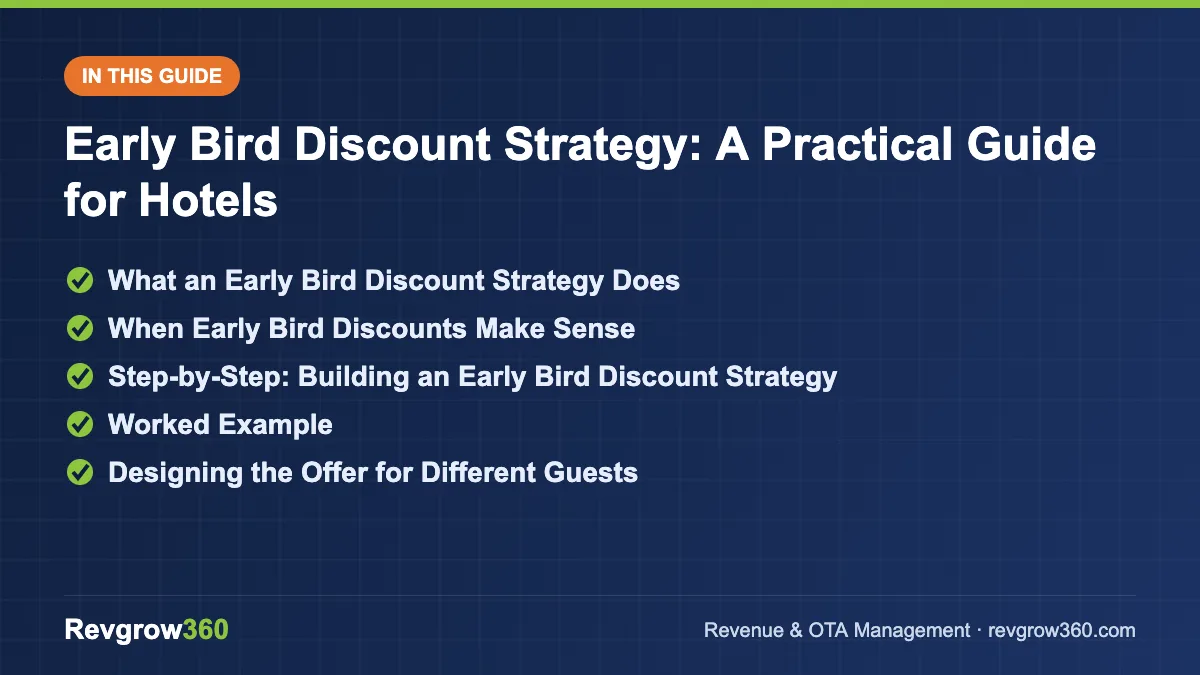
- Study the booking curve
- Set window, discount and cap
- Track pace and ADR impact
What an Early Bird Discount Strategy Does
An early bird rate is a rate plan available only when booked a set number of days before arrival, such as 30, 45 or 60 days. In return for the lower price, the guest accepts stricter terms: advance payment, a non-refundable booking or a cancellation penalty.
The strategy serves three goals:
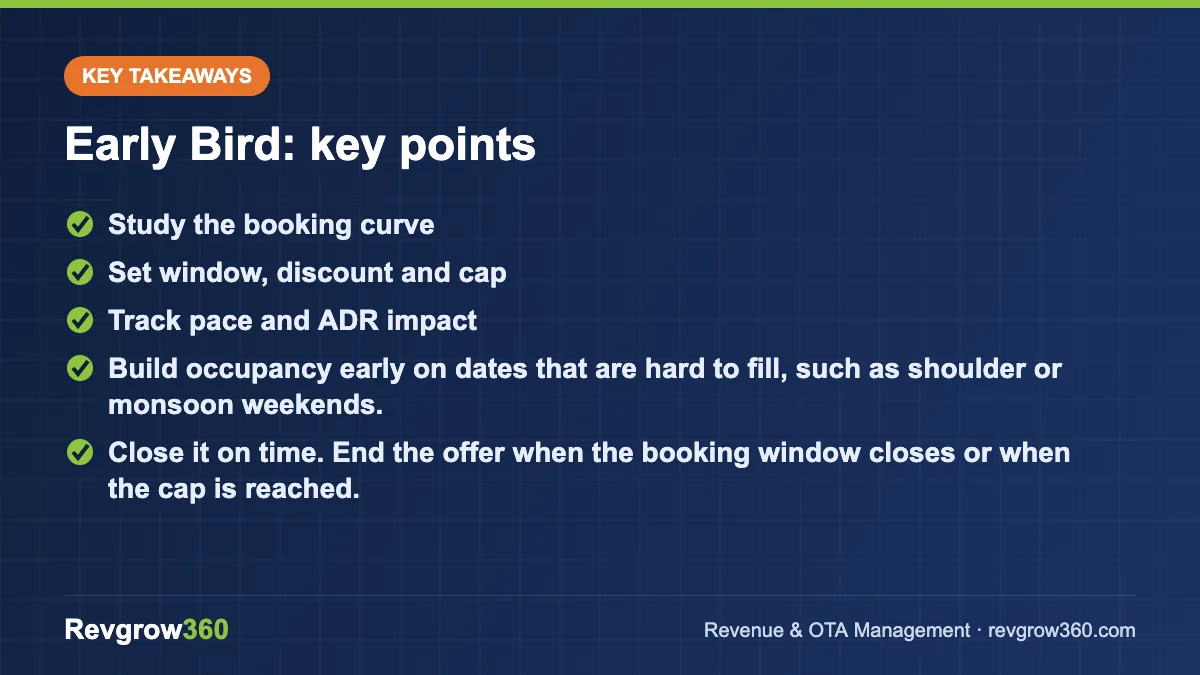
- Build occupancy early on dates that are hard to fill, such as shoulder or monsoon weekends.
- Improve forecast accuracy and cash flow, since early reservations show demand and may bring prepayments.
- Reduce dependence on OTAs by encouraging planners to book direct with an attractive offer. See our guide to increasing hotel direct bookings.
It is one tool inside a wider dynamic pricing strategy, and it works only if you understand your demand pattern.
Find the right room rate for your costs and profit.
When Early Bird Discounts Make Sense
| Situation | Early bird? | Reason |
|---|---|---|
| Low-demand periods, such as monsoon weekdays | Yes | You need volume and early demand signals |
| Shoulder season weekends | Yes, selectively | Helps fill before competitors do |
| Festival, wedding or event peaks that usually sell out | No or minimal | Rooms will sell at full rate anyway |
| Destination weddings and group travel | Yes, with deposits | Long planning cycle; secures blocks |
| Corporate weekday travel | Rarely | Business travellers book late and rely on flexibility |
Revenue Health Score · free
Free tool: check your hotel’s revenue health
Answer a few quick questions about your rooms, rates, OTAs and reviews. Get a score out of 100, your weakest revenue areas and the first actions to fix them.
Step-by-Step: Building an Early Bird Discount Strategy
- Study your booking curve. Find how many days before arrival you normally receive bookings for each month and day of the week. If 60 percent of December rooms are sold 60 days out, an early bird is not needed there.
- Pick target dates. Choose periods where you are behind last year’s pace or where demand historically arrives late.
- Define the booking window. For example, book at least 30 days ahead for stays between 1 July and 30 September.
- Set the discount level. A common range is roughly 10 to 20 percent below BAR, but test within your market and costs. Make sure the rate stays above your floor price.
- Set the conditions. Choose non-refundable, partial prepayment or a strict cancellation date. State them clearly.
- Add a limited inventory cap. Offer only a share of rooms, such as 20 to 30 percent, at the early bird rate. This avoids filling the hotel with the lowest-rated guests.
- Load in all channels with parity in mind. Use your channel manager so the rate is consistent. Read our channel manager guide.
- Promote it. Email past guests, publish it on your website and social media, and highlight a “book early and save” banner.
- Monitor pace. Compare bookings against forecast weekly. If rooms sell quickly, shorten the offer or reduce the discount.
- Close it on time. End the offer when the booking window closes or when the cap is reached.
Worked Example
A 30-room resort in Munnar sees low demand from July to September. In the previous year, 40 percent of rooms for August weekends were sold by 30 days out, and the final occupancy was 62 percent at an ADR of ₹4,800.
| Item | Plan |
|---|---|
| Offer | Early bird: book 30 or more days ahead, non-refundable |
| Discount | 15 percent off BAR, so ₹4,080 on a ₹4,800 BAR |
| Inventory cap | 8 of 30 rooms per night |
| Target | Lift pre-booked occupancy from 40 to 55 percent at 30 days out |
If the plan works, the resort has 16 or more rooms sold at 30 days instead of 12, and can use the extra visibility to price the remaining rooms upward. It also holds more cash early. If instead 8 early bird rooms sold that would have sold at ₹4,800 later, the resort lost ₹720 on each. That is the risk to measure. Compare ADR, occupancy and RevPAR against the previous year after the season.
The figures are illustrative, and your market may behave differently.
Designing the Offer for Different Guests
Leisure couples and families
Offer an early bird with a breakfast or dinner inclusion in place of a larger price cut. Value-adds protect your rate and are cheaper to deliver than a discount of the same perceived value.
Weddings and events
Offer room block discounts if the organiser confirms numbers 60 to 90 days ahead and pays a deposit. Set a release date for unconfirmed rooms.
Repeat guests
Give past guests early access to the offer by email or WhatsApp before you publish it widely. This rewards loyalty and generates direct bookings.
Early Bird and Cancellation Policy
The discount should come with a trade-off. A fully refundable early bird gives the guest all the benefits with no risk, and the hotel gets little. If you choose partial refundability, set a clear cut-off date and a fair cancellation fee. Explain it clearly at booking. Be careful with refund policies and payment processing rules, and confirm any consumer-law implications with an adviser.
Common Mistakes
- Offering early bird discounts on peak dates that sell out anyway.
- No inventory cap, so the best rooms go at the lowest price.
- Discounts too deep, which pull down ADR for the season.
- Making the offer public on OTAs but not on your website, or vice versa.
- No clear cancellation terms.
- Not tracking whether early bookings were truly additional.
- Failing to close the offer once pace improves.
Early Bird Strategy Checklist
| Check | Done |
|---|---|
| Booking curve reviewed for target months | |
| Target dates and window defined | |
| Discount above floor price | |
| Inventory cap set | |
| Cancellation terms written | |
| Loaded across channels with parity | |
| Promotion plan for email and social | |
| Weekly pace review scheduled |
Promoting the Early Bird Offer
An offer no one sees will not work. Plan a simple promotion calendar:
- Publish a dedicated page on your website with the dates, rate, terms and a booking button.
- Send an email or WhatsApp broadcast to past guests, with a clear deadline.
- Post a short video of the property in that season on social media.
- Tell local travel agents and corporate contacts, who often plan group trips ahead.
- Add the offer to Google Business Profile posts. See our Google Hotel Ads guide for paid visibility.
Measuring an Early Bird Campaign
| Metric | What to compare |
|---|---|
| Rooms booked through the offer | Against your cap and target |
| Pace at 30, 15 and 7 days out | This year versus last year |
| Final occupancy and ADR | This season versus last season |
| Share of direct bookings | Before and after the offer |
| Cancellations and refunds | To confirm terms are working |
If final ADR for the season falls more than occupancy gains justify, tighten the cap or reduce the discount next year. If the offer fills rooms but those dates would have filled anyway, move it to different dates.
Early Bird Versus Other Advance Rates
Early bird is one of several advance-purchase designs. A tiered version offers 20 percent off at 60 days, 15 percent at 30 days and 10 percent at 14 days. Tiers reward the earliest guests most and reduce the cliff at the end of the window, but they need careful loading in the channel manager. Start with one simple tier, learn from the results and add more only if your team can manage them.
Key Takeaways
- Early bird rates trade a discount for commitment and early cash.
- Use them on soft or late-booking periods, not on peak dates.
- Cap inventory, set clear terms and keep the rate above your floor.
- Prefer added value over deep price cuts where possible.
- Review pace weekly and measure ADR and RevPAR after the season.
Revgrow360 helps hotels design offers that fill rooms without eroding rate. Explore our hotel revenue management services or request a free hotel audit.
For more background, see this revenue management overview on Wikipedia.
Frequently asked questions
What is an early bird discount in a hotel?
It is a lower rate for guests who book a set number of days ahead, usually with stricter terms such as non-refundable or partial prepayment. It helps fill soft periods early, improves forecasting and brings cash in advance.
How much discount should an early bird offer give?
It depends on your market, costs and demand. Many hotels test roughly 10 to 20 percent below BAR, keep the rate above the floor price and cap the number of rooms. Review pace and results, then adjust for each season.
When should hotels avoid early bird offers?
Avoid them for peak dates, festivals, events and weekends that usually sell out at full rate, and for corporate demand that books late. Discounting there only gives away revenue you would have earned anyway.
Should early bird rates be refundable?
Usually not fully. The discount is paid for commitment, so use non-refundable or a strict cancellation cut-off with a fair fee. Explain terms clearly at booking and check consumer-law and payment rules with an adviser.
More Revenue Management guides
Hotel Promotions That Don’t Hurt ADR: A Practical Guide
Learn hotel promotions that don't hurt ADR: add value, target segments, cap inventory and measure RevPAR, with a worked example and checklist.
Last Minute Pricing for Hotels: A Practical Guide
A practical guide to last minute pricing for hotels, with triggers, a floor price, targeted offers and a worked example using real…
What Does a Hotel Revenue Manager Do? Role, Skills and Routine
Forecasting, pricing, inventory and distribution: here is what a hotel revenue manager actually does, the skills it takes and a realistic daily…
Hotel Rate Fences Explained: A Practical Guide
Rate fences are conditions that let hotels discount for price-sensitive guests without cutting prices for everyone. Learn types, design and testing.
Open Pricing vs BAR Pricing: A Practical Guide
Compare open pricing with BAR pricing for hotels, with a worked example and a practical guide to choosing or combining the two…
How to Choose a Competitive Set: A Practical Guide
A practical method to choose a hotel competitive set using criteria, scoring and review, so benchmarking and pricing decisions are reliable.
Free PDF checklist
Where is your hotel losing money?
27 quick checks on pricing, OTAs, reviews and direct bookings, with the first fix for every leak.
Get the free checklist →