 By Md Arif Ahamed
Quick summary: What does a hotel revenue manager do? Learn the core responsibilities, key skills, tools, a typical daily and weekly routine, and signs your pricing works.
What does a hotel revenue manager do? In short, they decide how to sell each room, on each night, through each channel, at the price that produces the most revenue and profit for the hotel. The role combines analysis, pricing, distribution and teamwork, and it has a direct effect on the bottom line. This guide explains what a hotel revenue manager does day to day, the skills the job requires, the tools they use, a realistic daily and weekly routine, and how hotel owners can tell whether their revenue function is working.
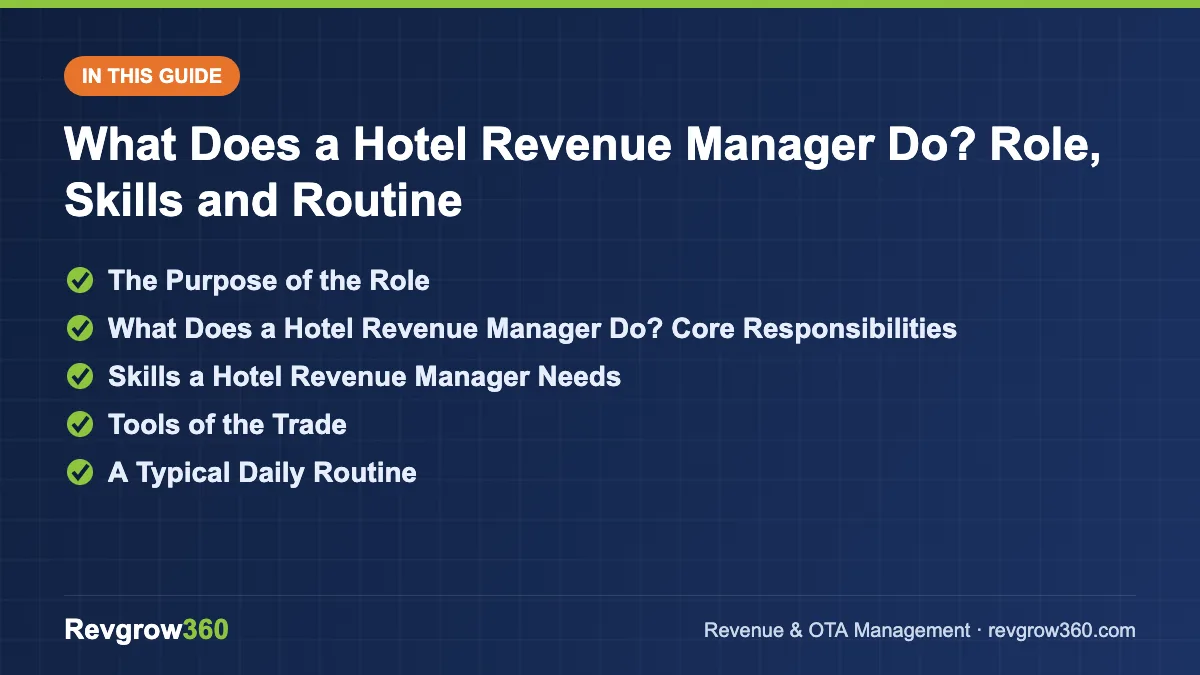
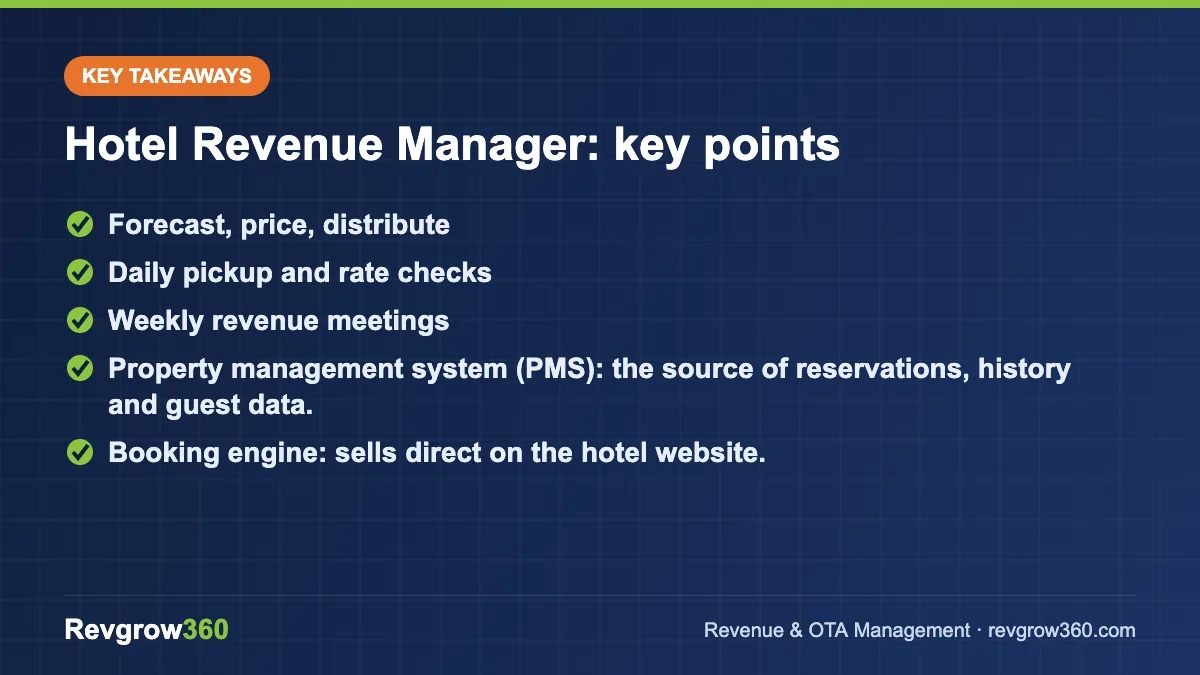
- Forecast, price, distribute
- Daily pickup and rate checks
- Weekly revenue meetings
The Purpose of the Role
Hotels have fixed capacity and perishable inventory: a room unsold tonight can never be sold again. Demand changes by season, day of week, events and channel. The revenue manager’s job is to match the right room to the right guest at the right price through the right channel at the right time. In practice that means balancing occupancy and rate to grow RevPAR, and increasingly looking beyond rooms to total revenue and profit.
What Does a Hotel Revenue Manager Do? Core Responsibilities
1. Forecasting demand
The revenue manager forecasts rooms sold, rates and revenue for future dates, using historical data, bookings on the books, pace and an events calendar. The forecast guides every other decision.
2. Pricing
They build and manage the rate structure: best available rates by date, room-type differentials, rate plans (flexible, non-refundable, packages) and discount rules. They adjust prices as demand changes, sometimes several times a day in busy periods.
3. Inventory and restrictions
They control availability by room type and rate, apply length of stay restrictions on peak dates, manage overbooking levels and decide group and wholesale allocations.
4. Distribution and channel management
They decide which channels sell the hotel and manage rates and availability across OTAs, the hotel website, GDS and wholesalers through a channel manager. They watch rate parity and channel costs.
5. Competitor and market analysis
They monitor competitor rates, new hotels, flight and route changes and local events, and use market data where available. Benchmarking services such as STR are used by many hotels to compare performance with a competitive set.
6. Reporting and analysis
They report occupancy, ADR, RevPAR, TRevPAR, channel mix, pickup and pace to owners and management, and explain the reasons behind changes.
7. Working with other departments
They coordinate with sales on group and corporate pricing, with marketing on campaigns for soft periods, with front office on upselling and overbooking, and with finance on budgets.
Revenue Health Score · free
Free tool: check your hotel’s revenue health
Answer a few quick questions about your rooms, rates, OTAs and reviews. Get a score out of 100, your weakest revenue areas and the first actions to fix them.
Skills a Hotel Revenue Manager Needs
| Skill | Why it matters | How it shows up |
|---|---|---|
| Analytical thinking | Decisions are based on data, not instinct | Reading pace reports, spotting trends, forecasting |
| Spreadsheet and systems skills | Data lives in PMS, channel manager and RMS | Building reports, pivot tables, configuring tools |
| Commercial judgement | Data does not capture everything | Pricing local events, deciding on groups |
| Distribution knowledge | Channels have different costs and rules | Managing OTA extranets, parity, promotions |
| Communication | Other teams must act on decisions | Clear weekly meetings and reports |
| Attention to detail | Small errors can cost a lot | Catching a wrong rate load or restriction |
| Calm decision-making | Demand shifts quickly | Acting decisively on last-minute changes |
Tools of the Trade
- Property management system (PMS): the source of reservations, history and guest data.
- Channel manager: pushes rates, availability and restrictions to all channels. See our guide to the best channel manager for hotels.
- Booking engine: sells direct on the hotel website.
- Revenue management system (RMS): recommends or sets rates using data models.
- Rate shopping tools: track competitor prices.
- Spreadsheets: still essential for forecasts, analysis and custom reports.
- OTA extranets: for content, promotions, performance reports and reviews.
A Typical Daily Routine
Every hotel differs, but a revenue manager’s day often looks like this:
- Morning: check overnight results. Review yesterday’s occupancy, ADR and revenue; note no-shows and cancellations.
- Review pickup. See how many new bookings arrived overnight for the next 30, 60 and 90 days, and compare with last year’s pace.
- Check competitors. Look at rate shopping reports for the next few weeks, especially key dates.
- Adjust rates and restrictions. Move prices where pace or market conditions justify it; add or remove minimum stays.
- Check channels. Spot-check OTA listings and the booking engine to confirm rates loaded correctly and parity holds.
- Answer requests. Price group enquiries, corporate requests and wholesale allocation requests.
- Afternoon: analysis and projects. Work on forecasts, promotions for soft periods, content improvements or reporting.
- End of day: final check of the next few days’ availability and overbooking position.
The Weekly and Monthly Rhythm
Weekly
- Revenue meeting with GM, sales and front office to review the next 90 days.
- Update the forecast and agree actions for exceptions.
- Review channel performance and OTA rankings.
Monthly
- Month-end report: results versus budget and last year, with explanations.
- Forecast accuracy check.
- Channel mix and net ADR review.
- Updated pricing strategy for upcoming seasons.
Worked Example: A Day at a 40-Room Hotel in Goa
At a hypothetical 40-room hotel in Goa, the revenue manager arrives on a Monday morning. Pickup over the weekend shows 9 new bookings for a festival weekend five weeks away, which now has 30 rooms on the books against 22 at the same point last year. Competitors have already moved rates up.
Actions taken:
- Raises the best available rate for the Saturday by two steps on the rate ladder.
- Applies a two-night minimum on Saturday arrivals.
- Stops a mobile-only OTA discount for that weekend.
- Meanwhile, a midweek in the following month is pacing behind last year, so they work with marketing on a direct-booking offer and a targeted OTA promotion for those dates.
In a few hours, the hotel has protected a high-demand weekend and started stimulating a weak period. That is the job in a nutshell.
How a Revenue Manager Is Measured
Revenue managers are usually judged on results relative to the market and to budget, not on occupancy alone. Common measures include:
- RevPAR growth versus last year and versus the competitive set.
- ADR and occupancy balance, especially on peak and soft dates.
- Net RevPAR or net ADR, after commissions and channel costs.
- TRevPAR where the role covers upselling and packages.
- Forecast accuracy compared with actual results.
- Channel mix, including growth in direct bookings.
Looking at several measures together prevents a common trap: chasing occupancy with discounts, or pushing rates so high that the hotel loses share to competitors.
Career Path and Background
Revenue managers come from a range of backgrounds. Many start in front office or reservations, where they learn how bookings, rates and channels work in practice. Others come from sales, finance or data analysis. Typical progression moves from revenue analyst or reservations and revenue executive, to revenue manager for one hotel, then to cluster or area revenue manager covering several properties, and eventually to director of revenue or commercial roles. Hospitality degrees, short courses in revenue management and strong spreadsheet skills all help, but practical experience of pricing decisions and their results matters most.
Revenue Manager in Small Hotels and Homestays
Small properties rarely have a full-time revenue manager. The work is often split between the owner, the front office manager and an external partner. That can work well, provided someone owns forecasting and pricing every week and decisions are based on data. Many independent hotels use an outsourced team to cover the analytical and channel work while the owner keeps strategic control; our hotel revenue management service is designed for this model.
How to Tell if Your Revenue Function Is Working
- Rates change regularly in line with demand, not just seasonally.
- There is a written forecast for at least the next 90 days.
- Peak dates sell out at higher rates, not early at low rates.
- Soft periods have planned actions weeks in advance.
- You receive clear monthly reports on RevPAR, channel mix and pace.
- OTA content, rates and restrictions are consistent across channels.
Key takeaways
- A hotel revenue manager forecasts demand, sets prices, controls inventory and manages distribution.
- The role blends analytics, commercial judgement and communication with other departments.
- Daily work centres on pickup, competitor rates, rate changes and channel checks.
- Weekly and monthly reviews keep forecasts and strategy on track.
- Small hotels can share the role between owner, staff and an outsourced partner.
Revgrow360’s revenue analysts act as an extended revenue team for independent hotels, resorts and homestays, and have supported 500+ hotels so far. Request a free hotel audit to see how your pricing and distribution compare with best practice.
Frequently asked questions
What is the main goal of a hotel revenue manager?
The main goal is to maximise revenue and profit from the hotel's fixed, perishable inventory. That means selling the right room to the right guest at the right price through the right channel at the right time, balancing occupancy and rate to grow RevPAR and, increasingly, total revenue and profit.
What skills does a hotel revenue manager need?
Key skills include analytical thinking, strong spreadsheet and systems knowledge, commercial judgement, understanding of distribution channels and OTAs, clear communication and attention to detail. Revenue managers also need to stay calm and decisive when demand changes quickly, and to explain their decisions clearly to owners and other departments.
Does a small hotel need a revenue manager?
A small hotel needs the revenue management work done, but not necessarily a full-time hire. Many owners share the tasks with front office staff or use an outsourced revenue management partner. What matters is that someone forecasts, prices and reviews channels every week using data rather than instinct alone.
What tools does a hotel revenue manager use?
Typical tools include the property management system, a channel manager, the hotel booking engine, rate shopping tools for competitor prices, OTA extranets and spreadsheets. Many hotels also use a revenue management system that recommends or sets rates automatically, alongside benchmarking data on market performance where available.
More Revenue Management guides
Hotel Promotions That Don’t Hurt ADR: A Practical Guide
Learn hotel promotions that don't hurt ADR: add value, target segments, cap inventory and measure RevPAR, with a worked example and checklist.
Early Bird Discount Strategy: A Practical Guide for Hotels
A practical early bird discount strategy for hotels: when to use it, how to set the window, discount and room cap, and…
Last Minute Pricing for Hotels: A Practical Guide
A practical guide to last minute pricing for hotels, with triggers, a floor price, targeted offers and a worked example using real…
Hotel Rate Fences Explained: A Practical Guide
Rate fences are conditions that let hotels discount for price-sensitive guests without cutting prices for everyone. Learn types, design and testing.
Open Pricing vs BAR Pricing: A Practical Guide
Compare open pricing with BAR pricing for hotels, with a worked example and a practical guide to choosing or combining the two…
How to Choose a Competitive Set: A Practical Guide
A practical method to choose a hotel competitive set using criteria, scoring and review, so benchmarking and pricing decisions are reliable.
Free PDF checklist
Where is your hotel losing money?
27 quick checks on pricing, OTAs, reviews and direct bookings, with the first fix for every leak.
Get the free checklist →