 By Md Arif Ahamed
Quick summary: Last minute pricing for hotels: a step-by-step method with floor price, triggers, targeted offers and a worked example to sell rooms without hurting ADR.
Last minute pricing for hotels is the practice of adjusting room rates in the final days or hours before arrival to sell remaining inventory without damaging your rate position. The goal is not to dump rooms at the lowest price, but to use data on pace, demand and competitors to decide when to hold, when to discount and who should see the discount. This guide gives a step-by-step method, an example with numbers, tools and a checklist.
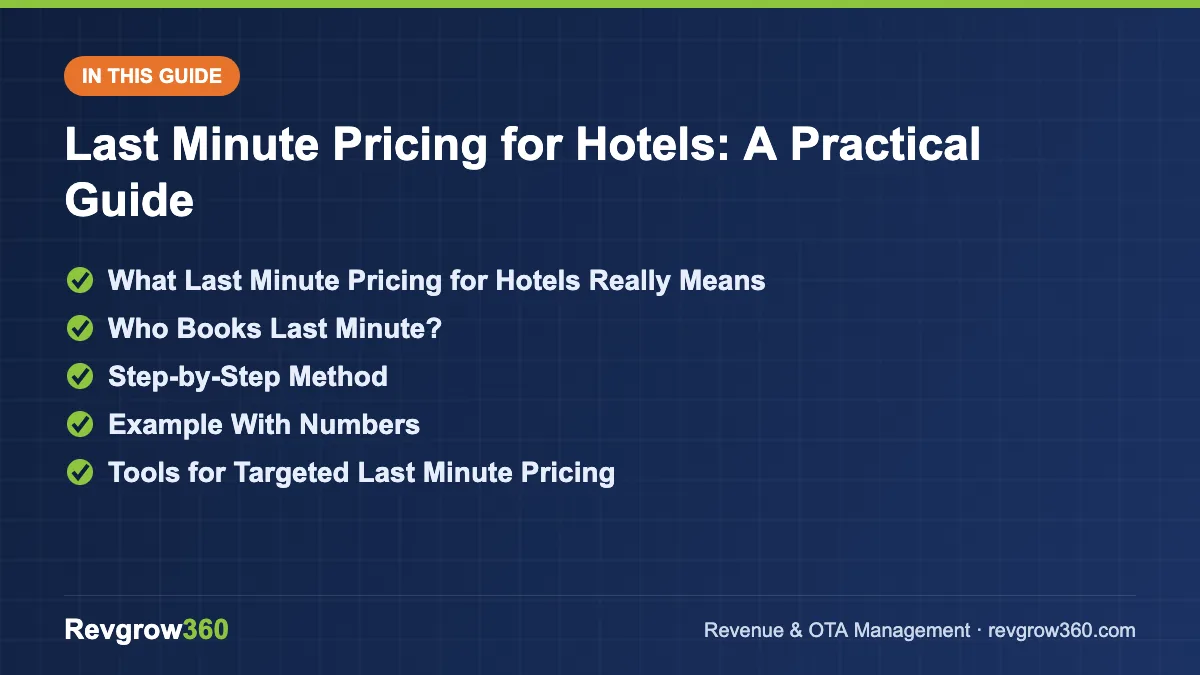
- Read pace and competitors
- Set a floor price and triggers
- Use targeted offers, not cuts
What Last Minute Pricing for Hotels Really Means
A hotel room is perishable. A room that is not sold tonight earns nothing, and it cannot be stored for tomorrow. That is why many hotels cut prices close to arrival. But careless cuts teach guests to wait for late deals, lower your ADR and create parity problems.
Effective last minute pricing balances three questions:
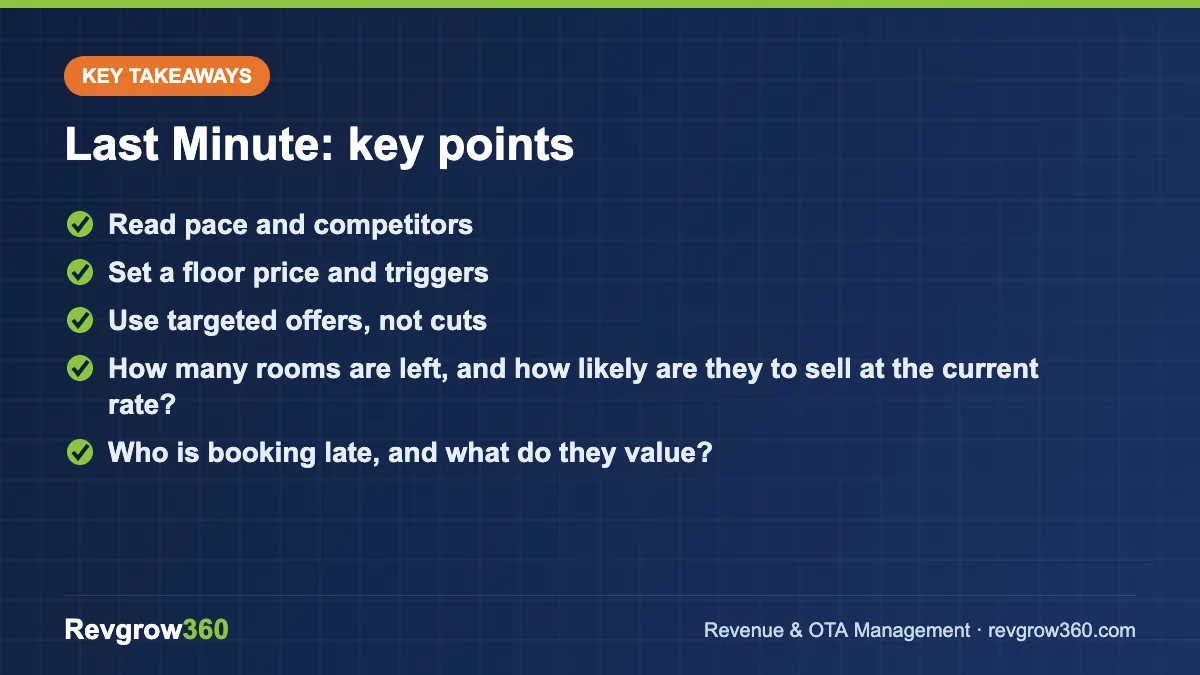
- How many rooms are left, and how likely are they to sell at the current rate?
- What is a room worth if it stays empty compared with a lower-rate sale, after costs such as breakfast, laundry and commission?
- Who is booking late, and what do they value?
It sits inside a wider hotel dynamic pricing strategy, and relies on good demand forecasting.
Find the right room rate for your costs and profit.
Who Books Last Minute?
| Segment | Behaviour | Pricing implication |
|---|---|---|
| Business travellers | Book within days, price-insensitive, want location and Wi-Fi | Hold rates in cities and on weekdays |
| Spontaneous leisure travellers | Book from mobile, compare quickly, motivated by deals | Mobile-only or app-only offers can work |
| Local staycation guests | Decide within days, drive-in markets | Weekend packages with food or spa |
| Stranded or disrupted travellers | Need a room now due to cancellations or delays | Do not discount; demand is urgent |
| Walk-ins | Arrive without booking | Use a floor price and upsell |
Revenue Health Score · free
Free tool: check your hotel’s revenue health
Answer a few quick questions about your rooms, rates, OTAs and reviews. Get a score out of 100, your weakest revenue areas and the first actions to fix them.
Step-by-Step Method
- Know your booking window. From PMS history, find how many rooms normally sell at 14, 7, 3, 1 and 0 days before arrival for each day of the week.
- Measure today’s pace. Compare rooms on the books for a date with the same point last year or a typical week. If you are behind, you may need action. If you are ahead, hold or raise.
- Check competitors. Look at the rates and availability of your direct competitive set. If they are selling out, do not cut. If they are cutting too, decide whether to follow.
- Calculate a floor price. Add variable cost per occupied room, such as housekeeping, utilities, breakfast and commission, plus a minimum margin. Never sell below this floor.
- Choose the lever. Instead of lowering BAR for everyone, use targeted tools: mobile rates, last-minute rate plans, packages or bundles.
- Set triggers. For example: if more than 25 percent of rooms remain unsold at 3 days out for a Tuesday, release a last-minute rate at BAR minus 10 percent. Review again at 24 hours.
- Apply restrictions. Use minimum stay or non-refundable terms where useful, and close discounts if demand picks up.
- Monitor and reverse. Check pickup every few hours on critical dates. If rooms sell fast, raise the price.
- Review after the date. Compare final occupancy, ADR and RevPAR with the plan and adjust triggers.
Example With Numbers
A 40-room hotel in Goa has a Tuesday in October with 22 rooms sold and 18 unsold, three days out. BAR is ₹5,000. Variable cost per occupied room is about ₹800, and OTA commission is 15 percent.
| Option | Extra rooms sold | Rate | Net rate after 15 percent commission | Extra contribution |
|---|---|---|---|---|
| Hold BAR | 2 | ₹5,000 | ₹4,250 | (4,250 – 800) x 2 = ₹6,900 |
| Last-minute rate at 10 percent off | 5 | ₹4,500 | ₹3,825 | (3,825 – 800) x 5 = ₹15,125 |
| Deep cut at 30 percent off | 8 | ₹3,500 | ₹2,975 | (2,975 – 800) x 8 = ₹17,400 |
The deep cut earns the most extra contribution on paper, but it also lowers ADR, risks displacing guests who would have booked at a higher rate, and can set an expectation among repeat guests. The 10 percent option may be better if mobile-only and not shown on the public rate grid. The numbers are illustrative; use your own demand history.
Measure the result with RevPAR and ADR, not occupancy alone.
Tools for Targeted Last Minute Pricing
- Mobile-only rates: OTAs and some booking engines let you offer a lower rate only to mobile users.
- Last-minute rate plans: available only inside a short window, such as 3 days before arrival.
- Packages: bundle dinner, spa or late check-out instead of cutting price. This protects the headline rate.
- Member or logged-in rates: reward direct guests with a discount that is not public.
- Same-day deals through your own channels: WhatsApp or email to past guests with limited rooms.
- Length-of-stay rules: read our guide to length of stay restrictions to avoid single-night gaps.
Protecting Rate Parity and Brand
Discounts that show on one OTA but not on others can create parity issues. Direct and OTA prices should be aligned, with direct offering a better deal through member or package benefits. Read about hotel rate parity. Avoid constant visible discounts. If every Sunday has a “last minute” offer, it stops being last minute and becomes your price.
When Not to Discount
- When competitors are nearly sold out or you have events nearby.
- When pickup in the last 48 hours is strong.
- When the last rooms are your best room types, which often sell at premium.
- When walk-in demand is typically high on that date.
- When you have overbooking exposure; see hotel overbooking strategy.
Common Mistakes
- Cutting prices for all channels at once.
- Discounting too early, before real demand data exists.
- No floor price, so rooms are sold below cost.
- Ignoring OTA commission and costs when judging profit.
- Failing to raise prices when demand returns.
- Letting front desk staff offer random discounts.
- Never checking whether the discount actually brought additional bookings.
Last Minute Pricing Checklist
| Check | Frequency |
|---|---|
| Review pickup and unsold rooms for the next 7 days | Daily |
| Compare competitor rates and availability | Daily |
| Confirm floor price per room type | Monthly |
| Update trigger rules by season | Quarterly |
| Check parity across channels | Weekly |
| Review results versus forecast | Weekly |
Building Triggers by Day of Week
A single rule for the whole week does not work. Sunday nights, Friday nights and mid-week behave differently, so set triggers by day type. A business hotel may find Monday to Wednesday strong and Friday to Sunday weak, while a resort sees the opposite.
| Day type | Example trigger at 3 days out | Action |
|---|---|---|
| Strong day, above 70 percent sold | Pickup on or above pace | Hold or increase BAR; close discounts |
| Average day, 40 to 70 percent sold | Pickup slightly behind | Open a mobile or member rate; watch competitors |
| Weak day, below 40 percent sold | Pickup well behind | Release last-minute plan or package; consider local promotion |
Review the triggers every quarter, because seasons and events change the pattern.
Selling Unsold Rooms Beyond Price
Price is only one tool. Before cutting, ask if the room can earn money another way. Day-use rooms for travellers with late flights, workspace packages for local professionals, and add-ons such as late check-out, parking or breakfast can raise income without touching the headline rate.
Make sure the front desk is ready for walk-ins. Give staff a floor price, a script and the authority to quote it. A walk-in guest at 9 pm who is told “the rate is ₹6,000” and leaves is a missed sale if you had ten empty rooms and a floor of ₹3,200.
Sample walk-in script
“Good evening, sir. Welcome. We have a few rooms available tonight. The standard rate is ₹5,000, but for a stay starting now I can offer ₹3,900 including breakfast. Shall I show you the room?”
Key Takeaways
- Use data on pace, competitors and cost to decide whether to cut, not instinct.
- Prefer targeted tools such as mobile rates and packages over blanket discounts.
- Set a floor price and clear triggers.
- Protect parity and brand by limiting public discounts.
- Judge results by RevPAR and profit, not occupancy alone.
Revgrow360 manages day-to-day pricing and channel strategy for hotels across India. Learn about our hotel revenue management service or book a free consultation.
For more background, see this revenue management overview on Wikipedia.
Frequently asked questions
Should hotels discount rooms at the last minute?
Sometimes, but not automatically. Check pace, competitor availability, your floor price and who is booking late. Use targeted tools like mobile or member rates, or packages, and raise rates again if pickup improves, so ADR and brand are protected.
How do I set a floor price for hotel rooms?
Add the variable cost of an occupied room, such as housekeeping, utilities, breakfast and commission, plus a minimum margin. Do not sell below that number, even close to arrival, because a sale below cost loses money on every room.
Will last minute discounts hurt my ADR?
They can if offered widely and often. Limit them to unsold inventory, restrict them to mobile or member channels, use packages and monitor results. Judge success by RevPAR and profit rather than occupancy alone.
How close to arrival should I cut prices?
There is no fixed rule. Use your own booking window data. Many hotels review at about seven days, three days and 24 hours before arrival, with triggers tied to unsold rooms, pickup and competitor behaviour for each day of the week.
More Revenue Management guides
Hotel Promotions That Don’t Hurt ADR: A Practical Guide
Learn hotel promotions that don't hurt ADR: add value, target segments, cap inventory and measure RevPAR, with a worked example and checklist.
Early Bird Discount Strategy: A Practical Guide for Hotels
A practical early bird discount strategy for hotels: when to use it, how to set the window, discount and room cap, and…
What Does a Hotel Revenue Manager Do? Role, Skills and Routine
Forecasting, pricing, inventory and distribution: here is what a hotel revenue manager actually does, the skills it takes and a realistic daily…
Hotel Rate Fences Explained: A Practical Guide
Rate fences are conditions that let hotels discount for price-sensitive guests without cutting prices for everyone. Learn types, design and testing.
Open Pricing vs BAR Pricing: A Practical Guide
Compare open pricing with BAR pricing for hotels, with a worked example and a practical guide to choosing or combining the two…
How to Choose a Competitive Set: A Practical Guide
A practical method to choose a hotel competitive set using criteria, scoring and review, so benchmarking and pricing decisions are reliable.
Free PDF checklist
Where is your hotel losing money?
27 quick checks on pricing, OTAs, reviews and direct bookings, with the first fix for every leak.
Get the free checklist →