 By Md Arif Ahamed
Quick summary: Master corporate rate negotiation in RFP season: set floor rates, test displacement, choose rate structures, trade concessions and manage corporate accounts.
Corporate rate negotiation is the process of agreeing a negotiated room rate, and related terms, with a company that sends business travellers to your hotel, usually during the company’s annual or half-yearly RFP (request for proposal) season. A good deal brings steady weekday volume at a rate that still makes money. A bad one fills rooms at a rate that is too low, with no volume guarantee. This guide explains how to prepare, price, negotiate and manage corporate accounts.
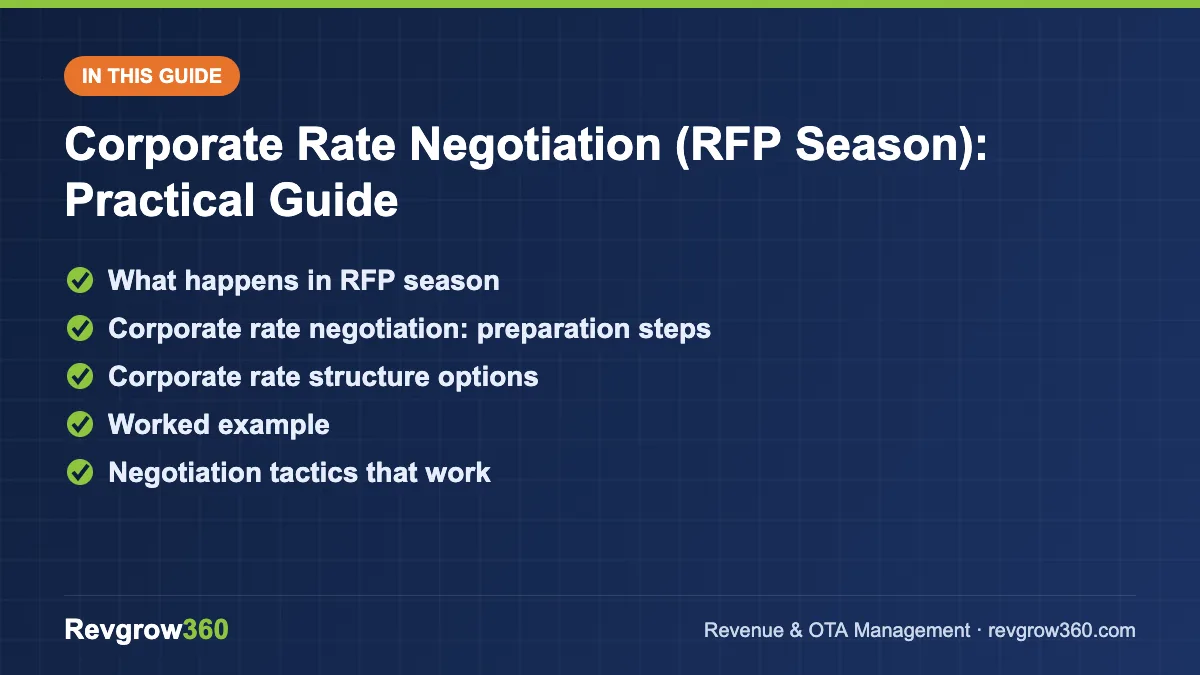
- Know your floor rate
- Check displacement first
- Trade discounts for volume
For many Indian city hotels, corporate accounts support midweek occupancy. The challenge is to win this business without giving away the rate you could earn elsewhere.
What happens in RFP season
Large companies, travel management companies (TMCs) and some government bodies invite hotels to submit rates for the coming year. They usually ask for a single rate per room type, sometimes with seasonal bands, along with inclusions such as breakfast and Wi-Fi, and terms such as cancellation, last room availability and tax treatment. Buyers compare hotels in the same city and choose a preferred list.
Smaller companies may negotiate directly with your sales team or general manager without a formal RFP.
A ready corporate rate contract.
Corporate rate negotiation: preparation steps
Step 1: Review the existing account
For each current account, look at room nights, average rate, revenue, cancellations, no-shows and seasonality. Calculate the share of total rooms they take.
| Account metric | What it tells you |
|---|---|
| Room nights last year | Real volume you can use as a negotiating fact |
| Average rate achieved | Whether last year’s rate was healthy |
| Cancellation and no-show rate | Cost of flexibility |
| Days of week used | Fit with your low-demand nights |
| Extras spent on F&B, laundry, meetings | Total account value |
Step 2: Set your floor and target rates
Find your seasonal ADR and demand pattern. See average daily rate (ADR) and hotel occupancy rate. Use a simple approach:
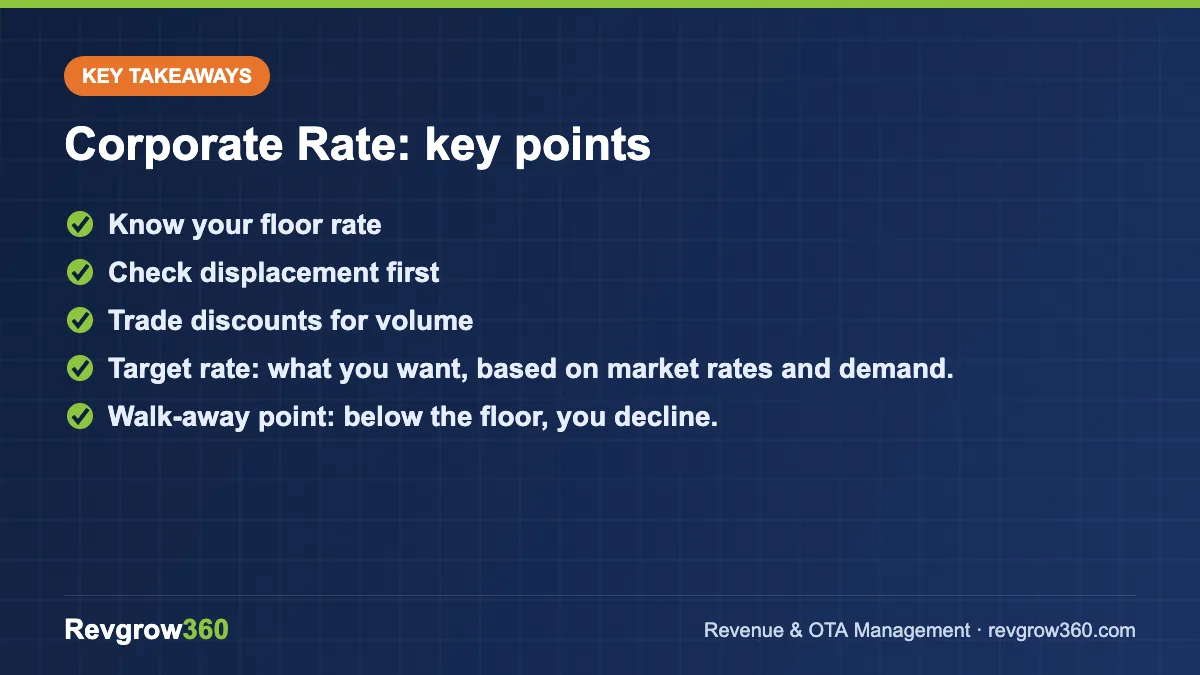
- Target rate: what you want, based on market rates and demand.
- Floor rate: the lowest rate you can accept and still earn a satisfactory profit after commission and cost of service.
- Walk-away point: below the floor, you decline.
Step 3: Know the competitors
Check rates and positioning of comparable hotels. Do not copy their numbers; use them to judge your value and your location advantage.
Step 4: Decide what you can offer apart from rate
Rate is one lever. Others include breakfast, free Wi-Fi, late checkout, airport transfer, meeting room hours, laundry allowances, loyalty benefits and room upgrades when available. A package of small, low-cost items can bridge a gap without lowering the rate.
Revenue Health Score · free
Free tool: check your hotel’s revenue health
Answer a few quick questions about your rooms, rates, OTAs and reviews. Get a score out of 100, your weakest revenue areas and the first actions to fix them.
Corporate rate structure options
| Structure | How it works | Pros and cons |
|---|---|---|
| Fixed flat rate | One rate all year | Simple, but poor in peak season |
| Seasonal rate | Different rates for low, shoulder and peak periods | Better alignment with demand |
| Discount off BAR | Percentage off the best available rate | Tracks the market; clear rules needed |
| Dynamic or capped rate | Lower of BAR or a ceiling rate | Buyers like it; can reduce your margin |
| Volume tiers | Rate reduces after a set number of room nights | Rewards loyalty; tracking required |
Prefer seasonal rates or a discount off BAR with blackout dates. See hotel dynamic pricing strategy for context.
Worked example
A 70-room business hotel in Bangalore receives an RFP from a company that expects 600 room nights a year, mostly Monday to Thursday. The hotel’s average transient rate on those nights is ₹5,600, and corporate booking via a TMC would carry a commission or fee.
| Item | Amount (hypothetical) |
|---|---|
| Company’s requested rate | ₹4,200 including breakfast |
| Hotel’s transient average on those nights | ₹5,600 |
| Estimated share of those rooms that would be sold at that rate anyway | 40 percent |
| Displacement cost per room night | ₹5,600 x 0.40 = ₹2,240 |
| Estimated breakfast cost | ₹300 |
| Net contribution per room night | ₹4,200 – ₹300 – ₹2,240 = ₹1,660 |
| Annual contribution at 600 room nights | ₹9,96,000 |
The deal is positive, but the negotiator may counter at ₹4,500 for peak months, or request a minimum volume or lower the breakfast to a cheaper option. If displacement were 80 percent, the same deal would be less attractive. These numbers are an illustration.
Negotiation tactics that work
- Start with value, not price. Mention location, reliability, service, quick response and amenities that matter to business guests.
- Offer a range, not one number. Quote seasonal rates with a clear reason for each band.
- Trade, do not concede. For every discount, ask for something: volume commitment, longer rate validity, preferred status, direct booking.
- Use data. Show last year’s room nights, cancellation record and average rate.
- Protect peak dates. Add blackout dates or higher rates for festivals, conferences and wedding seasons.
- Control last room availability. Avoid giving the same rate on all nights regardless of occupancy unless the volume justifies it.
- Know when to walk away. A rate below your floor can lower your market positioning and limit rate flexibility later.
Terms to check in the agreement
- Rate validity period and review dates.
- Inclusions and what is chargeable.
- Cancellation window and no-show terms.
- Booking method: direct, TMC or online portal, and any fees.
- Tax treatment and invoicing details. Confirm with your CA.
- Payment terms and credit period.
- Rate parity: corporate rates should not appear on public websites.
- Volume reporting and review meeting dates.
Sample negotiation conversation
Here is how a hotel sales manager might respond when a buyer asks for a lower rate.
“Thank you for sharing your volume forecast. We value your business and want to continue the partnership. Based on 600 room nights, we can offer ₹4,500 including breakfast for most months. For the peak period from December to February, we would suggest ₹5,200, as demand from other guests is much higher. If your team can commit to 800 room nights, we can reduce the standard rate to ₹4,350. Would that work for you?”
The response has four useful features: it acknowledges the buyer, offers a clear rate by season, links the discount to volume and ends with a question that keeps the discussion moving.
Preparing your RFP response
Many hotels lose RFPs because of poor response quality, not price. Prepare a standard response pack in advance, with these parts:
- Hotel profile, location advantages, distance to the buyer’s office or plant.
- Room types, facilities, business amenities, Wi-Fi speed and meeting rooms.
- Safety and quality information, such as fire safety compliance and hygiene practices.
- Rate sheet by season and room type, with clear inclusions.
- Policies for cancellation, no-show, early check-in and late checkout.
- References from satisfied corporate clients, but only with their permission.
- Contact person for escalation.
Submit before the deadline and double-check numbers. A wrong rate in an RFP can cost lakhs over a year. Think about how corporate rates fit into your overall hotel distribution strategy.
Managing the account after signing
- Load the rate in your PMS and channel manager with the correct codes and restrictions.
- Train the front desk and reservations team to recognise the corporate code.
- Track production monthly: room nights, revenue and rate. Compare with the commitment.
- Hold a quarterly review call with the company’s travel desk.
- Offer small recognition gestures, such as a welcome note, to frequent travellers.
- Promote direct booking options to reduce costs. See how to increase hotel direct bookings.
Common mistakes
- Giving the lowest rate to win the account, without checking displacement.
- Not asking for volume or reviewing production after the first year.
- Accepting last room availability at the corporate rate on peak nights.
- Failing to update corporate rates in all systems, which leads to errors.
- Ignoring ancillary spend when judging account value.
Key takeaways
- Corporate rate negotiation works best when you know your floor, your displacement and the account’s real volume.
- Prefer seasonal rates or discounts off BAR with blackout dates.
- Trade concessions for volume, longer validity or inclusions.
- Track production and review the account regularly.
Revgrow360 supports hotels with rate strategy and pricing during RFP season. Explore our hotel revenue management service or request a free hotel audit.
For more background, see this revenue management overview on Wikipedia.
Frequently asked questions
What is RFP season for hotels?
RFP season is the period, often towards the end of the year, when companies and travel management firms ask hotels to submit negotiated rates for the coming year. Hotels respond with room rates, inclusions and terms, and buyers choose a preferred list.
How do I decide my floor rate for a corporate account?
Start with your cost of service and the commission or fees, then check displacement by estimating what you could sell those rooms for to other guests. Your floor is the lowest rate that still gives an acceptable net contribution.
Should corporate rates be fixed or seasonal?
Seasonal rates or a discount off the best available rate with blackout dates usually protect revenue better than one flat annual rate. Fixed rates are simple but can underprice peak periods and overprice quiet ones.
What should I ask for in return for a discount?
Ask for a volume commitment, longer rate validity, preferred hotel status, direct booking channels, a shorter payment period or reduced last-room availability on peak dates. Trading rather than simply conceding protects your margin.
More Revenue Management guides
Group Pricing for Hotels: A Practical Guide
A practical method for pricing hotel groups: check demand, calculate displacement, add total value and protect the rate with contract terms.
Hotel Promotions That Don’t Hurt ADR: A Practical Guide
Learn hotel promotions that don't hurt ADR: add value, target segments, cap inventory and measure RevPAR, with a worked example and checklist.
Early Bird Discount Strategy: A Practical Guide for Hotels
A practical early bird discount strategy for hotels: when to use it, how to set the window, discount and room cap, and…
Last Minute Pricing for Hotels: A Practical Guide
A practical guide to last minute pricing for hotels, with triggers, a floor price, targeted offers and a worked example using real…
What Does a Hotel Revenue Manager Do? Role, Skills and Routine
Forecasting, pricing, inventory and distribution: here is what a hotel revenue manager actually does, the skills it takes and a realistic daily…
Hotel Rate Fences Explained: A Practical Guide
Rate fences are conditions that let hotels discount for price-sensitive guests without cutting prices for everyone. Learn types, design and testing.
Related guide: Best Revenue Management Company In India 2026
Free PDF checklist
Where is your hotel losing money?
27 quick checks on pricing, OTAs, reviews and direct bookings, with the first fix for every leak.
Get the free checklist →