 By Md Arif Ahamed
Quick summary: Open pricing vs BAR pricing for hotels: how each works, a side-by-side comparison, a worked example and how to choose or combine them for more revenue.
Open pricing vs BAR pricing is a choice between two ways of setting hotel room rates. BAR (Best Available Rate) pricing sets one flexible public rate for each room type per night, with discounts derived from it. Open pricing, sometimes called fully flexible or dynamic pricing, sets a different price for every stay date, length of stay and sometimes booking window, based on demand. BAR is simpler; open pricing is more detailed and usually more profitable when managed well.
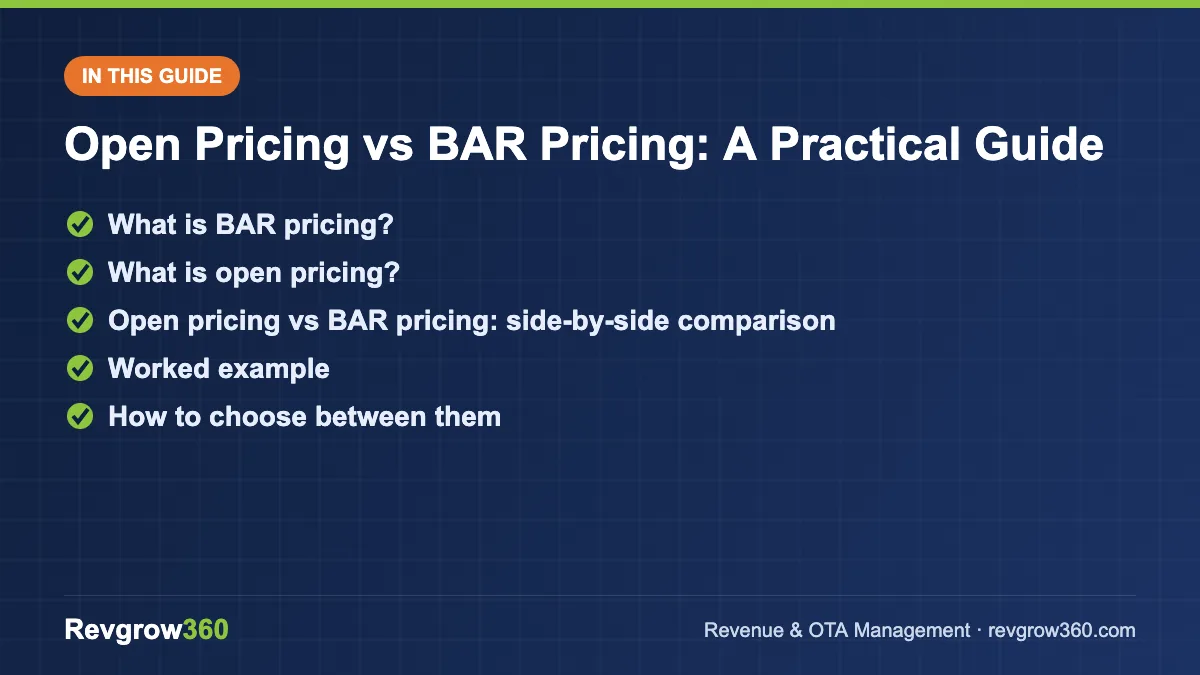
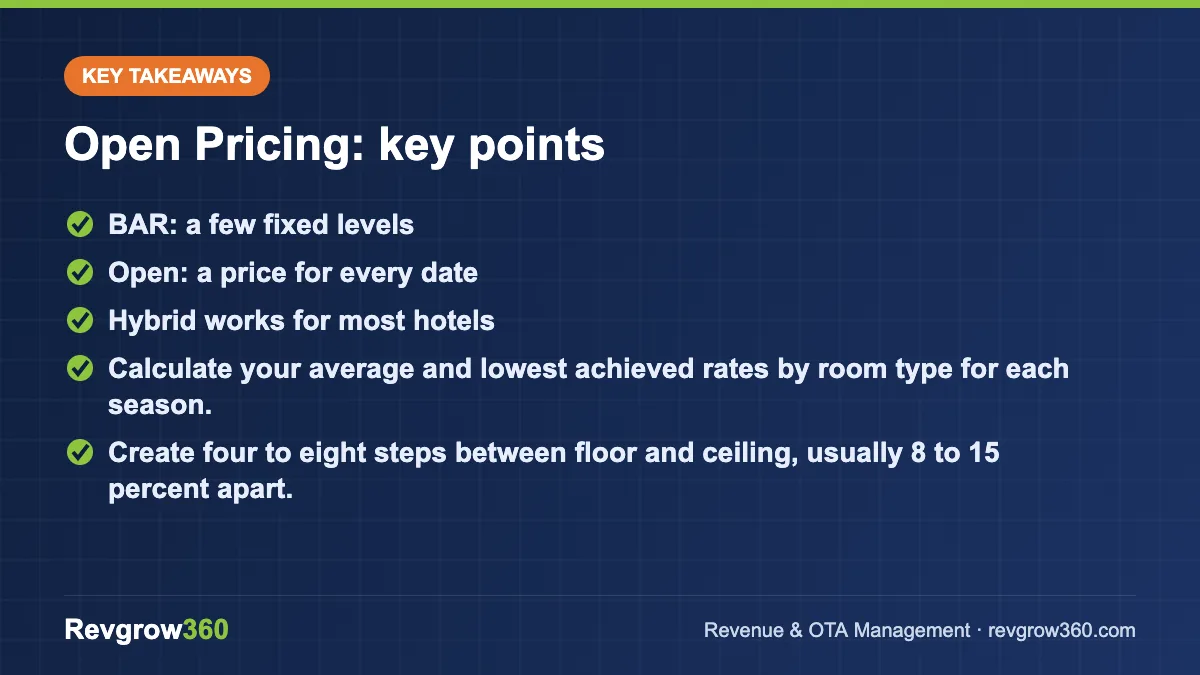
- BAR: a few fixed levels
- Open: a price for every date
- Hybrid works for most hotels
This guide compares the two, explains how each works, shows a worked example, offers a decision table for small and mid-size Indian hotels and lists the mistakes to avoid. Terminology differs between hotels and systems, so confirm what your own PMS and channel manager mean by each term.
What is BAR pricing?
BAR is the lowest publicly available rate for a room type on a given night, without special restrictions or negotiated conditions. It is usually the anchor from which other rates are built: a non-refundable rate may be 10 percent below BAR, a corporate rate may be a fixed discount off BAR, and a package may be BAR plus breakfast.
A hotel using BAR typically sets a small number of rate levels, or “BAR levels”, and moves between them based on demand. For example, Level 1 may be ₹3,500, Level 2 ₹4,000, Level 3 ₹4,600 and Level 4 ₹5,400. On a slow night the hotel offers Level 1, and as occupancy builds it closes the lower levels.
Find the right room rate for your costs and profit.
What is open pricing?
Open pricing sets rates freely by date, room type, length of stay, channel and sometimes lead time, without fixed levels. There may be no single fixed base price; each night has its own price shaped by forecast demand, competitor rates, pace and rules. Systems that automate it are often called revenue management systems or pricing engines.
Open pricing is closely related to dynamic pricing; read our hotel dynamic pricing strategy guide for the full approach.
Open pricing vs BAR pricing: side-by-side comparison
| Factor | BAR pricing | Open pricing |
|---|---|---|
| Structure | A few fixed price levels per room type | Free price for each date, room type and length of stay |
| Complexity | Low to medium | Medium to high |
| Speed of change | Move between levels when thresholds are met | Frequent, sometimes daily or automated changes |
| Control | Easy to explain and audit | Needs good data and discipline |
| Revenue potential | Good, but can leave money on the table | Higher potential when forecasts are strong |
| Staff skill needed | Basic | Analytical |
| Typical fit | Smaller hotels, resorts with clear seasons | Hotels with variable demand, many room types or channels |
| Risk | Stale levels, slow reaction | Price swings, errors, confusing the team and guests |
Worked example
A hypothetical 30-room hotel in Goa has BAR levels of ₹4,000, ₹4,800 and ₹5,800. Look at three dates in a week.
| Date | Forecast occupancy | BAR approach | Open pricing approach |
|---|---|---|---|
| Tuesday | 45% | Level 1: ₹4,000 | ₹3,700 with a small 2-night offer |
| Friday | 78% | Level 2: ₹4,800 | ₹5,200 |
| Saturday, festival | 95% | Level 3: ₹5,800 | ₹6,900 with a 2-night minimum |
On the festival night the BAR ladder stops at ₹5,800, because that is its top level. Open pricing can charge ₹6,900 if demand supports it. On a slow Tuesday, open pricing may use a lower price and a targeted offer rather than the lowest fixed level. Over a year, these differences add up, but only if forecasts and competitor data are accurate.
How to choose between them
- Check your data. If you do not have reliable daily history, forecasts and competitor rates, start with BAR.
- Check your team. Open pricing needs someone who can review prices daily and understand demand signals.
- Check your demand pattern. If demand swings sharply by date, festival, weekday and season, open pricing pays off faster.
- Check your systems. A good PMS, channel manager and rate shopping tool make open pricing safe. See what is a hotel channel manager.
- Start with BAR, then relax it. Many hotels begin with BAR levels and gradually move to open pricing for peak dates and longer stays.
- Review results. Compare RevPAR, ADR and occupancy against budget and against your competitive set after each quarter.
A hybrid approach is common: BAR levels for normal days, and open prices for events, long weekends and sold-out nights.
Where rate fences and restrictions fit
Both approaches work better with fences that separate guests by their willingness to pay. A non-refundable rate, an advance purchase rate, a minimum-stay requirement and a member-only rate let you offer lower prices without cutting the price for everyone. See our guide to hotel rate fences explained and length of stay restrictions.
Setting up BAR levels: a simple method
- Calculate your average and lowest achieved rates by room type for each season.
- Decide your floor rate, based on break-even and variable cost per room, and your ceiling rate, based on your highest demand dates.
- Create four to eight steps between floor and ceiling, usually 8 to 15 percent apart.
- Link each level to an occupancy or pace trigger. For example, when forecast occupancy passes 60 percent, move up one level; when it passes 80 percent, move up another.
- Add event overrides for festivals, weddings and long weekends.
- Review the ladder every season and after any major change in demand.
| Level | Example rate for a Deluxe room | Trigger |
|---|---|---|
| Level 1 | ₹3,500 | Forecast below 40% |
| Level 2 | ₹3,900 | 40% to 55% |
| Level 3 | ₹4,400 | 55% to 70% |
| Level 4 | ₹5,000 | 70% to 85% |
| Level 5 | ₹5,800 | Above 85% or major event |
This ladder is simple enough for a duty manager to apply and strong enough to protect revenue. The triggers are illustrative; calibrate them with your own booking pace and history.
Parity and OTA implications
Whichever model you use, keep rates consistent across your website and OTAs, or you risk parity problems and lost trust. Open pricing creates more rate changes, so a channel manager that pushes updates quickly is essential. Read hotel rate parity to understand the issues.
Moving from BAR to open pricing step by step
You do not need to switch overnight. Start by adding event overrides above your top BAR level. Next, add length-of-stay rules for peak weekends. Then allow price changes by room type rather than one ladder for all. Finally, test day-by-day pricing for one season while keeping the BAR ladder as a safety net. Measure RevPAR against the same period last year and against your competitive set before expanding further.
Common mistakes
- Treating open pricing as random price changes. It needs a forecast and rules.
- Too many BAR levels or too few. Four to eight levels often work for small hotels.
- Never moving BAR levels. Levels should be reviewed each season.
- Ignoring competitors. Both models need market information.
- Cutting price too early. Wait for booking pace signals before discounting.
- Letting rate shoppers drive every move. Your own demand matters more.
- No minimum rate. Always set a floor based on your costs and break-even.
Tools and checklist
- PMS with room type and rate plan management.
- Channel manager that updates all OTAs at once.
- Competitor rate shopping, manual or tool-based.
- A simple forecast and pace report.
- A written pricing policy with floor rates, discount limits and approval rules.
- Decide the model: BAR, open or hybrid.
- Set a floor rate and a ceiling rate per room type.
- Define the levels or rules and the triggers to change them.
- Assign one owner for daily review.
- Review performance monthly and refine.
Key takeaways
- BAR uses a few fixed price levels; open pricing sets a rate for each date and situation.
- BAR is simpler and easier to manage; open pricing offers more revenue potential but needs more data and skill.
- Many hotels begin with BAR and move to a hybrid model.
- Rate fences, floor prices and rate parity are essential in both models.
- Review results against budget and competitors every month.
Revgrow360 helps hotels choose and run the right pricing model. Learn more about hotel revenue management or book a free consultation.
For more background, see this revenue management overview on Wikipedia.
Frequently asked questions
What is BAR pricing in hotels?
BAR stands for Best Available Rate, the lowest public rate for a room type on a given night without special restrictions. Hotels usually set a few BAR levels and move between them as demand changes, and derive other rates such as non-refundable or corporate from it.
What is open pricing in hotels?
Open pricing sets a price for each date, room type and sometimes length of stay or lead time freely, without fixed levels. Prices follow forecast demand, competitor rates and booking pace. It is closely related to dynamic pricing and often supported by a revenue management system.
Which is better for a small hotel, open pricing or BAR?
Small hotels with limited data and staff often do best starting with BAR levels, which are simple to run and audit. As data and skills improve, they can use open pricing for peak dates and longer stays. A hybrid approach is common.
Do open pricing and BAR need rate fences?
Yes. Rate fences such as non-refundable terms, advance purchase and minimum stay let hotels offer lower prices to price-sensitive guests without cutting prices for everyone. They work with both BAR and open pricing models.
More Revenue Management guides
Hotel Rate Fences Explained: A Practical Guide
Rate fences are conditions that let hotels discount for price-sensitive guests without cutting prices for everyone. Learn types, design and testing.
How to Choose a Competitive Set: A Practical Guide
A practical method to choose a hotel competitive set using criteria, scoring and review, so benchmarking and pricing decisions are reliable.
How to Read STR Reports: A Practical Guide
A plain-language guide to STR-style benchmarking reports, including MPI, ARI and RGI, with a worked example and monthly review steps.
Hotel Revenue Forecasting in Excel: A Practical Guide
Build a simple Excel workbook that combines history and on-the-books bookings to forecast rooms, ADR and revenue, then measure accuracy.
How to Build a Hotel Budget: A Practical Guide
A step-by-step method to build a hotel budget that starts with revenue, adds realistic costs and gets reviewed every month.
OTA Commission Rates for Hotels Explained
What hotels really pay OTAs once programmes, promotions and taxes are added, with typical commission ranges and practical ways to reduce OTA…