 By Md Arif Ahamed
Quick summary: Learn how to choose a competitive set for your hotel: criteria, a scoring method, a worked example, review timing and mistakes that distort benchmarking.
Knowing how to choose a competitive set means picking the hotels guests genuinely compare with yours, based on location, price, quality, room type and the channels where you compete. A competitive set is the small group of rival hotels, usually five to eight, that you use to benchmark rates, occupancy and revenue. The right set tells you the truth about your performance; the wrong set misleads every pricing decision.
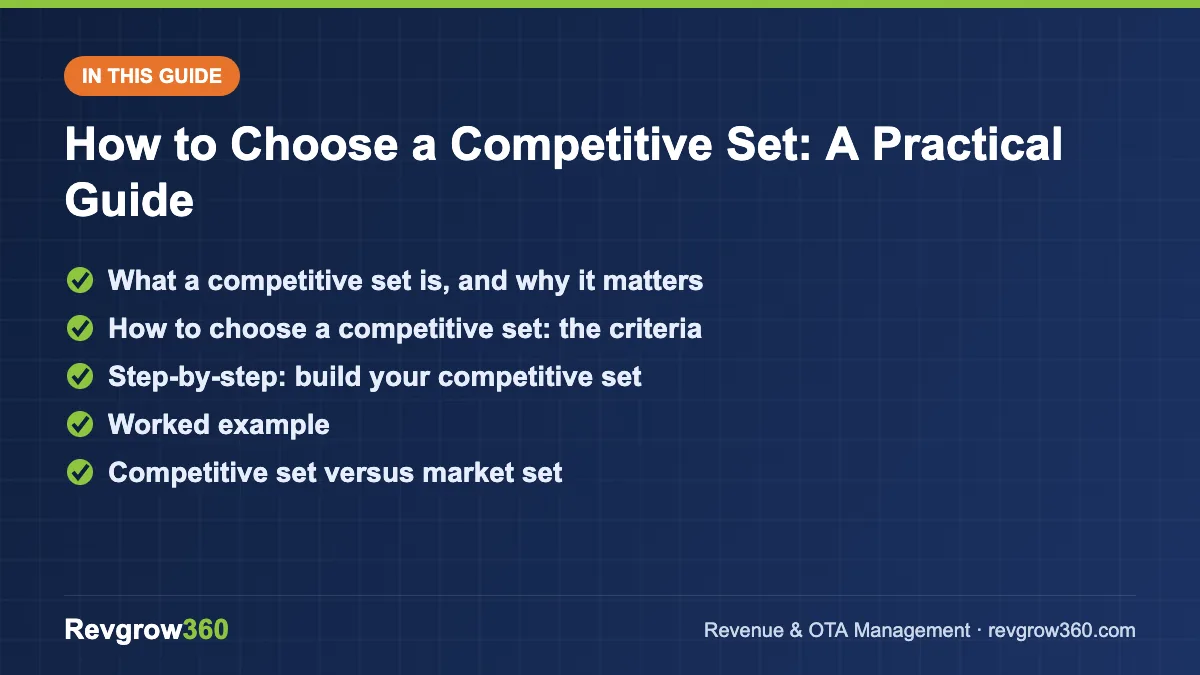
- Search like a guest
- Score on location, price, quality
- Review every six months
This guide gives a practical method for choosing, testing and reviewing your competitive set, with a scoring table, a worked example for a hotel in Darjeeling and the mistakes to avoid. It applies to rate shopping, STR-style benchmarking and any manual comparison you do.
What a competitive set is, and why it matters
A competitive set, or comp set, is the group of hotels you measure yourself against. Its numbers become your yardstick: if the set averages 65 percent occupancy and you run 58, you are losing share. If the set’s average rate is ₹4,400 and yours is ₹3,900, you are priced below the market.
Because every pricing and promotion decision references this set, a poor choice distorts everything. A budget guesthouse compared with five-star resorts will always look weak. A premium boutique compared with budget lodges will look strong when it is not. Reading benchmarking reports properly depends on this foundation; see how to read STR reports.
Compare your performance with your competitors.
How to choose a competitive set: the criteria
Look at the hotels from the guest’s point of view. Guests do not compare by star label; they compare what they see on an OTA search page for their dates and budget.
| Criterion | Question to ask |
|---|---|
| Location | Is it in the same area or same distance from the main attraction, station or airport? |
| Price range | Does it sell at a similar average rate over the year? |
| Quality and star rating | Are rooms, facilities and reviews comparable? |
| Room count and size | Is it a similar scale of inventory? |
| Guest segment | Does it attract the same leisure, business or family guests? |
| Facilities | Does it have comparable pool, restaurant, parking, view or spa? |
| Distribution | Does it appear on the same OTAs and in the same search results? |
| Review score | Is the guest rating in a similar band? |
Step-by-step: build your competitive set
- Search as a guest. On two or three major OTAs, search your city and dates for a typical weekend and a typical weekday. Note which hotels appear near yours at similar prices.
- Ask your guests. Ask recent guests and your reservations team which other hotels the guest also considered.
- Check your OTA tools. Many extranets show similar or competing properties. Use them as clues, not as final answers.
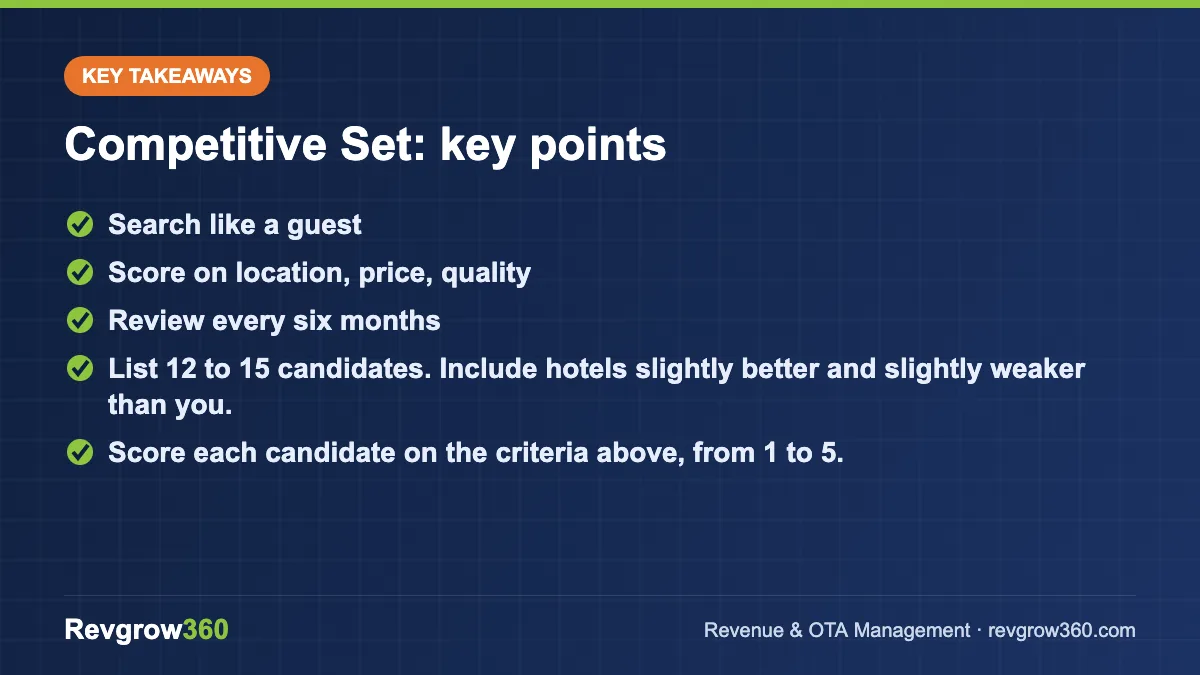
- List 12 to 15 candidates. Include hotels slightly better and slightly weaker than you.
- Score each candidate on the criteria above, from 1 to 5.
- Pick the top five to eight. Aim for a balanced mix, not only hotels cheaper or only hotels more expensive than you.
- Check data availability. A hotel is easier to track if rates are visible on public OTA pages or in your benchmarking provider’s data.
- Document the reasons. Write why each hotel is in the set, so the logic survives staff changes.
- Test it for a month. Compare average rate and review gaps, and remove any hotel that clearly does not fit.
Worked example
A hypothetical 20-room boutique hotel in Darjeeling, with a rating of 8.6 and an ADR of about ₹4,500, scores nine candidates.
| Candidate | Location | Price | Quality | Segment | Total (out of 20) | Decision |
|---|---|---|---|---|---|---|
| Hotel A, 24 rooms, Mall Road | 5 | 5 | 4 | 5 | 19 | Include |
| Hotel B, 18 rooms, near station | 4 | 4 | 4 | 4 | 16 | Include |
| Hotel C, 60 rooms, large resort | 3 | 2 | 5 | 3 | 13 | Exclude (different scale) |
| Hotel D, 15 rooms, budget lodge | 5 | 2 | 2 | 2 | 11 | Exclude (lower tier) |
| Hotel E, 22 rooms, heritage | 4 | 5 | 5 | 5 | 19 | Include |
| Hotel F, 12 rooms, homestay | 3 | 4 | 4 | 4 | 15 | Include |
The hotel keeps A, B, E and F, plus two others from the longer list, giving a set of six. Hotel C is excluded because its scale and facilities are very different, even though it is nearby.
Competitive set versus market set
| Set type | Description | Use |
|---|---|---|
| Primary competitive set | Five to eight closest rivals | Daily pricing and benchmarking |
| Secondary set | Aspirational or broader peers | Strategy and long-term positioning |
| Market or destination set | All comparable hotels in the area | Understanding overall demand |
Keep your primary set tight. Use the broader set only for context.
How to use the set for pricing
Track rates for the same room type, meal plan and cancellation terms across the set, and compare your price position by date. Do not copy competitor prices blindly. Use them as one input alongside your own demand forecast and booking pace; see hotel dynamic pricing strategy and hotel demand forecasting. If competitors sell out, you may be able to raise price. If they discount deeply and you remain full, hold your rate.
The index measures that come from this set are explained in our glossary article on the rate index.
Competitive set for different hotel types
The mix of criteria changes by property type. Use the guide below as a starting point.
| Hotel type | What matters most | Typical mistake |
|---|---|---|
| City business hotel | Distance to business districts, airport and corporate rates, meeting rooms | Including leisure resorts on the outskirts |
| Beach or hill resort | Distance to beach or view, pool, activities, leisure packages | Counting every hotel in the town regardless of position |
| Heritage or boutique | Character, reviews, experience, price band | Comparing with chain hotels that sell a different promise |
| Homestay or small guesthouse | Location, hospitality, price, room count, views | Using large hotels as the only benchmark |
If your area has few comparable hotels, widen the radius first, then adjust for travel time and guest purpose. In a small hill town, a hotel ten kilometres away may still be a true rival if guests treat the whole area as one destination.
How to track the set in practice
- Create a simple sheet with each hotel in the set, its room types and rating.
- Record the lowest public rate for a similar room and meal plan on key dates, such as next Friday, next Saturday and the next two festival dates.
- Record the date you checked, the OTA used and any special tags such as deals or sold out.
- Calculate your price position as a percentage above or below the set average.
- Review the sheet before each pricing decision, and weekly during peak season.
Be careful with one-off comparisons. A competitor that shows a very low price may simply be clearing a few rooms, and a competitor shown as sold out may have closed rooms for another reason.
When to review the set
- Every six months as a routine check.
- When a new competitor opens or an existing one renovates or rebrands.
- After you renovate, change category or reposition your price.
- When your performance versus the set changes sharply with no clear cause.
- When a competitor closes or shifts to a different segment.
Common mistakes
- Choosing by star rating alone. Guests compare by price, location and reviews, not by official category.
- Including only cheaper or only pricier hotels. This skews every index.
- Making the set too large. More than eight to ten hotels dilutes the signal.
- Letting ego choose. Owners sometimes add famous hotels they wish to match.
- Never updating the set. Markets change.
- Ignoring channels. A competitor sold mainly to corporate clients may not compete for your leisure guests.
- Comparing different room types. Always compare like-for-like rooms and inclusions.
Key takeaways
- A competitive set is five to eight hotels guests truly compare with yours.
- Choose by location, price, quality, scale, segment, facilities and distribution.
- Search as a guest, ask guests and score candidates before you decide.
- Balance the set with some hotels above and some below you.
- Review it every six months and whenever the market changes.
Revgrow360 helps hotels build the right benchmark and use it for smarter pricing. Explore revenue management services or book a free consultation.
For more background, see this revenue management overview on Wikipedia.
Frequently asked questions
What is a competitive set in hotels?
A competitive set is the group of rival hotels, usually five to eight, that you use to benchmark rates, occupancy and revenue. It should contain hotels that guests genuinely compare with yours based on location, price, quality, room type and distribution channels.
How many hotels should be in a competitive set?
Five to eight hotels is a common range. Fewer than five can be distorted by one hotel's behaviour, while more than eight to ten dilutes the signal. Quality of fit matters more than number, so include only genuine rivals.
How do I find my real competitors?
Search your city and dates as a guest on major OTAs, note which hotels appear near yours at similar prices, ask recent guests which other hotels they considered and check your OTA extranet. Then score candidates on location, price, quality, segment and facilities.
How often should a competitive set be reviewed?
Review it at least every six months, and sooner when a new hotel opens, a rival renovates or rebrands, you change your positioning or your performance versus the set changes sharply without a clear cause.
More Revenue Management guides
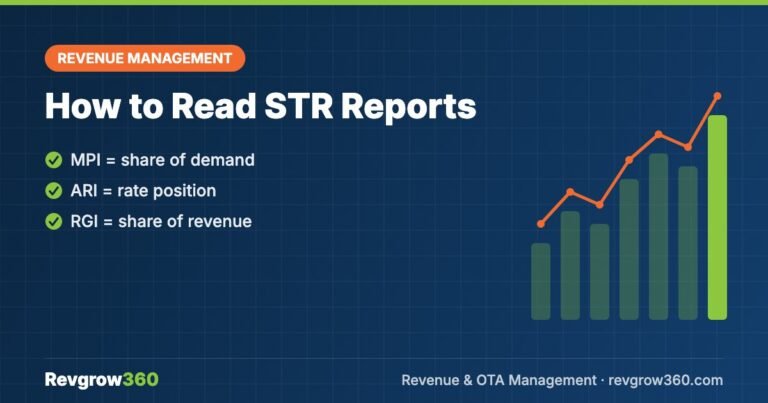
How to Read STR Reports: A Practical Guide
A plain-language guide to STR-style benchmarking reports, including MPI, ARI and RGI, with a worked example and monthly review steps.
Hotel Revenue Forecasting in Excel: A Practical Guide
Build a simple Excel workbook that combines history and on-the-books bookings to forecast rooms, ADR and revenue, then measure accuracy.
How to Build a Hotel Budget: A Practical Guide
A step-by-step method to build a hotel budget that starts with revenue, adds realistic costs and gets reviewed every month.
OTA Commission Rates for Hotels Explained
What hotels really pay OTAs once programmes, promotions and taxes are added, with typical commission ranges and practical ways to reduce OTA…
Revenue Management for Boutique Hotels: A Practical Guide
A practical guide to pricing and distribution for small, distinctive hotels, including room-type pricing, restrictions, channels and a weekly checklist.
Short Term Rental KPIs: 10 Metrics with Formulas
The 10 short term rental KPIs every host should track, each with a formula and a worked example, plus how to set…