 By Md Arif Ahamed
Quick summary: Revenue management for resorts explained: measure TRevPAR, segment guests, price by season, check group displacement and grow spa, F&B and activity income.
Revenue management for resorts is the discipline of maximising total income from rooms, food, spa, activities and events by matching price and inventory to demand. Unlike a city hotel, a resort guest spends a large share of money inside the property, stays longer and books earlier, so the best resort strategy looks at total revenue per guest, not only room rate. This guide explains the method step by step, with an example and a checklist.
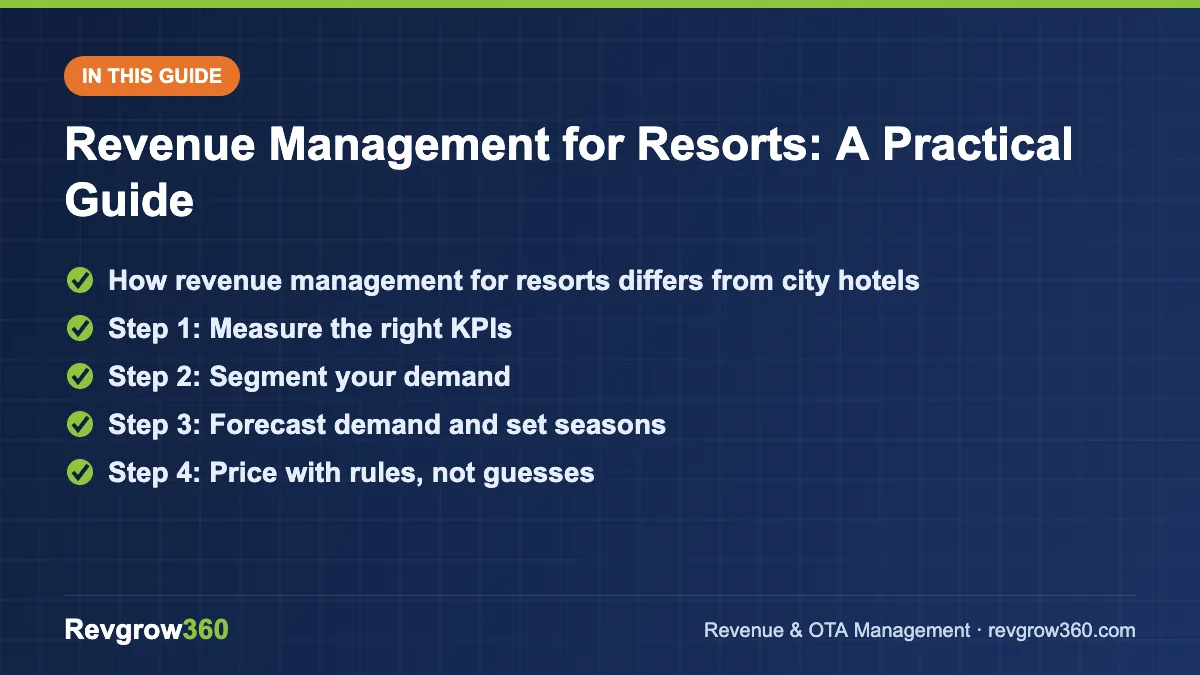
- Track TRevPAR, not just RevPAR
- Check displacement for groups
- Sell packages and experiences
How revenue management for resorts differs from city hotels
| Factor | City hotel | Resort |
|---|---|---|
| Main demand | Business, short stays | Leisure, longer stays, groups, weddings |
| Booking window | Short, often a few days | Longer, often weeks or months |
| Spend pattern | Mostly rooms | Rooms plus F&B, spa, activities, events |
| Seasonality | Weekday and weekend | Strong seasons, festivals, holidays, weather |
| Key metric | RevPAR | RevPAR plus TRevPAR and revenue per occupied room |
| Location | Convenient | Remote, so guests are captive for dining and activities |
Because resort guests are “captive”, a discount on room rate can be wise if the guest spends more on food and experiences. The reverse is also true: a high room rate may reduce the in-house spend and lower total profit.
Step 1: Measure the right KPIs
Track room metrics and total-revenue metrics together.
- Occupancy, ADR and RevPAR for rooms. See hotel KPIs.
- TRevPAR (total revenue per available room): total revenue from all departments divided by available rooms.
- Revenue per occupied room including F&B, spa and activities.
- Average length of stay and booking window.
- Channel mix and net ADR after commission.
Example: a hypothetical 60-room resort in Goa has 60 × 30 = 1,800 available room nights in a month. It sells 1,260 of them, giving 70% occupancy. Room revenue is ₹63,00,000, so ADR is ₹5,000 and RevPAR ₹3,500. F&B, spa and activities add ₹27,00,000, so TRevPAR is (₹63,00,000 + ₹27,00,000) ÷ 1,800 = ₹5,000.
Step 2: Segment your demand
List your guest segments and their behaviour.
| Segment | Typical behaviour | Revenue approach |
|---|---|---|
| Families | Holiday periods, book early, want packages | Family packages, kids’ activities, meal plans |
| Couples | Weekends, celebrations | Romance and spa packages, premium rooms |
| Groups and corporate retreats | Midweek, price-sensitive, bulk | Midweek group rates, check displacement |
| Weddings and events | High spend, long lead time | Venue and room block contracts, deposits |
| Tour operators | Contracted rates, volume | Allotments with release dates |
| Direct and repeat guests | Loyal, lower acquisition cost | Member offers, early-bird rates |
Step 3: Forecast demand and set seasons
Create a calendar with peak, high, shoulder and low seasons. Include holidays, school vacations, wedding dates, festivals and weather. Review historical pace: how many rooms were booked 60, 30 and 14 days before arrival last year? The method is covered in hotel demand forecasting.
Step 4: Price with rules, not guesses
- Set a rate ladder by season and day of week with a floor for each room type.
- Price room categories with clear gaps, for example pool-view above garden-view by a defined percentage.
- Open and close rate levels as occupancy fills: lower levels sell early, higher ones as the date approaches.
- Use packages (room plus breakfast and dinner, spa credit, activities) to lift total revenue and avoid direct price comparison.
- Apply restrictions such as minimum stay on peak weekends and long weekends. See length of stay restrictions.
Our dynamic pricing guide goes deeper.
Step 5: Manage groups and events with displacement
Weddings and corporate groups can fill a resort, but they may block higher-paying leisure guests. Compare the total value of the group (rooms, F&B, venue fee) with the expected value of the transient guests displaced.
Example: a wedding block of 20 rooms for 2 nights at ₹6,000 per room, plus ₹8,00,000 catering and venue income. Room revenue: 20 × 2 × ₹6,000 = ₹2,40,000. Total group revenue: ₹10,40,000. If displaced transient guests would have paid ₹8,500 on average with ₹1,500 in extra spend, that is 20 × 2 × ₹10,000 = ₹4,00,000. The wedding wins clearly, provided costs are covered.
Step 6: Build a balanced distribution mix
- Use OTAs for reach but watch commission; see OTA commission rates.
- Grow direct through a strong website and booking engine. Start with increasing direct bookings.
- Work with a few trusted tour operators, with clear allotments and release dates.
- Maintain consistent pricing across channels with a channel manager.
Step 7: Grow non-room revenue
Map every spend point: breakfast upgrade, dinner, spa, water sports, excursions, kids’ club, laundry, photography, transfers. Sell them before arrival through the confirmation email and at check-in. See upselling and ancillary revenue.
Managing the shoulder and low seasons
Peak weeks look after themselves. The real revenue work happens in shoulder and low months, when a 60-room resort may run at 35% occupancy and fixed costs stay high. Three tools help.
- Stay-longer offers. A “stay 3, pay 2.5” or a free dinner on the third night lifts length of stay and spreads cleaning cost.
- Local and regional demand. Target drive-in guests from nearby cities for weekend breaks, with simple packages and quick booking through WhatsApp.
- Corporate and wellness retreats. Offer midweek meeting packages, yoga or wellness programmes and team-building activities, priced per person with food included.
Keep a minimum rate for each room type so that low-season discounts do not damage your reputation or reset guest expectations for peak season. Where possible, add value rather than cut price: a spa credit costs less to deliver than the same value in room discount.
Staffing and cost alignment
Revenue management does not end with price. A resort that forecasts demand well can roster kitchen, spa, housekeeping and activity staff to match. If you know a 20-room wedding block arrives on Friday, schedule extra housekeeping on Thursday and a larger kitchen team on Saturday. If midweek is forecast at 30% occupancy, close one restaurant outlet or shorten its hours.
This links directly to profit. Extra revenue that needs extra cost does not help as much as extra revenue that reaches the bottom line. Review profitability by guest segment and by channel, not only by revenue, so that you grow the business that pays.
Common mistakes in resort revenue management
- Looking only at room RevPAR and ignoring total guest value.
- Selling out early at low rates and then turning away high-paying late bookings.
- Accepting groups without a displacement check.
- Giving tour operators allotments with no release date.
- Ignoring weather and travel disruption in the forecast.
- Not reviewing cancellation patterns, which hide true demand.
Pre-arrival selling and guest communication
Resort guests plan their holiday in advance, so the best time to sell activities, spa slots and dining is before arrival. Send a confirmation message with a short menu of options, a second message one week before arrival with transfer and activity booking links, and a final message the day before with directions and weather notes. Track how many guests buy at each step so you can improve the timing and offers.
Tools resorts typically use
A resort needs a PMS that handles multiple outlets and packages, a channel manager to keep rates and inventory aligned across OTAs, a booking engine for direct sales, and a simple reporting sheet that shows TRevPAR, pace and channel mix. Larger resorts may add a rate-shopping tool and a revenue management system. Start with the basics, and add tools only when the team will use the output every week.
Resort revenue checklist
| Task | Frequency |
|---|---|
| Review pace versus last year | Weekly |
| Check competitor rates | Weekly, daily in peak |
| Update rate ladder and restrictions | Weekly |
| Review group and event pipeline | Weekly |
| Review TRevPAR and channel mix | Monthly |
| Review season calendar | Quarterly |
Key takeaways
- Revenue management for resorts looks at total revenue per guest, not only room rate.
- Track RevPAR together with TRevPAR and channel net revenue.
- Segment guests and build packages for each.
- Run a displacement check before accepting any large group or wedding.
- Use a rate ladder, restrictions and early forecasting to manage long booking windows.
Revgrow360 works with resorts across India on pricing, distribution and OTA performance. Learn more about hotel revenue management or request a free hotel audit for your resort.
For more background, see this revenue management overview on Wikipedia.
Frequently asked questions
What is revenue management for resorts?
It is the practice of managing prices, inventory, packages and channels to maximise total income from rooms, food, spa, activities and events. Resorts focus on total revenue per available room, because guests spend heavily inside the property, not only on the room.
What is TRevPAR and why do resorts use it?
TRevPAR is total revenue per available room: all departmental revenue divided by available rooms. Resorts use it because in-house spend on dining, spa and activities is large. It shows whether a rate or package strategy raises overall income, not just room revenue.
How should a resort price weddings and groups?
Compare the total group value, including rooms, catering and venue fees, with the expected value of the transient guests it displaces. Use contracts with deposits, clear cut-off dates and attrition terms. Accept the group only when its net contribution is higher.
How far ahead should a resort forecast demand?
Resorts have longer booking windows, so forecasting should look at least 90 days ahead, with weekly review of pace at 60, 30 and 14 days. Include holidays, festivals, wedding dates and weather. Compare against last year and adjust rates and restrictions accordingly.
More Revenue Management guides
Revenue Management for Boutique Hotels: A Practical Guide
A practical guide to pricing and distribution for small, distinctive hotels, including room-type pricing, restrictions, channels and a weekly checklist.
Short Term Rental KPIs: 10 Metrics with Formulas
The 10 short term rental KPIs every host should track, each with a formula and a worked example, plus how to set…
Airbnb Income and Expense Tracking: A Simple System
Learn what to record for every booking and expense, how payouts differ from gross revenue, which categories to use and a monthly…
Revenue Management for Homestays: A Practical Guide
A practical, step-by-step guide to pricing, channels and add-on income for small homestays, with a worked example and a 30-minute weekly routine.
Hotel Rate Parity: What It Is and How to Maintain It
Rate parity keeps your price consistent across OTAs, metasearch and your website. Learn what causes disparity and a practical daily routine to…
Outsource Hotel Revenue Management vs In-House vs RMS Software
In-house hire, software or an outsourced team? Compare the three ways to run hotel revenue management and find the model that fits…