 By Md Arif Ahamed
Quick summary: Flow-through in hotel accounting shows how much extra revenue becomes profit. Learn the formula, a worked example, typical ranges and common mistakes.
Flow-through in hotel accounting is the share of each extra rupee of revenue that turns into extra profit. If a hotel earns ₹1,00,000 more revenue and ₹55,000 of that reaches gross operating profit, the flow-through is 55%. It tells an owner whether growth is actually making money or only making the top line look bigger.
Also read: Cost Per Occupied Room (CPOR) in Hotels: Formula
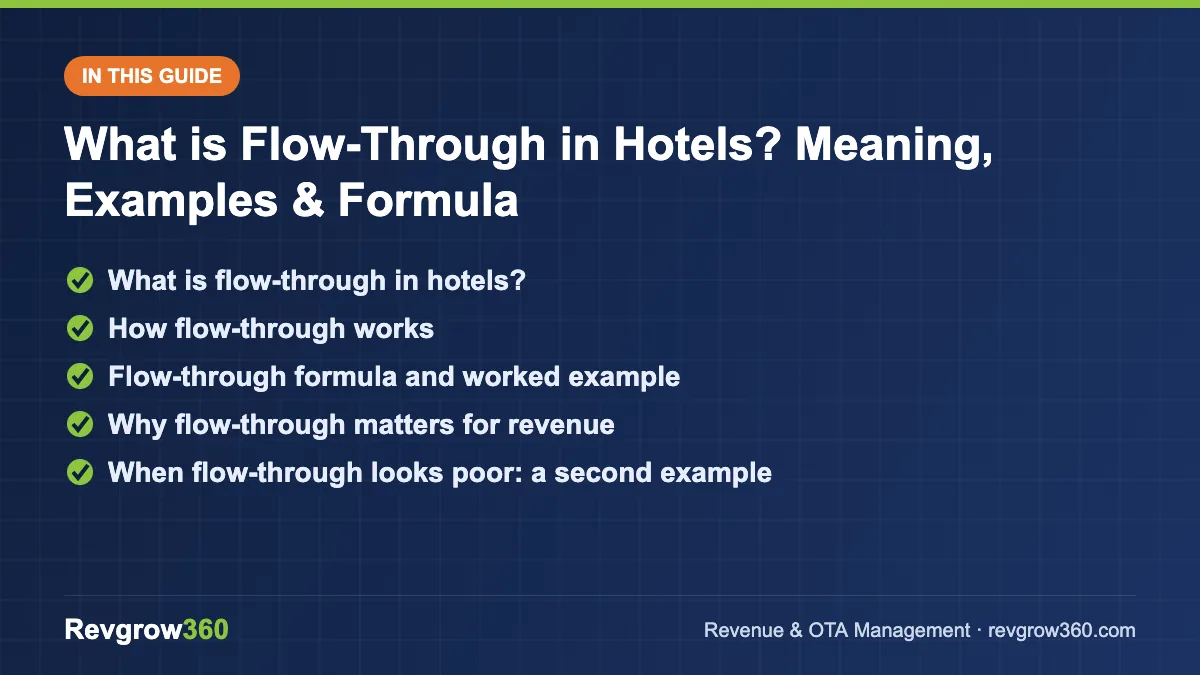
- Extra revenue vs extra profit
- Change in GOP / change in revenue
- Rate rises flow through best
What is flow-through in hotels?
Flow-through measures the change in profit divided by the change in revenue between two periods. Most hotels calculate it at the Gross Operating Profit (GOP) level, though you can also measure it at departmental level, such as rooms flow-through or F&B flow-through.
It is also called incremental margin. Where “GOP margin” tells you how profitable the whole business is, flow-through tells you how profitable the growth was. A hotel can have a healthy average margin and still have poor flow-through if costs rose as fast as sales.
158 hotel terms explained in plain English.
How flow-through works
Hotels have a mix of fixed and variable costs. Salaries of permanent staff, insurance, property tax, and base utilities do not change much when occupancy goes from 60% to 70%. Variable costs, such as laundry, housekeeping supplies, breakfast ingredients, OTA commission and payment gateway fees, do rise with every room sold.
When extra revenue arrives, only the variable costs rise. The balance drops to profit. That is why flow-through on room revenue is usually higher than on food and beverage revenue, where food cost and extra service staff take a larger share.
- Rate-driven growth usually has the highest flow-through, because a higher ADR costs almost nothing extra to deliver.
- Occupancy-driven growth has lower flow-through, because every extra room sold brings cleaning, amenities and commission.
- Cost-driven changes (a salary hike, a new energy contract) reduce flow-through even if revenue is unchanged.
Revenue Health Score · free
Free tool: check your hotel’s revenue health
Answer a few quick questions about your rooms, rates, OTAs and reviews. Get a score out of 100, your weakest revenue areas and the first actions to fix them.
Flow-through formula and worked example
The standard formula is:
Flow-through (%) = (Current GOP − Previous GOP) ÷ (Current Revenue − Previous Revenue) × 100
Take a hypothetical 40-room hotel in Goa comparing two October months.
| Item | October last year | October this year | Change |
|---|---|---|---|
| Total revenue | ₹28,00,000 | ₹32,00,000 | +₹4,00,000 |
| Gross operating profit | ₹9,80,000 | ₹12,00,000 | +₹2,20,000 |
| GOP margin | 35.0% | 37.5% | +2.5 points |
Flow-through = ₹2,20,000 ÷ ₹4,00,000 × 100 = 55%. Out of every extra ₹100 earned, ₹55 reached profit and ₹45 was absorbed by costs.
Reading the result
Because the flow-through (55%) is higher than the old GOP margin (35%), the margin improved. If flow-through had been 30%, the margin would have fallen even though revenue grew. This is the quickest test of whether growth is healthy.
Why flow-through matters for revenue
Revenue managers are often judged on RevPAR, but RevPAR ignores cost. Flow-through connects pricing and distribution decisions to the bottom line.
- Channel mix: a booking through your own website may flow through far better than the same booking through a high-commission OTA. See our guide on OTA commission rates for hotels.
- Pricing: raising rates on high-demand dates has the best flow-through, which is the core idea behind hotel dynamic pricing.
- Discount decisions: a 15% discount to fill a room may add revenue but add almost no profit once cleaning and commission are paid.
- Budgeting: owners can set a flow-through target (for example, “at least 50% on incremental room revenue”) and review it monthly.
When flow-through looks poor: a second example
Now imagine a 25-room hotel in Darjeeling that runs a heavy discount campaign in a quiet month. Revenue rises from ₹12,00,000 to ₹13,50,000, an increase of ₹1,50,000. But OTA commission, extra laundry and overtime push costs up, and GOP rises only from ₹3,60,000 to ₹3,90,000, an increase of ₹30,000.
Flow-through = ₹30,000 ÷ ₹1,50,000 × 100 = 20%. The hotel’s old margin was 30%, so the extra sales actually diluted profitability. The campaign looked like a success on the occupancy report but was weak on the profit statement.
Flow-through by department
You can apply the same formula to one department. Rooms flow-through uses change in rooms departmental profit over change in rooms revenue. F&B flow-through uses the same logic for food and beverage. Splitting it this way shows which part of the business is carrying the profit and which is not.
Typical flow-through ranges
There is no single correct number, and it depends on cost structure, ownership model and city. As rough guidance only, many hotels see room revenue flow-through well above 50%, total hotel flow-through somewhere in the 30% to 60% band, and F&B flow-through lower than rooms. Always compare against your own history and your own comp set rather than a global figure.
| Revenue source | Typical flow-through behaviour | Why |
|---|---|---|
| Rate increase on existing rooms | Very high | No added cost to deliver |
| Extra occupied rooms | Moderate to high | Cleaning, amenities, commission |
| Food and beverage | Lower | Food cost, service labour |
| Spa and activities | Varies | Therapist or vendor cost |
How to improve flow-through
- Push rate before volume on high-demand dates.
- Shift mix toward direct and lower-commission channels, starting with your direct booking strategy.
- Sell add-ons such as breakfast, airport transfer and late checkout, covered in hotel upselling and ancillary revenue.
- Review variable costs monthly: laundry rates, amenity usage, OTA fees.
- Roster staff to demand, not to a fixed pattern.
Common mistakes with flow-through
- Using too short a period. One quiet week can distort the number. Use a month or a season.
- Ignoring one-off costs. A repair or a refurbishment inside the period will make flow-through look poor. Adjust or footnote it.
- Comparing different seasons. Compare October with last October, not October with May.
- Dividing by a tiny revenue change. If revenue moved by only ₹10,000, the percentage is meaningless.
- Chasing flow-through alone. A very high figure from cutting guest-facing costs can hurt reviews and future revenue.
Related terms
- GOP margin: gross operating profit as a share of total revenue.
- GOPPAR: gross operating profit per available room.
- RevPAR: revenue per available room, explained in what is RevPAR.
- Cost per occupied room (CPOR): variable cost to serve one occupied room.
- Incremental margin: another name for flow-through.
Key takeaways
- Flow-through is the percentage of extra revenue that becomes extra profit.
- Formula: change in GOP ÷ change in revenue × 100.
- If flow-through is above your current margin, growth is improving profitability.
- Rate increases flow through better than extra occupancy; direct bookings beat high-commission channels.
- Measure over a month or season, adjust for one-off costs, and compare like with like.
Want to know how much of your growth is really reaching profit? Revgrow360 can review your revenue mix and channel costs as part of hotel revenue management. You can request a free hotel audit any time.
For more background, see this hotel industry overview on Wikipedia.
Frequently asked questions
What is a good flow-through percentage for a hotel?
There is no fixed benchmark. Many hotels aim for flow-through above their current GOP margin, so growth improves profitability. Room revenue typically flows through at a higher rate than food and beverage. Compare against your own past periods and local comp set rather than a global number.
How is hotel flow-through calculated?
Subtract previous-period GOP from current-period GOP, divide by the change in total revenue between the same periods, and multiply by 100. For example, ₹2,20,000 extra profit on ₹4,00,000 extra revenue gives a 55% flow-through.
Can flow-through be negative?
Yes. If revenue rises but costs rise more, profit falls and flow-through turns negative. This can happen when heavy discounting, high commission channels or large cost increases accompany extra sales. A negative figure is a warning that growth is not paying for itself.
What is the difference between GOP margin and flow-through?
GOP margin shows profit as a share of total revenue for one period. Flow-through compares two periods and shows how much of the revenue change reached profit. Margin describes the whole business; flow-through describes the quality of growth.
More Hotel Glossary guides
What is Wash Factor in Hotel? Meaning, Examples & Formula
Wash factor is the share of a group room block that goes unused. Learn the formula, an example and how to use…
What is Break-Even Occupancy in Hotel? Meaning & Formula
Break-even occupancy is the occupancy at which hotel revenue equals total costs. Learn the formula, an example and how to lower it.
What is Yield in Hotel? Meaning, Examples & Formula
Yield shows how much of your potential room revenue you earn. Learn the formula, a worked example and practical ways to improve…
What is Rate Index in Hotel? Meaning, Examples & Formula
The rate index compares your hotel's ADR with your competitive set. Learn the formula, a worked example and how to act on…
What is Room Night in Hotel? Meaning, Examples & Formula
A room night is one room occupied for one night. Learn how it is counted, the formulas that use it and why…
What is Lead Time in Hotels? Meaning, Examples & Formula
Lead time is the number of days between booking and check-in. Learn how to calculate it and use it to time rates,…
Related guide: What is Displacement Analysis in Hotels? Meaning & Formula