 By Md Arif Ahamed
Quick summary: Lead time in hotel revenue management is the days between booking and check-in. See the formula, a worked example and how to use it for rates and marketing.
Lead time in hotel revenue management is the number of days between the date a guest books a room and the date they check in. A guest who books on 5 November for arrival on 25 November has a lead time of 20 days. Lead time helps revenue managers understand how early each type of guest decides, so rates, restrictions and promotions can be timed to match.
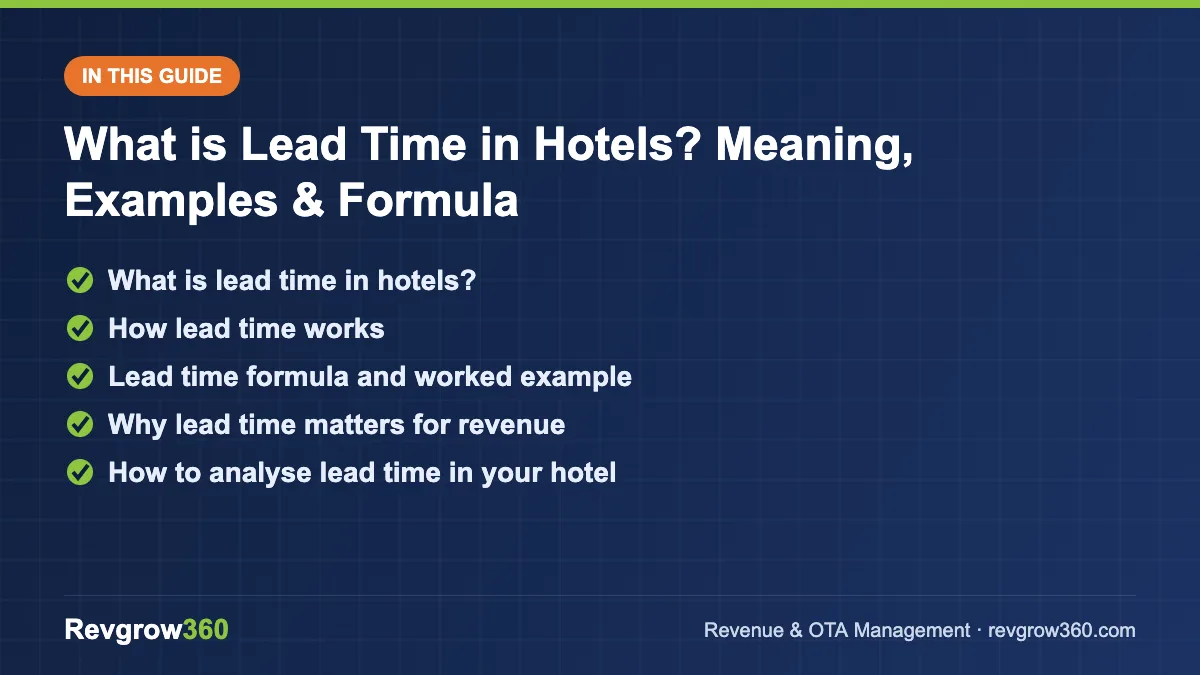
- Check-in date minus booking date
- Split by segment and channel
- Use it to time rates and offers
What is lead time in hotels?
Lead time is a simple measurement attached to every reservation. You can look at one booking’s lead time, or the average lead time across a segment, channel or month. It is often called “booking lead time” or “days out”.
It is related to the booking window, which describes the overall pattern. For example, “our corporate guests have a short booking window” means their lead times are mostly short. You can read more in our glossary entry on the booking window.
158 hotel terms explained in plain English.
How lead time works
Lead time varies by guest type, channel and season.
| Segment or channel | Typical lead time pattern | Reason |
|---|---|---|
| Corporate | Short and variable | Meetings and trips change often |
| Leisure families | Longer | School holidays and planned trips |
| Weddings and events | Very long | Planning takes months |
| Direct bookings by repeat guests | Often shorter | Familiarity with the hotel |
| OTA bookings | Wide spread | Mix of early planners and late bookers |
| Walk-ins | Zero | Same-day need |
Lead times also shift during festivals, long weekends and school holidays, when guests book earlier to secure rooms.
Lead time formula and worked example
Lead time (days) = Check-in date − Booking date
Average lead time = Sum of lead times ÷ Number of bookings
Take a hypothetical 24-room hotel in Darjeeling and compare two segments in October.
| Segment | Bookings | Total lead-time days | Average lead time |
|---|---|---|---|
| Leisure families | 20 | 20 × average 45 = 900 | 900 ÷ 20 = 45 days |
| Corporate guests | 10 | 10 × average 6 = 60 | 60 ÷ 10 = 6 days |
| All bookings combined | 30 | 960 | 960 ÷ 30 = 32 days |
The combined average of 32 days describes neither segment well. For leisure families, you should plan offers and rate changes 6 to 8 weeks out. For corporate guests, a rate change one week before arrival matters more. This is why you should split the data.
Why lead time matters for revenue
- Dynamic pricing. Rates for far-out dates can start higher or lower depending on how much demand the hotel typically sees at that stage. See hotel dynamic pricing.
- Last-minute strategy. If your hotel has many late bookers, holding some inventory for high last-minute rates may pay off.
- Early-bird offers. If guests book far ahead, early-bird rates can secure cash and reduce risk, but should not discount demand that would book anyway.
- Cancellation and overbooking. Long lead times often come with higher cancellation rates; this affects your overbooking strategy.
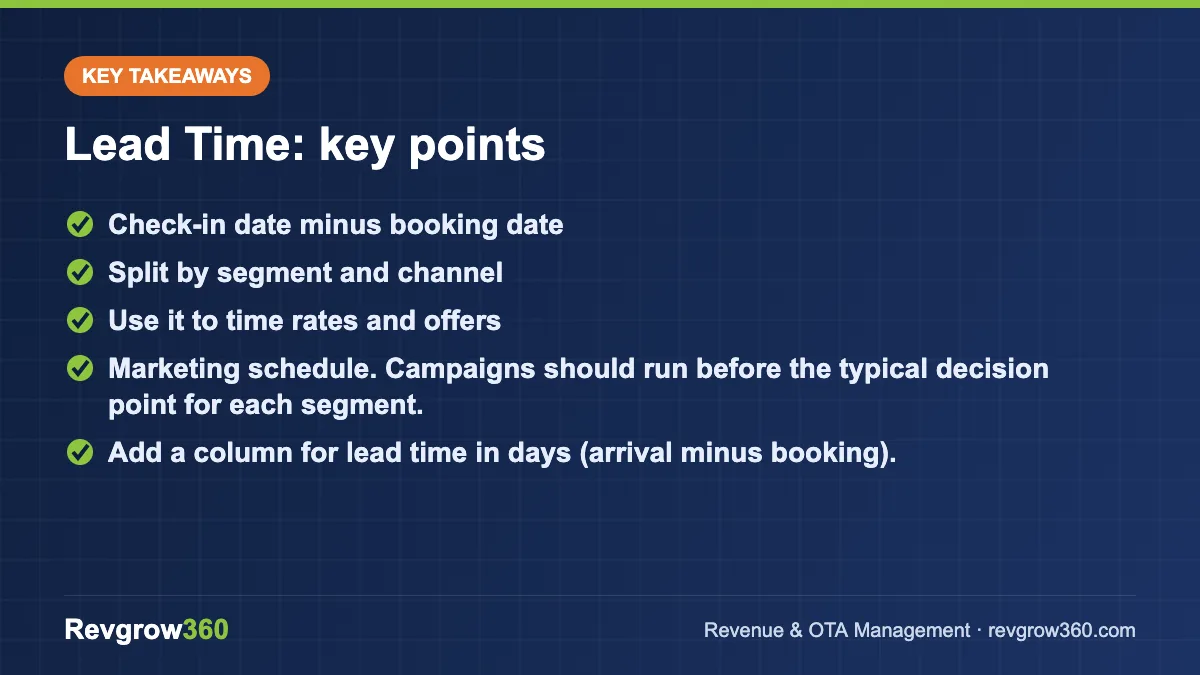
- Marketing schedule. Campaigns should run before the typical decision point for each segment.
- Forecasting accuracy. Lead time shapes how much of the final occupancy should be on the books at each stage; see hotel demand forecasting.
How to analyse lead time in your hotel
- Export bookings for the last 12 months with booking date, arrival date, channel, segment and room type.
- Add a column for lead time in days (arrival minus booking).
- Calculate averages and medians by segment and channel. The median (middle value) is less affected by a few very early bookings.
- Group into bands such as 0 to 3, 4 to 7, 8 to 14, 15 to 30, 31 to 60 and 61 or more days.
- Compare lead time by season and day of week.
- Check cancellation rate by lead-time band.
- Repeat every quarter.
Using lead time in your rate strategy
| Lead-time band | Possible strategy |
|---|---|
| 61 or more days | Advance-purchase or early-bird rate for flexible leisure guests; group enquiries |
| 31 to 60 days | Standard rates with gradual increases as occupancy builds |
| 8 to 30 days | Review pace weekly; adjust rates and restrictions; run targeted campaigns |
| 0 to 7 days | Daily rate checks; last-minute offers on weak dates; protect rate on strong dates |
These bands are examples. Use your own data to define them, as a resort and a city hotel will not match.
Example: lead time and cancellation
A hypothetical 60-room resort studies one year of bookings and finds that bookings made 90 days or more ahead cancel more often than those made within 14 days. The revenue manager responds by offering a slightly cheaper non-refundable rate for long lead times, asking for a larger deposit on far-out peak dates, and keeping a small overbooking buffer only for far-out bookings. The details depend on the hotel’s own data. The principle is that lead time changes risk, so rules should differ by lead time.
Lead time and walk-ins
Walk-ins have zero lead time. If they are a meaningful share of your business, such as at a highway hotel, keep rooms unsold for them on days when you expect demand, and price them according to the evening occupancy, not the earlier rate. See hotel occupancy rate for how to read late occupancy.
Common mistakes
- Looking at a single average for all guests.
- Ignoring channel differences; OTA and direct lead times can be quite different.
- Counting modified or cancelled bookings incorrectly.
- Offering deep early-bird discounts to guests who always book early.
- Not reviewing lead times after major events or changes in marketing.
- Mixing group lead times with individual guests.
Related terms
- Booking window: the overall pattern of lead times.
- Booking pace: how bookings accumulate compared with a benchmark.
- Pickup: new bookings during a period.
- Advance purchase: a rate that requires booking a minimum number of days ahead.
- Cut-off date: the last date for a group or contract to release rooms.
- Cancellation window: time before arrival when a free cancellation is allowed.
Key takeaways
- Lead time is the number of days between booking and check-in.
- Analyse it by segment, channel, season and room type, not only overall.
- Use it to time rate changes, early-bird offers, last-minute strategy and marketing.
- Check cancellation rate by lead-time band for overbooking decisions.
- Review each quarter as guest behaviour shifts.
Revgrow360 analyses booking behaviour for hotels across India and builds pricing calendars from it. Explore hotel revenue management or book a free consultation.
For more background, see this hotel industry overview on Wikipedia.
Frequently asked questions
What is lead time in a hotel?
Lead time is the number of days between the date a guest makes a booking and the date they check in. Hotels measure it for individual bookings and as averages by segment, channel and season to understand when guests decide and to time pricing and marketing.
How do you calculate lead time?
Subtract the booking date from the check-in date. For an average, add the lead times of all bookings and divide by the number of bookings. Use the median as well, because a few very early bookings can pull the average up.
What is a good lead time for a hotel?
There is no single good number. Resorts and leisure hotels usually have longer lead times, while business and drive-in hotels have shorter ones. Compare your lead time with your own history by segment and season, and plan rates and campaigns to match.
How is lead time used in revenue management?
Revenue managers use lead time to decide when to start rate increases, run early-bird or last-minute offers, schedule marketing, adjust forecasts and set overbooking levels. Splitting lead time by segment and channel makes these decisions more accurate.
More Hotel Glossary guides
What is Booking Window in Hotels? Meaning, Examples & Formula
The booking window is the time between booking and arrival. Learn how to calculate it and use it to time rates, offers…
What is Pickup Report in Hotels? Meaning, Examples & Formula
A pickup report shows net new room nights booked in a set period for each future date, helping revenue managers change rates…
What is Booking Pace in Hotels? Meaning, Examples & Formula
Booking pace shows how quickly rooms are being booked for a future date compared with the same point last year or forecast,…
What is Displacement Analysis in Hotels? Meaning & Formula
Displacement analysis compares the value of a group with the transient revenue it displaces, so hotels accept only business that adds net…
What is Flow-Through in Hotels? Meaning, Examples & Formula
Flow-through shows what share of every extra rupee of hotel revenue reaches profit. Learn the formula, a worked example and how to…
Cost Per Occupied Room (CPOR) in Hotels: Formula
CPOR shows what each occupied room costs to deliver. See the formula, a worked example and how to use it for pricing…