 By Md Arif Ahamed
Quick summary: Displacement analysis in hotel revenue management compares group value with displaced guests. Learn the formula, a worked example, break-even rate and mistakes.
Displacement analysis in hotel revenue management is the method of comparing the value of a group or other lower-rate business with the revenue you would lose from the regular guests it displaces. If the group is worth more than the displaced business, you accept it; if not, you decline or reprice it. It stops hotels from filling rooms with business that looks good on occupancy but earns less in total.
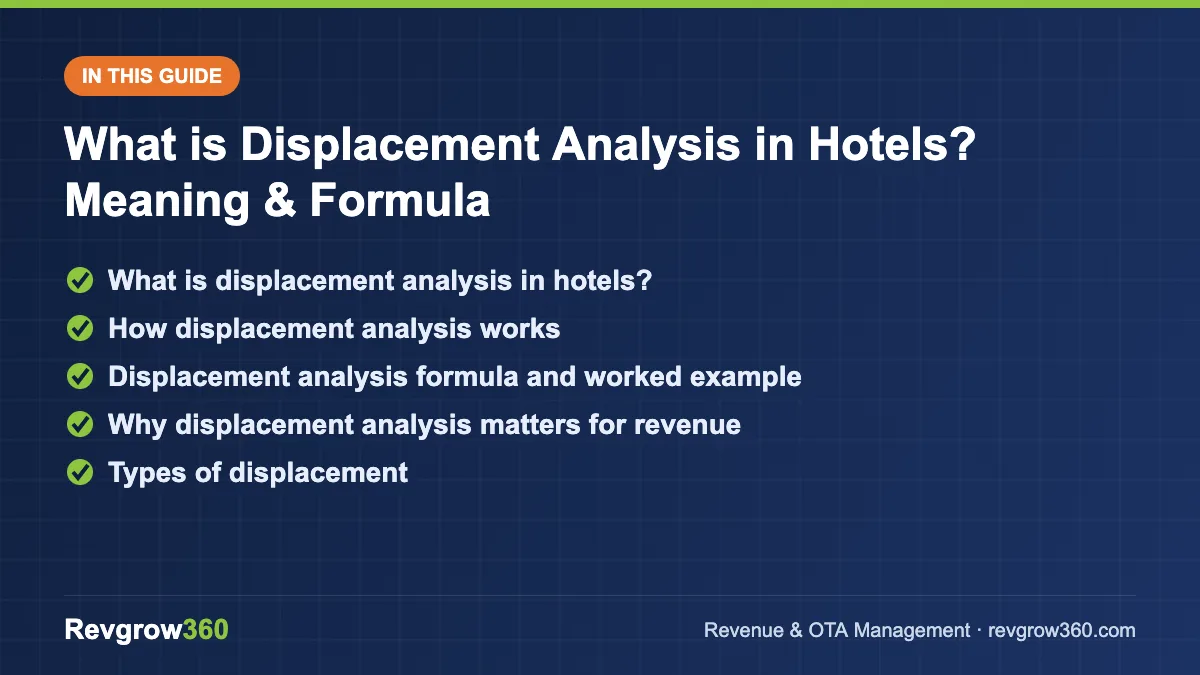
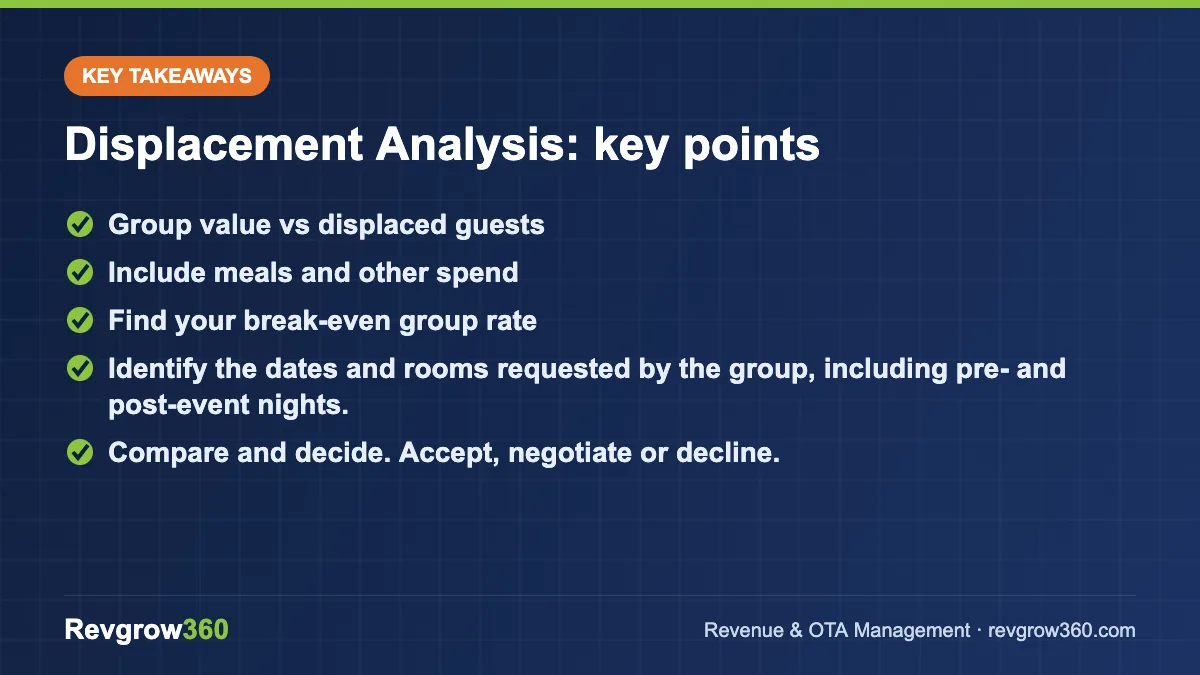
- Group value vs displaced guests
- Include meals and other spend
- Find your break-even group rate
What is displacement analysis in hotels?
When a hotel accepts a group booking, it blocks rooms for specific dates. Those rooms can no longer be sold to individual (transient) guests, who might have paid higher rates. Displacement analysis estimates this “displaced” demand and compares it with the group’s total value.
It is used mainly for groups, wedding blocks, tour operator allotments, long-stay corporate deals, and any request for a deeply discounted rate. The goal is not to say no to groups, but to price them correctly and accept them only when they add net revenue.
Should you accept this group?
How displacement analysis works
- Identify the dates and rooms requested by the group, including pre- and post-event nights.
- Forecast transient demand for those dates: how many rooms you expect to sell to individual guests, and at what average rate. Use pace data and history from demand forecasting.
- Find the displaced rooms. This is the number of transient rooms you would likely lose because the group takes inventory.
- Calculate group value. Include room revenue and, where relevant, F&B, venue hire and other spend, minus extra costs.
- Calculate displaced transient value. Include room revenue and the ancillary spend those guests would have made, minus their costs.
- Compare and decide. Accept, negotiate or decline.
Displacement analysis formula and worked example
Displacement = Group total contribution − Displaced transient contribution
If the result is positive, the group adds value. If negative, it displaces more than it brings.
Consider a hypothetical 50-room hotel in Goa. A company asks for 20 rooms for 3 nights in November at ₹3,800 per room per night, with ₹1,50,000 of meals and meeting room revenue. For those nights, the hotel forecasts that, without the group, it would sell 16 of the 20 rooms at ₹5,200 on average, with ₹600 per room-night of other spend.
| Item | Group | Displaced transient |
|---|---|---|
| Rooms and nights | 20 rooms × 3 nights = 60 room nights | 16 rooms × 3 nights = 48 room nights |
| Room revenue | 60 × ₹3,800 = ₹2,28,000 | 48 × ₹5,200 = ₹2,49,600 |
| Other revenue | ₹1,50,000 | 48 × ₹600 = ₹28,800 |
| Total revenue | ₹3,78,000 | ₹2,78,400 |
On room revenue alone, the group loses by ₹21,600. But with meals and meetings, the total favours the group by ₹99,600. You still need to subtract costs, such as food cost and extra labour, on both sides before deciding.
Break-even rate
You can also work out the lowest group rate you can accept. In the example, the displaced transient total is ₹2,78,400. The group’s other revenue is ₹1,50,000, so the room revenue needed to match is ₹1,28,400. Divided by 60 room nights, that is about ₹2,140 per room night before costs. That is the theoretical minimum; your actual floor should be higher to cover costs and protect your rate position.
Why displacement analysis matters for revenue
- Protects profit in busy periods. Occupancy alone can hide low-value business. See what is RevPAR for a measure that captures price and volume.
- Supports better negotiation. Knowing your break-even rate lets sales say, “At this rate we cannot offer this block.”
- Guides date selection. You can offer groups in low-demand dates and keep peak dates for transient guests.
- Improves forecasting discipline. It forces the team to look at demand before they say yes.
- Helps owners understand decisions. The logic is simple and transparent.
It fits into the wider strategy described in the hotel revenue management guide.
Types of displacement
| Type | Description | Example |
|---|---|---|
| Transient displacement | Group replaces individual guests | Wedding block on a peak weekend |
| Rate displacement | A discounted channel takes rooms that a higher-rate channel would have filled | Deep OTA promotion on a high-demand date |
| Length-of-stay displacement | A long stay blocks shorter, higher-rate stays | Workation booking over a festival weekend |
| Segment displacement | One segment crowds out another | Tour operator allotment on a corporate week |
Displacement analysis for a small hotel or resort
You do not need software. A simple sheet with four columns is enough: date, forecast transient rooms, forecast transient rate, and group offer. Fill it in when an enquiry arrives and note the answer. A 20-room hotel in Kalimpong that receives a 10-room offer for a long weekend can finish the check in ten minutes. If the check says the group is worth ₹15,000 less than the likely transient demand, the sales manager can reply with a counter-offer, a different date or a higher rate, instead of simply accepting or refusing.
Tips for doing displacement analysis well
- Include the shoulder nights before and after the group’s main dates.
- Be honest about forecast confidence. If demand is uncertain, use a range.
- Include other revenue only if you are sure the guests will spend.
- Factor in commission on displaced business and on the group.
- Check length of stay restrictions to see whether a stay pattern can be adjusted.
- Update the analysis as pace changes before the cut-off date.
Common mistakes
- Looking only at occupancy and not at total revenue.
- Ignoring the cost side, such as extra labour for a banquet.
- Assuming all displaced rooms would have been sold at the full average rate.
- Accepting groups without a clear cut-off and attrition clause.
- Forgetting that a large group can reduce the guest experience for others.
- Not recording lost business, so the team cannot learn.
Related terms
- Transient: individual guests, not part of a group.
- Group block: rooms reserved for a group at an agreed rate.
- Cut-off date: the date after which unused group rooms are released.
- Attrition: the share of a block a group may release without penalty.
- Opportunity cost: the value of the next best use of a room.
- Booking pace: how quickly rooms are being booked for a date.
Key takeaways
- Displacement analysis compares a group’s total value with the revenue from the transient guests it would displace.
- Use forecast demand, average rate and ancillary spend for both sides.
- Accept the group if the net contribution is higher, or negotiate the rate to reach the break-even point.
- Review the analysis regularly as pace changes.
If you are weighing a large group or wedding block and want a second opinion, Revgrow360 can help through hotel revenue management. You can book a free consultation at any time.
For more background, see this hotel industry overview on Wikipedia.
Frequently asked questions
What is displacement analysis in a hotel?
It is a method that compares the total value of a group or discounted booking with the revenue from the regular guests it would displace. If the group's net contribution is higher, the hotel accepts it; if not, it renegotiates the rate or declines the booking.
How do you calculate displacement?
Estimate the group's total contribution, including rooms and other spend, then subtract the contribution of the transient guests you would likely lose on the same dates. A positive result means the group adds value. Include costs and commission on both sides for accuracy.
When should a hotel use displacement analysis?
Use it for groups, wedding blocks, tour operator allotments, long stays and deep discount requests, especially on dates when transient demand is strong. It is less critical in low-demand periods when rooms would otherwise stay empty.
Is displacement analysis only about room revenue?
No. Where the group spends on meals, meeting rooms, events and other services, include that revenue and its costs. A group paying a lower room rate can still be worth more overall, while a pure room-only group at a low rate often is not.
More Hotel Glossary guides
What is Pickup Report in Hotels? Meaning, Examples & Formula
A pickup report shows net new room nights booked in a set period for each future date, helping revenue managers change rates…
What is Booking Pace in Hotels? Meaning, Examples & Formula
Booking pace shows how quickly rooms are being booked for a future date compared with the same point last year or forecast,…
What is Flow-Through in Hotels? Meaning, Examples & Formula
Flow-through shows what share of every extra rupee of hotel revenue reaches profit. Learn the formula, a worked example and how to…
Cost Per Occupied Room (CPOR) in Hotels: Formula
CPOR shows what each occupied room costs to deliver. See the formula, a worked example and how to use it for pricing…
RGI (Revenue Generation Index) in Hotels: Meaning & Formula
RGI compares your RevPAR with your competitive set. See the formula, a worked example and how to diagnose and improve it.
ARI (Average Rate Index) in Hotels: Meaning & Formula
ARI compares your hotel's ADR with its competitive set. See the formula, a worked example and how to improve your rate index.