 By Md Arif Ahamed
Quick summary: Understand room night in hotel terms: meaning, how nights are counted, formulas for occupancy, ADR and RevPAR, a worked example and common counting mistakes.
A room night in hotel terms is one room occupied for one night. It is the basic unit of hotel inventory and sales: if one guest stays in one room for three nights, the hotel sells three room nights. If two rooms are booked for two nights each, that is four room nights. Hotels use room nights to measure volume, plan inventory and calculate occupancy, ADR and RevPAR.
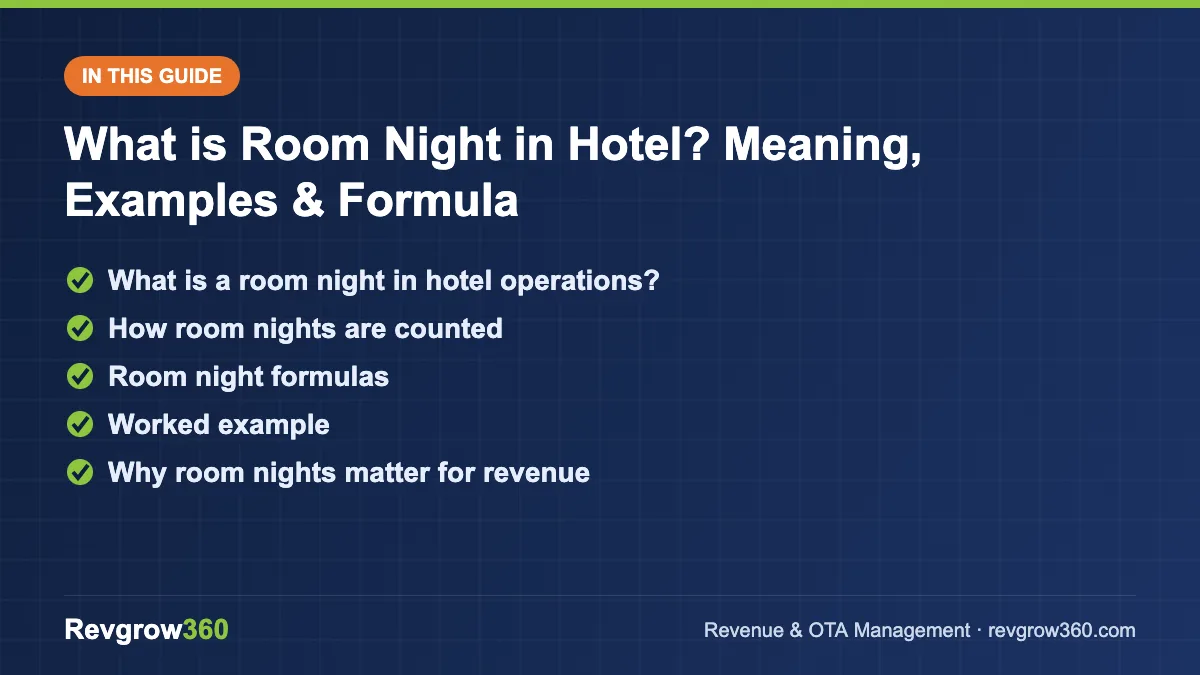
- One room, one night
- Rooms x nights = room nights
- Base for ADR and RevPAR
This guide explains the meaning, how room nights are counted, the formulas that use them, a worked example, why they matter for revenue and the mistakes people make when counting them.
What is a room night in hotel operations?
A room night counts the room, not the guests. One room with four guests staying one night is still one room night. The unit lets a hotel compare very different bookings on the same basis: a single business traveller, a family of five or a wedding group can all be measured in room nights.
The idea has two sides. Room nights available are the nights you could sell: rooms in the hotel times days in the period. Room nights sold are the nights actually occupied by paying guests. The comparison between the two gives your occupancy.
158 hotel terms explained in plain English.
How room nights are counted
You count one room night for each night a room is occupied, usually from the arrival date up to, but not including, the departure date. A guest who arrives on 10 March and leaves on 13 March has stayed three nights: 10, 11 and 12 March.
| Booking | Rooms | Nights | Room nights |
|---|---|---|---|
| Couple, one room, 2 nights | 1 | 2 | 2 |
| Family, two rooms, 3 nights | 2 | 3 | 6 |
| Corporate group, 10 rooms, 4 nights | 10 | 4 | 40 |
| Day-use booking, hours only | 1 | Part of a day | Counted according to your own policy; define it in advance |
Complimentary and house-use rooms are usually reported separately. Decide how your hotel treats them, and apply the rule consistently so that month-to-month comparisons stay accurate.
Room night formulas
- Room nights available = number of rooms x number of days in the period (minus rooms out of order, if you exclude them).
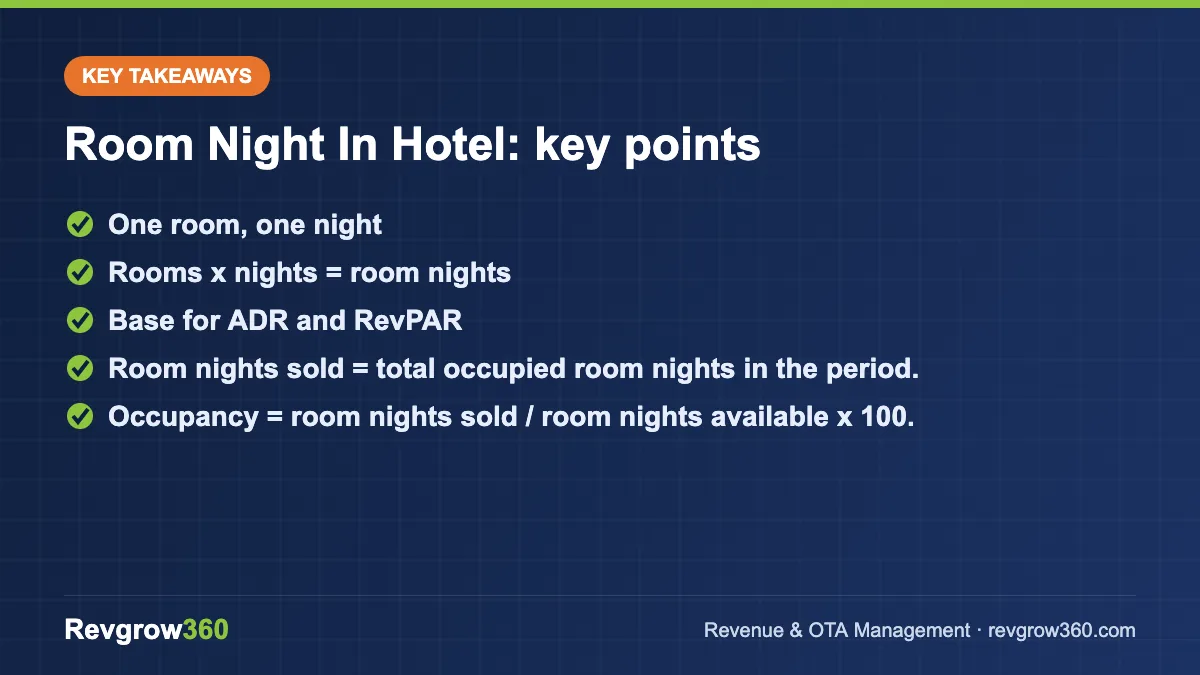
- Room nights sold = total occupied room nights in the period.
- Occupancy = room nights sold / room nights available x 100.
- ADR = room revenue / room nights sold.
- RevPAR = room revenue / room nights available.
Read more about these metrics in our guides to hotel occupancy rate, average daily rate and RevPAR.
Worked example
A hypothetical 30-room hotel in Goa operates in a 30-day month.
| Item | Value |
|---|---|
| Room nights available | 30 x 30 = 900 |
| Room nights sold | 612 |
| Room revenue | ₹26,32,000 |
| Occupancy | 612 / 900 = 68% |
| ADR | ₹26,32,000 / 612 = ₹4,301 |
| RevPAR | ₹26,32,000 / 900 = ₹2,924 |
The same 612 room nights could come from many different guest numbers. This is why revenue teams track room nights, not heads.
Why room nights matter for revenue
Room nights are the foundation of every hotel performance metric, and they tell you what you actually sold. Beyond basic reporting, they help in five ways:
- Forecasting. Forecasts are built as room nights per date. See hotel demand forecasting.
- Pricing. A room night is perishable: an unsold night cannot be sold later. This is the logic behind dynamic pricing.
- Channel analysis. You can see how many room nights each channel produced and what each one cost in commission.
- Contracts. Corporate and travel agent contracts are often agreed on a number of room nights per year.
- Staffing and costs. Cost per occupied room, such as housekeeping and laundry, is measured per room night sold.
Room nights also make group negotiation easier. A 40 room night booking at a discounted rate can be compared fairly with individual bookings at higher rates, once you consider displacement and total revenue.
Room nights versus nights stayed versus guest nights
| Term | Meaning |
|---|---|
| Room night | One room occupied for one night |
| Length of stay | Number of nights one booking stays |
| Guest night | One guest staying one night, so two guests in one room for one night equal two guest nights |
| Bed night | One bed occupied for one night; used in hostels and some tourism statistics |
Do not mix these. A report that adds room nights and guest nights together gives meaningless numbers.
How hotels use room nights day to day
Revenue managers read room nights in several views. Room nights on the books show confirmed future nights for each stay date. Room nights by channel show which sources deliver volume. Room nights by length of stay show whether guests stay one night or several, which affects housekeeping workload and the cost of each check-in. Corporate accounts are often reviewed on yearly room nights produced against the contract commitment.
Event planners and travel agents also quote in room nights. A wedding may ask for 25 rooms for three nights, which is 75 room nights. Knowing the total helps you check whether the block fits your inventory and what rate gives you an acceptable result.
Common mistakes
- Counting guests instead of rooms.
- Counting the departure date as a night.
- Including out-of-order rooms in available room nights without a stated rule.
- Mixing complimentary rooms with paid ones in ADR.
- Comparing room nights across periods of different length without converting to occupancy.
- Booking a long-stay discount without checking how many high-rate nights it displaces. See length of stay restrictions.
Related terms
- Available rooms: the room nights that can be sold.
- Rooms sold or occupied rooms: room nights sold.
- Occupancy rate: the percentage of available room nights sold.
- ADR and RevPAR: revenue measures built on room nights.
- Length of stay: the number of room nights per booking.
- Stay date: the night the room is occupied, as opposed to the booking date.
Key takeaways
- A room night is one room occupied for one night, regardless of the number of guests.
- Room nights available and sold produce occupancy, ADR and RevPAR.
- Count the nights from arrival up to, but not including, departure.
- Unsold room nights cannot be recovered, which drives pricing decisions.
- Use one consistent counting rule for complimentary, out-of-order and day-use rooms.
Want to turn your room night data into better pricing and channel decisions? Learn about hotel revenue management with Revgrow360 or book a free consultation.
For more background, see this hotel industry overview on Wikipedia.
Frequently asked questions
What is a room night in a hotel?
A room night is one room occupied for one night, no matter how many guests stay in it. It is the basic unit used to measure hotel inventory and sales, and it forms the base for occupancy, ADR and RevPAR calculations.
How do you calculate room nights?
Multiply the number of rooms by the number of nights stayed. Two rooms for three nights equal six room nights. For a hotel-wide figure, add up every occupied room for each night in the period, counting from arrival date up to but not including departure date.
What is the difference between a room night and a guest night?
A room night counts occupied rooms, while a guest night counts people. Two guests sharing one room for one night make one room night but two guest nights. Revenue metrics such as occupancy and ADR use room nights, so keep them separate in reports.
Why are room nights important for hotel revenue?
Room nights show how much inventory you sold and form the base for occupancy, ADR and RevPAR. An unsold room night cannot be recovered, so they guide pricing, forecasting, channel analysis and contract negotiations such as corporate and group deals.
More Hotel Glossary guides

What is Lead Time in Hotels? Meaning, Examples & Formula
Lead time is the number of days between booking and check-in. Learn how to calculate it and use it to time rates,…

What is Booking Window in Hotels? Meaning, Examples & Formula
The booking window is the time between booking and arrival. Learn how to calculate it and use it to time rates, offers…

What is Pickup Report in Hotels? Meaning, Examples & Formula
A pickup report shows net new room nights booked in a set period for each future date, helping revenue managers change rates…

What is Booking Pace in Hotels? Meaning, Examples & Formula
Booking pace shows how quickly rooms are being booked for a future date compared with the same point last year or forecast,…

What is Displacement Analysis in Hotels? Meaning & Formula
Displacement analysis compares the value of a group with the transient revenue it displaces, so hotels accept only business that adds net…

What is Flow-Through in Hotels? Meaning, Examples & Formula
Flow-through shows what share of every extra rupee of hotel revenue reaches profit. Learn the formula, a worked example and how to…