 By Md Arif Ahamed
Quick summary: Airbnb vs Booking.com for hotels and homestays: compare audiences, fees, listing style and workload, and learn how to run both without double bookings.
Airbnb vs Booking.com is a question almost every homestay, boutique hotel and small resort owner faces. Both platforms can bring a steady flow of guests, but they attract different travellers, work in different ways and suit different types of property. Many owners end up listing on both, which is usually sensible, but how you manage each one matters. This guide compares Airbnb and Booking.com for hotels and homestays on audience, fees, policies, listing style and workload, then gives you a practical way to decide where to focus and how to run both without double bookings.
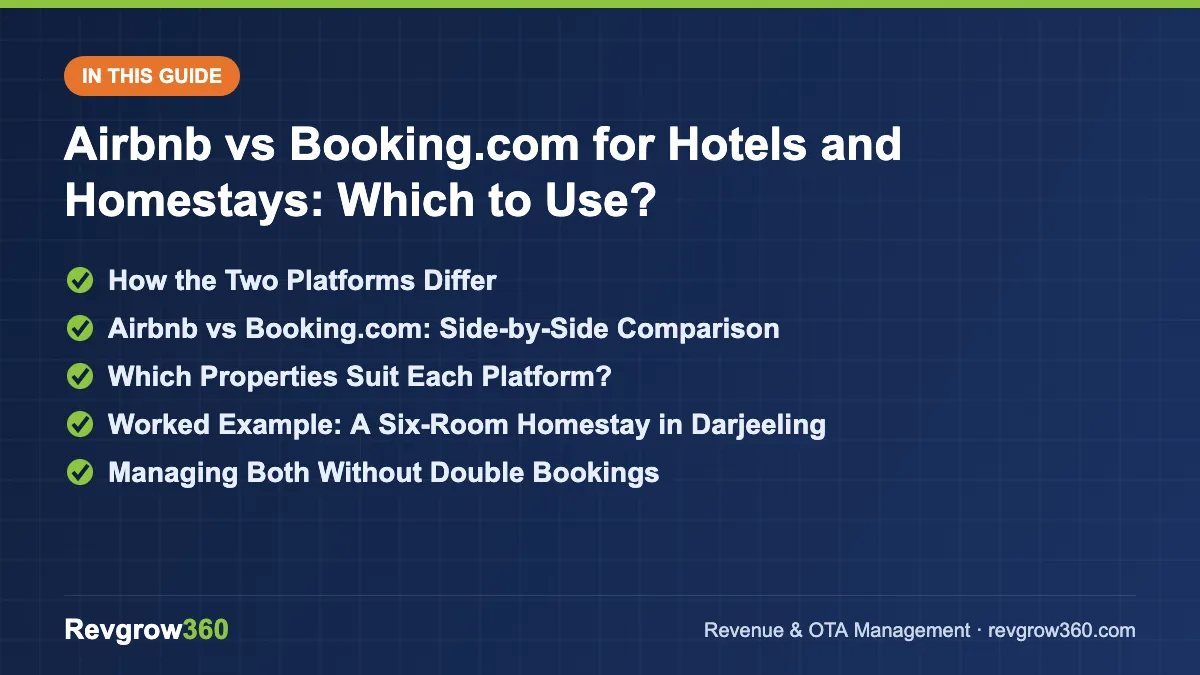
- Different guests, different style
- Many properties use both
- Sync with a channel manager
How the Two Platforms Differ
At a high level, Booking.com grew as an online travel agency focused on hotels and has since expanded into apartments, homes and other accommodation. Airbnb grew around homes and unique stays hosted by individuals and has since added boutique hotels and professional hosts. Both now list a wide range of property types, but their roots still shape how guests search and what they expect.
- Booking.com guests often search by location, dates, price and review score, comparing many properties quickly. Instant confirmation is the norm.
- Airbnb guests often search for an experience or type of space: a whole home, a view, a character property. Photos, host profile and the story of the place carry a lot of weight.
Estimate your monthly Airbnb earnings.
Airbnb vs Booking.com: Side-by-Side Comparison
| Factor | Airbnb | Booking.com |
|---|---|---|
| Core strength | Homes, unique stays, longer leisure trips | Hotels and all property types, broad global reach |
| Typical guest | Leisure travellers, families, groups, digital nomads | Leisure and business travellers, wide range of budgets |
| Fee model | Service fee, either split between host and guest or charged to the host only, depending on setup | Commission charged to the property, varying by market and programme |
| Booking style | Instant Book or request to book | Mostly instant confirmation |
| Listing focus | Space, host, story, photos | Room types, facilities, location, reviews |
| Room-type management | Works best for a few distinct units | Designed for multiple room types and rate plans |
| Guest communication | High; messaging before and after booking is common | Moderate; messaging available, many guests just book |
| Payments | Collected by the platform and paid out to the host | Property-collected or platform-collected, depending on setup |
Fee levels change and differ by country and programme, so always confirm current terms in each platform’s partner documentation; for Booking.com, see the Booking.com Partner Hub.
Which Properties Suit Each Platform?
Properties that often do well on Airbnb
- Homestays where guests stay with or near the host family.
- Villas, cottages and entire homes rented as a whole.
- Small boutique properties with a strong visual identity.
- Properties in hill stations, beach villages or rural areas where guests want character and space.
- Stays aimed at longer trips, remote workers or families.
Properties that often do well on Booking.com
- Hotels with several room types and many identical rooms.
- City and transit properties serving short stays.
- Resorts and mid-sized hotels selling to both leisure and business guests.
- Properties that want broad international reach and quick instant bookings.
- Guesthouses and homestays that operate more like small hotels.
In practice, many homestays and boutique hotels perform well on both. The question is less “which one” and more “how much effort to give each”.
Worked Example: A Six-Room Homestay in Darjeeling
A hypothetical six-room homestay near Darjeeling has three doubles, two family rooms and one attic room with a valley view. The owners cook home meals and run guided village walks.
- On Airbnb, they list the attic room and a family room as separate listings with strong photos and a detailed description of meals and walks. They also list the whole property for groups and families in peak months.
- On Booking.com, they list three room types (Double, Family, Attic Double) with clear facilities, meal plans and cancellation options, aimed at travellers comparing stays in the area.
- Both platforms connect to a channel manager, so a booking on one immediately closes the same room on the other.
The homestay reaches two different audiences without doubling the workload, because rates and availability are managed in one place.
Managing Both Without Double Bookings
Double bookings are the main risk of listing on several platforms. Avoid them by:
- Using a channel manager. It updates availability across all platforms in near real time. Calendar sync via iCal links can work for very small properties, but updates are slower and less reliable. Our guide to the best channel manager for hotels covers what to look for.
- Mapping rooms carefully. If you list the whole property on Airbnb and individual rooms elsewhere, the system must close all rooms when the whole property is booked.
- Keeping one master calendar. Direct bookings, phone reservations and walk-ins must be entered in the same system immediately.
- Checking after every change. When you add a room or listing, test a booking flow before going live.
Pricing Across Airbnb and Booking.com
Guests compare prices, so keep your offer consistent. Consider:
- Total price to the guest. Airbnb may add a guest service fee depending on the fee model; Booking.com usually shows the price the property sets, plus applicable taxes. Compare what the guest finally pays, not just your base rate.
- Net revenue to you. Calculate what you receive after fees on each platform and price accordingly.
- Parity obligations. Check your contract terms and local regulations on rate parity.
- Length-of-stay pricing. Weekly and monthly discounts are common on Airbnb and can fill quieter months with longer stays.
Listing Tips for Each Platform
Airbnb
- Lead with your best wide-angle photo and include photos of views, common areas and local surroundings.
- Write a warm, specific description: what guests will do, eat and see.
- Complete your host profile and respond to messages quickly.
- Set clear house rules and check-in instructions.
Booking.com
- Create accurate room types with correct bed configurations and sizes.
- Fill in every facility and policy field; guests filter by them.
- Offer both flexible and non-refundable rate plans.
- Keep photos current and ask happy guests to leave reviews.
Strong content across platforms makes a big difference to conversion. Our content management and OTA management services focus on exactly this.
Reviews and Ratings on Each Platform
Reviews influence ranking and conversion on both platforms, but they work a little differently. On Booking.com, guests rate the stay across categories such as cleanliness, comfort, location, facilities, staff and value, and an overall score is shown prominently in search results. On Airbnb, guests rate categories such as cleanliness, accuracy, communication, check-in, location and value, and hosts and guests review each other. Both platforms allow you to respond publicly to reviews.
Good practice applies to both:
- Describe the property accurately so expectations match reality; many low ratings come from mismatched expectations rather than poor service.
- Respond to reviews promptly, politely and specifically.
- Fix recurring issues raised in reviews, then mention the fix in your replies.
- Encourage satisfied guests to leave a review before they leave.
Consistent reviews across platforms also strengthen your overall online reputation; our online reputation management team helps properties manage this.
Cancellation Policies and House Rules
Both platforms let you choose from several cancellation policies, ranging from flexible to strict, and Booking.com in particular makes it easy to offer flexible and non-refundable rate plans side by side. Flexible policies usually increase bookings but also increase cancellations, so many properties offer a non-refundable option at a modest discount. Make house rules, check-in times, child and pet policies and any security deposit clear and identical across platforms, so guests are not surprised on arrival.
Decision Checklist
- Is your property mostly whole-home or character stays (lean Airbnb) or multiple standard rooms (lean Booking.com)?
- Do you want broad instant bookings, or are you comfortable with more guest messaging?
- Can you manage availability through a channel manager?
- Have you compared net revenue per booking on each platform?
- Do you have time to respond to messages and reviews on both?
- Are you building direct bookings alongside both platforms so you are not dependent on either?
Key takeaways
- In the Airbnb vs Booking.com decision, many homestays and boutique hotels benefit from using both.
- Airbnb tends to suit unique, home-style and whole-property stays; Booking.com suits multi-room properties seeking broad reach.
- Compare fees by net revenue and total guest price, and confirm current terms with each platform.
- A channel manager and one master calendar prevent double bookings.
- Tailor listing content to how guests search on each platform.
Revgrow360 sets up and manages listings for hotels, resorts and homestays across 50+ OTAs, and has supported 500+ hotels so far. Book a free consultation to plan the right platform mix for your property.
Frequently asked questions
Is Airbnb or Booking.com better for a homestay?
It depends on the property. Homestays with a strong personal or character element often do well on Airbnb, while those operating like small hotels with several rooms often perform well on Booking.com. Many homestays list on both, connected through a channel manager, to reach different audiences without double bookings.
Can a hotel list on Airbnb?
Yes. Airbnb accepts hotels, boutique hotels, bed and breakfasts and other professional hospitality properties alongside homes. Hotels should check how room types map to listings, which fee model applies to their account and how availability will sync with their channel manager before going live.
How do I avoid double bookings on Airbnb and Booking.com?
Connect both platforms to a channel manager so availability updates across all channels automatically when a booking arrives. Enter direct and walk-in bookings in the same system immediately. If you list the whole property and individual rooms, make sure the mapping closes all rooms when the whole property is booked.
Which platform charges hotels less?
Fee structures differ. Booking.com charges the property a commission that varies by market and programme, while Airbnb uses either a split fee between host and guest or a host-only fee depending on setup. Compare net revenue and the total price the guest pays, and confirm current terms on each platform.
More OTA Management guides
Hotel Distribution Strategy: Balancing OTAs, Direct, GDS and More
Your channel mix decides how much of each booking you keep. Learn how to balance OTAs, direct, GDS and wholesalers with a…
How to Improve Hotel Ranking on OTAs: Key Ranking Factors
OTA ranking follows a clear logic. Learn the factors Booking.com, MakeMyTrip, Agoda and Expedia reward, and a 90-day plan to move your…
Expedia Partner Central Guide for Hotels
Everything a hotel needs to know about Expedia Partner Central, from joining and payment models to promotions, analytics and a simple weekly…
How to List Hotel on EaseMyTrip: Step-by-Step Guide
A practical guide to listing your hotel on EaseMyTrip, with documents, onboarding steps, rate strategy, content tips and a launch checklist.
How to List Hotel on Cleartrip: Step-by-Step Guide
A step-by-step guide to listing your hotel on Cleartrip: documents, profile set-up, rates, policies, going live and getting bookings.
How to List Your Hotel on Agoda (YCS): Step-by-Step Guide
A complete walkthrough of listing a hotel, resort or homestay on Agoda and managing it in YCS, including promotions and the net-rate…