 By Md Arif Ahamed
Quick summary: Revenue management for boutique hotels: position your property, price each room type, use minimum stays, pick channels and grow direct and add-on revenue.
Revenue management for boutique hotels means pricing and selling a small, distinctive property so that its character earns a premium instead of competing on discounts. A boutique hotel with 10 to 50 rooms has less inventory to spread risk, a more specific guest, and a story that can justify a higher rate. This guide covers positioning, pricing, channels, direct booking and the weekly routine that keeps revenue growing.
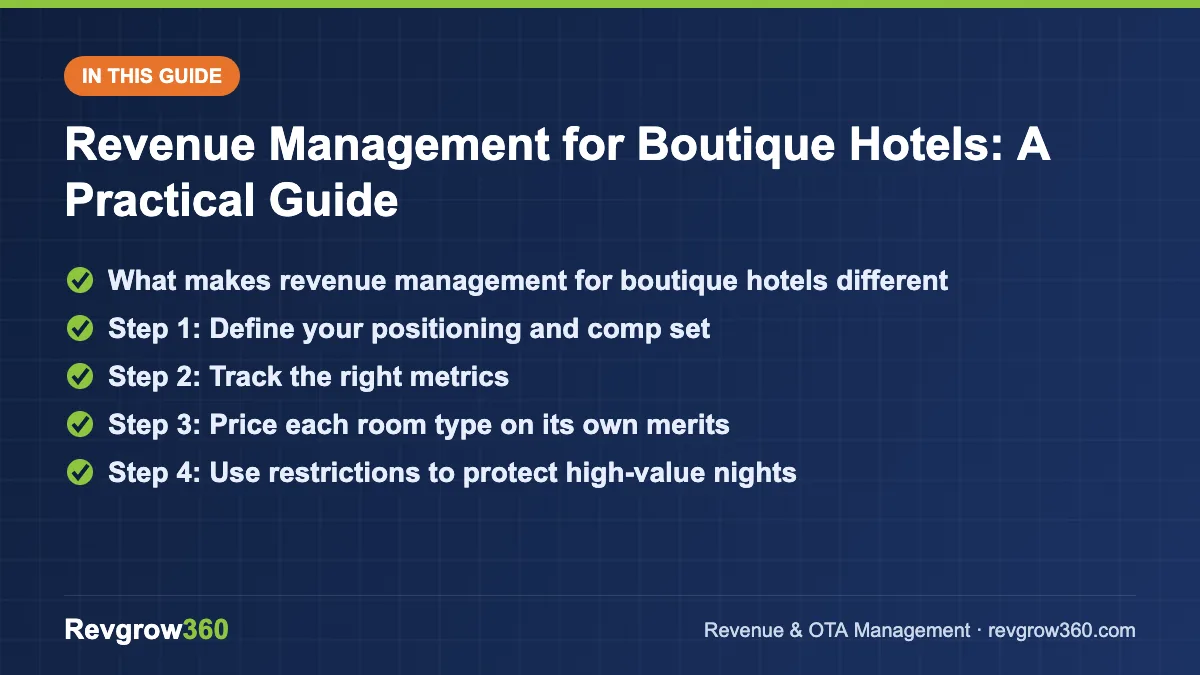
- Price by value, not discounts
- Set gaps between room types
- Grow direct and add-on income
What makes revenue management for boutique hotels different
Large chain hotels compete on brand and loyalty. Boutique hotels compete on design, personality, location and service. That changes the revenue approach in four ways.
- Rate is built on value, not just comparison. Guests pay more for a unique property, so the comp set is less obvious.
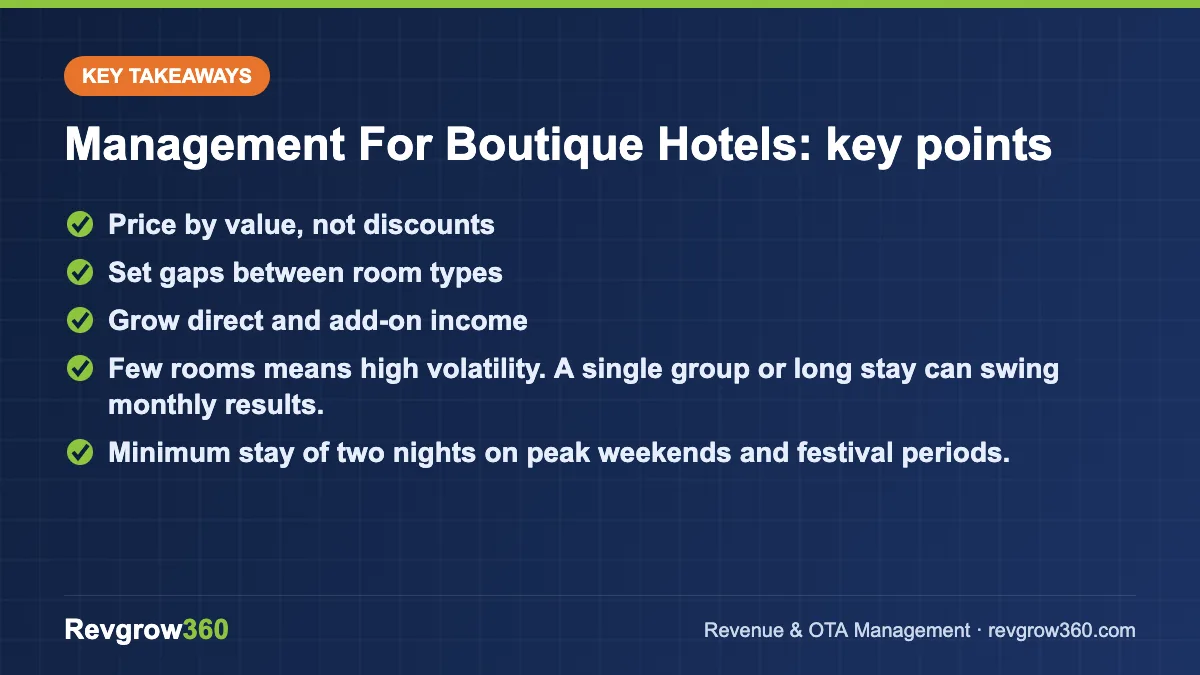
- Few rooms means high volatility. A single group or long stay can swing monthly results.
- Every room type is different. Rooms may vary in size, view and design, so each needs its own pricing logic.
- Reviews and photos drive conversion. A strong visual identity influences the booking more than a small rate difference.
Step 1: Define your positioning and comp set
Write one sentence about who you serve and why they choose you, for example “a heritage 24-room hotel in Kolkata for design-minded travellers and weekend couples”. Then pick a competitive set of 4 to 6 properties that your guest would genuinely compare. Include similar boutique stays, not only large hotels of the same star rating.
Track the competitor’s public rates and review scores weekly. Your aim is not to be the cheapest, but to price in line with the value you deliver.
Step 2: Track the right metrics
| Metric | What it tells you | Example (30-room hotel, 30 days) |
|---|---|---|
| Occupancy | Share of rooms sold | 630 of 900 room nights = 70% |
| ADR | Average price per room sold | ₹37,80,000 ÷ 630 = ₹6,000 |
| RevPAR | Room revenue per available room night | ₹37,80,000 ÷ 900 = ₹4,200 |
In this hypothetical case the hotel earns ₹37,80,000 in room revenue for the month. Compare these to your comp set, and watch the trend month by month. For the full list, see hotel KPIs.
Add two boutique-specific measures: review score by platform and direct booking share. Both influence long-term revenue.
Step 3: Price each room type on its own merits
Because boutique rooms are not identical, set a rate ladder with meaningful gaps and review it often.
| Room type | Relative position | Illustrative gap |
|---|---|---|
| Entry or courtyard room | Base | Base rate |
| Deluxe with view | Above base | Base plus 15% to 25% |
| Signature room | Premium | Base plus 35% to 60% |
| Suite | Top | Base plus 70% or more |
Gaps should reflect real differences. If guests keep choosing the signature room at the higher rate, the gap can widen. If suites rarely sell, narrow the gap or build a package.
Apply seasonal and day-of-week pricing, and move rates with demand using dynamic pricing. In peak weeks, close the lowest room type first and keep the entry room for the final days only when occupancy is high.
Step 4: Use restrictions to protect high-value nights
- Minimum stay of two nights on peak weekends and festival periods.
- Closed to arrival on days that would leave an orphan night.
- Advance-purchase rates for planned travel, with a non-refundable discount.
Read more in length of stay restrictions.
Step 5: Build a smart channel mix
A boutique hotel usually benefits from a selective channel strategy rather than listing everywhere.
- Main OTAs: choose two or three with the right guest profile. Optimise your listing with our guides on Booking.com and OTA ranking.
- Direct booking: a clean website, a simple booking engine and a best-rate promise. See the booking engine guide.
- Google Hotel Ads and metasearch: see Google Hotel Ads for how it works.
- Niche partners: design, wedding, travel-blogger and corporate partners with specific rates.
Keep prices consistent using rate parity discipline, and give direct guests a reason to book with you: breakfast, late checkout or a welcome drink.
Step 6: Grow revenue beyond the room
- Experiences: heritage walks, cooking classes, art or craft sessions.
- Food and beverage: a signature breakfast, a small bar or a local-cuisine dinner.
- Events: small weddings, shoots, private dinners and corporate offsites.
- Retail: local products and curated gifts.
Pre-arrival emails and WhatsApp messages are the best place to sell these.
Use design, story and reviews to defend your rate
A boutique hotel sells a feeling before it sells a room. Guests decide on photos, the first lines of the description and review comments. Treat these as part of your revenue toolkit.
- Photos: show each room type clearly, with true colours and the view guests will actually get. Update seasonal images such as monsoon, winter or festival decor.
- Description: lead with what is unique, such as a restored courtyard, local art or a rooftop. Avoid generic phrases that could describe any hotel.
- Reviews: ask every satisfied guest to review at checkout, reply to all feedback within two days, and fix repeat complaints. Better review scores allow higher rates; see hotel online reputation management.
- Story: a short, honest story about the building, the owners or the neighbourhood helps guests understand why your rate is different.
Test the effect. When you refresh photos and rewrite a description, compare page views, conversion and ADR over the following month with the month before, keeping season and events in mind.
Managing groups, events and long stays
Because a boutique hotel has few rooms, one group can fill most of the house. Use a displacement check before accepting any group: add the group’s total revenue, including food, venue and extras, and compare it with what the same rooms would earn from individual guests. If the group is worth more and it does not damage the experience of other guests, accept it with a deposit and a clear cancellation schedule.
Long stays, such as workations or film crews, can fill quiet weeks but lock rooms for peak dates. Offer a weekly rate that is lower than the daily rate but still above your cost floor, and add a clause that the rate does not apply during peak weeks.
A worked example
A hypothetical 20-room boutique hotel in Jaipur has an ADR of ₹7,000 at 62% occupancy. The owner finds that weekend rooms sell out three weeks ahead but are still priced at the weekday rate. By lifting weekend rates 15%, adding a two-night minimum on festival weekends and moving 10% of OTA bookings to direct through a best-rate offer, the hotel can improve ADR and reduce commission without changing the product. The effect depends on demand, so test with a small set of dates first and compare with the same period last year.
Tools a boutique hotel needs
You do not need an expensive system. A cloud PMS, a channel manager that connects your chosen OTAs, a booking engine on your own website and a shared sheet for pace and competitor rates are enough for most properties under 50 rooms. Review the numbers together every Monday and write down the pricing decision you made and why, so that you can learn from each season.
Common mistakes boutique hotels make
- Comparing price only with large star hotels.
- Discounting the best room types too early.
- Using one rate for all rooms and all days.
- Neglecting photos, descriptions and reviews on OTAs.
- Accepting low-rate groups without a displacement check.
- Leaving direct booking as an afterthought.
Boutique hotel weekly revenue checklist
| Task | Frequency |
|---|---|
| Review pace for next 60 days against last year | Weekly |
| Check comp set rates and review scores | Weekly |
| Adjust room-type ladder and restrictions | Weekly |
| Review OTA listing, photos and content | Monthly |
| Review channel mix and commission cost | Monthly |
| Respond to every review | Daily |
Key takeaways
- Revenue management for boutique hotels is about pricing the value of a distinctive stay.
- Choose a comp set of genuinely similar properties.
- Price each room type on its own and use minimum-stay rules on peak dates.
- Be selective with OTAs and invest in direct booking.
- Add experiences, food and events for extra revenue per guest.
- Reviews and visuals directly influence your rate power.
Revgrow360 helps boutique hotels price with confidence, improve OTA performance and grow direct revenue. See our OTA management service or book a free consultation.
For more background, see this revenue management overview on Wikipedia.
Frequently asked questions
What is revenue management for boutique hotels?
It is the practice of pricing and distributing a small, distinctive property to earn a premium for its character. It combines demand forecasting, room-type pricing, restrictions, selective channel use and direct booking growth, rather than competing only on discounts with larger hotels.
How should a boutique hotel choose its comp set?
Pick 4 to 6 properties your ideal guest would genuinely compare, such as other boutique or heritage stays in the same area, not just large hotels of the same star rating. Track their public rates, review scores and availability weekly to guide your pricing.
Should boutique hotels list on every OTA?
Not necessarily. Choose two or three OTAs whose guests match your property, optimise their listings well, and invest in direct channels. More listings mean more commission and more work, so add a new channel only when you can manage content, rates and inventory.
How can a boutique hotel increase direct bookings?
Offer a simple booking engine on a fast website, a best-rate promise, and a small direct-only benefit such as breakfast or late checkout. Collect guest emails and WhatsApp consent, and send occasional offers to past guests. Good photos and strong reviews support conversion.
More Revenue Management guides
Short Term Rental KPIs: 10 Metrics with Formulas
The 10 short term rental KPIs every host should track, each with a formula and a worked example, plus how to set…
Airbnb Income and Expense Tracking: A Simple System
Learn what to record for every booking and expense, how payouts differ from gross revenue, which categories to use and a monthly…
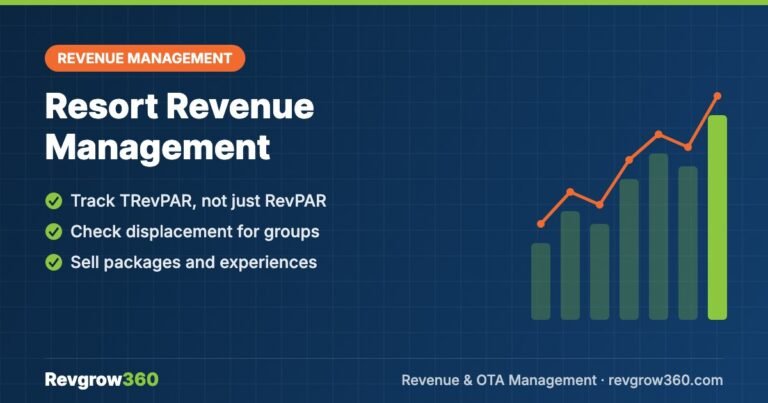
Revenue Management for Resorts: A Practical Guide
How resorts can manage rates, groups, packages and non-room revenue to maximise total income per guest, with a worked example and checklist.
Revenue Management for Homestays: A Practical Guide
A practical, step-by-step guide to pricing, channels and add-on income for small homestays, with a worked example and a 30-minute weekly routine.
Hotel Rate Parity: What It Is and How to Maintain It
Rate parity keeps your price consistent across OTAs, metasearch and your website. Learn what causes disparity and a practical daily routine to…
Outsource Hotel Revenue Management vs In-House vs RMS Software
In-house hire, software or an outsourced team? Compare the three ways to run hotel revenue management and find the model that fits…