 By Md Arif Ahamed
Quick summary: Revenue management training for hotel owners: a seven-module plan covering metrics, demand, pricing, restrictions, channels, competitors and weekly reporting.
Revenue management training for hotel owners teaches the person who makes pricing and investment decisions how to read demand, set rates, control channels and measure results, so they can lead the property’s revenue strategy or manage a revenue manager effectively. Owners do not need to become analysts. They need to understand the main levers, ask the right questions and review the right numbers each week. This guide gives a practical training plan with modules, exercises, sample questions and a way to measure progress.
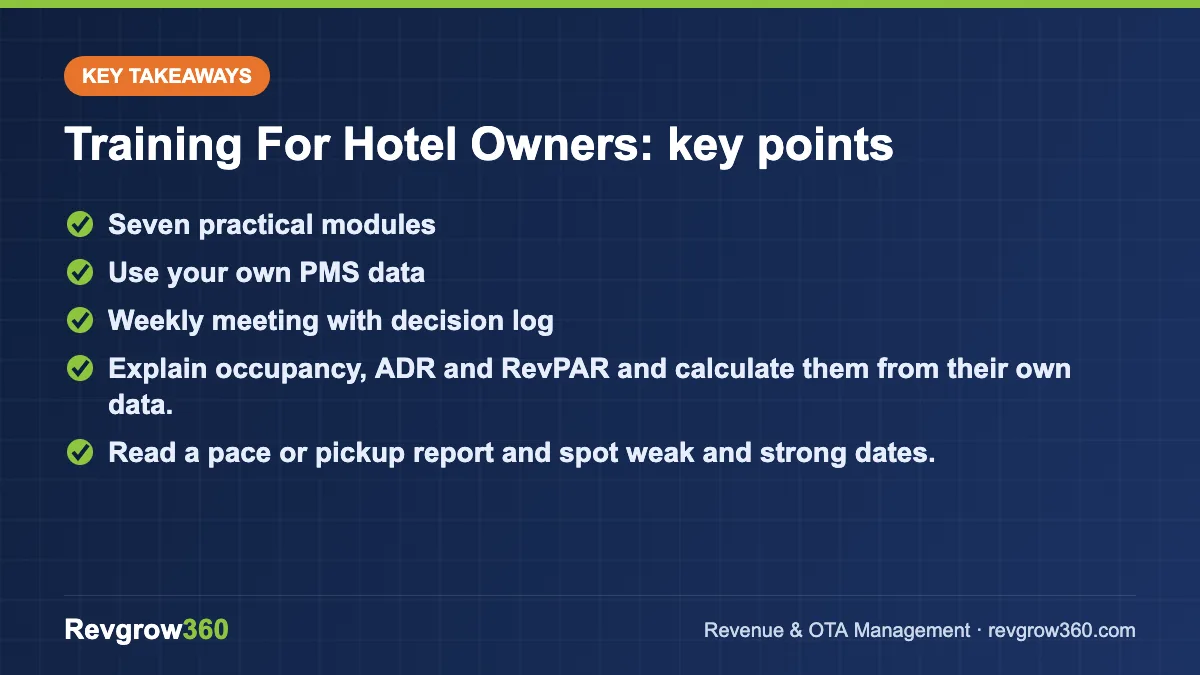
- Seven practical modules
- Use your own PMS data
- Weekly meeting with decision log
Many owners rely on habits: fixed rates, copying neighbours or discounting when occupancy looks low. Training replaces guesswork with a simple, repeatable method.
Learning objectives
After the programme, an owner should be able to:
- Explain occupancy, ADR and RevPAR and calculate them from their own data.
- Read a pace or pickup report and spot weak and strong dates.
- Decide when to raise, hold or lower rates and apply restrictions.
- Understand the cost of each distribution channel and the idea of net revenue.
- Compare the hotel with its competitive set.
- Ask the team the right questions in a weekly revenue meeting.
- Judge whether a revenue manager, agency or system is delivering results.
Monthly training calendar.
Revenue management training for hotel owners: the programme
| Module | Content | Exercise |
|---|---|---|
| 1. Core metrics | Occupancy, ADR, RevPAR, TRevPAR, GOPPAR and why occupancy alone is misleading | Calculate last month’s metrics from the PMS report |
| 2. Demand and forecasting | Seasons, events, booking windows, pace, pickup, lead time | Mark the next 90 days as low, medium and high demand |
| 3. Pricing | BAR, rate plans, dynamic pricing, floor and ceiling rates, packages | Create a simple rate grid for three demand levels |
| 4. Restrictions | Minimum stay, stop sell, close to arrival, overbooking | Choose restrictions for a festival weekend |
| 5. Distribution | OTA, direct, corporate, agents, commissions, parity, channel manager | Calculate net revenue by channel |
| 6. Competitor analysis | Competitive set, rate shopping, review comparison | Compare five competitors for one weekend |
| 7. Reporting and meetings | Dashboard, weekly meeting, decision log | Set up a one-page weekly report |
Revenue Health Score · free
Free tool: check your hotel’s revenue health
Answer a few quick questions about your rooms, rates, OTAs and reviews. Get a score out of 100, your weakest revenue areas and the first actions to fix them.
Module details
Module 1: Core metrics
Teach three formulas first:
- Occupancy = Rooms sold / Rooms available x 100. See hotel occupancy rate.
- ADR = Room revenue / Rooms sold. See average daily rate.
- RevPAR = Room revenue / Rooms available or Occupancy x ADR. See what is RevPAR.
Worked example: a 30-room hotel sells 20 rooms on a night with room revenue of ₹80,000 (about $865). Occupancy is 20/30 = 66.7 percent. ADR is ₹80,000 (about $865)/20 = ₹4,000 (about $43). RevPAR is ₹80,000 (about $865)/30 = ₹2,667 (about $29). Ask the owner to compare the same night with a night that had 27 rooms sold at ₹2,800 (about $30), to see why the first night is stronger on revenue per available room, even though occupancy is lower.
Module 2: Demand and forecasting
Show the owner how to look at bookings on hand for future dates compared with the same date last year. A calendar with colour codes for demand levels is enough. Add local events, school holidays, wedding dates and festivals. Our guide on hotel demand forecasting offers a deeper method.
Module 3: Pricing
Explain that rate should move with demand, not stay fixed. Introduce a rate grid: a base rate for low demand, a higher rate for medium and a premium rate for peak, with rules for raising or lowering. Walk through hotel dynamic pricing strategy. Warn against deep last-minute discounts that damage rate integrity.
Module 4: Restrictions and overbooking
Explain how minimum stays and arrival rules protect peak dates. See length of stay restrictions and hotel overbooking strategy. Use a sample festival weekend and ask the owner to set rules.
Module 5: Distribution
Show a channel table with share of bookings, commission, cancellations and net revenue. Introduce the difference between gross and net, and the role of the booking engine and the channel manager. Our pages on what is a hotel channel manager and hotel distribution strategy are good references.
Module 6: Competitors
Choose five true competitors and track their rates and reviews for the same dates. Look for patterns and decide how to position the hotel: lower, equal or higher, and why.
Module 7: Reporting and meetings
Create a one-page weekly report with occupancy, ADR, RevPAR, pace against last year, channel share, cancellations, competitor rates and actions. Hold a 30-minute weekly meeting with the revenue lead, front office and sales.
Sample owner questions for the weekly revenue meeting
- Which dates in the next 30 days are behind last year, and what is our plan for each?
- Which dates are filling too fast, and should we raise rates?
- What is our net revenue by channel this month?
- Where are we cheaper or more expensive than the competitors, and why?
- What did we change last week, and what was the result?
- Are there groups or events we should accept or decline?
Role-play exercise: a slow weekend
Give the owner this scenario: a 40-room hotel in Kolkata has 12 rooms booked for a weekend two weeks away. Last year at this point, it had 25 booked. The current rate is ₹5,000 (about $54). Ask:
- Is this a demand problem, a pricing problem or a visibility problem?
- What data would you check first?
- What options do you have: a package, a targeted offer, a corporate push or a small rate change?
- What will you measure after three days?
A good answer examines competitor rates, listing quality, reviews, and channel performance before cutting price. A package with breakfast or a direct booking offer may be better than a broad discount.
How to measure progress
| Measure | How to check |
|---|---|
| Knowledge test | Short quiz on formulas and definitions; aim for 80 percent or more |
| Practical task | Owner builds a 90-day demand calendar and rate grid |
| Meeting quality | Weekly meeting happens on time with a one-page report and a decision log |
| Business results | Track RevPAR, ADR, direct booking share and net revenue per available room against the same period last year |
| Team confidence | Revenue lead and front office use the same terms and process |
Results depend on market conditions, so compare against competitors as well as your own history.
A suggested six-week schedule
| Week | Focus | Homework |
|---|---|---|
| 1 | Metrics and reading PMS reports | Calculate occupancy, ADR and RevPAR for the last three months |
| 2 | Demand calendar and forecasting | Complete a 90-day demand calendar |
| 3 | Pricing and rate plans | Draft a rate grid and a floor rate for each room type |
| 4 | Restrictions and overbooking | Set rules for the next two peak weekends |
| 5 | Channels and competitors | Build a net revenue table by channel and a competitor sheet |
| 6 | Reporting and the weekly meeting | Run the first full weekly revenue meeting |
Keep each session practical. Ask the owner to bring a laptop with real reports and make decisions during the session, not only listen.
Building a revenue culture in the team
Training the owner is the first step, but results come when the team follows the same logic. Share the weekly report with front office, reservations and sales, and explain why rates move. Celebrate good decisions, such as holding the rate on a busy day or converting a direct booking. Encourage staff to flag demand signals, such as a spike in calls for a date or news about an event. When everyone understands the goal, the owner no longer has to approve every small decision.
Common mistakes owners make
- Judging success by occupancy only.
- Discounting early without checking demand.
- Changing rates every day without a clear logic.
- Ignoring channel costs and net revenue.
- Delegating completely and never reviewing the numbers.
- Making rate decisions based on one competitor.
- Expecting instant results from one change.
Learning resources and next steps
Begin with the hotel revenue management guide, then read about what a hotel revenue manager does to understand how to work with one. Industry sources such as STR publish benchmarking tools that some hotels use for market comparison. You may also choose a managed service so that experts handle daily pricing while you stay involved in strategy.
Key takeaways
- Revenue management training for hotel owners should focus on metrics, demand, pricing, restrictions, channels and reporting.
- Use the owner’s own PMS data and real dates for exercises.
- Run a weekly revenue meeting with a one-page report and decision log.
- Measure learning and business results, and compare with the market.
Revgrow360 offers hands-on revenue management support and owner training. Learn about our revenue management service or book a free consultation.
Frequently asked questions
What should revenue management training for hotel owners cover?
It should cover core metrics (occupancy, ADR, RevPAR), demand and forecasting, pricing and rate plans, restrictions and overbooking, distribution and net revenue, competitor analysis, and reporting through a weekly revenue meeting.
Do hotel owners need to become revenue managers?
No. Owners need enough understanding to set direction, read the key numbers, ask the right questions and judge results from a revenue manager, agency or system. Daily pricing can be handled by trained staff or experts.
How long does it take to train an owner?
A basic programme can run over four to six weeks with weekly sessions of one to two hours plus practical exercises on the hotel's own data. Habits form through the weekly revenue meeting, which continues after training.
How do I know the training is working?
Check whether the owner can calculate metrics and read pace reports, whether the weekly meeting runs with a one-page report and decision log, and whether RevPAR, ADR, direct share and net revenue improve against last year and competitors.
More Hotel Training guides
PMS Training for Front Office: Complete Guide
A practical 7-day plan to train front office staff on your property management system, with role-play scripts and measures that show whether…
OTA Extranet Training for Hotel Staff: Complete Guide
A modular training plan to teach hotel staff to use OTA extranets safely: rates, restrictions, reservations, messages and reports.
Hotel Sales Training: Complete Guide for Hotel Teams
A four-week hotel sales training plan with scripts, role-plays, a scorecard and the metrics to prove it works.
Guest Service Excellence: Complete Guide for Hotels
A complete guide to guest service excellence in hotels, with service standards, a training method, scripts, role-plays and metrics.
Food Safety Training for Hotel Staff: Complete Guide
A practical guide to food safety training for hotel staff, with modules, role-play scripts, a schedule and ways to measure results.
Hotel Housekeeping Training: Complete Guide
A full hotel housekeeping training plan with objectives, a four-week schedule, cleaning sequence, role-plays and measurement methods.
Free PDF checklist
Where is your hotel losing money?
27 quick checks on pricing, OTAs, reviews and direct bookings, with the first fix for every leak.
Get the free checklist →