 By Md Arif Ahamed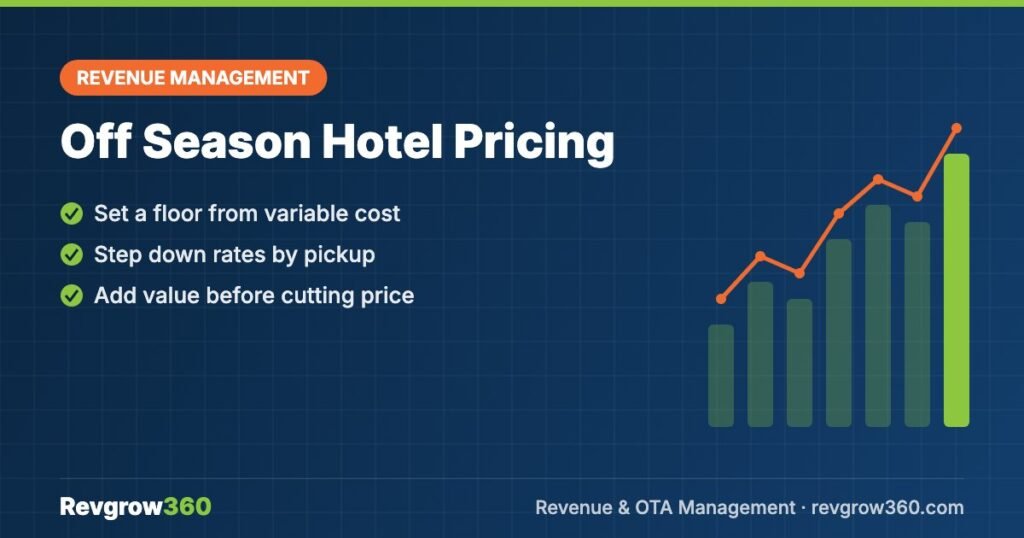
Here is how to price hotel rooms in off season: set a rate floor from your variable costs, then lower prices in steps based on booking pace, add value through packages instead of cutting the headline rate, and target the right segments such as locals, corporate travellers, long-stay guests and groups. The aim is not to be the cheapest. It is to earn as much total contribution as possible while demand is low.
- Set a floor from variable cost
- Step down rates by pickup
- Add value before cutting price
Off season is when weak pricing habits cost hotels the most. Panic discounting can fill rooms at rates that do not cover costs, and it trains guests to wait for deals. A structured approach protects revenue and brand.
Understand your off season
Start by defining what low season means for your property. For a hill hotel in Darjeeling it might be the monsoon months. For a Goa resort it may be June to September. For a Kolkata business hotel it may be a festival week or mid-summer. Use at least two years of data if you have it.
| Question | Where to find the answer |
|---|---|
| Which months are weakest? | Monthly occupancy and RevPAR report |
| Who still travels? | Booking source and guest segment data |
| How early do guests book? | Booking window report |
| What do nearby hotels charge? | OTA search results, competitor checks |
| What are our fixed and variable costs? | Accounts and department heads |
Find the right room rate for your costs and profit.
How to price hotel rooms in off season: step by step
- Work out your floor rate. Calculate the variable cost per occupied room: housekeeping, laundry, amenities, breakfast, commission and payment fees. Your floor must at least cover this, and ideally contribute to fixed costs. Learn about related metrics in hotel KPIs.
- Set a target occupancy and rate range. Decide what a good off-season month looks like, for example 45 to 55 percent at a rate near 70 to 80 percent of your shoulder-season ADR. Use your own numbers.
- Segment demand. List the segments still travelling: locals, corporate, government, long-stay, groups, medical travellers, sports teams, event guests and domestic leisure.
- Build rate plans by segment. Create separate plans, such as a corporate rate, a long-stay weekly rate, a non-refundable rate and a package rate.
- Use stepped reductions. Do not cut all dates by 30 percent. Reduce the weakest dates first, based on pickup, and hold rates on dates that still sell.
- Add value before cutting price. Include breakfast, a late check-out or a local experience. Value-added offers keep the room rate higher and attract guests who care about the stay.
- Control the channel mix. Prefer direct, corporate and low-commission sources where possible. Be selective with deep OTA discounts. See OTA commission rates.
- Review weekly. Check pickup against forecast and adjust.
Off-season pricing example
A hypothetical 24-room hotel in Munnar has a peak-season ADR of ₹6,000 and an off-season rooms cost (variable) of about ₹900 per occupied room. Last year in July it ran 28% occupancy at ₹4,800 ADR. Its target this year is 45% occupancy.
| Plan | Rate | Occupancy | Rooms sold (30 nights) | Revenue | Variable cost | Contribution |
|---|---|---|---|---|---|---|
| Last year | ₹4,800 | 28% | 202 | ₹9,69,600 | ₹1,81,800 | ₹7,87,800 |
| Cut to ₹3,200 for all dates | ₹3,200 | 50% | 360 | ₹11,52,000 | ₹3,24,000 | ₹8,28,000 |
| Tiered rates plus packages | ₹4,000 | 45% | 324 | ₹12,96,000 | ₹2,91,600 | ₹10,04,400 |
All figures are illustrative. The deep cut fills more rooms, but contribution is much lower than the tiered plan. The tiered approach earns more with fewer rooms sold, less wear and a better guest mix. Your results will differ, but the method of comparing contribution, not just occupancy, is what matters.
Segments to target in the off season
Local and regional guests
Staycations, family functions and weekend escapes appeal when travel is easy. Promote through social media, WhatsApp and past-guest lists.
Corporate and government
Negotiate rates with companies, training institutes and government departments. A small volume of steady weekday business covers fixed costs.
Long-stay guests
Offer weekly or monthly rates for workcations, students, medical stays and relocating employees. Lower daily cost but lower turnover cost and steady occupancy.
Groups and events
Weddings, training programmes, sports teams and tour operators fill rooms in slow months. Quote with food and venue packages.
International and niche travellers
Offer rain, wellness, birdwatching or photography experiences if your destination has a unique off-season appeal.
Off-season packages that protect your rate
- Stay 3, pay 2: raises length of stay without a public price cut.
- Breakfast and dinner inclusive: lifts total revenue per guest.
- Wellness or monsoon package: turns the weather into a selling point.
- Early-bird non-refundable rate: secures cash flow early.
- Local experience credit: costs you less than its perceived value.
Read our guide on hotel marketing ideas for campaign concepts that suit slow periods.
How to calculate your floor rate
Your floor rate is the lowest price you will accept for a room-night. Work it out in four steps.
- List variable costs per occupied room: cleaning labour, linen and laundry, toiletries, utilities used by a guest, and complimentary breakfast.
- Add the channel cost. If an OTA charges 18 percent, then on a ₹2,500 booking that is ₹450.
- Add a small buffer for payment fees and wear and tear.
- Add a minimum contribution towards fixed costs, so the booking is worth taking.
For example, if variable costs are ₹800 and channel cost is ₹450, the break-even is about ₹1,250. A floor of ₹1,800 to ₹2,000 leaves a contribution. Set a different floor for direct, OTA and corporate sales, because the channel cost differs.
Reading pickup to decide when to cut
Pickup is the number of rooms booked for a future date compared with the same point last year. Check it every week.
| Days before arrival | If pickup is behind last year | If pickup is ahead |
|---|---|---|
| 60 to 30 days | Hold rate, add a package or early-bird offer | Raise rate a little |
| 30 to 14 days | Reduce by one step on weak dates only | Hold or raise |
| 14 to 3 days | Use targeted offers, local promotions and corporate outreach | Restrict discounted rates |
| Under 3 days | Last-minute rate to fill empty rooms, above your floor | Sell at the best rate |
Do not discount a date just because it is empty today. A date 45 days away with no bookings may still fill, and early discounting wastes the chance. Use demand forecasting to judge what is normal for your hotel.
Keep guests happy at lower prices
Some owners worry that low prices attract difficult guests or hurt reviews. The best defence is to keep the service standard the same. Do not remove breakfast quality, skip housekeeping or cut staff so deeply that guests feel the difference. Reviews written in the off season stay online all year, so protect them. Ask every guest for feedback, and use reputation management habits to reply quickly.
Mistakes to avoid
- Across-the-board discounts. They give away revenue on dates that would sell anyway.
- Pricing below variable cost. You lose money on every room sold.
- Relying only on OTAs. Heavy commission reduces net revenue. Build direct and corporate sources.
- Ignoring parity. Do not offer a lower public price through a side channel in violation of OTA contracts. See hotel rate parity.
- Leaving rates unchanged. Review pickup weekly.
- Not communicating value. Photos, reviews and content still matter in slow months.
Off-season pricing checklist
- Floor rate calculated from variable costs
- Off-season months and targets defined
- Segments and rate plans created
- Packages loaded on website and OTAs
- Corporate and long-stay outreach started
- Weekly pickup and rate review scheduled
Key takeaways
- Calculate a floor rate from variable cost before you discount.
- Reduce price in steps by pickup, and add value before cutting rate.
- Judge success by contribution and RevPAR, not occupancy alone.
- Target locals, corporate, long-stay and group demand.
- Review weekly and keep rate integrity across channels.
Revgrow360 builds off-season pricing and channel plans for hotels across India. Explore hotel revenue management with Revgrow360 or book a free consultation.
Frequently asked questions
Should hotels cut rates in the off season?
Selectively. Calculate a floor from variable costs, then reduce rates in steps on the weakest dates based on pickup. Adding value such as breakfast or a late check-out usually protects revenue better than cutting every date by the same percentage.
How low can hotel rates go in low season?
Not below the variable cost of selling the room, and ideally above it by enough to contribute to fixed costs. Variable costs include commission, housekeeping, laundry, amenities and breakfast, so calculate them honestly before setting the floor.
Which guests should hotels target in the off season?
Local and regional leisure guests, corporate and government accounts, long-stay guests, groups and event organisers, and niche travellers drawn to the season. Create specific rate plans and outreach for each segment instead of one general discount.
Do off-season packages work better than discounts?
Often yes. Packages such as stay three pay two, inclusive meals or local experiences keep your published room rate intact, increase length of stay and raise guest spend, while a straight discount lowers revenue on every booking.
More Revenue Management guides
Length of Stay Restrictions: MinLOS, CTA and CTD Explained
Restrictions decide which stays guests can book on your busiest dates. Learn how MinLOS, CTA and CTD work and when to use…
Hotel Pricing Strategy for Weekends: A Practical Guide
Learn how to price weekend nights by demand, with rate tiers, minimum stays, packages and a worked example for a hill hotel.
Hotel Overbooking Strategy and Walk Policy: A Practical Guide
Overbooking can recover revenue lost to late cancellations and no-shows, but only with the right numbers and a clear walk policy. Here…
Hotel Demand Forecasting: Methods, Examples and a Routine
Every pricing and staffing decision depends on a forecast. Learn the main hotel demand forecasting methods, a worked example and a simple…
Hotel KPIs Every Owner Should Track (With Formulas)
Occupancy alone cannot tell you if your hotel is performing. Here are the eight KPIs every owner should track, with formulas and…
Hotel Dynamic Pricing Strategy: A Practical Guide
Fixed seasonal rates leave money on the table. Learn how to build a controlled, demand-based pricing strategy for your hotel step by…