 By Md Arif Ahamed
Quick summary: Booking pace in hotel revenue management shows how fast rooms sell versus last year. Learn the formula, a worked example, how to track it and mistakes to avoid.
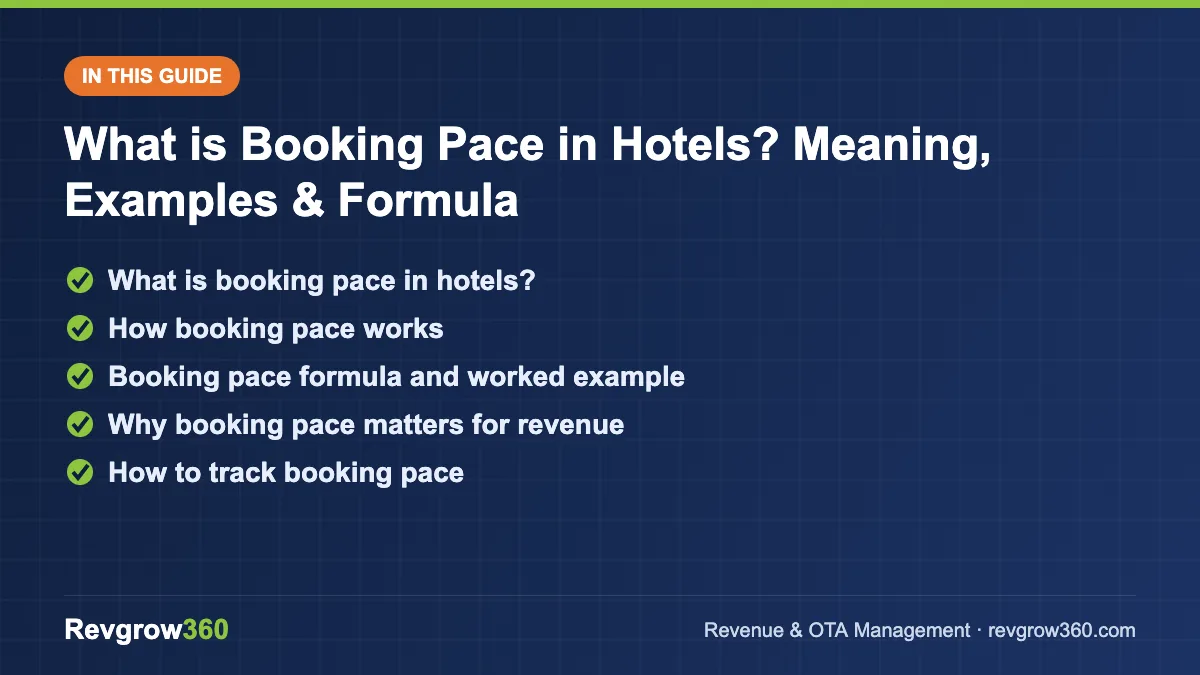
Booking pace in hotel revenue management is the speed at which rooms are being booked for a future date, compared with the same point in time for a previous period or a forecast. If you have 30 rooms booked for next Saturday with 14 days to go, and last year at the same point you had 20, your booking pace is ahead. Pace tells you whether to raise rates, hold them or start promotions, while there is still time to act.
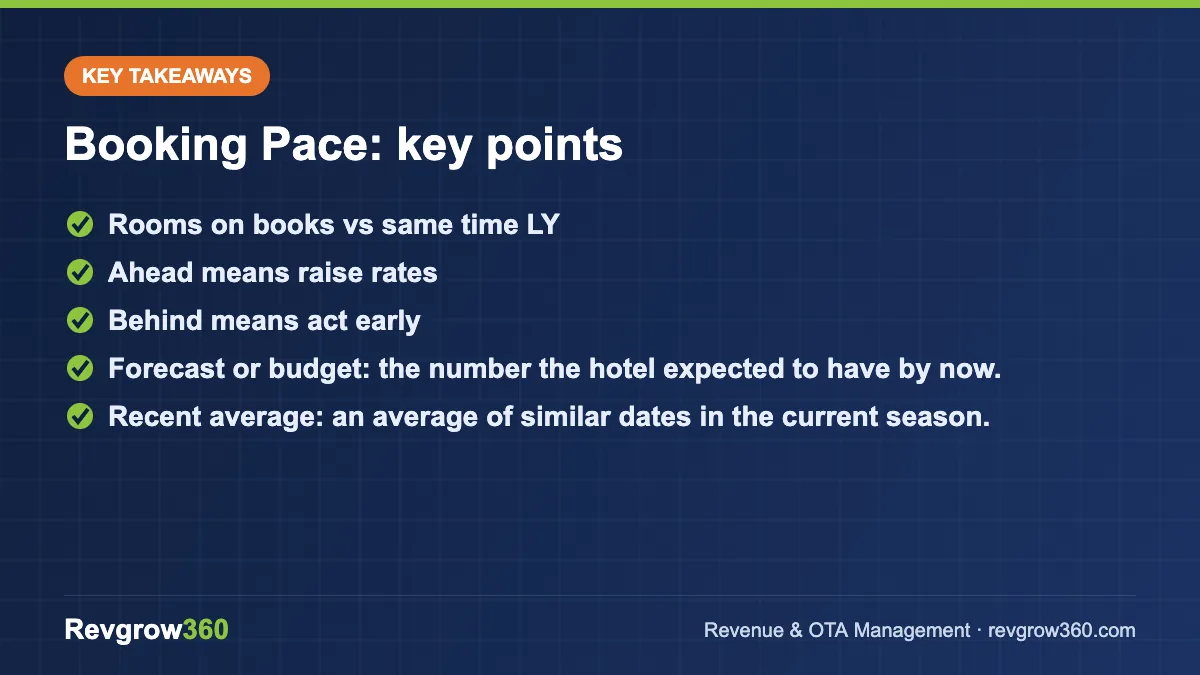
- Rooms on books vs same time LY
- Ahead means raise rates
- Behind means act early
What is booking pace in hotels?
Booking pace (also called pace or pickup pace) looks at how reservations accumulate over time for a particular stay date. Instead of asking “how many rooms are sold?”, it asks “how many are sold now compared with where we normally are at this point?”
It is a forward-looking measure. Occupancy and RevPAR show what happened. Pace shows what is likely to happen and gives you time to change pricing, restrictions and marketing.
Are you ahead of last year?
How booking pace works
For each future stay date, the hotel records the number of rooms booked (on the books) at fixed days before arrival, such as 90, 60, 30, 14, 7 and 3 days out. These are compared with:
- Same time last year (STLY): the number of rooms on the books at the same days-out last year, adjusted for day of week and events.
- Forecast or budget: the number the hotel expected to have by now.
- Recent average: an average of similar dates in the current season.
If pace is ahead, demand is strong and the hotel can raise rates or close discounts. If it is behind, the hotel can test promotions, adjust restrictions or boost marketing.
Booking pace formula and worked example
Pace variance = Rooms on the books now − Rooms on the books at the same point last year
Pace variance (%) = (Rooms on the books now − Rooms last year at same point) ÷ Rooms last year at same point × 100
Take a hypothetical 60-room resort in Munnar, looking at the weekend of 20 December, 30 days out.
| Measure | This year | Last year (same point) | Difference |
|---|---|---|---|
| Rooms on the books | 36 | 30 | +6 |
| Average rate on the books | ₹6,200 | ₹5,800 | +₹400 |
| Pace variance (rooms) | (36 − 30) ÷ 30 × 100 = +20% | ||
The resort is 20% ahead in rooms and ahead in rate. With 30 days left, the revenue manager may raise rates for the remaining rooms, add a two-night minimum and stop discounted OTA promotions for these dates.
Reading pace by days out
| Days out | This year | Last year | Pace |
|---|---|---|---|
| 60 | 18 | 14 | Ahead |
| 30 | 36 | 30 | Ahead |
| 14 | 44 | 41 | Slightly ahead |
| 7 | 47 | 47 | On par |
In this illustration, the lead is narrowing: pace is flattening as the date approaches. That might mean demand is catching up with last year or that earlier rates were too low. Look at rate and cancellations before deciding.
Why booking pace matters for revenue
- Timely pricing decisions. You can raise rates early on strong dates and avoid selling out cheaply. See hotel dynamic pricing.
- Early warning on weak dates. A slow pace 45 days out gives time to run an offer, contact corporate clients or push direct channels.
- Better forecasts. Pace feeds demand forecasting.
- Smarter restrictions. Minimum stays and closed arrivals can be applied when pace is strong. See length of stay restrictions.
- Group decisions. If pace is strong, a group may displace higher-paying guests.
How to track booking pace
- Export “on the books” figures from your PMS on the same day each week for each future date.
- Save them in a sheet with columns for stay date, days out, rooms, revenue and average rate.
- Compare with the same weekday and event last year, not the same calendar date.
- Add a column for cancellations, so you see net pace.
- Colour code: green for ahead, amber for on par, red for behind.
- Review weekly, and daily when a date is close and uncertain.
Booking pace and booking window
Pace is shaped by how early your guests book. A hill-station resort with long lead times will show most of its pace 30 to 90 days out; a city business hotel may see most bookings in the last week. Always compare pace on the right time scale for your guest type. See also booking window and lead time in our glossary.
Pace report layout you can copy
A simple pace sheet for each stay date could look like this. Keep one row per date and update it weekly.
| Stay date | Days out | Rooms OTB | Rooms STLY | Variance | ADR OTB | Action |
|---|---|---|---|---|---|---|
| Fri 12 Dec | 45 | 14 | 10 | +40% | ₹5,100 | Raise rate 8% |
| Sat 13 Dec | 46 | 22 | 15 | +47% | ₹5,600 | Add 2-night minimum |
| Tue 16 Dec | 49 | 4 | 6 | -33% | ₹3,900 | Watch; plan midweek offer |
The percentages and actions are illustrations. Decide your own thresholds, for example “act when pace is 15% or more ahead or behind”.
Pace for different hotel types
A city business hotel looks mostly at the last 7 to 14 days. A resort focuses on 30 to 90 days. A homestay with a few rooms should track pace in rooms rather than percentages, because one booking changes the percentage a lot.
Common mistakes
- Comparing with the same calendar date rather than the same weekday or event.
- Ignoring rate and looking only at rooms.
- Reacting too early to a slow pace for a short-lead market.
- Not adjusting for group blocks, which can distort pace.
- Forgetting to track cancellations.
- Using last year’s pace when last year was unusual, for example during a disruption.
Related terms
- On the books (OTB): confirmed reservations for a future date.
- Pickup: rooms booked during a defined period, such as the last 7 days.
- STLY: same time last year.
- Booking window: the time between booking and arrival.
- Forecast: the expected final occupancy for a date.
- Occupancy rate: see hotel occupancy rate.
Key takeaways
- Booking pace compares rooms on the books now with the same point in a previous period or forecast.
- Pace ahead suggests raising rates and tightening restrictions; pace behind suggests promotions or marketing.
- Compare by days out, weekday and event, and include rate and cancellations.
- Track weekly in a simple sheet from your PMS.
Revgrow360 helps hotels build pace reports and act on them through revenue management. You can request a free hotel audit to see how your pace compares.
For more background, see this hotel industry overview on Wikipedia.
Frequently asked questions
What is booking pace in a hotel?
Booking pace is the speed at which reservations accumulate for a future stay date, compared with the same point in time last year or with a forecast. It shows whether demand is ahead or behind, so the hotel can adjust rates, restrictions and marketing early.
How do you calculate booking pace variance?
Subtract the rooms on the books at the same point last year from the rooms on the books now, divide by last year's figure and multiply by 100. For example, 36 rooms against 30 last year gives +20%. Also compare average rate and cancellations.
What should a hotel do if pace is behind?
Check whether the market is short-lead before reacting. If the date is genuinely soft, test targeted offers, push direct and corporate channels, review rate position against competitors and adjust restrictions. Avoid deep discounts on all channels, which can lower rate for guests who would have booked anyway.
What is the difference between pace and pickup?
Pace compares rooms on the books with a benchmark such as last year at the same point. Pickup measures how many rooms were booked in a specific recent period, such as the last 7 days. Both are used together to read demand and decide pricing actions.
More Hotel Glossary guides
What is Pickup Report in Hotels? Meaning, Examples & Formula
A pickup report shows net new room nights booked in a set period for each future date, helping revenue managers change rates…
What is Displacement Analysis in Hotels? Meaning & Formula
Displacement analysis compares the value of a group with the transient revenue it displaces, so hotels accept only business that adds net…
What is Flow-Through in Hotels? Meaning, Examples & Formula
Flow-through shows what share of every extra rupee of hotel revenue reaches profit. Learn the formula, a worked example and how to…
Cost Per Occupied Room (CPOR) in Hotels: Formula
CPOR shows what each occupied room costs to deliver. See the formula, a worked example and how to use it for pricing…
RGI (Revenue Generation Index) in Hotels: Meaning & Formula
RGI compares your RevPAR with your competitive set. See the formula, a worked example and how to diagnose and improve it.
ARI (Average Rate Index) in Hotels: Meaning & Formula
ARI compares your hotel's ADR with its competitive set. See the formula, a worked example and how to improve your rate index.