 By Md Arif Ahamed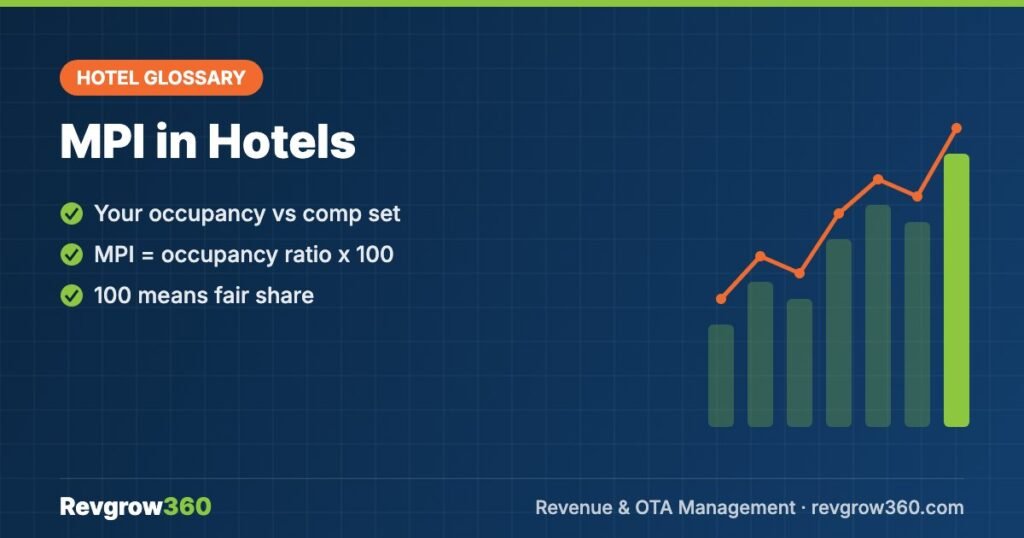
MPI (market penetration index) in hotel management measures how much of its fair share of room demand your hotel captures compared with a set of competing hotels. It is calculated by dividing your occupancy by the average occupancy of your competitive set and multiplying by 100. An MPI of 100 means you capture exactly your fair share, above 100 means you win more than your share, and below 100 means you are losing guests to competitors.
- Your occupancy vs comp set
- MPI = occupancy ratio x 100
- 100 means fair share
MPI is also called the occupancy index. It is one of the three STR-style performance indexes, together with ARI and RGI, and it answers one clear question: are we filling rooms as well as our competitors?
What is MPI (market penetration index) in hotel benchmarking?
Looking at your own occupancy alone can be misleading. If your hotel runs 60% occupancy in a month when the whole market runs 75%, you have a problem even though 60% sounds acceptable. If you run 60% when the market runs 50%, you are doing well. MPI makes this comparison easy by turning it into one number.
The comparison group is called the competitive set or comp set: a group of hotels similar to yours in location, category, price and guest type. Benchmark providers such as STR report these figures to subscribing hotels, and some hotels build their own comp set from manual checks and shared data.
Compare your performance with your competitors.
MPI formula
MPI = (Hotel occupancy / Comp set occupancy) x 100
Occupancy itself is rooms sold divided by rooms available. If you need a refresher, see hotel occupancy rate.
MPI worked example
A hypothetical 50-room hotel in Pune sold 1,050 rooms in a 30-day month. Rooms available = 50 x 30 = 1,500.
| Step | Calculation | Result |
|---|---|---|
| Hotel occupancy | 1,050 / 1,500 | 70% |
| Comp set occupancy (average of competitors) | Given in benchmark report | 72% |
| MPI | (70 / 72) x 100 | 97.2 |
The hotel captured about 97% of its fair share of demand, so it is slightly behind the market on occupancy. If the comp set had been at 65%, MPI would be (70 / 65) x 100 = 107.7, showing the hotel is winning more than its share.
How to read MPI
| MPI value | Meaning | Typical question to ask |
|---|---|---|
| Above 100 | You capture more than your fair share | Are we pricing too low to fill rooms? |
| Around 100 | You capture your fair share | Can we improve rate or mix? |
| Below 100 | You capture less than your fair share | Is it rate, visibility, reviews or product? |
A high MPI is not automatically good. If you reach 120 by discounting heavily, your rate may be falling and your revenue per room may be weaker. Always read MPI with ARI and RGI.
MPI, ARI and RGI together
| Index | Measures | Formula |
|---|---|---|
| MPI | Occupancy share | Hotel occupancy / comp set occupancy x 100 |
| ARI | Rate share | Hotel ADR / comp set ADR x 100 |
| RGI | Revenue per room share | Hotel RevPAR / comp set RevPAR x 100 |
RGI is roughly MPI multiplied by ARI divided by 100. For example, an MPI of 110 and an ARI of 90 gives an RGI of about 99. The hotel wins on occupancy but loses on rate, so revenue per room is close to fair share. Read what is RevPAR and average daily rate to understand the underlying numbers.
Why MPI matters for revenue
MPI tells you whether a weak occupancy month is your problem or the market’s. That affects what you do next.
- MPI low, market weak: you may be losing share, so look at price position, reviews, OTA ranking and availability.
- MPI high, ARI low: you are likely too cheap. Test higher rates on high-demand dates.
- MPI and ARI both strong: protect your position, and look for ways to grow total revenue.
- MPI falling over several months: something has changed in your product, service or distribution.
It also helps you set fair targets for your team and check whether a new marketing push or channel change is working.
How to improve MPI
Improve visibility
Update OTA content, photos and availability, and work on your ranking. See how to improve hotel ranking on OTAs.
Fix price position
Check whether your rates are out of line with the comp set for similar rooms. Use dynamic pricing to adjust by demand.
Strengthen reviews and product
Low scores and weak photos reduce conversion. Reply to reviews and fix recurring complaints.
Open the right channels
Make sure inventory is available on the platforms where your guests search, and that rates stay consistent. See hotel distribution strategy.
How to build a simple comp set
If you do not subscribe to benchmark data, you can still approximate a competitive set. Pick four to six hotels that guests might choose instead of yours: similar location, star category, room count, price and guest type. Avoid including a much larger or cheaper hotel. Review the set once a year and whenever a new competitor opens.
For occupancy data you may need to rely on shared data between hotel owners, local hotel associations or benchmark reports. Where data is not available, track availability and sold-out dates on OTAs as a rough guide to demand, and use it only as a directional signal.
When MPI is misleading
MPI can mislead when your hotel is much smaller than the set, when a competitor is closed for renovation, or when a large group booking fills your rooms for a week. Note such events in your monthly report, and consider showing MPI with and without the unusual period.
Common MPI mistakes
- Choosing a weak comp set. Compare with similar hotels in location, category and price.
- Chasing MPI alone. Filling rooms at very low rates can reduce RevPAR.
- Using different periods. Compare the same dates for your hotel and the set.
- Ignoring room count differences. Occupancy is a percentage, but a small hotel can swing widely with a few rooms.
- Reading one month in isolation. Look at trends over three to twelve months.
Related terms
ARI (average rate index), RGI (revenue generation index), competitive set, occupancy, ADR, RevPAR, fair share and hotel KPIs.
Key takeaways
- MPI = your occupancy divided by comp set occupancy, multiplied by 100.
- 100 is fair share, above 100 means you win more than your share and below 100 means you lose share.
- Read MPI with ARI and RGI so you do not buy occupancy with low rates.
- A well-chosen comp set and consistent periods make the index meaningful.
Revgrow360 helps hotels benchmark performance and turn index data into pricing and channel decisions. Learn about our hotel revenue management service or request a free hotel audit.
Frequently asked questions
What does MPI mean in hotels?
MPI stands for Market Penetration Index, also called the occupancy index. It divides your hotel's occupancy by the average occupancy of your competitive set and multiplies by 100 to show whether you capture your fair share of demand.
What is a good MPI for a hotel?
An MPI of 100 means fair share. Above 100 means you capture more than your share, and below 100 means less. A higher number is not always better, since heavy discounting can lift MPI while weakening rate and revenue per room.
How is MPI different from occupancy?
Occupancy shows only your own rooms sold percentage. MPI compares that percentage with similar hotels, so it shows whether a strong or weak figure is due to the market or to your own performance.
What is a competitive set?
A competitive set, or comp set, is a group of hotels similar to yours in location, category, price and guest type. Choosing it carefully is important, because MPI, ARI and RGI are only as meaningful as the hotels you compare against.
More Hotel Glossary guides
What is ARPAR in Hotels? Meaning, Examples & Formula
ARPAR adjusts RevPAR for the variable cost of selling rooms. See the formula, a worked example and how to use it.
What is NRevPAR in Hotels? Meaning, Examples & Formula
NRevPAR shows room revenue per available room after distribution costs. See the formula, an example and ways to improve it.
What is RevPAG in Hotels? Meaning, Examples & Formula
RevPAG measures hotel revenue per guest rather than per room. See the formula, an example and ways to improve it.
What is TRevPAR in Hotels? Meaning, Examples & Formula
TRevPAR measures all hotel revenue per available room, not just rooms. See the formula, an example and how to improve it.
What is GOPPAR in Hotels? Meaning, Examples & Formula
GOPPAR shows how much operating profit a hotel keeps per available room. Learn the formula, a worked example and how to improve…