 By Md Arif Ahamed
Quick summary: Revenue management for homestays made simple: track occupancy and ADR, price by season, use minimum stays, pick channels and sell add-ons to earn more.
Revenue management for homestays means setting the right price, for the right guest, on the right channel, at the right time, so that a small property earns the most from its few rooms. A homestay with 4 to 12 rooms cannot afford empty nights or underpriced weekends. The good news is that you do not need expensive software. A simple calendar, a rate plan, a few rules and a weekly habit of review can lift income noticeably. This guide shows you how.
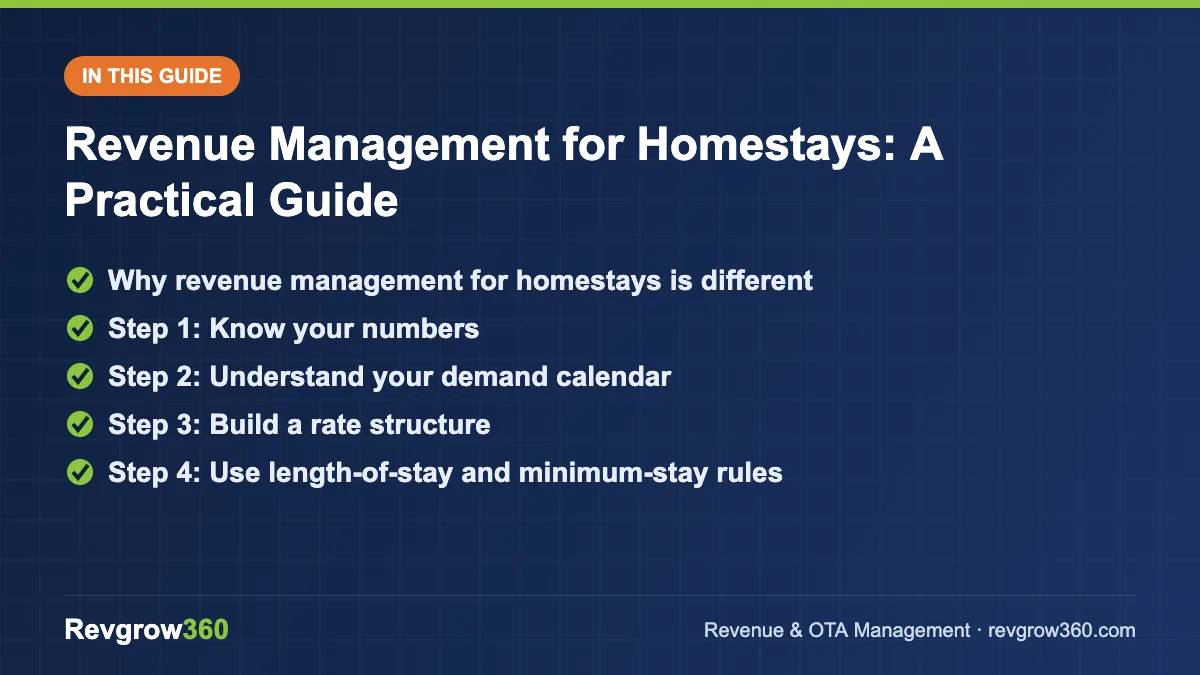
- Track occupancy, ADR, RevPAR
- Price by season and weekday
- Sell meals and experiences
Why revenue management for homestays is different
A large hotel has hundreds of rooms and many segments. A homestay has few rooms, often one owner-host, a strong local character and a seasonal market. That changes how you manage revenue.
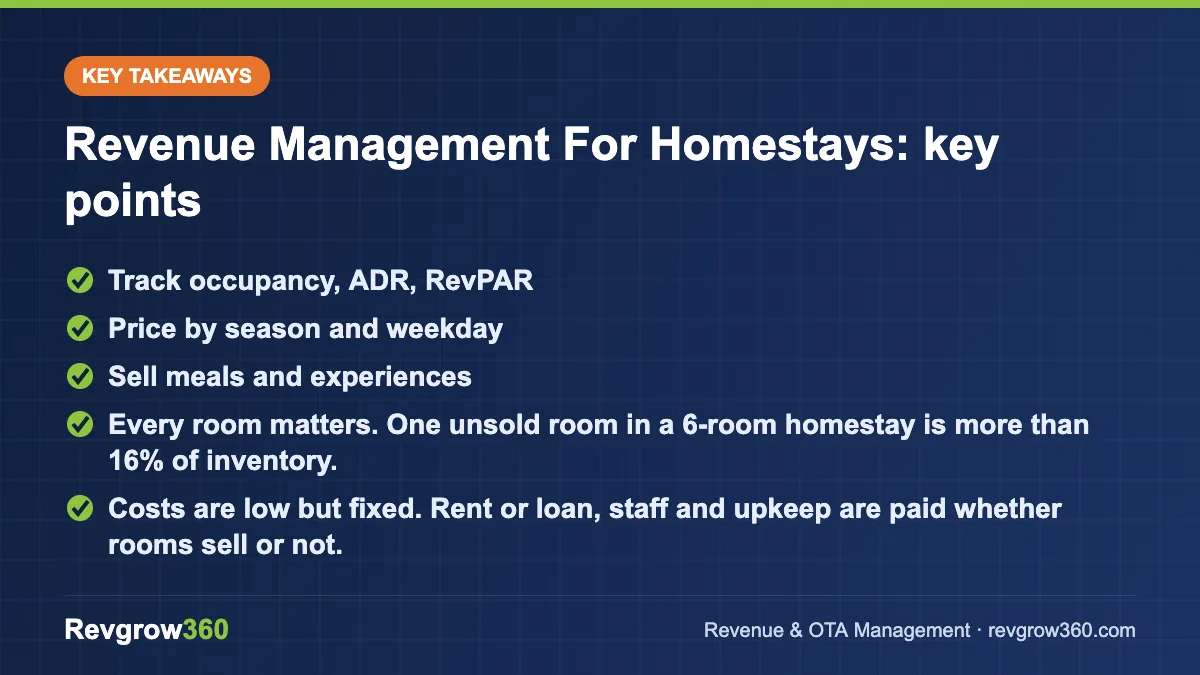
- Every room matters. One unsold room in a 6-room homestay is more than 16% of inventory.
- Experience is the product. Guests pay for the host, the view, the food and the story, not only a bed.
- Demand is strongly seasonal and event-driven. Hill stations, beaches and heritage towns have clear peaks, festivals and long weekends.
- Costs are low but fixed. Rent or loan, staff and upkeep are paid whether rooms sell or not.
- Distribution is concentrated. Many homestays depend on two or three OTAs plus WhatsApp and repeat guests.
If you are still setting up, read how to start a homestay business in India first, then return to pricing.
Estimate monthly income from your homestay.
Step 1: Know your numbers
You cannot manage what you do not measure. Track three numbers every month.
| Metric | Formula | Example (6-room homestay, 30-day month) |
|---|---|---|
| Occupancy | Rooms sold ÷ rooms available | 90 sold ÷ 180 available = 50% |
| ADR | Room revenue ÷ rooms sold | ₹3,06,000 ÷ 90 = ₹3,400 |
| RevPAR | Room revenue ÷ rooms available | ₹3,06,000 ÷ 180 = ₹1,700 |
Learn each metric in detail: occupancy rate, ADR and RevPAR. Also record how many nights came from each channel and the commission paid.
Step 2: Understand your demand calendar
Mark your year in three colours: high, shoulder and low. Include school holidays, long weekends, festivals, wedding dates, local events, trekking or harvest seasons, and weather patterns.
For a homestay in Darjeeling, for example, the autumn festival season and the spring flush could be high; monsoon could be low; and weekends in winter could be shoulder. Your own booking history is the best guide. Ask every guest how they found you and why they came.
Use simple demand forecasting: compare how many nights were booked 30, 14 and 7 days out this year versus last year, and adjust.
Step 3: Build a rate structure
Set a base rate and a floor
Work out your cost per occupied room (cleaning, linen, breakfast, utilities, commission) and set a floor below which you never sell. Then set a base rate for the shoulder season.
Use seasonal and day-of-week pricing
| Period | Rate approach | Illustration for a ₹3,000 base room |
|---|---|---|
| Peak or festival | Base plus 40% to 100% | ₹4,200 to ₹6,000 |
| Shoulder weekend | Base plus 10% to 25% | ₹3,300 to ₹3,750 |
| Shoulder weekday | Base rate | ₹3,000 |
| Low season | Base minus 10% to 20%, never below floor | ₹2,400 to ₹2,700 |
The percentages above are illustrations only. Test them against your own demand. Our guide to dynamic pricing explains how to adjust further.
Create two or three clear rate plans
- Standard: room with breakfast, flexible cancellation.
- Non-refundable: 8% to 12% cheaper, full prepayment.
- Experience package: room plus dinner, guided walk or village visit, priced at a premium.
Step 4: Use length-of-stay and minimum-stay rules
On peak weekends, require a two-night minimum so that a Friday-only booking does not block a Saturday that could sell for more. In slow weeks, allow one-night stays to fill gaps. The logic is explained in length of stay restrictions.
Step 5: Choose channels carefully
A homestay usually needs a mix:
- OTAs for reach: start with Booking.com and MakeMyTrip and add others later.
- Direct: WhatsApp, Instagram, a simple website with a booking button, and Google Business Profile.
- Repeat and referral guests: a small returning-guest offer costs less than commission.
Keep rates consistent across channels; see rate parity. Once you list on more than one OTA, use a channel manager to avoid double bookings.
Step 6: Raise revenue per guest
With few rooms, ancillary income can make a big difference. Offer home-cooked dinners, bonfire evenings, guided treks, airport or station pickup, laundry, packed lunches and local crafts. Present them at booking confirmation and at arrival. See upselling and ancillary revenue.
A worked example
A hypothetical 6-room homestay near Kalimpong runs at 50% occupancy and ₹3,400 ADR in a month, giving ₹3,06,000 room revenue. The owner makes three changes: raises weekend rates by 15%, adds a two-night minimum on one long weekend, and sells a dinner package to a third of guests.
If the weekend rise holds occupancy steady and adds roughly ₹25,000 in room revenue, and dinner sales add a further ₹20,000 at healthy margins, monthly revenue rises by about ₹45,000 without adding a room. These are illustrative numbers only; your results will vary with demand.
Handling cancellations, deposits and no-shows
Small properties feel every cancellation. Write a simple policy and show it on every channel: for example, a 30% advance at booking, free cancellation up to 7 days before arrival in the low season, and a stricter window during festivals and long weekends. Keep the policy short enough to read on a phone.
When a guest cancels early, release the room at once and reopen it on all channels. When a date is selling fast, a non-refundable plan at a lower price gives you cash certainty. Track your cancellation rate by channel every month. If one channel cancels far more than others, price its rate plans differently or tighten its policy.
Packaging and promotions that protect your rate
A discount should have a purpose, a limit and an end date. Instead of cutting the room rate for everyone, build offers that fill specific gaps.
- Midweek stay offer: a third night at a reduced rate for Sunday to Thursday arrivals.
- Early-bird offer: a small discount for bookings made 45 days or more ahead, which gives you cash and certainty.
- Workation offer: a weekly rate with fast Wi-Fi and a quiet desk, useful in low season.
- Returning guest offer: a thank-you rate sent by WhatsApp to past guests only.
Every offer should be tracked: how many bookings it brought, and whether those nights would have sold anyway.
Common revenue mistakes homestays make
- Pricing by gut feeling or by copying the neighbour.
- Giving the same rate every day of the year.
- Discounting early and deeply so no inventory is left for late high-paying guests.
- Ignoring commission cost when comparing channels.
- Not updating calendars after a direct booking, causing double bookings.
- Forgetting to ask for reviews, which hurts ranking and conversion. See how to improve OTA ranking.
Weekly revenue routine (30 minutes)
- Check bookings for the next 30 days and compare with last year.
- Look at competitor homestays’ public rates for the same dates.
- Raise rates where you are ahead of pace; hold or promote where you are behind.
- Check minimum-stay rules and close dates for personal or maintenance use.
- Reply to all reviews and enquiries.
- Record the week’s occupancy, ADR and revenue in a simple sheet.
Tools you can use
- A shared spreadsheet or Google Calendar.
- A basic PMS or booking engine; see the booking engine guide.
- A channel manager once you use two or more OTAs.
- OTA extranet analytics for views, conversion and cancellations.
Key takeaways
- Revenue management for homestays is about pricing by demand, not by habit.
- Track occupancy, ADR and RevPAR monthly.
- Use seasonal, weekday and length-of-stay rules, with a protected price floor.
- Blend OTAs and direct channels, and keep rates consistent.
- Add experiences and food to raise income per guest.
- A 30-minute weekly routine beats occasional big changes.
Revgrow360 supports homestays, resorts and hotels across India with pricing, OTA and distribution strategy. Explore our revenue management service or book a free consultation to review your homestay’s rates.
For more background, see this revenue management overview on Wikipedia.
Frequently asked questions
What is revenue management for homestays?
It is the practice of adjusting prices, minimum-stay rules and channels based on demand so that a small property earns the most from limited rooms. It uses simple tools such as an occupancy calendar, seasonal rates and regular review of booking pace and competitor prices.
Do small homestays need revenue management software?
Not at the start. A spreadsheet, a calendar and OTA extranet reports are usually enough for a few rooms. Once you list on multiple OTAs or have more rooms, a channel manager and a basic PMS help avoid double bookings and save time.
How often should a homestay change its rates?
Review weekly and adjust whenever demand changes, such as when a festival is announced or bookings are ahead or behind last year. Seasonal and weekend rates can be set months in advance, then fine-tuned using booking pace for upcoming dates.
How can a homestay earn more without raising room rates?
Sell home-cooked meals, guided walks, pickups, bonfires, laundry and local products. Offer them at booking, confirmation and arrival. Combining a room with an experience in a package also raises revenue per guest and makes your property harder to compare on price alone.
More Revenue Management guides
Hotel Rate Parity: What It Is and How to Maintain It
Rate parity keeps your price consistent across OTAs, metasearch and your website. Learn what causes disparity and a practical daily routine to…
Outsource Hotel Revenue Management vs In-House vs RMS Software
In-house hire, software or an outsourced team? Compare the three ways to run hotel revenue management and find the model that fits…
Hotel Revenue Management for Small Hotels: A Practical Guide
How small hotels can use simple data, rate levels, restrictions and a weekly routine to raise RevPAR without expensive systems.
How to Price Hotel Rooms in Off Season: A Practical Guide
A practical method for off-season pricing: floor rates, stepped reductions, packages and segment targeting, with a worked example.
Length of Stay Restrictions: MinLOS, CTA and CTD Explained
Restrictions decide which stays guests can book on your busiest dates. Learn how MinLOS, CTA and CTD work and when to use…
Hotel Pricing Strategy for Weekends: A Practical Guide
Learn how to price weekend nights by demand, with rate tiers, minimum stays, packages and a worked example for a hill hotel.