 By Md Arif Ahamed
Quick summary: Learn what RGI (revenue generation index) in hotel benchmarking means, the formula, a worked example and how to use it with MPI and ARI to diagnose problems.
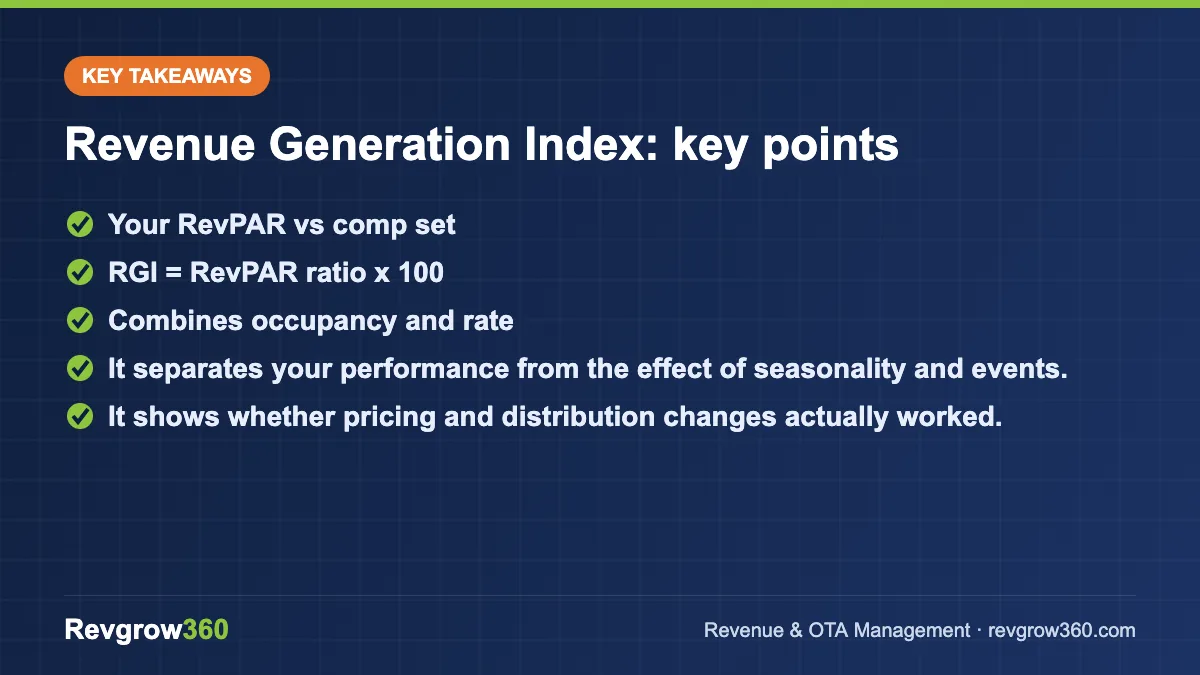
RGI (revenue generation index) in hotel management compares your hotel’s RevPAR with the average RevPAR of your competitive set. It is calculated by dividing your RevPAR by the comp set’s RevPAR and multiplying by 100. An RGI of 100 means you earn your fair share of room revenue, above 100 means you outperform your market and below 100 means you underperform.
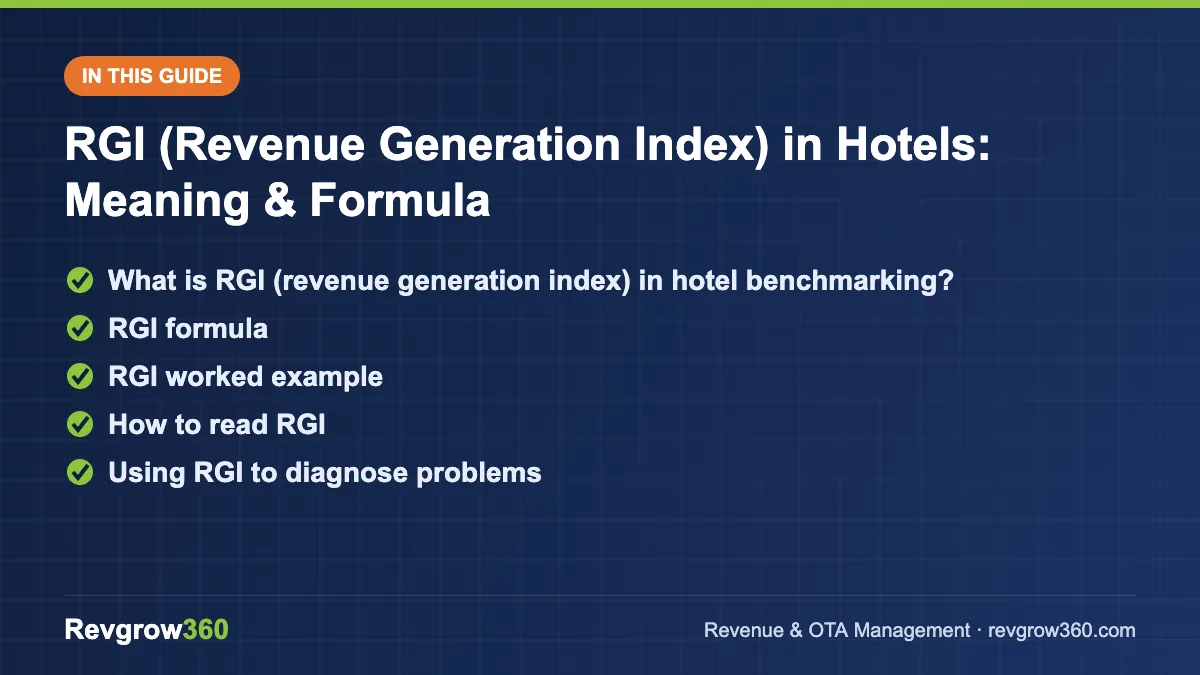
- Your RevPAR vs comp set
- RGI = RevPAR ratio x 100
- Combines occupancy and rate
RGI is also called the revenue index. It is the most important of the three benchmark indexes because it combines occupancy and rate in one number, showing whether your overall pricing and sales strategy is working against similar hotels.
What is RGI (revenue generation index) in hotel benchmarking?
RevPAR tells you how much room revenue you earn per available room. But RevPAR alone cannot tell you if a figure is strong. If your RevPAR rises 8 percent while the market rises 12 percent, you actually lost ground. RGI solves this by measuring your RevPAR against your competitive set.
The competitive set is a group of similar hotels in your area. Benchmark reports from providers such as STR supply set data, and small hotels sometimes build simpler versions by tracking nearby hotels manually. You can read about the base metric in what is RevPAR.
Compare your performance with your competitors.
RGI formula
RGI = (Hotel RevPAR / Comp set RevPAR) x 100
Because RevPAR equals occupancy multiplied by ADR, RGI is also approximately:
RGI = (MPI x ARI) / 100
RGI worked example
A hypothetical 60-room hotel in Kolkata sold 1,260 rooms for ₹50,40,000 in a 30-day month. Rooms available = 60 x 30 = 1,800.
| Step | Calculation | Result |
|---|---|---|
| Occupancy | 1,260 / 1,800 | 70% |
| ADR | 50,40,000 / 1,260 | ₹4,000 |
| Hotel RevPAR | 50,40,000 / 1,800 | ₹2,800 |
| Comp set RevPAR | From benchmark report | ₹2,900 |
| RGI | (2,800 / 2,900) x 100 | 96.6 |
The hotel earns about 97 percent of its fair share of room revenue. Next step: split the result into MPI and ARI. If the comp set has 72% occupancy and an ADR of ₹4,028, then MPI is about 97 and ARI is about 99. The hotel is slightly behind on both, so a general review of visibility and price position is needed.
How to read RGI
| RGI value | Meaning | Action |
|---|---|---|
| Above 100 | You outperform your set | Protect what works; check if the lead is from rate or occupancy |
| About 100 | You earn fair share | Look for small gains in mix and rate |
| Below 100 | You underperform | Diagnose with MPI and ARI, then fix the weak part |
As a rough rule, many hotels treat a sustained RGI above 100 as healthy, but the right target depends on your product, age and position in the market.
Using RGI to diagnose problems
RGI shows the result. MPI and ARI explain the cause.
| Pattern | Likely cause | First step |
|---|---|---|
| RGI low, MPI low, ARI normal | Visibility or demand problem | Check OTA ranking, photos, reviews, availability |
| RGI low, MPI normal, ARI low | Under-pricing | Review rate levels and channel mix |
| RGI low, MPI high, ARI low | Occupancy bought with discounts | Raise rates on high-demand dates |
| RGI low, MPI low, ARI high | Overpriced for the product | Check value for money and reviews |
| RGI high | Strategy is working | Keep monitoring and test small rate increases |
This diagnostic approach turns an index into a clear action list, and it links directly to hotel revenue management practice.
Why RGI matters for revenue
Revenue managers are judged on how well they perform against the market, not only on the absolute numbers. RGI is the fairest score for that, because it removes market ups and downs from the picture.
- It separates your performance from the effect of seasonality and events.
- It shows whether pricing and distribution changes actually worked.
- It gives owners a simple scorecard for the revenue function.
- It helps set realistic targets, such as moving from RGI 95 to 100 over six months.
How to improve RGI
Match rate to demand
Use forecasts and pickup to raise price when demand is strong and use targeted offers when it is weak. See hotel demand forecasting.
Fix distribution
Make sure your hotel appears on the right channels with consistent rates and good content. See hotel distribution strategy.
Improve reviews and content
Better ratings and photos help both occupancy and rate. See improve hotel ranking on OTAs.
Upsell and package
Sell better rooms and add-ons to raise the average rate per room sold.
How to track RGI every month
- Collect your occupancy, ADR and RevPAR for the month.
- Collect the comp set figures for the same dates from your benchmark report or your own tracking.
- Calculate MPI, ARI and RGI, and record them in a simple table by month.
- Note events, closures, group bookings and rate changes that may explain movements.
- Pick one action for the next month, such as reviewing weekday rates or improving OTA photos.
Over a year this table becomes a clear story of how your hotel moves against its market. Share it with owners and department heads, and use it to set targets.
Common RGI mistakes
- Comparing with a poor comp set. Choose hotels similar in location, category and price.
- Looking at RGI without MPI and ARI. The two indexes explain what is behind it.
- Judging by one month. Use trends and compare like periods.
- Believing 100 is the goal for every hotel. A strong hotel may aim for a premium.
- Ignoring profit. A high RGI achieved with high commission channels may not be profitable. Add profit-based KPIs.
How often to review RGI
Review RGI monthly for strategy, and look at weekday and weekend RGI separately. A hotel may beat the market on weekends but lag midweek, which tells you where to focus sales and pricing effort.
Related terms
MPI, ARI, RevPAR, ADR, occupancy, competitive set, fair share, benchmarking and GOPPAR.
Key takeaways
- RGI = your RevPAR divided by comp set RevPAR, multiplied by 100.
- It combines occupancy and rate and shows your fair share of room revenue.
- Use MPI and ARI to find out why RGI is high or low.
- Track trends over several months and add profit-based metrics.
If you want your hotel to beat its competitive set, Revgrow360’s hotel revenue management team can help. Request a free hotel audit to see where you stand.
Frequently asked questions
What does RGI mean in hotels?
RGI stands for Revenue Generation Index, also called the RevPAR index. It divides your hotel's RevPAR by the competitive set's RevPAR and multiplies by 100, showing whether you earn your fair share of room revenue in your market.
How is RGI related to MPI and ARI?
RGI is approximately MPI multiplied by ARI divided by 100. MPI shows your occupancy share, ARI your rate position and RGI the combined revenue result. Use MPI and ARI to explain why your RGI is high or low.
What is a good RGI for a hotel?
An RGI of 100 means fair share, and a sustained figure above 100 usually indicates outperformance. The right target depends on your product and position. Judge it over several months and alongside profit measures, not on a single month.
Where do hotels get comp set data for RGI?
Many hotels subscribe to benchmark reports from providers such as STR. Smaller hotels can approximate a comp set by tracking similar nearby hotels' rates and, where available, shared occupancy data, though the results are less precise.
More Hotel Glossary guides
ARI (Average Rate Index) in Hotels: Meaning & Formula
ARI compares your hotel's ADR with its competitive set. See the formula, a worked example and how to improve your rate index.
MPI (Market Penetration Index) in Hotels: Meaning & Formula
MPI compares your hotel's occupancy with its competitive set. See the formula, an example and how to improve your index.
What is ARPAR in Hotels? Meaning, Examples & Formula
ARPAR adjusts RevPAR for the variable cost of selling rooms. See the formula, a worked example and how to use it.
What is NRevPAR in Hotels? Meaning, Examples & Formula
NRevPAR shows room revenue per available room after distribution costs. See the formula, an example and ways to improve it.
What is RevPAG in Hotels? Meaning, Examples & Formula
RevPAG measures hotel revenue per guest rather than per room. See the formula, an example and ways to improve it.
What is TRevPAR in Hotels? Meaning, Examples & Formula
TRevPAR measures all hotel revenue per available room, not just rooms. See the formula, an example and how to improve it.